Composite Materials
Presented to:
Dr. Arjumand Iqbal Durrani
Presented by:
Muhammad Muzzammil 2017-MIN-16
Presentation Content
Introduction
Properties
Factors affecting Composites
Phases of Composites
Classification of Composites
Manufacturing of Composites
Utilization and Application
Why to use Composites
Advantages and Disadvantages
Failures
References
Introduction
 A composite material is made by combining two or more materials
 The two materials work together to give the composites a unique properties
 However within the composite you can easily tell the different materials
apart as they do not dissolve or blend into each other.
General Properties:
 High Strength-to-weight ratio
 Corrosion Resistance
 Wear Resistance
 Low electrical conductivity
 Lower cost
 Easy processing
 Covers almost all application areas
Factors affecting Microstructure of composites
 Type of Reinforcement
 Reinforcement size and its Orientation
 Matrix Type
 Fiber-Volume-Fraction (FVF)
 Bonding between Reinforcement and matrix
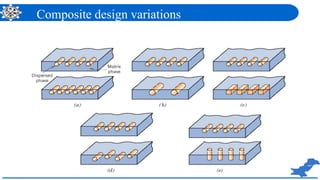
Composite design variations
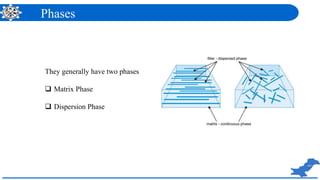
Phases
They generally have two phases
 Matrix Phase
 Dispersion Phase
Matrix Phase
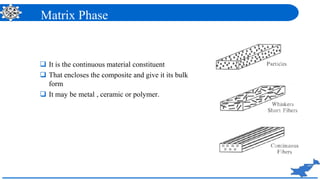
 It is the continuous material constituent
 That encloses the composite and give it its bulk
form
 It may be metal , ceramic or polymer.
Dispersion Phase
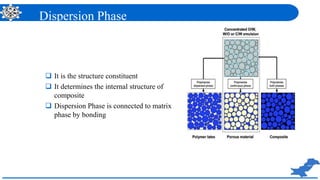
 It is the structure constituent
 It determines the internal structure of
composite
 Dispersion Phase is connected to matrix
phase by bonding
Classification of Composites
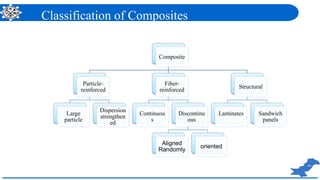
Composite
Particle-
reinforced
Large
particle
Dispersion
strengthen
ed
Fiber-
reinforced
Continuou
s
Discontinu
ous
Aligned
Randomly
oriented
Structural
Laminates Sandwich
panels
Particle-reinforced composites
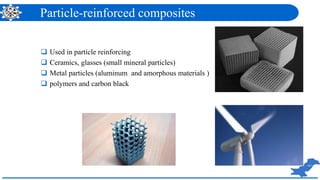
 Used in particle reinforcing
 Ceramics, glasses (small mineral particles)
 Metal particles (aluminum and amorphous materials )
 polymers and carbon black
Fiber-Reinforced Composites
 Strength of Composites - The tensile strength of a fiber-reinforced composite (TSc)
depends on the bonding between the fibers and the matrix.
Types of fiber reinforced composite
• Continuous & Aligned
• Discontinuous & Aligned
• Random
Structural Composites
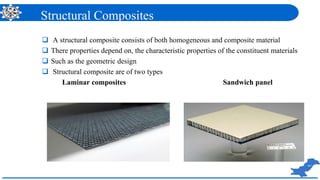
 A structural composite consists of both homogeneous and composite material
 There properties depend on, the characteristic properties of the constituent materials
 Such as the geometric design
 Structural composite are of two types
Laminar composites Sandwich panel
Manufacturing Of Composite
Composite materials can be formed by two processes
Pultrusion
Prepreg
Pultrusion
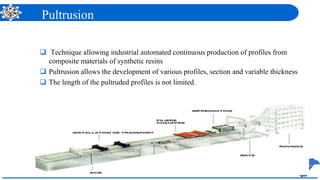
 Technique allowing industrial automated continuous production of profiles from
composite materials of synthetic resins
 Pultrusion allows the development of various profiles, section and variable thickness
 The length of the pultruded profiles is not limited.
Prepreg
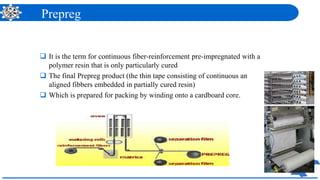
 It is the term for continuous fiber-reinforcement pre-impregnated with a
polymer resin that is only particularly cured
 The final Prepreg product (the thin tape consisting of continuous an
aligned fibbers embedded in partially cured resin)
 Which is prepared for packing by winding onto a cardboard core.
Application and Utilization
 In automobile industries (e.g. Steel & Aluminum body)
 Marine applications like shafts, hulls, spars (for racing boats)
 Aeronautical application like components of rockets, aircrafts,
missiles
 Communication antennae, electronic circuit boards
 Safety equipment like ballistic protection and Air bags of cars.
m
Application and Utilization
Why to use composite materials
 Lower specific gravity in general
 Improved stiffness of material
 Composite maintain their weight even at high temperatures
 Toughness is improved
 Fabrication or production is cheaper
 Creep and fatigue strength is better
 Controlled Electrical conductivity is possible
 Corrosion and oxidation resistance
Advantages and Disadvantages
Failure Of Composite Material
 Composite can fail due to breaking of the fiber, micro cracking of the matrix,
 De-bonding (i.e. separation of fibers from matrix)
 Failure under longitudinal compressive loading
 Failure under longitudinal tensile loading
 Failure under transverse compressive loading
 Failure under transverse tensile loading
Thank you for your attention!!

Composite materials

  • 1.
    Composite Materials Presented to: Dr.Arjumand Iqbal Durrani Presented by: Muhammad Muzzammil 2017-MIN-16
  • 2.
    Presentation Content Introduction Properties Factors affectingComposites Phases of Composites Classification of Composites Manufacturing of Composites Utilization and Application Why to use Composites Advantages and Disadvantages Failures References
  • 3.
    Introduction  A compositematerial is made by combining two or more materials  The two materials work together to give the composites a unique properties  However within the composite you can easily tell the different materials apart as they do not dissolve or blend into each other.
  • 4.
    General Properties:  HighStrength-to-weight ratio  Corrosion Resistance  Wear Resistance  Low electrical conductivity  Lower cost  Easy processing  Covers almost all application areas
  • 5.
    Factors affecting Microstructureof composites  Type of Reinforcement  Reinforcement size and its Orientation  Matrix Type  Fiber-Volume-Fraction (FVF)  Bonding between Reinforcement and matrix
  • 6.
  • 7.
    Phases They generally havetwo phases  Matrix Phase  Dispersion Phase
  • 8.
    Matrix Phase  Itis the continuous material constituent  That encloses the composite and give it its bulk form  It may be metal , ceramic or polymer.
  • 9.
    Dispersion Phase  Itis the structure constituent  It determines the internal structure of composite  Dispersion Phase is connected to matrix phase by bonding
  • 10.
  • 11.
    Particle-reinforced composites  Usedin particle reinforcing  Ceramics, glasses (small mineral particles)  Metal particles (aluminum and amorphous materials )  polymers and carbon black
  • 12.
    Fiber-Reinforced Composites  Strengthof Composites - The tensile strength of a fiber-reinforced composite (TSc) depends on the bonding between the fibers and the matrix.
  • 13.
    Types of fiberreinforced composite • Continuous & Aligned • Discontinuous & Aligned • Random
  • 14.
    Structural Composites  Astructural composite consists of both homogeneous and composite material  There properties depend on, the characteristic properties of the constituent materials  Such as the geometric design  Structural composite are of two types Laminar composites Sandwich panel
  • 15.
    Manufacturing Of Composite Compositematerials can be formed by two processes Pultrusion Prepreg
  • 16.
    Pultrusion  Technique allowingindustrial automated continuous production of profiles from composite materials of synthetic resins  Pultrusion allows the development of various profiles, section and variable thickness  The length of the pultruded profiles is not limited.
  • 17.
    Prepreg  It isthe term for continuous fiber-reinforcement pre-impregnated with a polymer resin that is only particularly cured  The final Prepreg product (the thin tape consisting of continuous an aligned fibbers embedded in partially cured resin)  Which is prepared for packing by winding onto a cardboard core.
  • 18.
    Application and Utilization In automobile industries (e.g. Steel & Aluminum body)  Marine applications like shafts, hulls, spars (for racing boats)  Aeronautical application like components of rockets, aircrafts, missiles  Communication antennae, electronic circuit boards  Safety equipment like ballistic protection and Air bags of cars.
  • 19.
  • 20.
    Why to usecomposite materials  Lower specific gravity in general  Improved stiffness of material  Composite maintain their weight even at high temperatures  Toughness is improved  Fabrication or production is cheaper  Creep and fatigue strength is better  Controlled Electrical conductivity is possible  Corrosion and oxidation resistance
  • 21.
  • 22.
    Failure Of CompositeMaterial  Composite can fail due to breaking of the fiber, micro cracking of the matrix,  De-bonding (i.e. separation of fibers from matrix)  Failure under longitudinal compressive loading  Failure under longitudinal tensile loading  Failure under transverse compressive loading  Failure under transverse tensile loading
  • 23.
    Thank you foryour attention!!