18-Apr-16
1
Composite Materials
An Introduction
What is a composite?
• An Engineered material
• A mixture of two or more materials
Definition:
“Composite materials are engineered materials
made from two or more constituent materials
that remain separate and distinct while forming a
single component”
18-Apr-16
2
What is a composite?
Definition:
“Composite materials are considered to be any
multiphase material that exhibits a significant
proportions of the properties of the both
constituents phases such that a better
combination of properties (both physical and
chemical) is realised”
Properties of composite can be tailored by
varying the constituent phases
Components of composite
Matrix : A continuous phase (material) that holds
second phase
Reinforcing phase: A phase (material) that
provides reinforcement (Strength)
18-Apr-16
3
Criteria for a composite
Prerequisite for composite
• Two phases are distinguishable at micro and macro level
(keeps their identity)
• Two phases are insoluble in each other
• Must be chemically inert with respect to each other so
that no interaction occurs at high temperature until one of
the components melt (exception small degree of
interdiffusion is good for bonding)
• Composite should offer better properties or obtain new
set of properties as a contribution from both matrix and
reinforcing phase
• Different part bonded together have different properties
or different dimensionalities
Composites are all around us
• Mud bricks made sturdier houses if lined with straw.
• Ancient Pharaohs made their slaves to make bricks by
mixing straw. Pyramids made from such bricks are still
standing.
18-Apr-16
4
Composites in nature
Natural composites can be found in both animal and plants
• Wood (Lignin+Cellulose)
Composites in nature
• Bone
18-Apr-16
5
• Birds’ feathers
• Spider web
Why is spider silk so strong?
Beehive made by honey bee (inspiration for structural composites)
Honey comb panels used in air crafts
http://www.universalmetaltek.com/honeycomb_panel.htm
Visit this site for info
18-Apr-16
6
Composites are all around
us
Which materials are composites?
• Wood (lignin +cellulose)
• Concrete (gravel+sand+cement)
• Reinforced concrete (gravel+sand+steel)
• Steel (ferrite and pearlite)
• Multiple polymer layers
• Reinforced plastic (it does not improve
properties)
• Paper (only cellulose fibers)
18-Apr-16
7
Applications of composites
And many more
Functions of the composite constituents
Matrix • Act as a glue to hold the reinforcing phase
, homogenous and continuous phase
• Infiltrate the fibres or fillers and solidify at
reasonable temperature and pressure
• Form a coherent bond, usually chemical in
nature at the interfaces between the matrix
and constituents
• Envelop the fibres or fillers which are very
notch sensitive
• Transfer stresses to the reinforcing phase
(fibres), stops crack propagation
• Isolate fibres or particles
• Debond from the fibres with absorption of
significant amount of strain energy
• Remain physically and chemically stable
after manufacture
Matrix
Filler
18-Apr-16
8
Functions of the composite constituents
Reinforcing phase
(dispersed phase)
• It is uniformly dispersed in the matrix
• Provides strength to the composites
• Act as load bearing material
• Should have high strength
• Chemically inert
• Often higher content of reinforcing phase
improves strength
• Dimensionality of the reinforcing phase
control the properties of the composites
Matrix
Filler
Filler can be polymer,
ceramic or metal based
When to consider composites?
• Composites have high stiffness, strength and toughness
(comparable to the advance alloys) but they provide
these at substantially very low loading of
fillers/reinforcing phase and relatively low densities.
Composites offer high specific modulus and high specific
strength
S.M = M.E/specific gravity,
S.S = UTS/specific gravity
Light weight materials are suitable for
aerospace and aircrafts applications
Fuel consumptions also decreases
S.S of Aligned glass fibre-epoxy = 680 MPa
S.S of Steel = 244 MPa
18-Apr-16
9
When to consider composites?
• Composites can be anisotropic (i.e., they have different
mechanical properties in different directions)
Example,
Rocket motor cases and pressure vessels (Stresses are
two times higher in circumferential direction than axial
direction)
Anisotropy offers more efficient
structural components
When to consider composites?
• Composites have very high fatigue strength
• Better fatigue resistance than metal alloys
• Longer life of the components
• Often show evidence of fatigue damage but do not
undergo damage catastrophically
Gives warning before failure
No sudden failure
Longer life
Part replacement possible before failure
18-Apr-16
10
When to consider composites?
• Composites have damping ability
• The absorbed mechanical strain energy is dissipated as
heat
• Much higher damping ability than metals and can be
tailored for desired level.
Mechanically induced vibrations can be
damped
Offers noise reduction
When to consider composites?
• Composites can offer good lubrication or sliding friction
• Have high wear resistance
• Some composites are designed for very high friction
Tribological properties comparable or
better than metals
18-Apr-16
11
When to consider composites?
• Composites do not rust or corrode
• Have good oxidation resistance
• Good resistance to environmental degradation
• Longer life cycle
Work in harsh, corrosive environment
When to consider composites?
• Composites can reduce number of components in the
design
• Simple manufacturing
• Part reduction
Fewer joints, better integrity of the
product
18-Apr-16
12
Are composites perfect ?
• Not all applications require light weight materials.
Conventional steels may work fine at low cost
• Anisotropy, complicates the design analysis (limitations of
stress analysis tools/softwares). Only expert design engineer
can work with them.
• Cost can be issue (A designer must look for various
composites’ advantages to offset cost)
• Long term durability is concern
• Machining of composites is difficult
• Repair is not very effective
• Not recyclable
• Limited ease of fabrication
• Processing issues
• Some times properties deteriorate instead of improving
Classification of composites
On the basis of Matrix Composites can be
classified as:
• Polymer matrix composites (PMC)
• Metal matrix composites (MMC)
• Ceramic matrix composites (CMC)
18-Apr-16
13
Classification of composite materials on the
basis of dispersed phase
(10-100 nm)
Nanocomposites
Composite materials in Skis
18-Apr-16
14
Various types of fillers
Types of Nanofillers
Non-Carbon
based/ceramic/metallic
Graphite nanoplatelets, Graphene
Carbon black,
Carbon nanofibres
Graphite nanofibres
Carbon nanotubes
SiO2, Al2O3, SiC, BN, ZrO, CaCO3,
Clays, TiC, Cu, Ag, Al, etc.
In the form of cubic, spherical or flakes.
Hollow spheres or rods.
Carbon based
18-Apr-16
15
Fibres
• Natural fibres
Fillers coming from renewable resources or
biodegradable (Green composites)
Cellulose, cotton, jute, hemp, flax, sisal, starch,
etc.
• Synthetic fibres
Glass fibre, Aramid fibre (kevlar), Carbon fibre,
boron, SiC, metal fibres, graphite fibres, etc.
Large Particulate Composites
• Concrete
• Cermets
Rule of Mixture predict the elastic modulus of LPC fall in between the
upper and lower bound (limits) as given by following equations:
Upper bound :
Lower bound :
18-Apr-16
16
CERMETS
Applications:
Cutting tools (WC/Co or WC/Ni or TiC/Co , etc.
For maximizing cutting
action up to 90 vol.% of
particulates are added.
Particulate composites
Elastomers reinforced with Carbon
black particles
• 30-40 vol% carbon black (dia 20-50
nm) reinforced in rubber for tyre
applications
• Tensile strength, toughness, tear
and abrasion resistance increases
• Good dispersion and strong
bonding between particles and
matrix requires
18-Apr-16
17
Matrices for Composites
Acrylics
Phenolics (thermosets) are also popular
Advantages and Disadvantages of thermosets and
thermoplastics
Acrylics
18-Apr-16
18
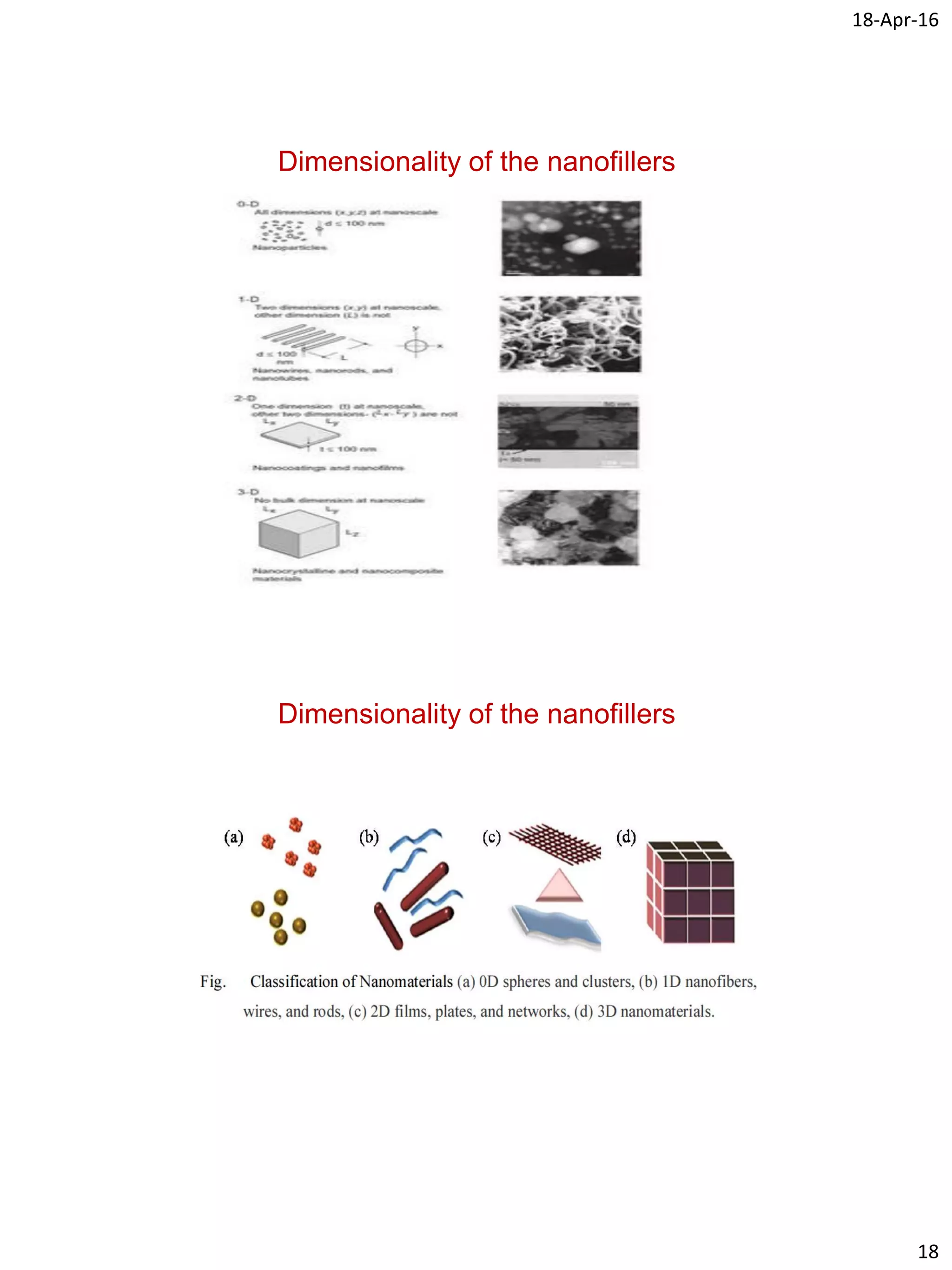
Dimensionality of the nanofillers
18-Apr-16
19
Morphologies of the nanofillers
18-Apr-16
20

Composite materials

  • 1.
    18-Apr-16 1 Composite Materials An Introduction Whatis a composite? • An Engineered material • A mixture of two or more materials Definition: “Composite materials are engineered materials made from two or more constituent materials that remain separate and distinct while forming a single component”
  • 2.
    18-Apr-16 2 What is acomposite? Definition: “Composite materials are considered to be any multiphase material that exhibits a significant proportions of the properties of the both constituents phases such that a better combination of properties (both physical and chemical) is realised” Properties of composite can be tailored by varying the constituent phases Components of composite Matrix : A continuous phase (material) that holds second phase Reinforcing phase: A phase (material) that provides reinforcement (Strength)
  • 3.
    18-Apr-16 3 Criteria for acomposite Prerequisite for composite • Two phases are distinguishable at micro and macro level (keeps their identity) • Two phases are insoluble in each other • Must be chemically inert with respect to each other so that no interaction occurs at high temperature until one of the components melt (exception small degree of interdiffusion is good for bonding) • Composite should offer better properties or obtain new set of properties as a contribution from both matrix and reinforcing phase • Different part bonded together have different properties or different dimensionalities Composites are all around us • Mud bricks made sturdier houses if lined with straw. • Ancient Pharaohs made their slaves to make bricks by mixing straw. Pyramids made from such bricks are still standing.
  • 4.
    18-Apr-16 4 Composites in nature Naturalcomposites can be found in both animal and plants • Wood (Lignin+Cellulose) Composites in nature • Bone
  • 5.
    18-Apr-16 5 • Birds’ feathers •Spider web Why is spider silk so strong? Beehive made by honey bee (inspiration for structural composites) Honey comb panels used in air crafts http://www.universalmetaltek.com/honeycomb_panel.htm Visit this site for info
  • 6.
    18-Apr-16 6 Composites are allaround us Which materials are composites? • Wood (lignin +cellulose) • Concrete (gravel+sand+cement) • Reinforced concrete (gravel+sand+steel) • Steel (ferrite and pearlite) • Multiple polymer layers • Reinforced plastic (it does not improve properties) • Paper (only cellulose fibers)
  • 7.
    18-Apr-16 7 Applications of composites Andmany more Functions of the composite constituents Matrix • Act as a glue to hold the reinforcing phase , homogenous and continuous phase • Infiltrate the fibres or fillers and solidify at reasonable temperature and pressure • Form a coherent bond, usually chemical in nature at the interfaces between the matrix and constituents • Envelop the fibres or fillers which are very notch sensitive • Transfer stresses to the reinforcing phase (fibres), stops crack propagation • Isolate fibres or particles • Debond from the fibres with absorption of significant amount of strain energy • Remain physically and chemically stable after manufacture Matrix Filler
  • 8.
    18-Apr-16 8 Functions of thecomposite constituents Reinforcing phase (dispersed phase) • It is uniformly dispersed in the matrix • Provides strength to the composites • Act as load bearing material • Should have high strength • Chemically inert • Often higher content of reinforcing phase improves strength • Dimensionality of the reinforcing phase control the properties of the composites Matrix Filler Filler can be polymer, ceramic or metal based When to consider composites? • Composites have high stiffness, strength and toughness (comparable to the advance alloys) but they provide these at substantially very low loading of fillers/reinforcing phase and relatively low densities. Composites offer high specific modulus and high specific strength S.M = M.E/specific gravity, S.S = UTS/specific gravity Light weight materials are suitable for aerospace and aircrafts applications Fuel consumptions also decreases S.S of Aligned glass fibre-epoxy = 680 MPa S.S of Steel = 244 MPa
  • 9.
    18-Apr-16 9 When to considercomposites? • Composites can be anisotropic (i.e., they have different mechanical properties in different directions) Example, Rocket motor cases and pressure vessels (Stresses are two times higher in circumferential direction than axial direction) Anisotropy offers more efficient structural components When to consider composites? • Composites have very high fatigue strength • Better fatigue resistance than metal alloys • Longer life of the components • Often show evidence of fatigue damage but do not undergo damage catastrophically Gives warning before failure No sudden failure Longer life Part replacement possible before failure
  • 10.
    18-Apr-16 10 When to considercomposites? • Composites have damping ability • The absorbed mechanical strain energy is dissipated as heat • Much higher damping ability than metals and can be tailored for desired level. Mechanically induced vibrations can be damped Offers noise reduction When to consider composites? • Composites can offer good lubrication or sliding friction • Have high wear resistance • Some composites are designed for very high friction Tribological properties comparable or better than metals
  • 11.
    18-Apr-16 11 When to considercomposites? • Composites do not rust or corrode • Have good oxidation resistance • Good resistance to environmental degradation • Longer life cycle Work in harsh, corrosive environment When to consider composites? • Composites can reduce number of components in the design • Simple manufacturing • Part reduction Fewer joints, better integrity of the product
  • 12.
    18-Apr-16 12 Are composites perfect? • Not all applications require light weight materials. Conventional steels may work fine at low cost • Anisotropy, complicates the design analysis (limitations of stress analysis tools/softwares). Only expert design engineer can work with them. • Cost can be issue (A designer must look for various composites’ advantages to offset cost) • Long term durability is concern • Machining of composites is difficult • Repair is not very effective • Not recyclable • Limited ease of fabrication • Processing issues • Some times properties deteriorate instead of improving Classification of composites On the basis of Matrix Composites can be classified as: • Polymer matrix composites (PMC) • Metal matrix composites (MMC) • Ceramic matrix composites (CMC)
  • 13.
    18-Apr-16 13 Classification of compositematerials on the basis of dispersed phase (10-100 nm) Nanocomposites Composite materials in Skis
  • 14.
    18-Apr-16 14 Various types offillers Types of Nanofillers Non-Carbon based/ceramic/metallic Graphite nanoplatelets, Graphene Carbon black, Carbon nanofibres Graphite nanofibres Carbon nanotubes SiO2, Al2O3, SiC, BN, ZrO, CaCO3, Clays, TiC, Cu, Ag, Al, etc. In the form of cubic, spherical or flakes. Hollow spheres or rods. Carbon based
  • 15.
    18-Apr-16 15 Fibres • Natural fibres Fillerscoming from renewable resources or biodegradable (Green composites) Cellulose, cotton, jute, hemp, flax, sisal, starch, etc. • Synthetic fibres Glass fibre, Aramid fibre (kevlar), Carbon fibre, boron, SiC, metal fibres, graphite fibres, etc. Large Particulate Composites • Concrete • Cermets Rule of Mixture predict the elastic modulus of LPC fall in between the upper and lower bound (limits) as given by following equations: Upper bound : Lower bound :
  • 16.
    18-Apr-16 16 CERMETS Applications: Cutting tools (WC/Coor WC/Ni or TiC/Co , etc. For maximizing cutting action up to 90 vol.% of particulates are added. Particulate composites Elastomers reinforced with Carbon black particles • 30-40 vol% carbon black (dia 20-50 nm) reinforced in rubber for tyre applications • Tensile strength, toughness, tear and abrasion resistance increases • Good dispersion and strong bonding between particles and matrix requires
  • 17.
    18-Apr-16 17 Matrices for Composites Acrylics Phenolics(thermosets) are also popular Advantages and Disadvantages of thermosets and thermoplastics Acrylics
  • 18.
    18-Apr-16 18 Dimensionality of thenanofillers Dimensionality of the nanofillers
  • 19.
  • 20.