Metal Matrix Composite
(Basic Concept and Research Aspect)
Dr B. Radha Krishnan,
Associate Professor/ Mechanical Engineering
Nadar Saraswathi College of Engineering and Technology,
Theni
NADAR SARASWATHI COLLEGE OF ENGINEERING AND TECHNOLOGY
• Department of Mechanical Engineering
• Established in 2010
• Approved research centre in mechanical Engineering
• Top 10 position in South Tamilnadu in past 6 years
• Research facility enriched for Composite materials
Why?
• Can modified the desired mechanical properties.
• Can replace the materials especially in heavy load
applications.
• Can produce the complex shape.
• Improve the performance
History
• 1939 – glass fiber for high temperature application.
• 1950 – Boron and Carbon fibers for rope manufacturing.
• 1960 – Polymer matrix composite
• 1970- Metal matrix composite for military and aerospace
applications.
• 1990- ceramic matrix composite.
- high temperature applications like aircraft engine and
power plant turbines.
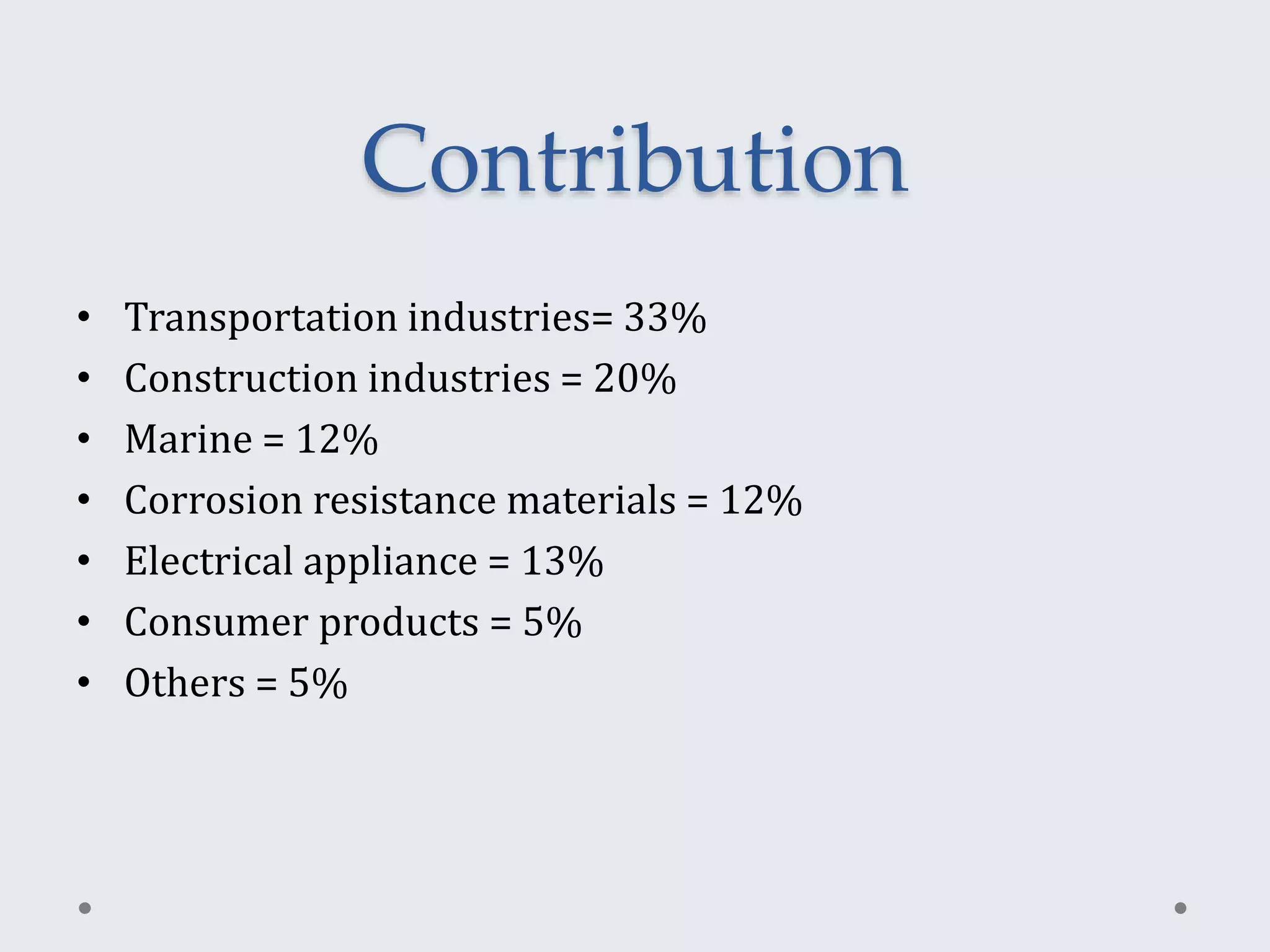
Contribution
• Transportation industries= 33%
• Construction industries = 20%
• Marine = 12%
• Corrosion resistance materials = 12%
• Electrical appliance = 13%
• Consumer products = 5%
• Others = 5%
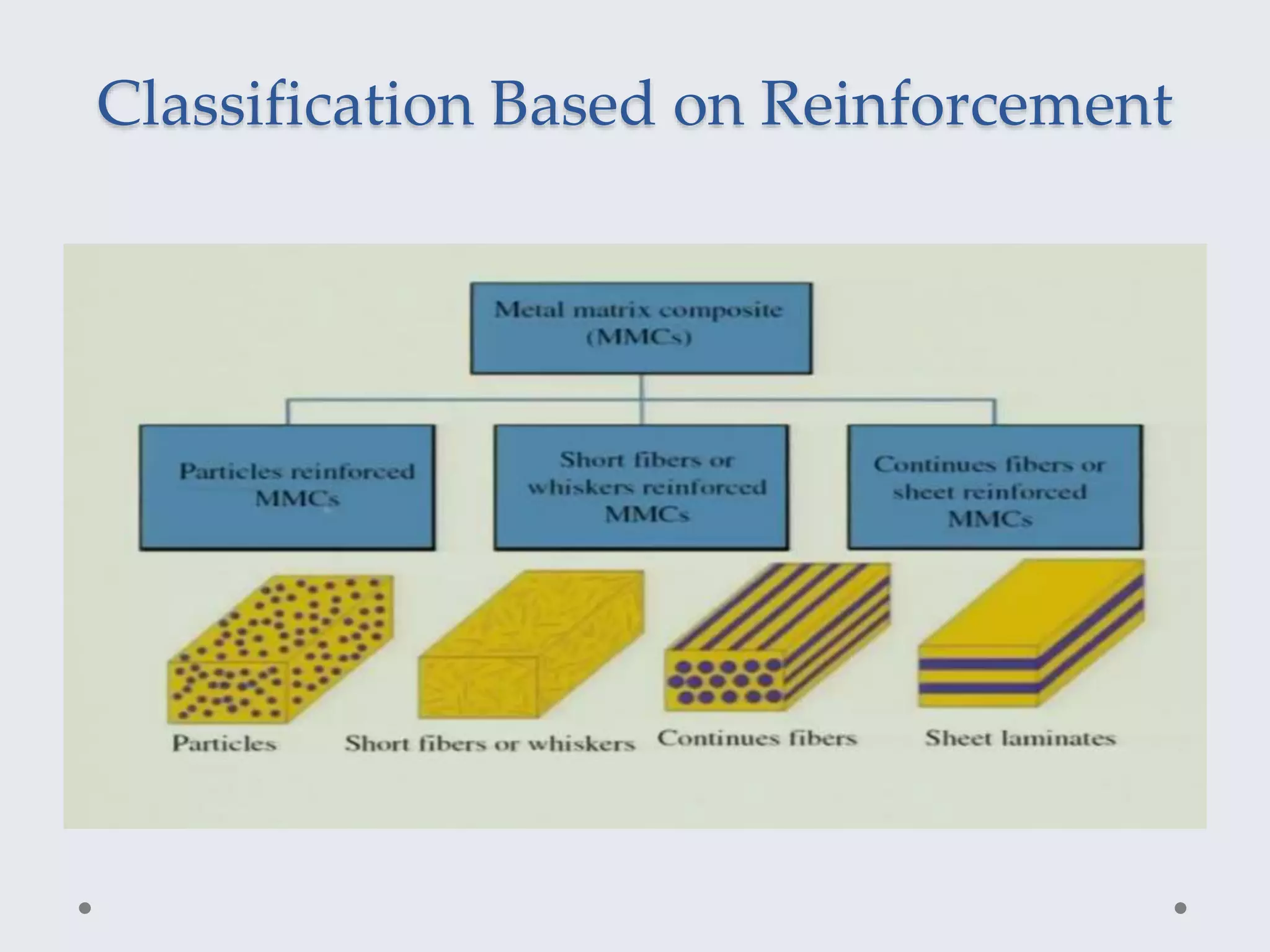
Classification
Classification Based on Reinforcement
Factors Considering for Reinforcement
• Low density, High stiffness
• High Young's Modulus
• High compression and tensile stress
• Thermal stability
• Machinability
• Economic efficiency
(Mechanical properties can change, during high temp
process)
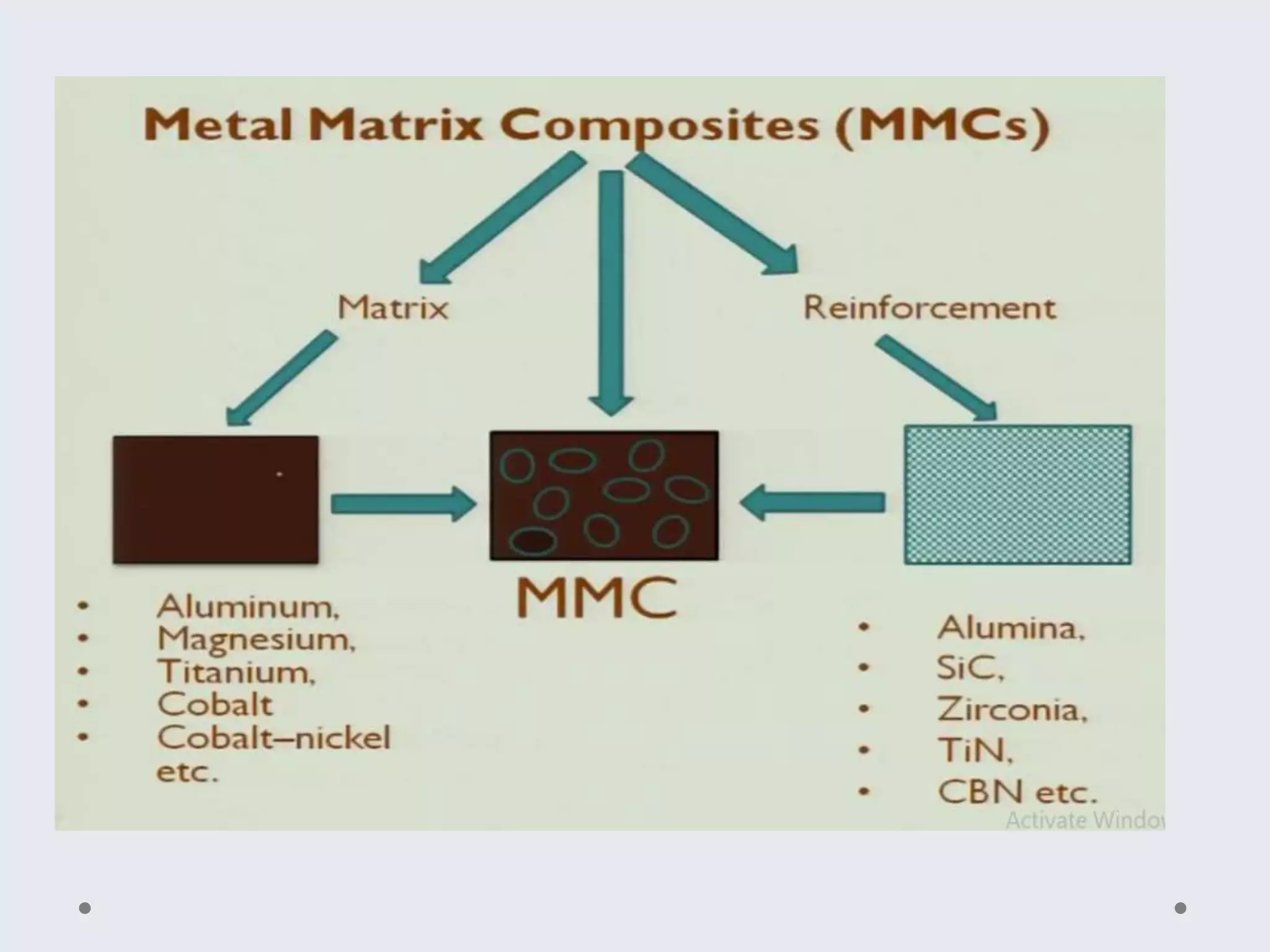
Metal Matrix Composite
A metal matrix composite (MMC) is composite material with
at least two constituent parts, one being a metal necessarily,
The other material may be a different metal or another
material, such as a ceramic or organic compound.
When at least three materials are present, it is called a hybrid
composite.
Microstructure Analysis
Classifications
•Aluminium Matrix Composite
•Copper Matrix Composite
•Magnesium Matrix Composite
•Titanium Matrix Composite
Aluminium Matrix Composite
• It is used for manufacturing the automotive parts like Piston,
push rod, brake components, Bicycles frame.
 Low density
 Abrasion resistance
 High strength and stiffness.
 High thermal conductivity
Processed by
a) Stir Casting
b) Powder metallurgy
c) Infiltration
( Mainly reinforced with Al2O3 and SiC )
Copper Matrix Composite
• It was mainly applicable for electrical and electronic component
productions such as electronic relay, springs.
 Low coefficient of thermal expansion
 Good wear resistance
 Good electrical conductivity
 Good thermal conductivity
Processed by
a) Powder metallurgy
b) Infiltration
(Reinforced by Carbon fibre for continuous product, SiC, Tungsten,
Stainless steel 304 ( Long fibre))
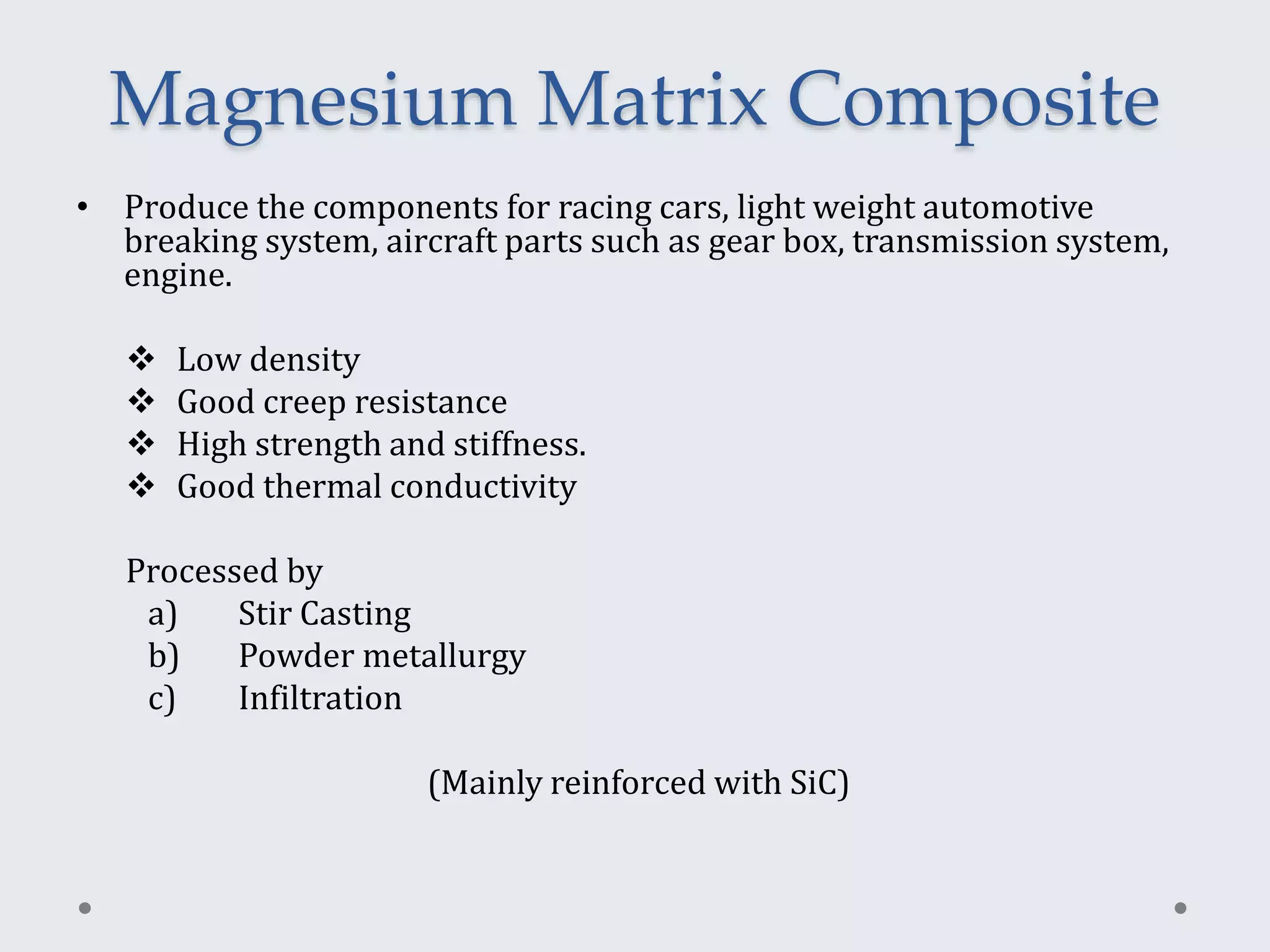
Magnesium Matrix Composite
• Produce the components for racing cars, light weight automotive
breaking system, aircraft parts such as gear box, transmission system,
engine.
 Low density
 Good creep resistance
 High strength and stiffness.
 Good thermal conductivity
Processed by
a) Stir Casting
b) Powder metallurgy
c) Infiltration
(Mainly reinforced with SiC)
Titanium Matrix Composite
• Reinforced by continuous monofilament silicon carbide
fiber( CVD)
• Titanium boride and Titanium Carbide.
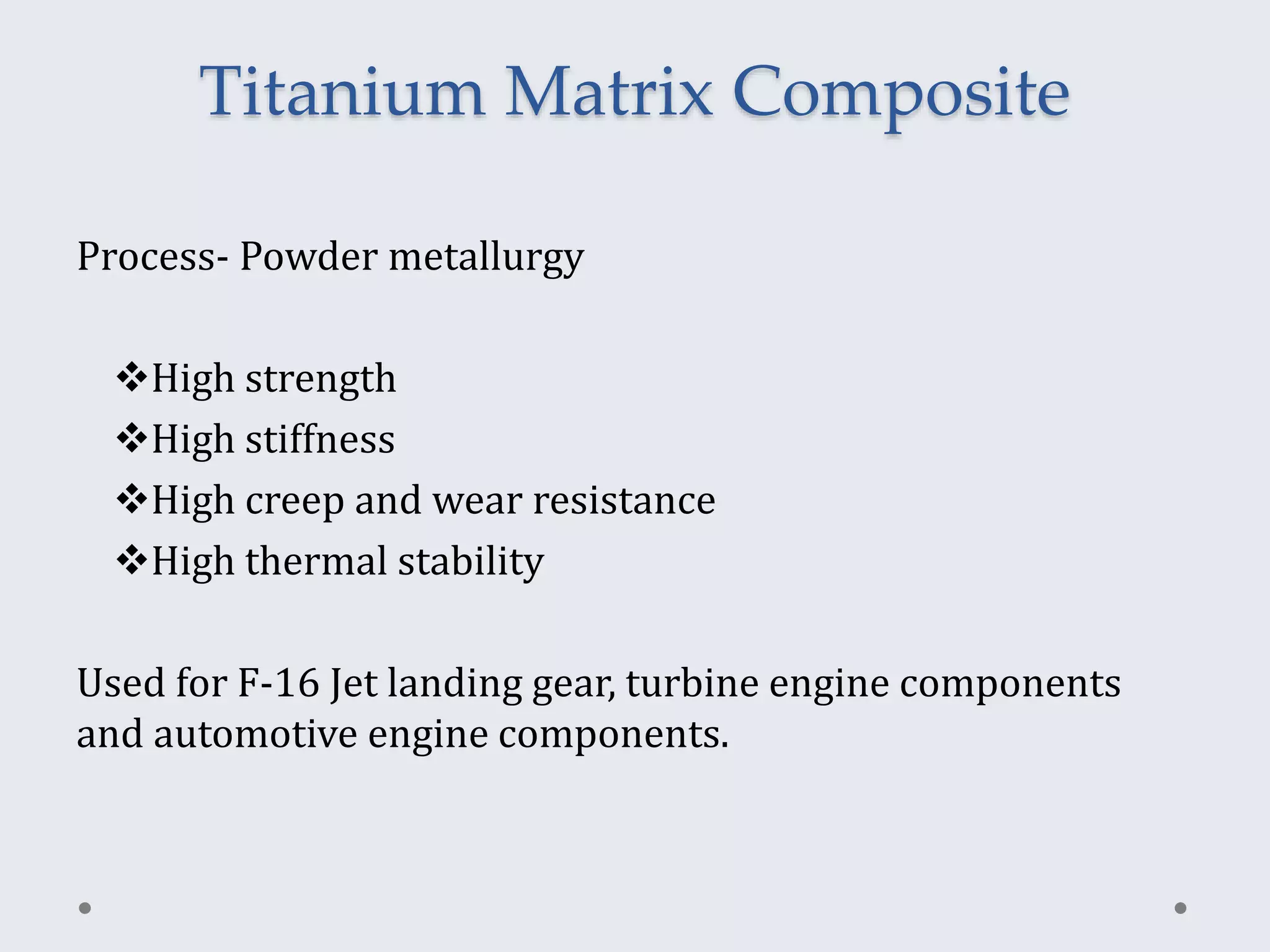
Titanium Matrix Composite
Process- Powder metallurgy
High strength
High stiffness
High creep and wear resistance
High thermal stability
Used for F-16 Jet landing gear, turbine engine components
and automotive engine components.
Selection of Materials
1. Based on the applications and issues
(Real time field applications and problems occur during the
machining process)
2. From the existing research.
(Improve the properties with percentage changing of
reinforcement)
Need to ensure
• Melting point of the Matrix
( eg., Al6063 - 615oC - 654oC, SiC -2,830 °C).
• Selection of process
• Essential Testing methods
1.SEM- Matrix and Reinforcement bonding
2.EDAX (Energy Dispersive X-Ray Analysis)- Chemical Composition
3.Wear Analysis
4.Hardness testing
5.Tensile and compressive ( based on application)
If machining process,
Roughness profile by SEM analysis. Wear rate
• Need to mention the existing materials properties for justification
• Reinforced materials grain size (Micro or Nano)
- prefer nano particles, for good interfacial bonding
• Reinforced materials should add uniformly in stir casting
process
• Process may without exceeding the material melting point,
thereby significantly lowering the risk of oxidation, phase
transformation, and excessive thermal residual stress.
ex ., Diamond-reinforced metal matrix composites (DMMC) have
great potential for wear-resistance applications due to the superior
hardness of the diamond component. Cold spray as an emerging
coating technique is able to fabricate coatings
Processing Methods
Stir Casting Process
• Matrix- Al, Co, Cu, Ti, Mg.
• Can maintain atmosphere by vacuum.
• Stir for , uniform melting, uniform dispose the
reinforcement.
• Need to analyse the density of materials
• Ranges of melting temperature, if raise above, may change
the properties of composite.
• Reinforced should in particulate and whisker, but whisker
is challenge one.
• Not more than 30%.
• Technology wise it was simple and low cost.
Powder metallurgy
process
• The conventional powder metallurgy process consists of
three main-steps: powder mixing, compacting (sintering)
and extrusion.
• To carry out the processing of MMC Through powder
metallurgy, development of powder metallurgy set up is
essential.
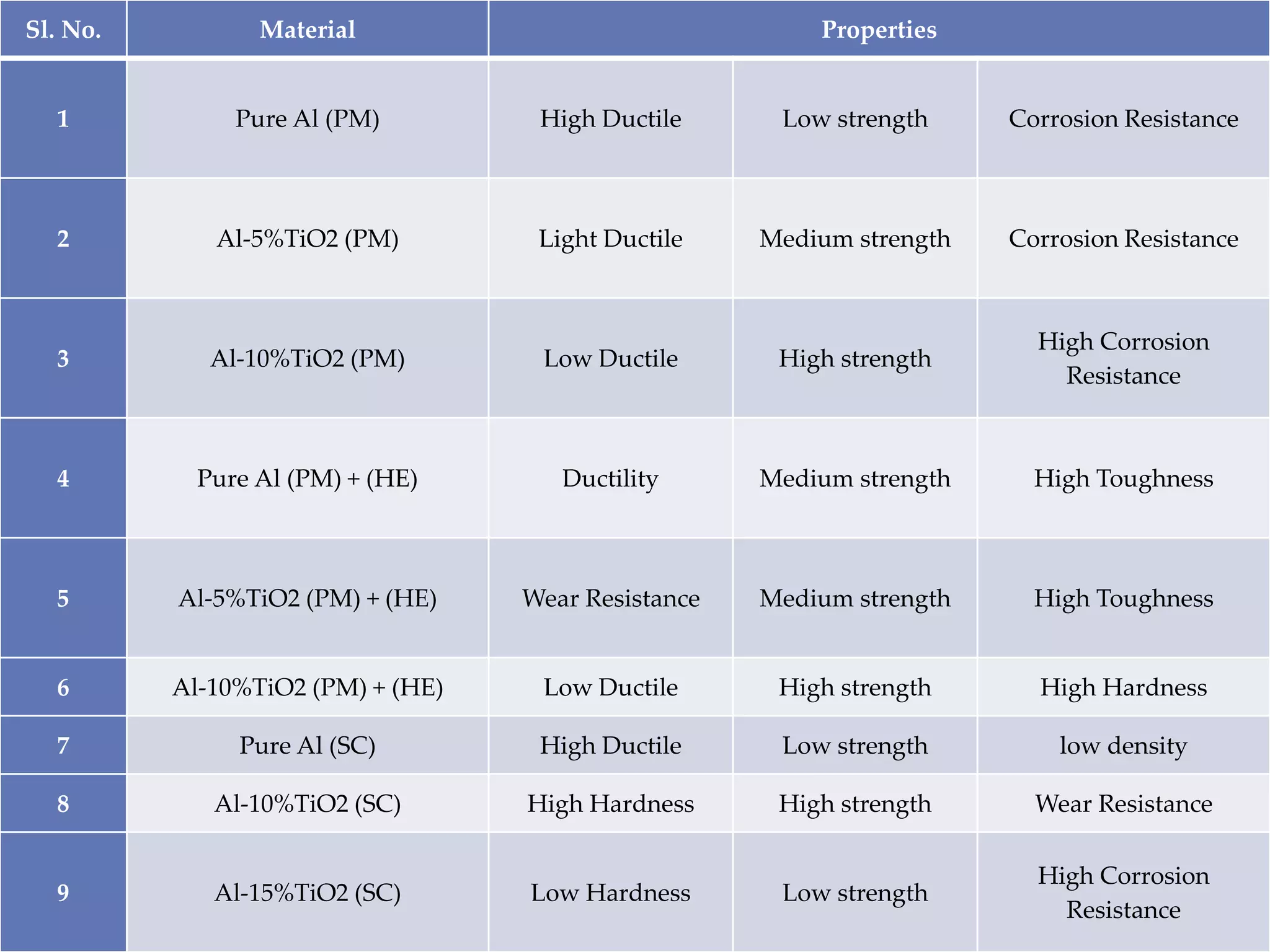
Data prediction from Existing Work
(Aluminium Matrix Composite)
Sl. No. Material Properties
1 Pure Al (PM) High Ductile Low strength Corrosion Resistance
2 Al-5%TiO2 (PM) Light Ductile Medium strength Corrosion Resistance
3 Al-10%TiO2 (PM) Low Ductile High strength
High Corrosion
Resistance
4 Pure Al (PM) + (HE) Ductility Medium strength High Toughness
5 Al-5%TiO2 (PM) + (HE) Wear Resistance Medium strength High Toughness
6 Al-10%TiO2 (PM) + (HE) Low Ductile High strength High Hardness
7 Pure Al (SC) High Ductile Low strength low density
8 Al-10%TiO2 (SC) High Hardness High strength Wear Resistance
9 Al-15%TiO2 (SC) Low Hardness Low strength
High Corrosion
Resistance
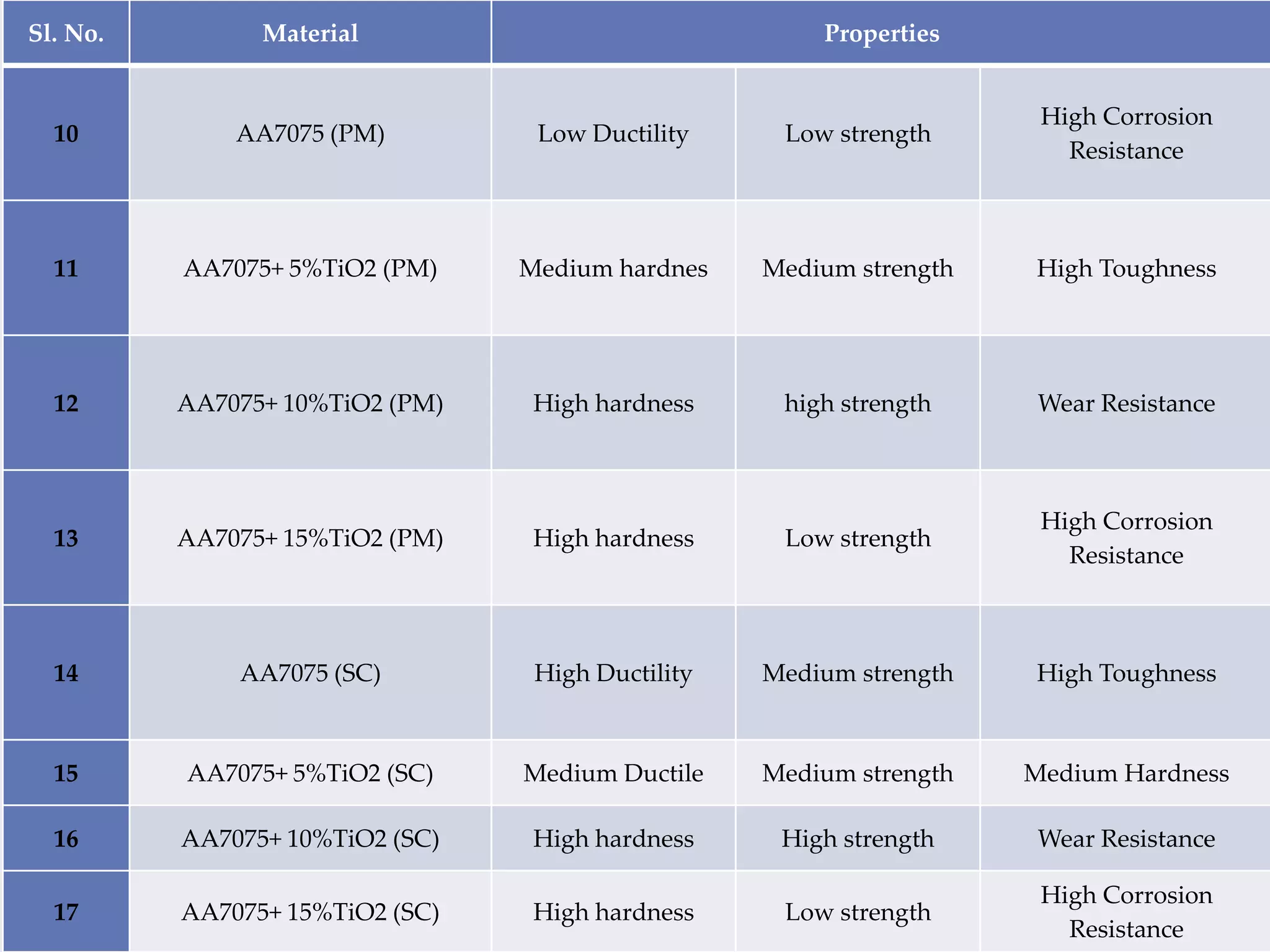
Sl. No. Material Properties
10 AA7075 (PM) Low Ductility Low strength
High Corrosion
Resistance
11 AA7075+ 5%TiO2 (PM) Medium hardnes Medium strength High Toughness
12 AA7075+ 10%TiO2 (PM) High hardness high strength Wear Resistance
13 AA7075+ 15%TiO2 (PM) High hardness Low strength
High Corrosion
Resistance
14 AA7075 (SC) High Ductility Medium strength High Toughness
15 AA7075+ 5%TiO2 (SC) Medium Ductile Medium strength Medium Hardness
16 AA7075+ 10%TiO2 (SC) High hardness High strength Wear Resistance
17 AA7075+ 15%TiO2 (SC) High hardness Low strength
High Corrosion
Resistance
Thank you for everyone

Metal Matrix Composite (Research Aspect).pptx

  • 1.
    Metal Matrix Composite (BasicConcept and Research Aspect) Dr B. Radha Krishnan, Associate Professor/ Mechanical Engineering Nadar Saraswathi College of Engineering and Technology, Theni
  • 2.
    NADAR SARASWATHI COLLEGEOF ENGINEERING AND TECHNOLOGY • Department of Mechanical Engineering • Established in 2010 • Approved research centre in mechanical Engineering • Top 10 position in South Tamilnadu in past 6 years • Research facility enriched for Composite materials
  • 3.
    Why? • Can modifiedthe desired mechanical properties. • Can replace the materials especially in heavy load applications. • Can produce the complex shape. • Improve the performance
  • 4.
    History • 1939 –glass fiber for high temperature application. • 1950 – Boron and Carbon fibers for rope manufacturing. • 1960 – Polymer matrix composite
  • 5.
    • 1970- Metalmatrix composite for military and aerospace applications. • 1990- ceramic matrix composite. - high temperature applications like aircraft engine and power plant turbines.
  • 6.
    Contribution • Transportation industries=33% • Construction industries = 20% • Marine = 12% • Corrosion resistance materials = 12% • Electrical appliance = 13% • Consumer products = 5% • Others = 5%
  • 7.
  • 9.
  • 10.
    Factors Considering forReinforcement • Low density, High stiffness • High Young's Modulus • High compression and tensile stress • Thermal stability • Machinability • Economic efficiency (Mechanical properties can change, during high temp process)
  • 11.
    Metal Matrix Composite Ametal matrix composite (MMC) is composite material with at least two constituent parts, one being a metal necessarily, The other material may be a different metal or another material, such as a ceramic or organic compound. When at least three materials are present, it is called a hybrid composite.
  • 12.
  • 13.
    Classifications •Aluminium Matrix Composite •CopperMatrix Composite •Magnesium Matrix Composite •Titanium Matrix Composite
  • 14.
    Aluminium Matrix Composite •It is used for manufacturing the automotive parts like Piston, push rod, brake components, Bicycles frame.  Low density  Abrasion resistance  High strength and stiffness.  High thermal conductivity Processed by a) Stir Casting b) Powder metallurgy c) Infiltration ( Mainly reinforced with Al2O3 and SiC )
  • 15.
    Copper Matrix Composite •It was mainly applicable for electrical and electronic component productions such as electronic relay, springs.  Low coefficient of thermal expansion  Good wear resistance  Good electrical conductivity  Good thermal conductivity Processed by a) Powder metallurgy b) Infiltration (Reinforced by Carbon fibre for continuous product, SiC, Tungsten, Stainless steel 304 ( Long fibre))
  • 16.
    Magnesium Matrix Composite •Produce the components for racing cars, light weight automotive breaking system, aircraft parts such as gear box, transmission system, engine.  Low density  Good creep resistance  High strength and stiffness.  Good thermal conductivity Processed by a) Stir Casting b) Powder metallurgy c) Infiltration (Mainly reinforced with SiC)
  • 17.
    Titanium Matrix Composite •Reinforced by continuous monofilament silicon carbide fiber( CVD) • Titanium boride and Titanium Carbide.
  • 18.
    Titanium Matrix Composite Process-Powder metallurgy High strength High stiffness High creep and wear resistance High thermal stability Used for F-16 Jet landing gear, turbine engine components and automotive engine components.
  • 19.
    Selection of Materials 1.Based on the applications and issues (Real time field applications and problems occur during the machining process) 2. From the existing research. (Improve the properties with percentage changing of reinforcement)
  • 20.
    Need to ensure •Melting point of the Matrix ( eg., Al6063 - 615oC - 654oC, SiC -2,830 °C). • Selection of process • Essential Testing methods 1.SEM- Matrix and Reinforcement bonding 2.EDAX (Energy Dispersive X-Ray Analysis)- Chemical Composition 3.Wear Analysis 4.Hardness testing 5.Tensile and compressive ( based on application) If machining process, Roughness profile by SEM analysis. Wear rate • Need to mention the existing materials properties for justification
  • 21.
    • Reinforced materialsgrain size (Micro or Nano) - prefer nano particles, for good interfacial bonding • Reinforced materials should add uniformly in stir casting process • Process may without exceeding the material melting point, thereby significantly lowering the risk of oxidation, phase transformation, and excessive thermal residual stress. ex ., Diamond-reinforced metal matrix composites (DMMC) have great potential for wear-resistance applications due to the superior hardness of the diamond component. Cold spray as an emerging coating technique is able to fabricate coatings
  • 22.
  • 23.
  • 24.
    • Matrix- Al,Co, Cu, Ti, Mg. • Can maintain atmosphere by vacuum. • Stir for , uniform melting, uniform dispose the reinforcement. • Need to analyse the density of materials • Ranges of melting temperature, if raise above, may change the properties of composite. • Reinforced should in particulate and whisker, but whisker is challenge one. • Not more than 30%. • Technology wise it was simple and low cost.
  • 25.
    Powder metallurgy process • Theconventional powder metallurgy process consists of three main-steps: powder mixing, compacting (sintering) and extrusion. • To carry out the processing of MMC Through powder metallurgy, development of powder metallurgy set up is essential.
  • 26.
    Data prediction fromExisting Work (Aluminium Matrix Composite)
  • 27.
    Sl. No. MaterialProperties 1 Pure Al (PM) High Ductile Low strength Corrosion Resistance 2 Al-5%TiO2 (PM) Light Ductile Medium strength Corrosion Resistance 3 Al-10%TiO2 (PM) Low Ductile High strength High Corrosion Resistance 4 Pure Al (PM) + (HE) Ductility Medium strength High Toughness 5 Al-5%TiO2 (PM) + (HE) Wear Resistance Medium strength High Toughness 6 Al-10%TiO2 (PM) + (HE) Low Ductile High strength High Hardness 7 Pure Al (SC) High Ductile Low strength low density 8 Al-10%TiO2 (SC) High Hardness High strength Wear Resistance 9 Al-15%TiO2 (SC) Low Hardness Low strength High Corrosion Resistance
  • 28.
    Sl. No. MaterialProperties 10 AA7075 (PM) Low Ductility Low strength High Corrosion Resistance 11 AA7075+ 5%TiO2 (PM) Medium hardnes Medium strength High Toughness 12 AA7075+ 10%TiO2 (PM) High hardness high strength Wear Resistance 13 AA7075+ 15%TiO2 (PM) High hardness Low strength High Corrosion Resistance 14 AA7075 (SC) High Ductility Medium strength High Toughness 15 AA7075+ 5%TiO2 (SC) Medium Ductile Medium strength Medium Hardness 16 AA7075+ 10%TiO2 (SC) High hardness High strength Wear Resistance 17 AA7075+ 15%TiO2 (SC) High hardness Low strength High Corrosion Resistance
  • 29.
    Thank you foreveryone