Course content
• 1.Introduction
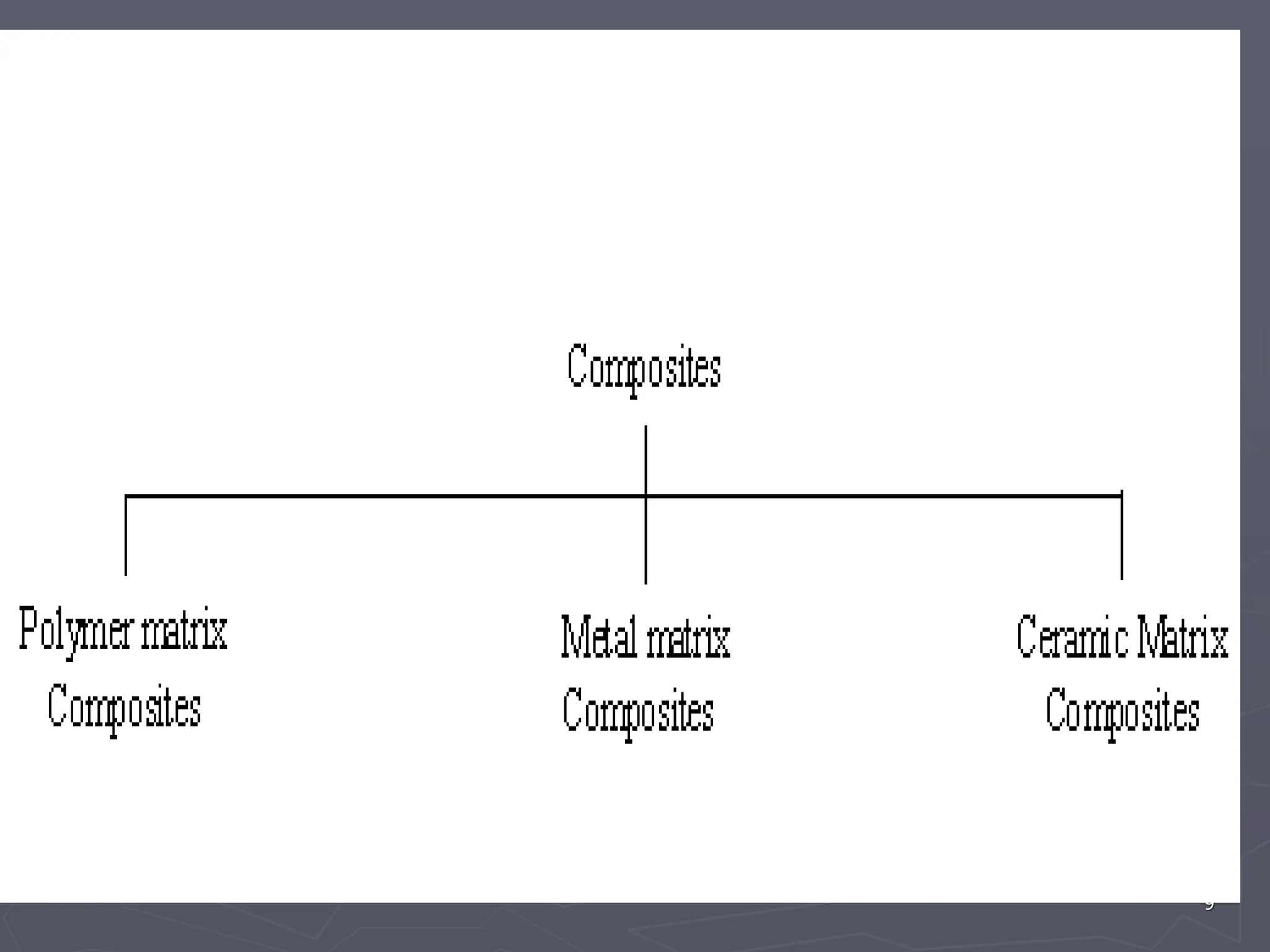
• 2.Classification of composite material
• 3. Factors affecting the properties of composite
material .
• 4. Mechanics of composite material
• 5. Failure of composite material
• 6. Manufacturing of MMC,PMC and CMC
• 7 Design of sandwich structure
• 8. corrosion of material
8.
Introduction
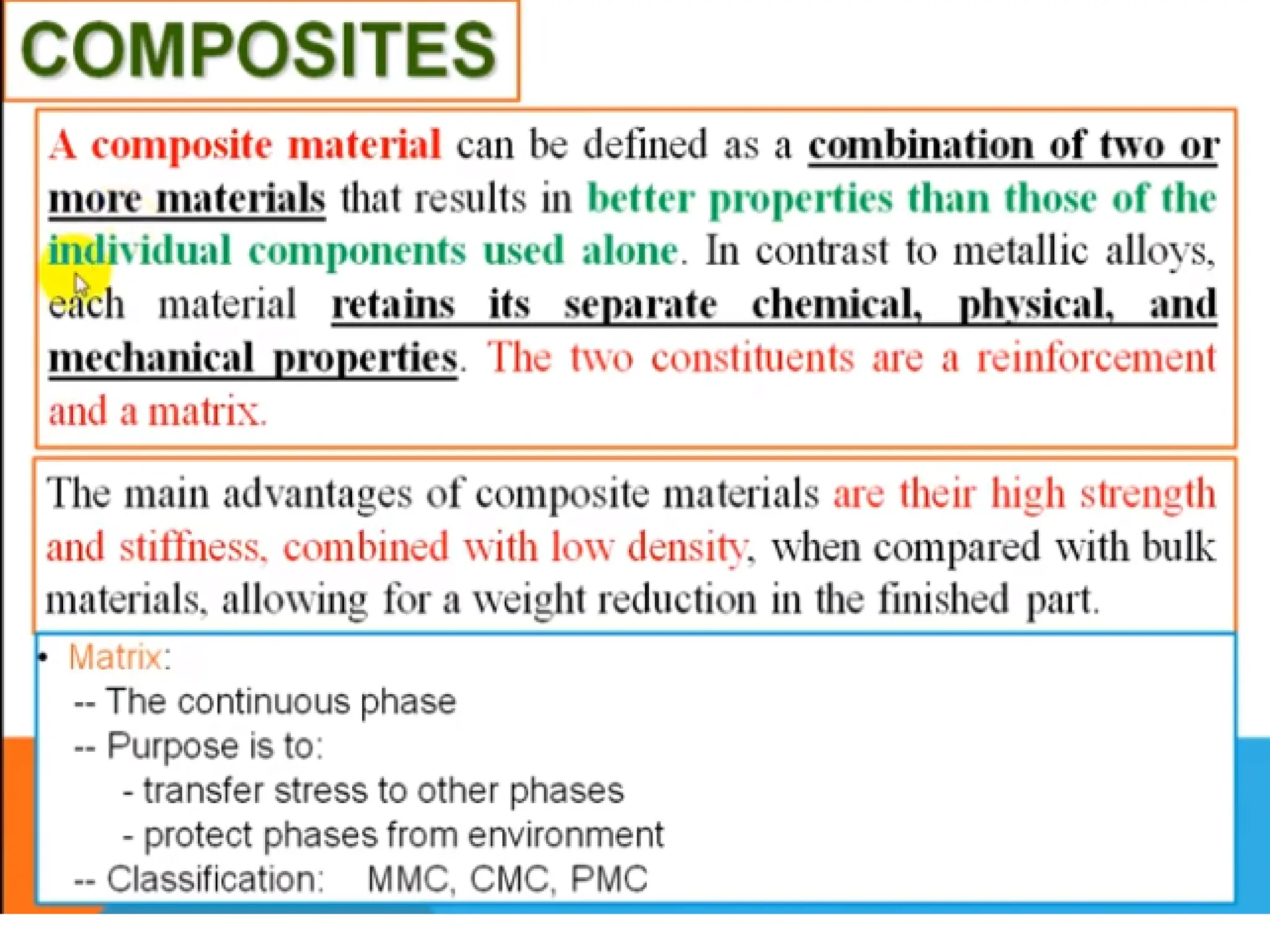
A material systemcomposed of two or
more physically distinct phases whose
combination produces aggregate
properties that are different from those of
its constituents.
9.
What is acomposite?
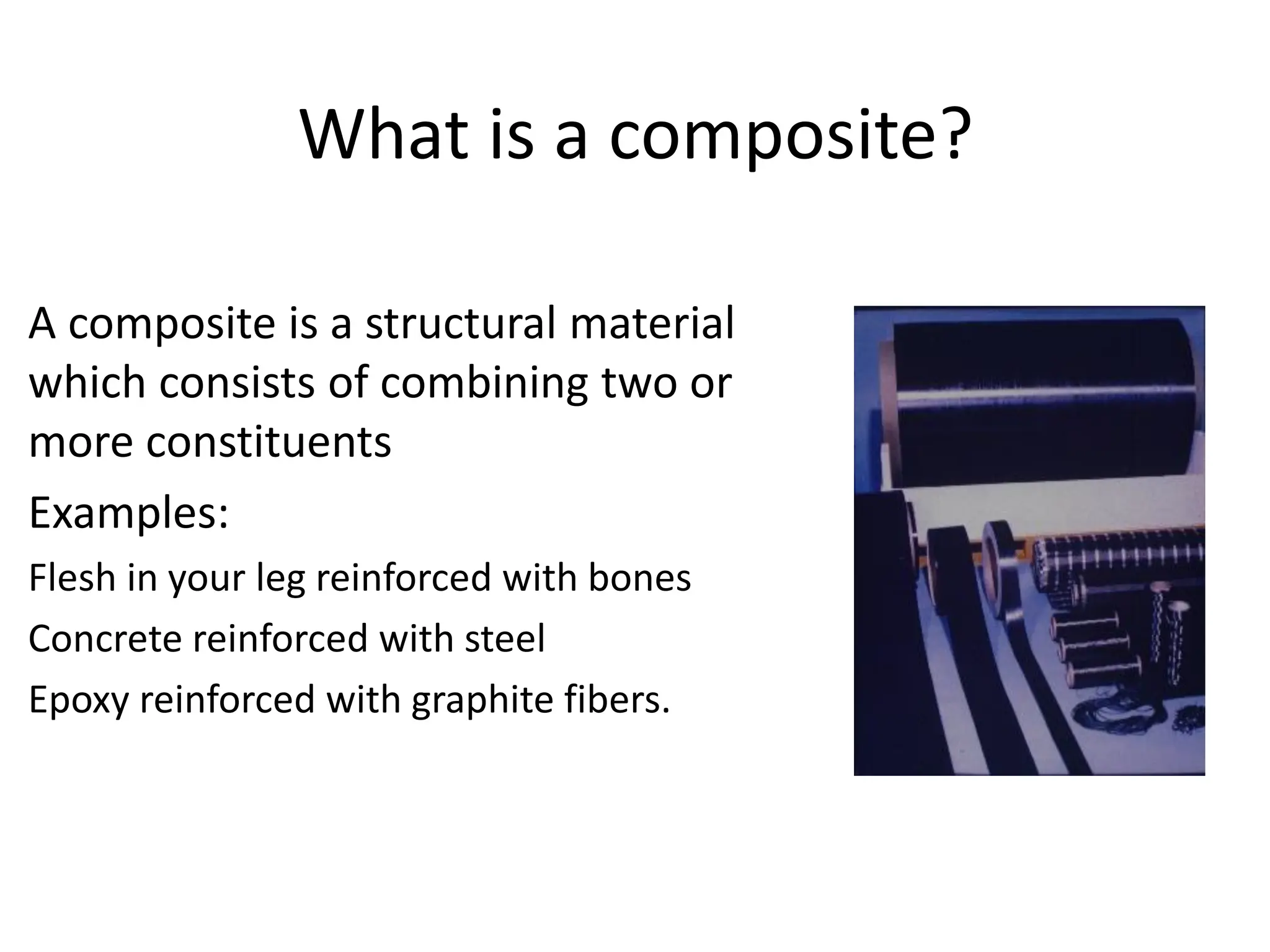
A composite is a structural material
which consists of combining two or
more constituents
Examples:
Flesh in your leg reinforced with bones
Concrete reinforced with steel
Epoxy reinforced with graphite fibers.
Examples of NaturalComposites
• Wood
– Cellulose Fibers
– Lignin Matrix
• Bones
– Collagen Fibers
– Mineral Matrix
12.
Historical Perspective
• 4000B.C. Fibrous composites were used in
Egypt in making laminated writing materials
• 1300 BC: “You are no longer to supply the
people with straw for making bricks; let them
go and gather their own straw” - Exodus 5.7.
• 1700 : French Scientist, Reumer talked about
potential of glass fibers
13.
Historical Perspectives (continued)
•1939: Glass fiber manufactured commercially
for high temperature electrical applications
• 1950s: Boron and carbon fibers were
produced to make ropes.
• 1960s: Matrix added to make polymeric
matrix composites
14.
Historical Perspectives (continued)
•1970s: Cold war forces development of metal
matrix composites for military aircrafts and
missile guidance systems
• 1990s: High temperature ceramic matrix
composites are being aggressively researched
for use in next generation aircraft engines and
power plant turbines
15.
Why Composites areImportant
• Composites can be very strong and stiff, yet very light in
weight, so ratios of strength-to-weight and
stiffness-to-weight are several times greater than steel or
aluminum
• High creep resistance
• Fatigue properties are generally better than for common
engineering metals
• Toughness is often greater too
• Composites can be designed that do not corrode like
steel
• Possible to achieve combinations of properties not
attainable with metals, ceramics, or polymers alone
16.
Disadvantages and Limitationsof
Composite Materials
• Properties of many important composites are anisotropic - the
properties differ depending on the direction in which they are
measured – this may be an advantage or a disadvantage.
• Difficulty in fabrication.
• Repair can be difficult.
• Inspection and testing typically more complex.
• Many of the polymer-based composites are subject to attack by
chemicals or solvents, just as the polymers themselves are
susceptible to attack.
• Composite materials are generally expensive.
• Manufacturing methods for shaping composite materials are
often slow and costly.
Components in aComposite
Material
• Nearly all composite materials consist of
two phases:
–Primary phase - forms the matrix within
which the secondary phase is embedded
–Secondary phase - embedded phase
sometimes referred to as a reinforcing
phase, because it usually serves to
strengthen the composite.
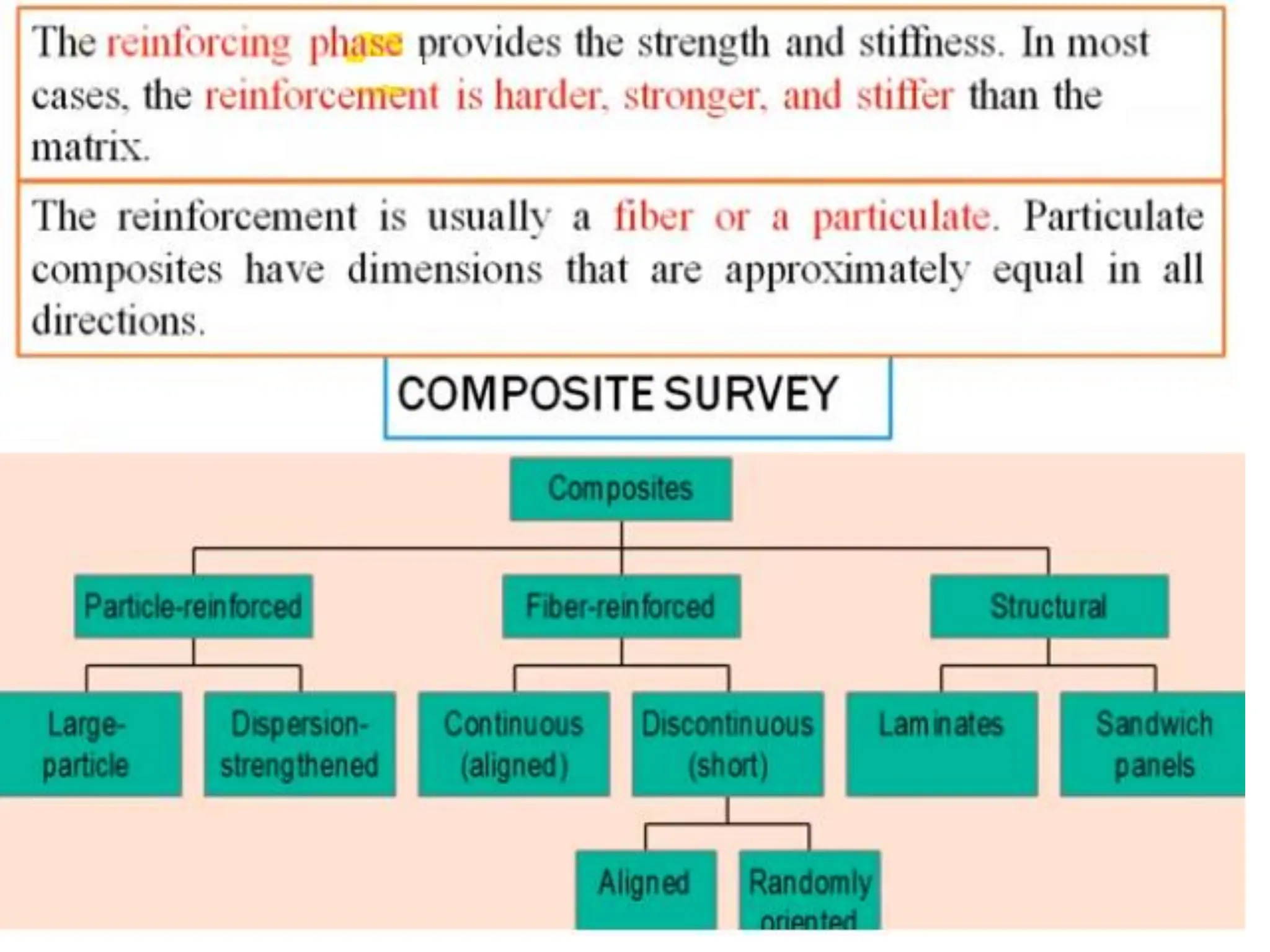
– The reinforcing phase may be in the form of
fibers, particles, or various other geometries .
25.
Functions of theMatrix Material
(Primary Phase)
• Protect phases from environment.
• Transfer Stresses to phases.
• Holds the embedded phase in place, usually
enclosing and often concealing it .
• When a load is applied, the matrix shares the
load with the secondary phase, in some cases
deforming so that the stress is essentially born
by the reinforcing agent .
26.
Functions of theReinforced Material
(Secondary Phase)
❖Secondary Phase (Reinforced material) provide key structural
properties to the composite material.
❖The Reinforcing phase may be in the form of fibers, particles or
flakes.
❖Ex: Plant fibers : Cotton, Jute, Hemp, sisal etc.
❖Animal fiber: Silk, wool etc.
❖Man made fibers : Glass, carbon , Kevlar, Graphite etc.
All the natural fibers are Hydrophilic in nature ( Tendency to
mix with water). But the matrix is polymeric are hydrophobic
( failing to mix with water) . This discrepancy leads to
formation of ineffective interface.
❖ Fluctuating Mechanical Properties creates a problem of
using natural fiber for plastic reinforcement.