

Internal Communication: Downward, Upward

and Horizontal


External Communication


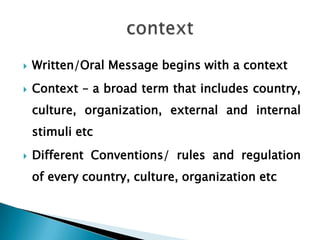
Context



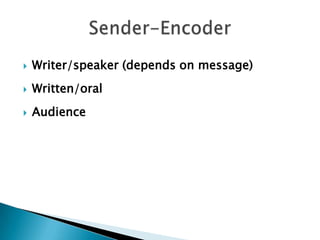
Sender-Encoder



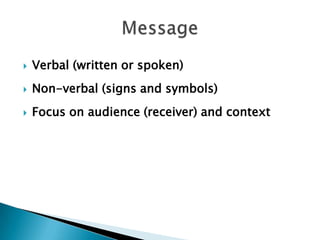
Message



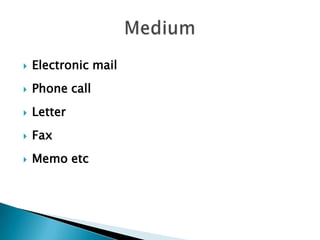
Medium



Receiver-Decoder



Feedback


Written/Oral Message begins with a context



Context – a broad term that includes country,
culture, organization, external and internal
stimuli etc



Different Conventions/ rules and regulation
of every country, culture, organization etc


Writer/speaker (depends on message)



Written/oral



Audience


Verbal (written or spoken)



Non-verbal (signs and symbols)



Focus on audience (receiver) and context


Electronic mail



Phone call



Letter



Fax



Memo etc


Reader/listener



One or more receivers



Interpretation of the message (verbal & nonverbal)


Response/reaction of the audience (receiver)



Feedback can be oral/written



Success/failure of communication


Immediate Feedback



Shorter sentences and shorter words



Conversational



Prompt action



Less detailed technical information



More colloquial language



More interrogative and exclamatory sentences


Delayed Feedback



longer sentences and longer words



More Formal



Delayed action



More detailed technical information



Useful for permanent record: Documentation



Possibility of review

Components of communication