TOPIC 10
ORGANIZATIONAL COMMUNICATION
Dr. Syazwani
OBJECTIVES
• Define the nature and function of communication.
• Understand the communication process.
• Differentiate between 3 formal communication
channels in organization
RECAP: COMMUNICATION
• Communication thus can be defined as the process by which
information is exchanged and understood by two or more
people, usually with the intent to motivate or influence behavior.
• Communication is not just sending information, communication
is a two-way street that includes listening and other forms of
feedback.
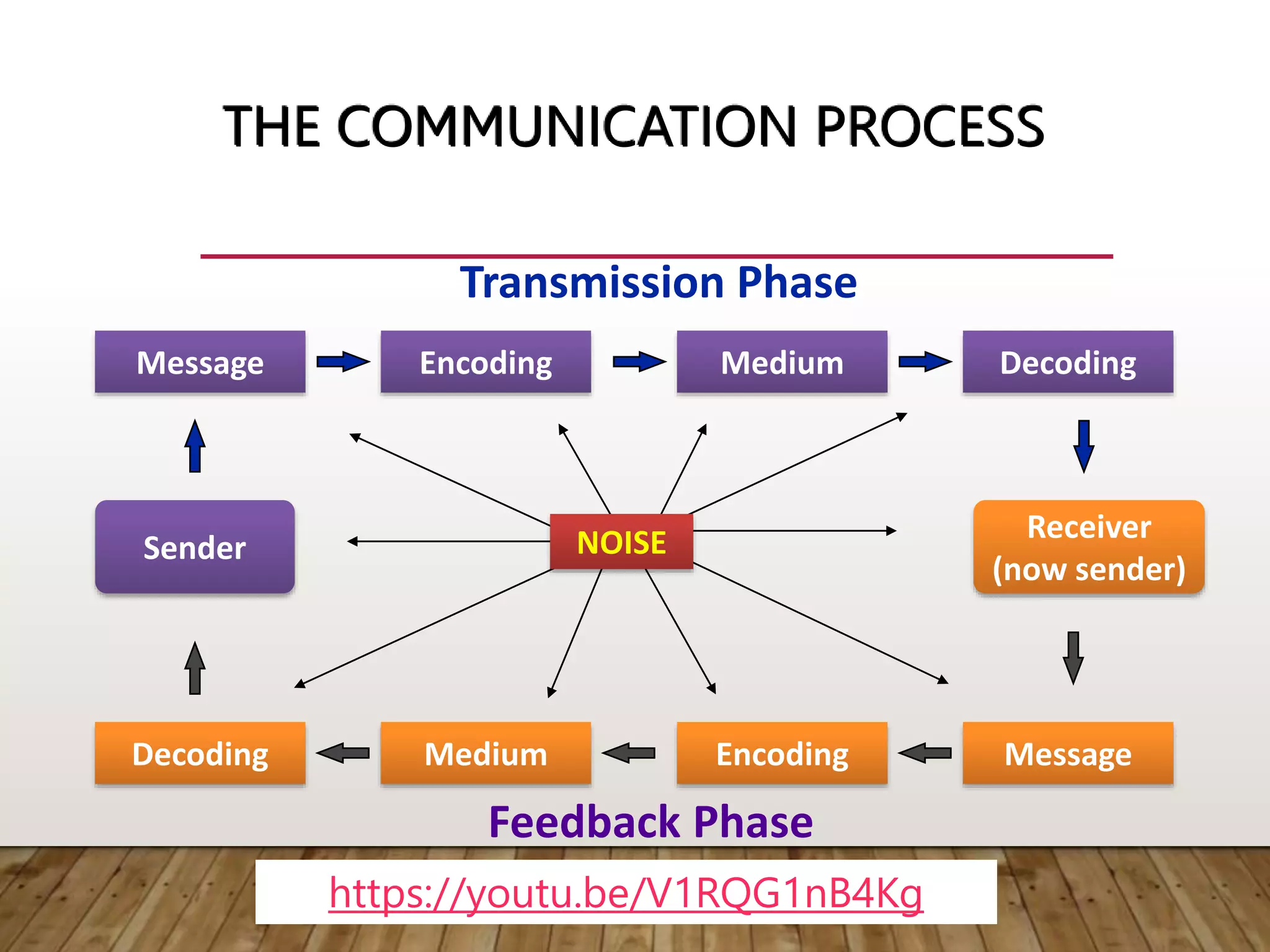
THE COMMUNICATION PROCESS
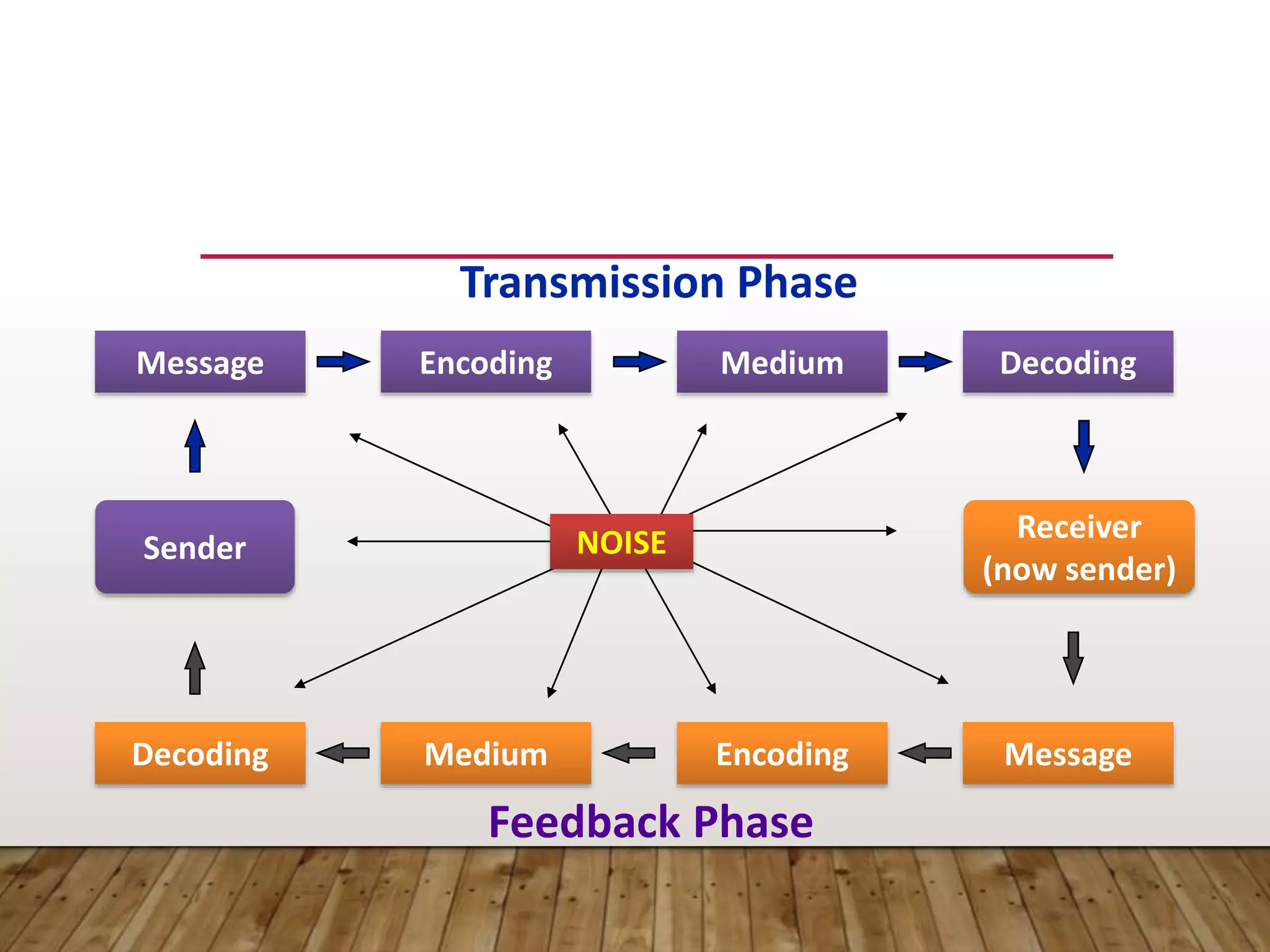
Message Encoding Medium Decoding
Decoding Medium Encoding Message
Receiver
(now sender)
Sender
Transmission Phase
Feedback Phase
NOISE
https://youtu.be/V1RQG1nB4Kg
ELEMENTS IN COMMUNICATION
PROCESS
• The sender is anyone who wishes to convey an idea or
concept to others, to seek information, or to express a
thought or emotion.
• The receiver is the person to whom the message is sent.
• The message is the tangible formulation of the
idea/information that is sent to the receiver through
channel.
• The sender encodes the idea by selecting symbols with
which to compose a message.
• The medium is a channel of communication; report, a
telephone call or e-mail message, or a face-to-face meeting.
• The receiver decodes the symbols to interpret the meaning of
the message.
• Noise is a potential sources for communication errors,
• Feedback occurs when the receiver responds to the sender's
communication with a return message. Without feedback, the
communication is one-way; with feedback, it is two-way.
Message Encoding Medium Decoding
Decoding Medium Encoding Message
Receiver
(now sender)
Sender
Transmission Phase
Feedback Phase
NOISE
COMMUNICATION CHANNELS
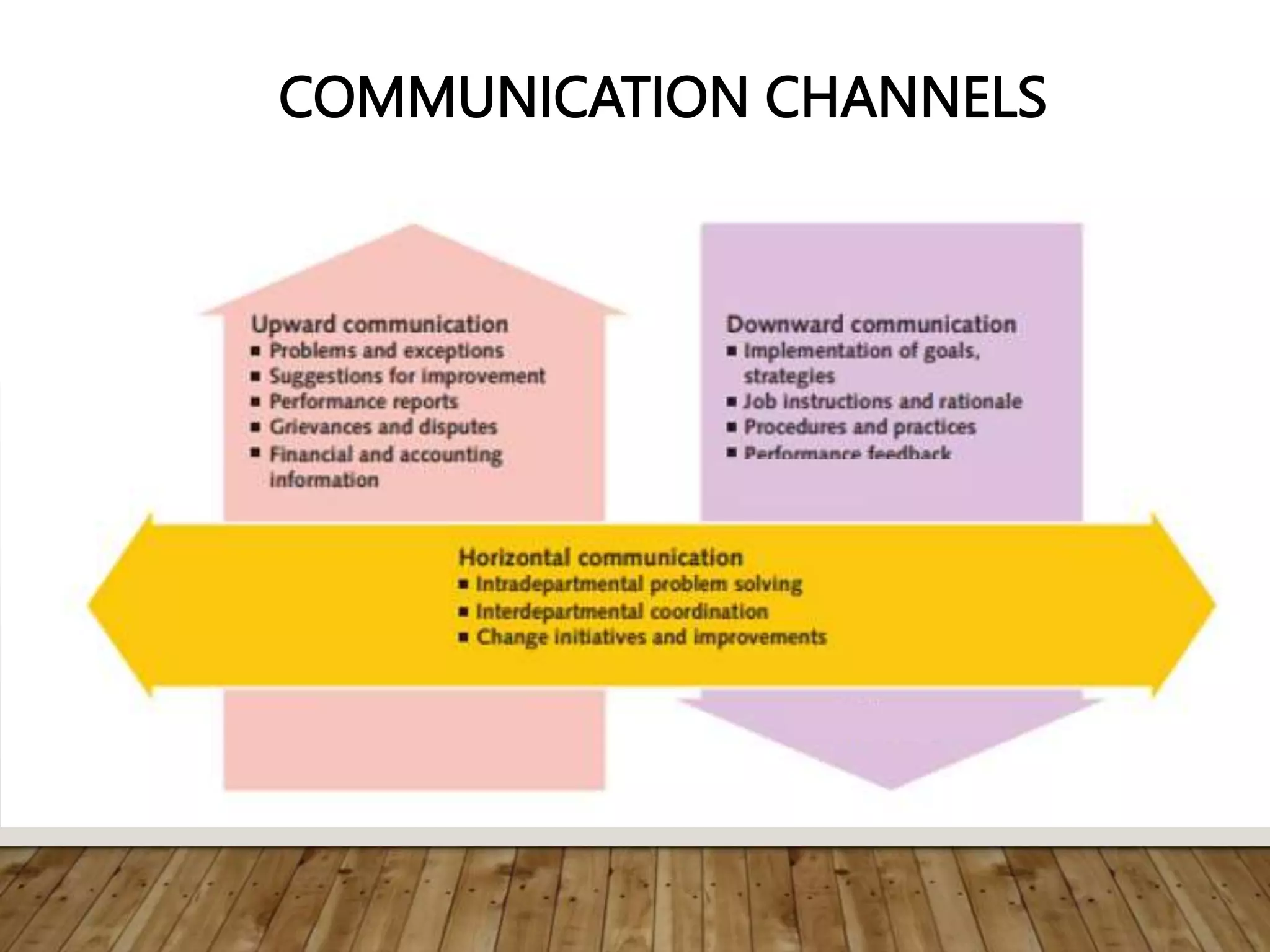
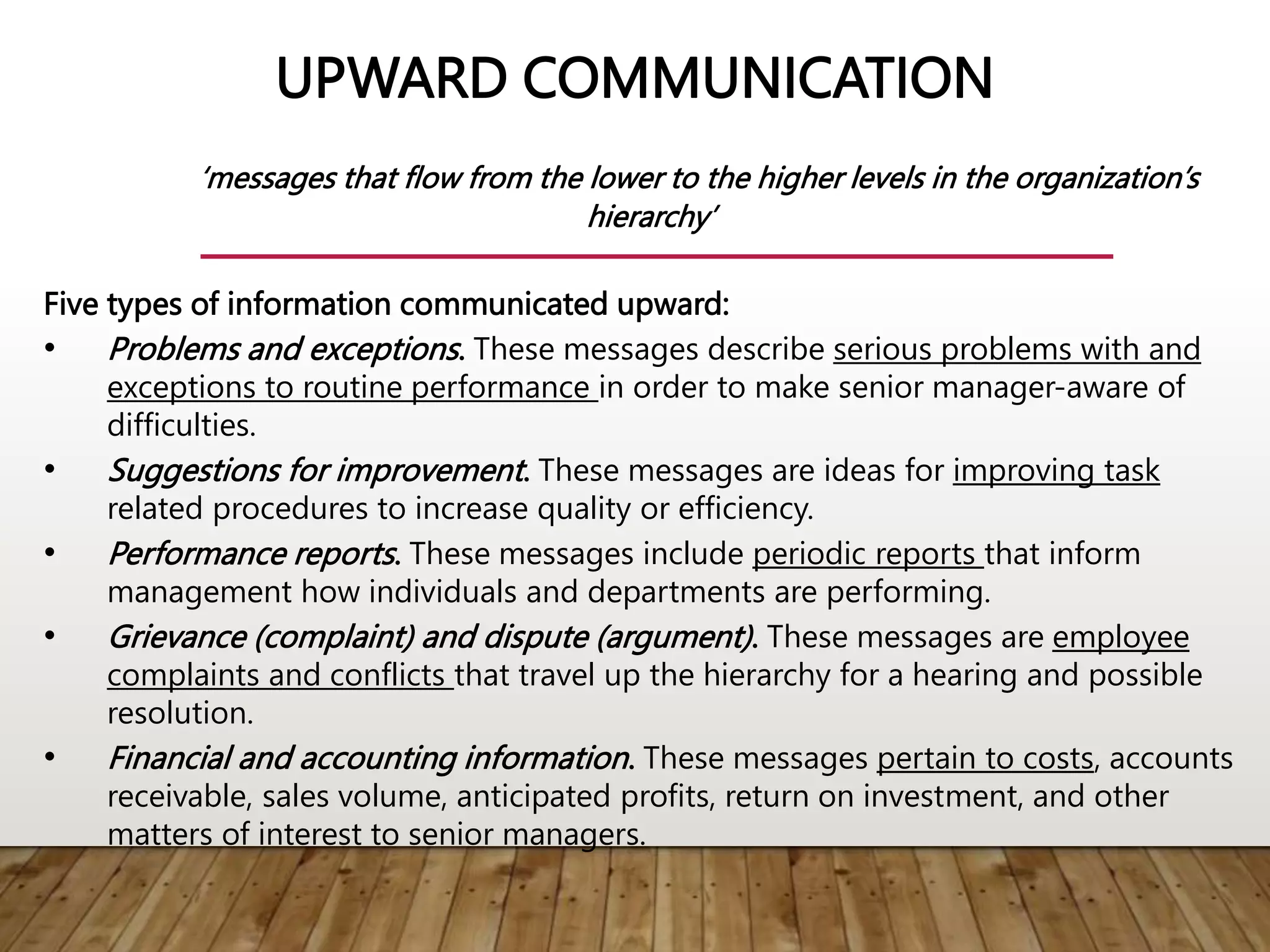
UPWARD COMMUNICATION
‘messages that flow from the lower to the higher levels in the organization’s
hierarchy’
Five types of information communicated upward:
• Problems and exceptions. These messages describe serious problems with and
exceptions to routine performance in order to make senior manager-aware of
difficulties.
• Suggestions for improvement. These messages are ideas for improving task
related procedures to increase quality or efficiency.
• Performance reports. These messages include periodic reports that inform
management how individuals and departments are performing.
• Grievance (complaint) and dispute (argument). These messages are employee
complaints and conflicts that travel up the hierarchy for a hearing and possible
resolution.
• Financial and accounting information. These messages pertain to costs, accounts
receivable, sales volume, anticipated profits, return on investment, and other
matters of interest to senior managers.
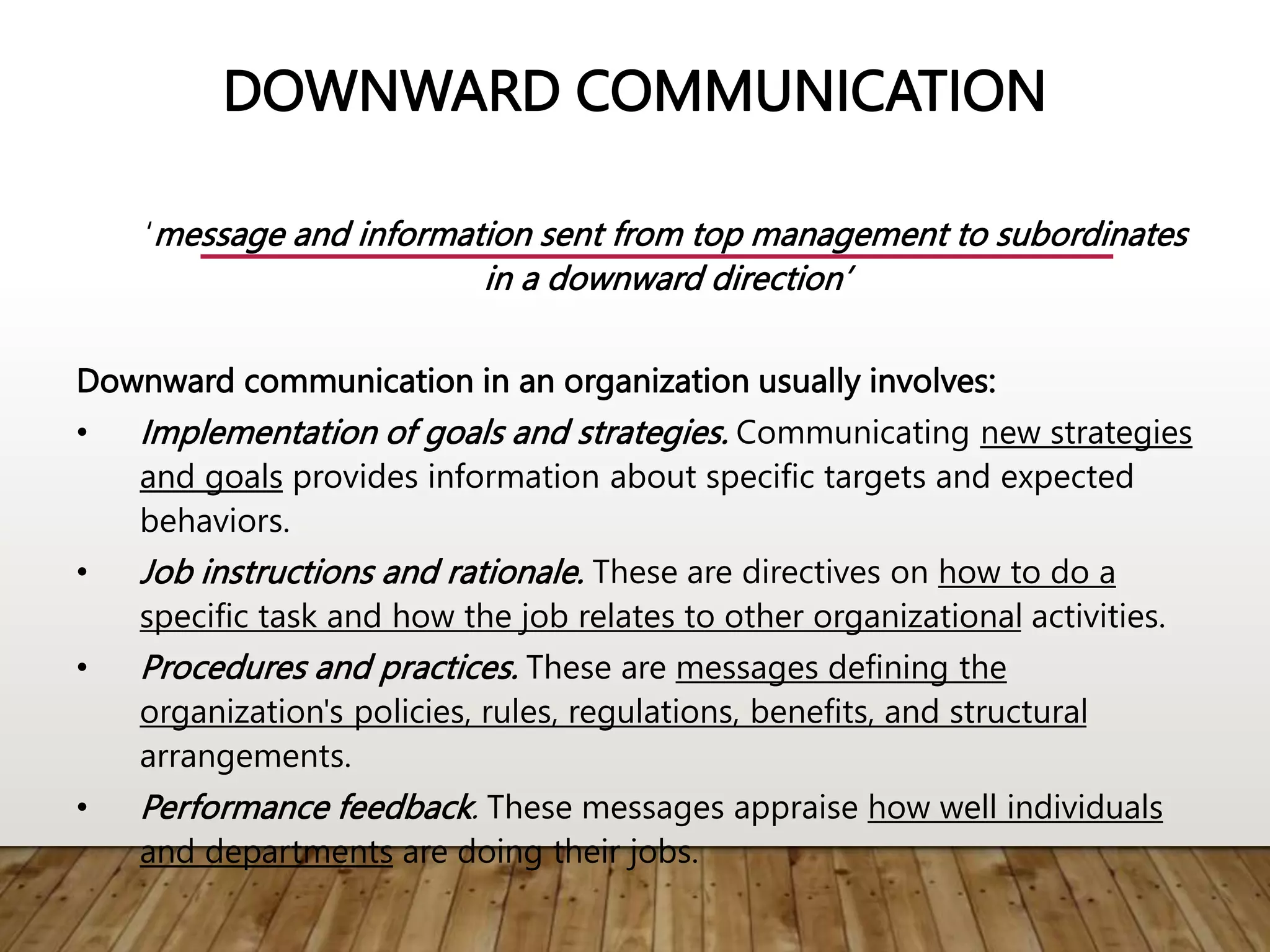
DOWNWARD COMMUNICATION
‘message and information sent from top management to subordinates
in a downward direction’
Downward communication in an organization usually involves:
• Implementation of goals and strategies. Communicating new strategies
and goals provides information about specific targets and expected
behaviors.
• Job instructions and rationale. These are directives on how to do a
specific task and how the job relates to other organizational activities.
• Procedures and practices. These are messages defining the
organization's policies, rules, regulations, benefits, and structural
arrangements.
• Performance feedback. These messages appraise how well individuals
and departments are doing their jobs.
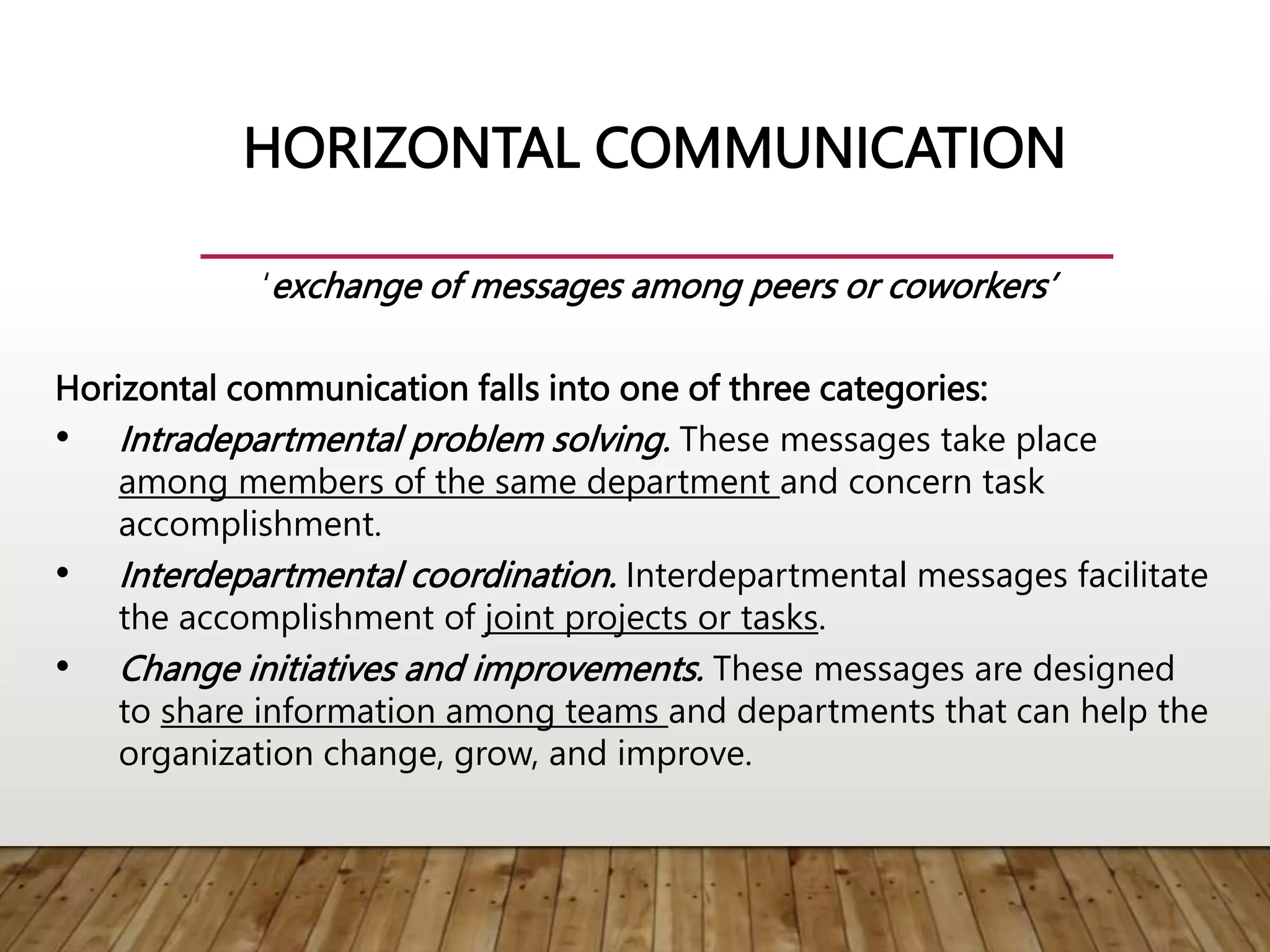
HORIZONTAL COMMUNICATION
‘exchange of messages among peers or coworkers’
Horizontal communication falls into one of three categories:
• Intradepartmental problem solving. These messages take place
among members of the same department and concern task
accomplishment.
• Interdepartmental coordination. Interdepartmental messages facilitate
the accomplishment of joint projects or tasks.
• Change initiatives and improvements. These messages are designed
to share information among teams and departments that can help the
organization change, grow, and improve.
CLASS ACTIVITY
Mark is not satisfied with how his employer, Johnson
Electronics, distributes products to customers. He believes that
the process is inefficient and costs far too much. He has some
ideas as to how the distributing cost could be decreased. Mark
would like to share his ideas with his superiors. Which form of
communication is best suited for such a situation? Discuss.
THANK YOU

Communication in Organization Slide.pptx

  • 1.
  • 2.
    OBJECTIVES • Define thenature and function of communication. • Understand the communication process. • Differentiate between 3 formal communication channels in organization
  • 3.
    RECAP: COMMUNICATION • Communicationthus can be defined as the process by which information is exchanged and understood by two or more people, usually with the intent to motivate or influence behavior. • Communication is not just sending information, communication is a two-way street that includes listening and other forms of feedback.
  • 4.
    THE COMMUNICATION PROCESS MessageEncoding Medium Decoding Decoding Medium Encoding Message Receiver (now sender) Sender Transmission Phase Feedback Phase NOISE https://youtu.be/V1RQG1nB4Kg
  • 5.
    ELEMENTS IN COMMUNICATION PROCESS •The sender is anyone who wishes to convey an idea or concept to others, to seek information, or to express a thought or emotion. • The receiver is the person to whom the message is sent. • The message is the tangible formulation of the idea/information that is sent to the receiver through channel. • The sender encodes the idea by selecting symbols with which to compose a message.
  • 6.
    • The mediumis a channel of communication; report, a telephone call or e-mail message, or a face-to-face meeting. • The receiver decodes the symbols to interpret the meaning of the message. • Noise is a potential sources for communication errors, • Feedback occurs when the receiver responds to the sender's communication with a return message. Without feedback, the communication is one-way; with feedback, it is two-way.
  • 7.
    Message Encoding MediumDecoding Decoding Medium Encoding Message Receiver (now sender) Sender Transmission Phase Feedback Phase NOISE
  • 8.
  • 9.
    UPWARD COMMUNICATION ‘messages thatflow from the lower to the higher levels in the organization’s hierarchy’ Five types of information communicated upward: • Problems and exceptions. These messages describe serious problems with and exceptions to routine performance in order to make senior manager-aware of difficulties. • Suggestions for improvement. These messages are ideas for improving task related procedures to increase quality or efficiency. • Performance reports. These messages include periodic reports that inform management how individuals and departments are performing. • Grievance (complaint) and dispute (argument). These messages are employee complaints and conflicts that travel up the hierarchy for a hearing and possible resolution. • Financial and accounting information. These messages pertain to costs, accounts receivable, sales volume, anticipated profits, return on investment, and other matters of interest to senior managers.
  • 10.
    DOWNWARD COMMUNICATION ‘message andinformation sent from top management to subordinates in a downward direction’ Downward communication in an organization usually involves: • Implementation of goals and strategies. Communicating new strategies and goals provides information about specific targets and expected behaviors. • Job instructions and rationale. These are directives on how to do a specific task and how the job relates to other organizational activities. • Procedures and practices. These are messages defining the organization's policies, rules, regulations, benefits, and structural arrangements. • Performance feedback. These messages appraise how well individuals and departments are doing their jobs.
  • 11.
    HORIZONTAL COMMUNICATION ‘exchange ofmessages among peers or coworkers’ Horizontal communication falls into one of three categories: • Intradepartmental problem solving. These messages take place among members of the same department and concern task accomplishment. • Interdepartmental coordination. Interdepartmental messages facilitate the accomplishment of joint projects or tasks. • Change initiatives and improvements. These messages are designed to share information among teams and departments that can help the organization change, grow, and improve.
  • 12.
    CLASS ACTIVITY Mark isnot satisfied with how his employer, Johnson Electronics, distributes products to customers. He believes that the process is inefficient and costs far too much. He has some ideas as to how the distributing cost could be decreased. Mark would like to share his ideas with his superiors. Which form of communication is best suited for such a situation? Discuss.
  • 13.