Communication Skills for Managers Dr. Ravi Shanker Communication Process
Communication Process
Objectives Discuss the basic purpose of communication Describe a basic model for communication Explain the communication hierarchy Explain various barriers to communication and suggest ways to overcome them
Changes Affecting the Workplace Heightened global competition Flattened management hierarchies Expanded team-based management Innovative communication technologies New work environments Increasingly diverse workforce Success in the new workplace requires excellent communication skills.
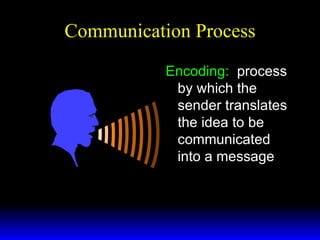
Communication Process Encoding:  process by which the sender translates the idea to be communicated into a message
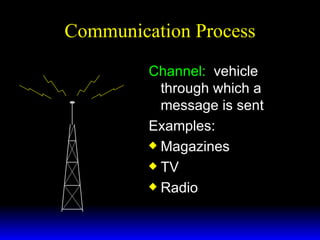
Communication Process Channel:  vehicle through which a message is sent Examples: Magazines TV Radio
Decoding:  process where receiver interprets the message Communication Process
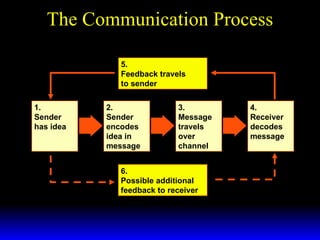
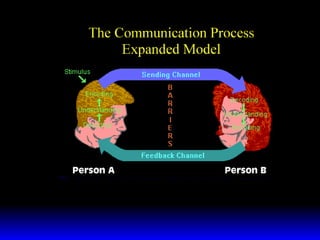
The Communication Process CLAUDE SHANNON MODEL-1948 1. Sender has idea THE PROCESS OF COMMUNICATION STARTS IN THE MIND OF THE SENDER
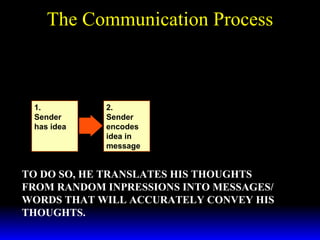
The Communication Process 2. Sender encodes idea in message 1. Sender has idea TO DO SO, HE TRANSLATES HIS THOUGHTS FROM RANDOM INPRESSIONS INTO MESSAGES/ WORDS THAT WILL ACCURATELY CONVEY HIS THOUGHTS.
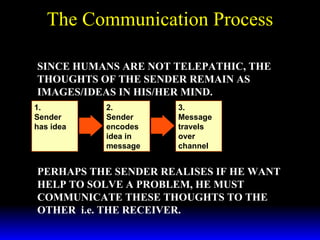
The Communication Process 2. Sender encodes idea in message 3. Message travels over channel 1. Sender has idea SINCE HUMANS ARE NOT TELEPATHIC, THE THOUGHTS OF THE SENDER REMAIN AS IMAGES/IDEAS IN HIS/HER MIND. PERHAPS THE SENDER REALISES IF HE WANT HELP TO SOLVE A PROBLEM, HE MUST COMMUNICATE THESE THOUGHTS TO THE OTHER  i.e. THE RECEIVER.
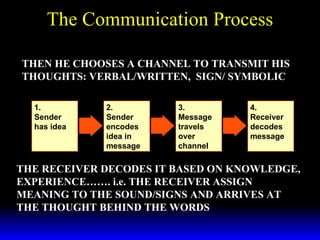
The Communication Process 2. Sender encodes idea in message 3. Message travels over channel 1. Sender has idea 4. Receiver decodes message THEN HE CHOOSES A CHANNEL TO TRANSMIT HIS THOUGHTS: VERBAL/WRITTEN,  SIGN/ SYMBOLIC THE RECEIVER DECODES IT BASED ON KNOWLEDGE, EXPERIENCE……. i.e. THE RECEIVER ASSIGN MEANING TO THE SOUND/SIGNS AND ARRIVES AT THE THOUGHT BEHIND THE WORDS
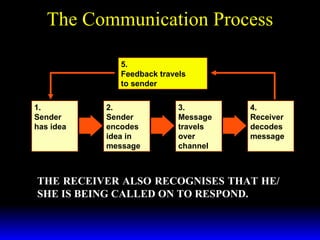
The Communication Process 2. Sender encodes idea in message 3. Message travels over channel 1. Sender has idea 4. Receiver decodes message 5. Feedback travels to sender THE RECEIVER ALSO RECOGNISES THAT HE/SHE IS BEING CALLED ON TO RESPOND.
The Communication Process 2. Sender encodes idea in message 3. Message travels over channel 1. Sender has idea 4. Receiver decodes message 6. Possible additional feedback to receiver 5. Feedback travels to sender
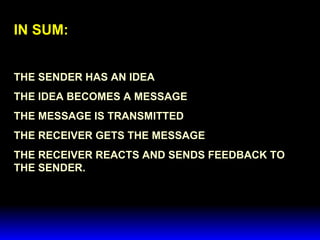
IN SUM: THE SENDER HAS AN IDEA THE IDEA BECOMES A MESSAGE THE MESSAGE IS TRANSMITTED THE RECEIVER GETS THE MESSAGE THE RECEIVER REACTS AND SENDS FEEDBACK TO THE SENDER.
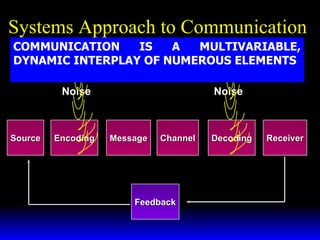
Systems Approach to Communication  Source Encoding Message Channel Decoding Receiver COMMUNICATION IS A MULTIVARIABLE, DYNAMIC INTERPLAY OF NUMEROUS ELEMENTS Feedback Noise Noise
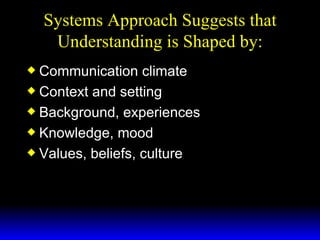
Communication climate Context and setting Background, experiences Knowledge, mood Values, beliefs, culture Systems Approach Suggests that Understanding is Shaped by:
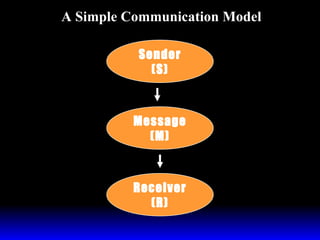
A Simple Communication Model Sender (S) Message (M) Receiver (R)
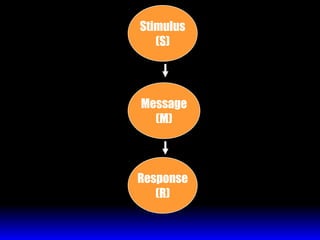
Stimulus (S) Message (M) Response (R)
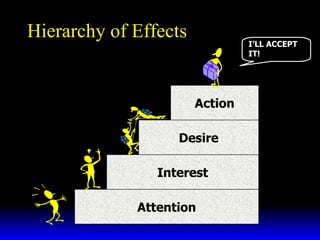
Hierarchy of Effects Attention Desire Interest I’LL ACCEPT  IT! Action
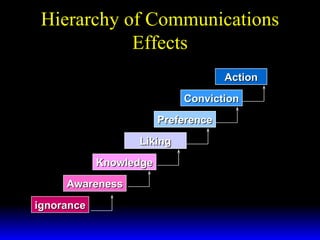
Hierarchy of Communications Effects ignorance Awareness Knowledge Liking  Preference Conviction Action
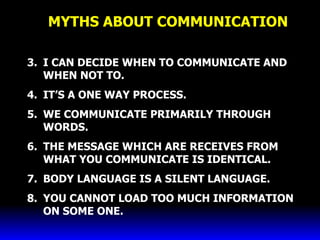
MYTHS ABOUT COMMUNICATION I CAN DECIDE WHEN TO COMMUNICATE AND WHEN NOT TO. IT’S A ONE WAY PROCESS. WE COMMUNICATE PRIMARILY THROUGH WORDS. THE MESSAGE WHICH ARE RECEIVES FROM WHAT YOU COMMUNICATE IS IDENTICAL. BODY LANGUAGE IS A SILENT LANGUAGE. YOU CANNOT LOAD TOO MUCH INFORMATION ON SOME ONE.
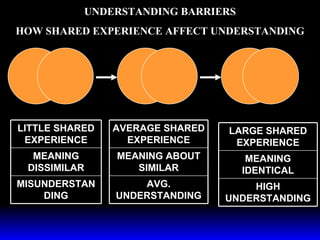
UNDERSTANDING BARRIERS HOW SHARED EXPERIENCE AFFECT UNDERSTANDING LITTLE SHARED EXPERIENCE MEANING DISSIMILAR MISUNDERSTANDING AVERAGE SHARED EXPERIENCE MEANING ABOUT SIMILAR AVG. UNDERSTANDING LARGE SHARED EXPERIENCE MEANING IDENTICAL HIGH UNDERSTANDING
 
MIS-COMMUNICATION  IN COMMUNICATION
Message Distortion Downward Communication Through Five Levels of Management Message   Amount of message  written by board of directors 100%
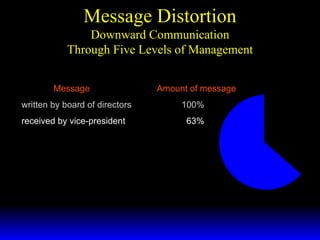
Message Distortion Downward Communication Through Five Levels of Management Message   Amount of message written by board of directors 100% received by vice-president   63%
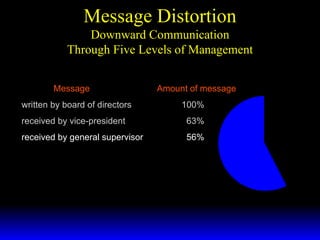
Message Distortion Downward Communication Through Five Levels of Management Message   Amount of message written by board of directors 100% received by vice-president   63% received by general supervisor   56%
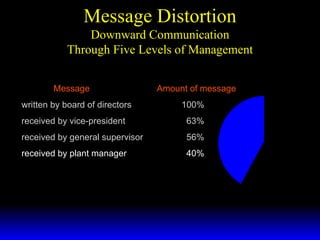
Message Distortion Downward Communication Through Five Levels of Management Message   Amount of message written by board of directors 100% received by vice-president   63% received by general supervisor   56% received by plant manager   40%
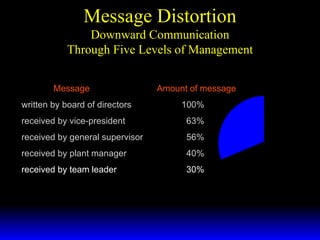
Message Distortion Downward Communication Through Five Levels of Management Message   Amount of message written by board of directors 100% received by vice-president   63% received by general supervisor   56% received by plant manager   40% received by team leader   30%
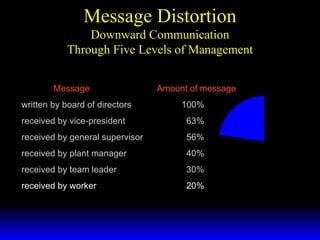
Message Distortion Downward Communication Through Five Levels of Management Message   Amount of message written by board of directors 100% received by vice-president   63% received by general supervisor   56% received by plant manager   40% received by team leader   30% received by worker   20%
MEANING ORGANISATIONAL INTERPERSONAL INDIVIDUAL ECO, GEO MEDIA & CHANNEL TECHNOLOGICAL EMOTIONAL LANGUAGE Barriers to Communication
TENDENCY TO BE JUDGEMENTAL & TO TAKE MENTAL EXCURSIONS LACK OF INTEREST BIAS, PREJUDICE APPEARANCE & PERSONALITY INDIVIDUAL DIFFERENCES KNOWLEDGE PERCEPTION CULTURE NOISE & DISTRACTIONS Barriers to Communication
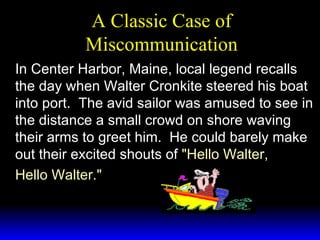
A Classic Case of Miscommunication In Center Harbor, Maine, local legend recalls the day when Walter Cronkite steered his boat into port.  The avid sailor was amused to see in the distance a small crowd on shore waving their arms to greet him.  He could barely make out their excited shouts of  "Hello Walter, Hello Walter."
As his boat sailed closer, the crowd grew larger, still yelling, "Hello Walter, Hello Walter."  Pleased at the reception, Cronkite tipped his white captain's hat, waved back, even took a bow.  But before reaching dockside, Cronkite's boat abruptly jammed aground.  The crowd stood silent.  The veteran news anchor suddenly realized what they'd been shouting:  "Low water, low water."
Analysis of Communication Process
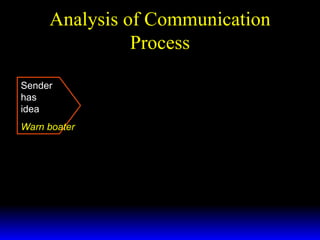
Analysis of Communication Process Sender  has  idea Warn boater
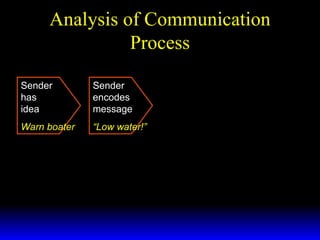
Analysis of Communication Process Sender  has  idea Warn boater Sender encodes message “ Low water!”
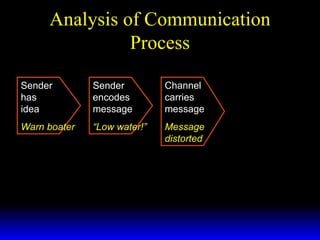
Analysis of Communication Process Sender  has  idea Warn boater Sender encodes message “ Low water!” Channel carries message Message distorted
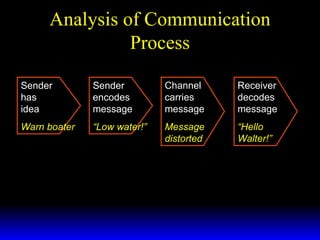
Analysis of Communication Process Sender  has  idea Warn boater Sender encodes message “ Low water!” Channel carries message Message distorted Receiver decodes message “ Hello Walter!”
Frame of reference Receiver accustomed to acclaim and  appreciative crowds. Language skills   Maine accent makes "water" and "Walter"  sound similar. Listening skills   Receiver more accustomed to speaking  than to listening. Emotional interference Ego prompted receiver to believe crowd  was responding to his celebrity status. Physical barriers Noise from boat, distance between  senders and receivers. Which of these barriers could be overcome through improved communication skills? What barriers helped create the miscommunication here?
Additional Communication Barriers  Fear of reprisal for honest communication Differing frames of reference among communicators Lack of communication skills Ego involvement Turf wars
Barriers to Interpersonal  Communication Bypassing Limited frame of reference Lack of language skills Lack of listening skills Emotional interference Physical distractions
Barriers That Block the Flow of Information in Organizations Closed communication climate Top-heavy organizational structure Long Lines of communication Lack of trust between management and employees Competition for power, status, rewards
Overcoming Communication Barriers Realize that communication is imperfect. Adapt the message to the receiver. Improve your language and listening skills. Question your preconceptions. Plan for feedback.
Organizational Communication Functions:  internal and external Form:  oral and written Form:  channel selection dependent on  Message content Need for immediate response Audience size and distance Audience reaction Need to show empathy, friendliness, formality Flow: Formal:  down, up, horizontal Informal:  grapevine
Surmounting Organizational Barriers Encourage open environment for interaction and feedback. Flatten the organizational structure. Promote horizontal communication. Provide hotline for anonymous feedback.  Provide sufficient information through formal channels.
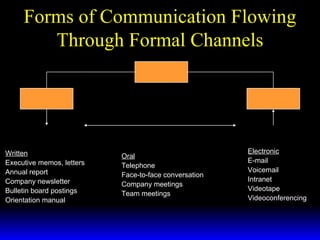
Forms of Communication Flowing Through Formal Channels Written Executive memos, letters Annual report Company newsletter Bulletin board postings Orientation manual Electronic E-mail Voicemail Intranet Videotape  Videoconferencing Oral Telephone Face-to-face conversation Company meetings Team meetings
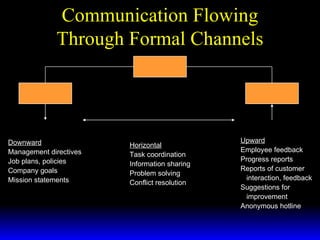
Communication Flowing Through Formal Channels Downward Management directives Job plans, policies Company goals Mission statements Upward Employee feedback Progress reports Reports of customer interaction, feedback Suggestions for  improvement Anonymous hotline Horizontal Task coordination Information sharing Problem solving Conflict resolution
UPWARD CHANNELS: (TYPES OF INFORMATION) WHAT THE EMPLYEE HAS DONE WHAT THOSE UNDER THE EMPLOYEE HAVE DONE WHAT THE EMPPLOYEE’S PEERS HAVE DONE WHAT THE EMPLOYEE’S PROBLEMS ARE, AND THAT OF HIS DEPARTMENT WHAT HE THINKS NEEDS TO BE DONE HIS PERCEPTIONS OF JOB PERFORMANCE WHAT ORGANISATIONAL POLICIES & PRACTICES  NEEDS ADJUSTING
DOWNWORDC CHANNELS: (TYPES OF COMMUNICATION) JOB INSTRUCTIONS JOB RATIONALE POLICY & PROCEDURES FEED BACK INDOCTRINATION SOURCE: KATZ & KAHN, THE SOCIAL PSYCHOLOGY OF ORGANISATIONS
HORIZONTAL CHANNELS: (MAJOR PURPOSES) TASK COORDINATION  PROBLEM SOLVING SHARING INFORMATION CONFLICT RESOLUTION
Tools for Doing the Right Thing Is the action you are considering legal? How would you see the problem if you were on the other side? What alternate solutions are available? Can you discuss the problem with someone you trust? How would you feel if your family, friends, employer, or co-workers learned of your action?
Five Common Ethical Traps The false-necessity trap (convincing yourself that no other choice exists) The doctrine-of-relative-filth trap (comparing your unethical behavior with someone else’s  even more unethical behavior) The rationalization trap (justifying unethical actions with excuses) The self-deception trap (persuading yourself, for example, that a lie is not really a lie) The ends-justify-the-means trap (using unethical methods to accomplish a desirable goal)
REVIEW Discuss the basic purpose of communication Describe a basic model for communication Explain the communication hierarchy Explain various barriers to communication and suggest ways to overcome them

communication process

  • 1.
    Communication Skills forManagers Dr. Ravi Shanker Communication Process
  • 2.
  • 3.
    Objectives Discuss thebasic purpose of communication Describe a basic model for communication Explain the communication hierarchy Explain various barriers to communication and suggest ways to overcome them
  • 4.
    Changes Affecting theWorkplace Heightened global competition Flattened management hierarchies Expanded team-based management Innovative communication technologies New work environments Increasingly diverse workforce Success in the new workplace requires excellent communication skills.
  • 5.
    Communication Process Encoding: process by which the sender translates the idea to be communicated into a message
  • 6.
    Communication Process Channel: vehicle through which a message is sent Examples: Magazines TV Radio
  • 7.
    Decoding: processwhere receiver interprets the message Communication Process
  • 8.
    The Communication ProcessCLAUDE SHANNON MODEL-1948 1. Sender has idea THE PROCESS OF COMMUNICATION STARTS IN THE MIND OF THE SENDER
  • 9.
    The Communication Process2. Sender encodes idea in message 1. Sender has idea TO DO SO, HE TRANSLATES HIS THOUGHTS FROM RANDOM INPRESSIONS INTO MESSAGES/ WORDS THAT WILL ACCURATELY CONVEY HIS THOUGHTS.
  • 10.
    The Communication Process2. Sender encodes idea in message 3. Message travels over channel 1. Sender has idea SINCE HUMANS ARE NOT TELEPATHIC, THE THOUGHTS OF THE SENDER REMAIN AS IMAGES/IDEAS IN HIS/HER MIND. PERHAPS THE SENDER REALISES IF HE WANT HELP TO SOLVE A PROBLEM, HE MUST COMMUNICATE THESE THOUGHTS TO THE OTHER i.e. THE RECEIVER.
  • 11.
    The Communication Process2. Sender encodes idea in message 3. Message travels over channel 1. Sender has idea 4. Receiver decodes message THEN HE CHOOSES A CHANNEL TO TRANSMIT HIS THOUGHTS: VERBAL/WRITTEN, SIGN/ SYMBOLIC THE RECEIVER DECODES IT BASED ON KNOWLEDGE, EXPERIENCE……. i.e. THE RECEIVER ASSIGN MEANING TO THE SOUND/SIGNS AND ARRIVES AT THE THOUGHT BEHIND THE WORDS
  • 12.
    The Communication Process2. Sender encodes idea in message 3. Message travels over channel 1. Sender has idea 4. Receiver decodes message 5. Feedback travels to sender THE RECEIVER ALSO RECOGNISES THAT HE/SHE IS BEING CALLED ON TO RESPOND.
  • 13.
    The Communication Process2. Sender encodes idea in message 3. Message travels over channel 1. Sender has idea 4. Receiver decodes message 6. Possible additional feedback to receiver 5. Feedback travels to sender
  • 14.
    IN SUM: THESENDER HAS AN IDEA THE IDEA BECOMES A MESSAGE THE MESSAGE IS TRANSMITTED THE RECEIVER GETS THE MESSAGE THE RECEIVER REACTS AND SENDS FEEDBACK TO THE SENDER.
  • 15.
    Systems Approach toCommunication Source Encoding Message Channel Decoding Receiver COMMUNICATION IS A MULTIVARIABLE, DYNAMIC INTERPLAY OF NUMEROUS ELEMENTS Feedback Noise Noise
  • 16.
    Communication climate Contextand setting Background, experiences Knowledge, mood Values, beliefs, culture Systems Approach Suggests that Understanding is Shaped by:
  • 17.
    A Simple CommunicationModel Sender (S) Message (M) Receiver (R)
  • 18.
    Stimulus (S) Message(M) Response (R)
  • 19.
    Hierarchy of EffectsAttention Desire Interest I’LL ACCEPT IT! Action
  • 20.
    Hierarchy of CommunicationsEffects ignorance Awareness Knowledge Liking Preference Conviction Action
  • 21.
    MYTHS ABOUT COMMUNICATIONI CAN DECIDE WHEN TO COMMUNICATE AND WHEN NOT TO. IT’S A ONE WAY PROCESS. WE COMMUNICATE PRIMARILY THROUGH WORDS. THE MESSAGE WHICH ARE RECEIVES FROM WHAT YOU COMMUNICATE IS IDENTICAL. BODY LANGUAGE IS A SILENT LANGUAGE. YOU CANNOT LOAD TOO MUCH INFORMATION ON SOME ONE.
  • 22.
    UNDERSTANDING BARRIERS HOWSHARED EXPERIENCE AFFECT UNDERSTANDING LITTLE SHARED EXPERIENCE MEANING DISSIMILAR MISUNDERSTANDING AVERAGE SHARED EXPERIENCE MEANING ABOUT SIMILAR AVG. UNDERSTANDING LARGE SHARED EXPERIENCE MEANING IDENTICAL HIGH UNDERSTANDING
  • 23.
  • 24.
    MIS-COMMUNICATION INCOMMUNICATION
  • 25.
    Message Distortion DownwardCommunication Through Five Levels of Management Message Amount of message written by board of directors 100%
  • 26.
    Message Distortion DownwardCommunication Through Five Levels of Management Message Amount of message written by board of directors 100% received by vice-president 63%
  • 27.
    Message Distortion DownwardCommunication Through Five Levels of Management Message Amount of message written by board of directors 100% received by vice-president 63% received by general supervisor 56%
  • 28.
    Message Distortion DownwardCommunication Through Five Levels of Management Message Amount of message written by board of directors 100% received by vice-president 63% received by general supervisor 56% received by plant manager 40%
  • 29.
    Message Distortion DownwardCommunication Through Five Levels of Management Message Amount of message written by board of directors 100% received by vice-president 63% received by general supervisor 56% received by plant manager 40% received by team leader 30%
  • 30.
    Message Distortion DownwardCommunication Through Five Levels of Management Message Amount of message written by board of directors 100% received by vice-president 63% received by general supervisor 56% received by plant manager 40% received by team leader 30% received by worker 20%
  • 31.
    MEANING ORGANISATIONAL INTERPERSONALINDIVIDUAL ECO, GEO MEDIA & CHANNEL TECHNOLOGICAL EMOTIONAL LANGUAGE Barriers to Communication
  • 32.
    TENDENCY TO BEJUDGEMENTAL & TO TAKE MENTAL EXCURSIONS LACK OF INTEREST BIAS, PREJUDICE APPEARANCE & PERSONALITY INDIVIDUAL DIFFERENCES KNOWLEDGE PERCEPTION CULTURE NOISE & DISTRACTIONS Barriers to Communication
  • 33.
    A Classic Caseof Miscommunication In Center Harbor, Maine, local legend recalls the day when Walter Cronkite steered his boat into port. The avid sailor was amused to see in the distance a small crowd on shore waving their arms to greet him. He could barely make out their excited shouts of "Hello Walter, Hello Walter."
  • 34.
    As his boatsailed closer, the crowd grew larger, still yelling, "Hello Walter, Hello Walter." Pleased at the reception, Cronkite tipped his white captain's hat, waved back, even took a bow. But before reaching dockside, Cronkite's boat abruptly jammed aground. The crowd stood silent. The veteran news anchor suddenly realized what they'd been shouting: "Low water, low water."
  • 35.
  • 36.
    Analysis of CommunicationProcess Sender has idea Warn boater
  • 37.
    Analysis of CommunicationProcess Sender has idea Warn boater Sender encodes message “ Low water!”
  • 38.
    Analysis of CommunicationProcess Sender has idea Warn boater Sender encodes message “ Low water!” Channel carries message Message distorted
  • 39.
    Analysis of CommunicationProcess Sender has idea Warn boater Sender encodes message “ Low water!” Channel carries message Message distorted Receiver decodes message “ Hello Walter!”
  • 40.
    Frame of referenceReceiver accustomed to acclaim and appreciative crowds. Language skills Maine accent makes "water" and "Walter" sound similar. Listening skills Receiver more accustomed to speaking than to listening. Emotional interference Ego prompted receiver to believe crowd was responding to his celebrity status. Physical barriers Noise from boat, distance between senders and receivers. Which of these barriers could be overcome through improved communication skills? What barriers helped create the miscommunication here?
  • 41.
    Additional Communication Barriers Fear of reprisal for honest communication Differing frames of reference among communicators Lack of communication skills Ego involvement Turf wars
  • 42.
    Barriers to Interpersonal Communication Bypassing Limited frame of reference Lack of language skills Lack of listening skills Emotional interference Physical distractions
  • 43.
    Barriers That Blockthe Flow of Information in Organizations Closed communication climate Top-heavy organizational structure Long Lines of communication Lack of trust between management and employees Competition for power, status, rewards
  • 44.
    Overcoming Communication BarriersRealize that communication is imperfect. Adapt the message to the receiver. Improve your language and listening skills. Question your preconceptions. Plan for feedback.
  • 45.
    Organizational Communication Functions: internal and external Form: oral and written Form: channel selection dependent on Message content Need for immediate response Audience size and distance Audience reaction Need to show empathy, friendliness, formality Flow: Formal: down, up, horizontal Informal: grapevine
  • 46.
    Surmounting Organizational BarriersEncourage open environment for interaction and feedback. Flatten the organizational structure. Promote horizontal communication. Provide hotline for anonymous feedback. Provide sufficient information through formal channels.
  • 47.
    Forms of CommunicationFlowing Through Formal Channels Written Executive memos, letters Annual report Company newsletter Bulletin board postings Orientation manual Electronic E-mail Voicemail Intranet Videotape Videoconferencing Oral Telephone Face-to-face conversation Company meetings Team meetings
  • 48.
    Communication Flowing ThroughFormal Channels Downward Management directives Job plans, policies Company goals Mission statements Upward Employee feedback Progress reports Reports of customer interaction, feedback Suggestions for improvement Anonymous hotline Horizontal Task coordination Information sharing Problem solving Conflict resolution
  • 49.
    UPWARD CHANNELS: (TYPESOF INFORMATION) WHAT THE EMPLYEE HAS DONE WHAT THOSE UNDER THE EMPLOYEE HAVE DONE WHAT THE EMPPLOYEE’S PEERS HAVE DONE WHAT THE EMPLOYEE’S PROBLEMS ARE, AND THAT OF HIS DEPARTMENT WHAT HE THINKS NEEDS TO BE DONE HIS PERCEPTIONS OF JOB PERFORMANCE WHAT ORGANISATIONAL POLICIES & PRACTICES NEEDS ADJUSTING
  • 50.
    DOWNWORDC CHANNELS: (TYPESOF COMMUNICATION) JOB INSTRUCTIONS JOB RATIONALE POLICY & PROCEDURES FEED BACK INDOCTRINATION SOURCE: KATZ & KAHN, THE SOCIAL PSYCHOLOGY OF ORGANISATIONS
  • 51.
    HORIZONTAL CHANNELS: (MAJORPURPOSES) TASK COORDINATION PROBLEM SOLVING SHARING INFORMATION CONFLICT RESOLUTION
  • 52.
    Tools for Doingthe Right Thing Is the action you are considering legal? How would you see the problem if you were on the other side? What alternate solutions are available? Can you discuss the problem with someone you trust? How would you feel if your family, friends, employer, or co-workers learned of your action?
  • 53.
    Five Common EthicalTraps The false-necessity trap (convincing yourself that no other choice exists) The doctrine-of-relative-filth trap (comparing your unethical behavior with someone else’s even more unethical behavior) The rationalization trap (justifying unethical actions with excuses) The self-deception trap (persuading yourself, for example, that a lie is not really a lie) The ends-justify-the-means trap (using unethical methods to accomplish a desirable goal)
  • 54.
    REVIEW Discuss thebasic purpose of communication Describe a basic model for communication Explain the communication hierarchy Explain various barriers to communication and suggest ways to overcome them