LEVELS OF
COMMUNICATION
Dr.Smitha K.P.
Assistant Professor
Dept of Agrl Extension
College of Agriculture
Vellayani
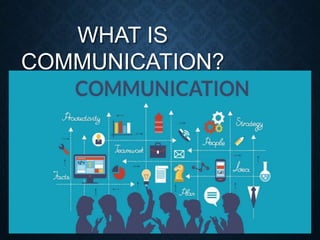
WHAT IS
COMMUNICATION?
LEVELS OF
COMMUNICATION
HUMAN COMMUNICATION TAKES PLACE AT
VARIOUS LEVELS:
1. Intrapersonal Communication
2. Interpersonal Communication
3. Group Communication
4. Public Communication
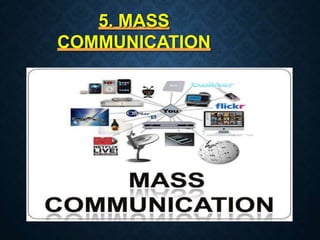
5. Mass Communication
6. Extra personal Communication
7. Organizational communication
1. INTRAPERSONAL
COMMUNICATION
⚫Intrapersonal level of communication is the
communication with the own self.
⚫It take place within an individual.
⚫Intrapersonal communication where a person is
sending message and the same person receives
them.
⚫Intrapersonal communication is a method of
communication that helps every person to
communicate with himself or herself.
⚫It helps in clarifying what is known as
self-concept
⚫It is basically an inward-looking exercise.
⚫It can also be understood as self-talk.
⚫Intrapersonal communication is an act of
imagination and visualization , and even recall and
memory.
o The communication within yourself.
o The sound of your thinking
o The little voice from within
o Self Concept; Self Awareness
o This the level where your self concept is
formed.
Examples:
âš« Thinking
âš« Self-talk
⚫Day dreaming
⚫Communication between body parts
⚫Making gesture while thinking
Thinking Daydreaming
Self-talk
2. INTERPERSONAL
COMMUNICATION
⚫Interpersonal communication is the by which
people exchange information, feelings, and
meaning through verbal and non-verbal messages.
⚫It is sending and receiving of messages between
two or more number of people.
⚫It can be formal and informal.
INTERPERSONAL
COMMUNICATION
⚫Usually it is purely oral communication.
⚫It is face-to-face communication.
• This level of communication usually involves
two people.
• Getting to know someone personally.
ELEMENTS OF INTERPERSONAL
COMMUNICATION
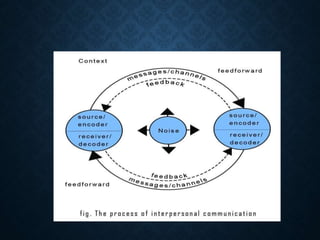
⚫Sender and Receiver
⚫Message
⚫Feedback
⚫Chanel
⚫Noise
⚫Context
SKILLS OF INTERPERSONAL
COMMUNICATION
⚫Listening Skill
⚫Communication Skill
⚫Verbal communication
⚫Non-verbal communication
⚫Persuading etc..
Examples:
⚫Talking with friend and family members
⚫Writing an email
⚫Giving a presentation
⚫Chatting/ calling
⚫Negotiations
⚫Facing an interview
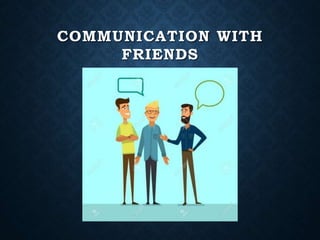
COMMUNICATION WITH
FRIENDS
GIVING
PRESENTATION
GROUP COMMUNICATION
An extension of interpersonal
communication where more than two individuals
are involved in exchange of ideas, skills and
interests.
A group is a number of people with a common
goal who interact with one another to accomplish
their goals, recognize one another’s existence
and see themselves as part of the group.
Groups provide an opportunity for people to
come together to discuss and exchange views of
GROUP COMMUNICATION
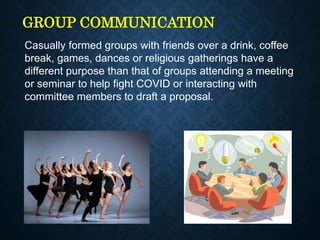
Casually formed groups with friends over a drink, coffee
break, games, dances or religious gatherings have a
different purpose than that of groups attending a meeting
or seminar to help fight COVID or interacting with
committee members to draft a proposal.
GROUP COMMUNICATION
Communication in a group, small or big, serves many
goals including collective decision-making, self-
expression, increasing one’s effect, elevating one’s status
and relaxation.
Group communication is considered effective :
• It provides an opportunity for direct interaction among
the members of the group;
• it helps in bringing about changes in attitudes and
beliefs.
Group communication has limitations too :
• It is time consuming and often inefficient, especially in
an emergency.
• Imbalances in status, skills and goals, may distort the
GROUP COMMUNICATION
A small group comprises of three to seven members.
Small groups are informal and less structured.
Larger groups adopt formal rules to maintain order.
There is more chance for individual participation in small
groups.
Small groups are easy to manage and are more efficient
in accomplishing tasks and making decisions.
Most researchers define a small group as having at least
three and no more than twelve or fifteen members.
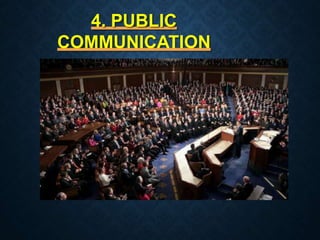
4. PUBLIC
COMMUNICATION
4. PUBLIC
COMMUNICATION
Public communication happens when individuals
and groups engage in dialogue in the public sphere
in order to deliver a message to a specific
audience.
Public speaking events, newspaper editorials and
billboard advertisements are a few forms of public
communication.
Public communication takes place when people
gather in a group too large for everyone to talk and
participate.
4. PUBLIC
COMMUNICATION
In Public Communication The speeches you deliver fall
into three general categories:
to inform, to persuade, and to entertain.
Sometimes you may want to share information and
create a clear understanding with an audience.
Other times you may want your audience to change
their attitude and/or follow a different course of action
5. MASS
COMMUNICATION
⚫Mass communication is the communication with
the large crowd.
⚫Mass communication is a process in which a
person, group of people,or an organization
sends a message through a channel of
communication to a large group of people and
organizations.
⚫The process whereby media organizations produce
and transmit messages to large publics and
the process by which those messages are
sought , used, understood, and Influenced by
audience.
⚫It is the high objective form of communication.
Examples:
⚫News paper
⚫Press conference
⚫Media interview
⚫Films
⚫Advertisement
⚫Social media
6. EXTRA PERSONAL
COMMUNICATION
⚫Extrapersonal communication is theway of
communicationin which a human interacts with
other species or non-living objects.
⚫Communication between human beings and
non-human entities is extra personal
communication.
EXAMPLES:
âš« Communication
âš« Communication
with Animal/Birds
with Plant
âš« Communication with Robots/Machines
âš« Talking to wall
âš« Talking to god
âš« Talking to mirror
âš« Shouting at an inanimate objects like telephone
while not working
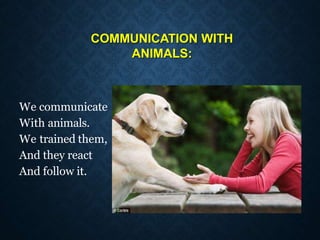
COMMUNICATION WITH
ANIMALS:
We communicate
With animals.
We trained them,
And they react
And follow it.
Talking with Robot Talking with wall
Taking with God shouting at phone
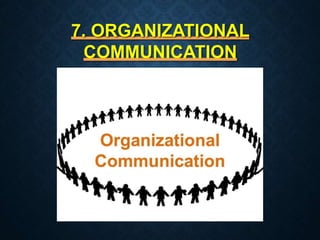
7. ORGANIZATIONAL
COMMUNICATION
ORGANIZATIONAL COMMUNICATIONIS THE
EXCHANGE OF INFORMATION , IDEAS AND
VIEWS WITHIN AND OUTSIDE THE
ORGANIZATION.
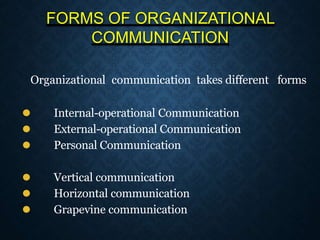
FORMS OF ORGANIZATIONAL
COMMUNICATION
Organizational communication takes different forms
âš« Internal-operational Communication
âš« External-operational Communication
âš« Personal Communication
âš« Vertical communication
âš« Horizontal communication
âš« Grapevine communication
INTERNAL-OPERATIONAL
COMMUNICATION:
âš« Communication that occurs for carrying out
operations of the organization is know as the
internal- operational communication.
⚫Example :Worker , manager , board of director ,
etc…
EXTERNAL-OPERATIONAL
COMMUNICATION:
⚫Communication with the external parties Or
groups is known as External-operational
communication.
⚫It include Customer , Suppliers , government
agencies , general public etc…
PERSONAL COMMUNICATION:
personal information , ideas and feeling rather
than business related information is termed as
personal communication.
âš« Communication that occurs for exchanging
Examples:
⚫Letters
⚫Email
⚫Memo
⚫Report
⚫Meeting
⚫interview
VERTICAL COMMUNICATION
• Flows vertically upwards or downwards through formal channels.
• Upward communication refers to the flow of communication from
a subordinate to a superior whereas downward communication
flows from a superior to a subordinate.
• Application for grant of leave, submission of a progress report,
request for loans etc. are some of the examples of upward
communication.
• Sending notice to employees to attend a meeting, delegating work
to the subordinates, informing them about the company policies,
etc. are some examples of downward communication.
HORIZONTAL COMMUNICATION
• Horizontal or lateral communication takes place between one
division and another.
• It happens among employees of the same cadre
• For example, a production manager may contact the finance
manager to discuss the delivery of raw material or its
purchase.
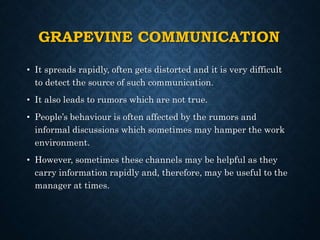
GRAPEVINE COMMUNICATION
• It spreads rapidly, often gets distorted and it is very difficult
to detect the source of such communication.
• It also leads to rumors which are not true.
• People’s behaviour is often affected by the rumors and
informal discussions which sometimes may hamper the work
environment.
• However, sometimes these channels may be helpful as they
carry information rapidly and, therefore, may be useful to the
manager at times.
THANK
YOU

levels of communication.pptx

  • 1.
    LEVELS OF COMMUNICATION Dr.Smitha K.P. AssistantProfessor Dept of Agrl Extension College of Agriculture Vellayani
  • 2.
  • 3.
    LEVELS OF COMMUNICATION HUMAN COMMUNICATIONTAKES PLACE AT VARIOUS LEVELS: 1. Intrapersonal Communication 2. Interpersonal Communication 3. Group Communication 4. Public Communication 5. Mass Communication 6. Extra personal Communication 7. Organizational communication
  • 4.
    1. INTRAPERSONAL COMMUNICATION ⚫Intrapersonal levelof communication is the communication with the own self. ⚫It take place within an individual. ⚫Intrapersonal communication where a person is sending message and the same person receives them.
  • 5.
    ⚫Intrapersonal communication isa method of communication that helps every person to communicate with himself or herself. ⚫It helps in clarifying what is known as self-concept ⚫It is basically an inward-looking exercise.
  • 6.
    ⚫It can alsobe understood as self-talk. ⚫Intrapersonal communication is an act of imagination and visualization , and even recall and memory. o The communication within yourself. o The sound of your thinking o The little voice from within o Self Concept; Self Awareness o This the level where your self concept is formed.
  • 7.
    Examples: ⚫ Thinking ⚫ Self-talk ⚫Daydreaming ⚫Communication between body parts ⚫Making gesture while thinking
  • 8.
  • 9.
  • 10.
    2. INTERPERSONAL COMMUNICATION ⚫Interpersonal communicationis the by which people exchange information, feelings, and meaning through verbal and non-verbal messages. ⚫It is sending and receiving of messages between two or more number of people. ⚫It can be formal and informal.
  • 11.
    INTERPERSONAL COMMUNICATION ⚫Usually it ispurely oral communication. ⚫It is face-to-face communication. • This level of communication usually involves two people. • Getting to know someone personally.
  • 12.
    ELEMENTS OF INTERPERSONAL COMMUNICATION ⚫Senderand Receiver ⚫Message ⚫Feedback ⚫Chanel ⚫Noise ⚫Context
  • 14.
    SKILLS OF INTERPERSONAL COMMUNICATION ⚫ListeningSkill ⚫Communication Skill ⚫Verbal communication ⚫Non-verbal communication ⚫Persuading etc..
  • 15.
    Examples: ⚫Talking with friendand family members ⚫Writing an email ⚫Giving a presentation ⚫Chatting/ calling ⚫Negotiations ⚫Facing an interview
  • 16.
  • 17.
  • 19.
    GROUP COMMUNICATION An extensionof interpersonal communication where more than two individuals are involved in exchange of ideas, skills and interests. A group is a number of people with a common goal who interact with one another to accomplish their goals, recognize one another’s existence and see themselves as part of the group. Groups provide an opportunity for people to come together to discuss and exchange views of
  • 20.
    GROUP COMMUNICATION Casually formedgroups with friends over a drink, coffee break, games, dances or religious gatherings have a different purpose than that of groups attending a meeting or seminar to help fight COVID or interacting with committee members to draft a proposal.
  • 21.
    GROUP COMMUNICATION Communication ina group, small or big, serves many goals including collective decision-making, self- expression, increasing one’s effect, elevating one’s status and relaxation. Group communication is considered effective : • It provides an opportunity for direct interaction among the members of the group; • it helps in bringing about changes in attitudes and beliefs. Group communication has limitations too : • It is time consuming and often inefficient, especially in an emergency. • Imbalances in status, skills and goals, may distort the
  • 22.
    GROUP COMMUNICATION A smallgroup comprises of three to seven members. Small groups are informal and less structured. Larger groups adopt formal rules to maintain order. There is more chance for individual participation in small groups. Small groups are easy to manage and are more efficient in accomplishing tasks and making decisions. Most researchers define a small group as having at least three and no more than twelve or fifteen members.
  • 23.
  • 24.
    4. PUBLIC COMMUNICATION Public communicationhappens when individuals and groups engage in dialogue in the public sphere in order to deliver a message to a specific audience. Public speaking events, newspaper editorials and billboard advertisements are a few forms of public communication. Public communication takes place when people gather in a group too large for everyone to talk and participate.
  • 25.
    4. PUBLIC COMMUNICATION In PublicCommunication The speeches you deliver fall into three general categories: to inform, to persuade, and to entertain. Sometimes you may want to share information and create a clear understanding with an audience. Other times you may want your audience to change their attitude and/or follow a different course of action
  • 26.
  • 27.
    ⚫Mass communication isthe communication with the large crowd. ⚫Mass communication is a process in which a person, group of people,or an organization sends a message through a channel of communication to a large group of people and organizations.
  • 28.
    ⚫The process wherebymedia organizations produce and transmit messages to large publics and the process by which those messages are sought , used, understood, and Influenced by audience. ⚫It is the high objective form of communication.
  • 29.
    Examples: ⚫News paper ⚫Press conference ⚫Mediainterview ⚫Films ⚫Advertisement ⚫Social media
  • 32.
    6. EXTRA PERSONAL COMMUNICATION ⚫Extrapersonalcommunication is theway of communicationin which a human interacts with other species or non-living objects. ⚫Communication between human beings and non-human entities is extra personal communication.
  • 33.
    EXAMPLES: âš« Communication âš« Communication withAnimal/Birds with Plant âš« Communication with Robots/Machines âš« Talking to wall âš« Talking to god âš« Talking to mirror âš« Shouting at an inanimate objects like telephone while not working
  • 34.
    COMMUNICATION WITH ANIMALS: We communicate Withanimals. We trained them, And they react And follow it.
  • 35.
    Talking with RobotTalking with wall
  • 36.
    Taking with Godshouting at phone
  • 37.
  • 38.
    ORGANIZATIONAL COMMUNICATIONIS THE EXCHANGEOF INFORMATION , IDEAS AND VIEWS WITHIN AND OUTSIDE THE ORGANIZATION.
  • 39.
    FORMS OF ORGANIZATIONAL COMMUNICATION Organizationalcommunication takes different forms âš« Internal-operational Communication âš« External-operational Communication âš« Personal Communication âš« Vertical communication âš« Horizontal communication âš« Grapevine communication
  • 40.
    INTERNAL-OPERATIONAL COMMUNICATION: ⚫ Communication thatoccurs for carrying out operations of the organization is know as the internal- operational communication. ⚫Example :Worker , manager , board of director , etc…
  • 41.
    EXTERNAL-OPERATIONAL COMMUNICATION: ⚫Communication with theexternal parties Or groups is known as External-operational communication. ⚫It include Customer , Suppliers , government agencies , general public etc…
  • 42.
    PERSONAL COMMUNICATION: personal information, ideas and feeling rather than business related information is termed as personal communication. âš« Communication that occurs for exchanging
  • 43.
  • 45.
    VERTICAL COMMUNICATION • Flowsvertically upwards or downwards through formal channels. • Upward communication refers to the flow of communication from a subordinate to a superior whereas downward communication flows from a superior to a subordinate. • Application for grant of leave, submission of a progress report, request for loans etc. are some of the examples of upward communication. • Sending notice to employees to attend a meeting, delegating work to the subordinates, informing them about the company policies, etc. are some examples of downward communication.
  • 46.
    HORIZONTAL COMMUNICATION • Horizontalor lateral communication takes place between one division and another. • It happens among employees of the same cadre • For example, a production manager may contact the finance manager to discuss the delivery of raw material or its purchase.
  • 47.
    GRAPEVINE COMMUNICATION • Itspreads rapidly, often gets distorted and it is very difficult to detect the source of such communication. • It also leads to rumors which are not true. • People’s behaviour is often affected by the rumors and informal discussions which sometimes may hamper the work environment. • However, sometimes these channels may be helpful as they carry information rapidly and, therefore, may be useful to the manager at times.
  • 48.