LISTENING
CONTENTS
• Definition
• Process of listening
• Types of listening
• Listening Vs Hearing
• References
• Objective quetions
DEFINITION
Listening is the active process of
receiving and responding to spoken
(and sometimes unspoken)
messages.
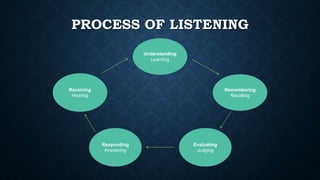
PROCESS OF LISTENING
Understanding
Learning
Evaluating
Judging
Responding
Answering
Remembering
Recalling
Receiving
Hearing
PROCESS OF LISTENING
1. Receiving
It refers to the response caused by sound
waves stimulating the sensory receptors of
the ear.
PROCESS OF LISTENING
2. Understanding
It is the stage at which you learn what the
speaker means
PROCESS OF LISTENING
3. Remembering
It is important listening process because it
means that an individual has not only
received and interpreted a message but has
also added it to the mind's storage bank.
PROCESS OF LISTENING
4. Evaluating
It consists of judging the messages in some
way. At times you may try to evaluate the
speaker’s underlying intentions or motives.
PROCESS OF LISTENING
5. Responding
This stage requires that the receiver
complete the process through verbal and/or
nonverbal feedback.
TYPES OF LISTENING
• Appreciative Listening
• Emphatic Listening
• Comprehensive/Active Listening
• Critical/ Analytical Listening
TYPES OF LISTENING
• Appreciative Listening
listening for pleasure and enjoyment.
- listen to music, to a comedy routine
Describes how well speakers choose and
use words, use humor, ask questions and
tell stories.
TYPES OF LISTENING
• Emphatic Listening
listening to provide emotional support for
the speaker.
focuses on understanding and identifying
with a person’s situation, feelings.
TYPES OF LISTENING
• Active Listening
listening to understand the message of a
speaker.
- as when we attend a classroom
lecture
focuses on accurately understanding the
meaning of the speaker’s words.
TYPES OF LISTENING
• Critical Listening
listening to evaluate a message for
purposes of accepting or rejecting it.
- sales pitch of a used-car dealer
focuses on evaluating whether a message is
logical and reasonable.
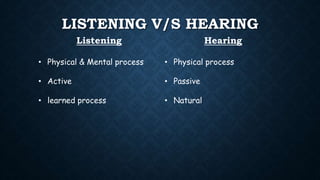
LISTENING V/S HEARING
Hearing
• Physical process
• Passive
• Natural
Listening
• Physical & Mental process
• Active
• learned process
REFERENCES
• Engeleberg, I. N. and John A. Daly. (2013). Think: Public Speaking. USA:
Pearson Education, Inc.
• Lucas, Stephen E. (2009). The Art of Public Speaking. 10th ed. New York:
McGraw-Hill Companies, Inc.
• Pearson, J. et. al. (2008). Human Communication. 3rd ed. New York: McGraw-
Hill Companies, Inc.
• Google.co.in
• Slideshare.net
-http://www.slideshare.net/search/slideshow?searchfrom=header&q=listening
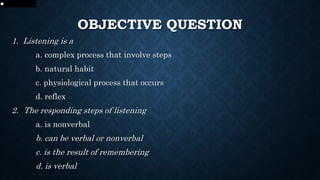
OBJECTIVE QUESTION
1. Listening is a
a. complex process that involve steps
b. natural habit
c. physiological process that occurs
d. reflex
2. The responding steps of listening
a. is nonverbal
b. can be verbal or nonverbal
c. is the result of remembering
d. is verbal
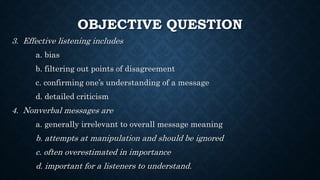
OBJECTIVE QUESTION
3. Effective listening includes
a. bias
b. filtering out points of disagreement
c. confirming one’s understanding of a message
d. detailed criticism
4. Nonverbal messages are
a. generally irrelevant to overall message meaning
b. attempts at manipulation and should be ignored
c. often overestimated in importance
d. important for a listeners to understand.
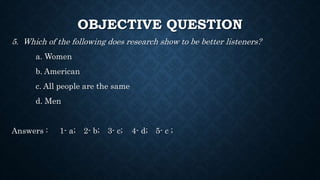
OBJECTIVE QUESTION
5. Which of the following does research show to be better listeners?
a. Women
b. American
c. All people are the same
d. Men
Answers : 1- a; 2- b; 3- c; 4- d; 5- c ;
Listening

Listening

  • 1.
  • 2.
    CONTENTS • Definition • Processof listening • Types of listening • Listening Vs Hearing • References • Objective quetions
  • 3.
    DEFINITION Listening is theactive process of receiving and responding to spoken (and sometimes unspoken) messages.
  • 4.
  • 5.
    PROCESS OF LISTENING 1.Receiving It refers to the response caused by sound waves stimulating the sensory receptors of the ear.
  • 6.
    PROCESS OF LISTENING 2.Understanding It is the stage at which you learn what the speaker means
  • 7.
    PROCESS OF LISTENING 3.Remembering It is important listening process because it means that an individual has not only received and interpreted a message but has also added it to the mind's storage bank.
  • 8.
    PROCESS OF LISTENING 4.Evaluating It consists of judging the messages in some way. At times you may try to evaluate the speaker’s underlying intentions or motives.
  • 9.
    PROCESS OF LISTENING 5.Responding This stage requires that the receiver complete the process through verbal and/or nonverbal feedback.
  • 10.
    TYPES OF LISTENING •Appreciative Listening • Emphatic Listening • Comprehensive/Active Listening • Critical/ Analytical Listening
  • 11.
    TYPES OF LISTENING •Appreciative Listening listening for pleasure and enjoyment. - listen to music, to a comedy routine Describes how well speakers choose and use words, use humor, ask questions and tell stories.
  • 12.
    TYPES OF LISTENING •Emphatic Listening listening to provide emotional support for the speaker. focuses on understanding and identifying with a person’s situation, feelings.
  • 13.
    TYPES OF LISTENING •Active Listening listening to understand the message of a speaker. - as when we attend a classroom lecture focuses on accurately understanding the meaning of the speaker’s words.
  • 14.
    TYPES OF LISTENING •Critical Listening listening to evaluate a message for purposes of accepting or rejecting it. - sales pitch of a used-car dealer focuses on evaluating whether a message is logical and reasonable.
  • 15.
    LISTENING V/S HEARING Hearing •Physical process • Passive • Natural Listening • Physical & Mental process • Active • learned process
  • 16.
    REFERENCES • Engeleberg, I.N. and John A. Daly. (2013). Think: Public Speaking. USA: Pearson Education, Inc. • Lucas, Stephen E. (2009). The Art of Public Speaking. 10th ed. New York: McGraw-Hill Companies, Inc. • Pearson, J. et. al. (2008). Human Communication. 3rd ed. New York: McGraw- Hill Companies, Inc. • Google.co.in • Slideshare.net -http://www.slideshare.net/search/slideshow?searchfrom=header&q=listening
  • 17.
    OBJECTIVE QUESTION 1. Listeningis a a. complex process that involve steps b. natural habit c. physiological process that occurs d. reflex 2. The responding steps of listening a. is nonverbal b. can be verbal or nonverbal c. is the result of remembering d. is verbal
  • 18.
    OBJECTIVE QUESTION 3. Effectivelistening includes a. bias b. filtering out points of disagreement c. confirming one’s understanding of a message d. detailed criticism 4. Nonverbal messages are a. generally irrelevant to overall message meaning b. attempts at manipulation and should be ignored c. often overestimated in importance d. important for a listeners to understand.
  • 19.
    OBJECTIVE QUESTION 5. Whichof the following does research show to be better listeners? a. Women b. American c. All people are the same d. Men Answers : 1- a; 2- b; 3- c; 4- d; 5- c ;