COMMUNICATION SKILLS
Objectives Define and understand communication and the communication process List and overcome the filters/barriers in a communication process Practice active listening Tips to improve verbal and non verbal communication
What is Communication? COMMUNICATION IS THE ART OF TRANSMITTING  INFORMATION, IDEAS AND ATTITUDES FROM ONE PERSON  TO ANOTHER.COMMUNICATION IS THE PROCESS OF  MEANINGFUL INTERACTION AMONG HUMAN BEINGS. ITS ESSENCES  : PERSONAL PROCESS  OCCURS BETWEEN PEOPLE  INVOLVES CHANGE IN BEHAVIOUR MEANS TO INFLUENCE OTHERS EXPRESSION OF THOUGHTS AND EMOTIONS THROUGH WORDS &  ACTIONS. TOOLS FOR CONTROLLING AND MOTIVATING PEOPLE. IT IS A SOCIAL AND EMOTIONAL PROCESS.
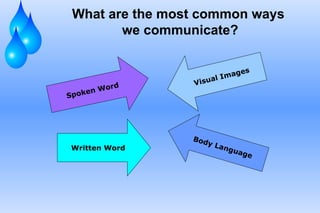
What are the most common ways  we communicate? Spoken Word Written Word Visual Images Body Language
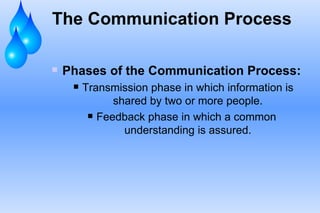
The Communication Process Phases of the Communication Process: Transmission phase in which information is shared by two or more people. Feedback phase in which a common  understanding is assured.
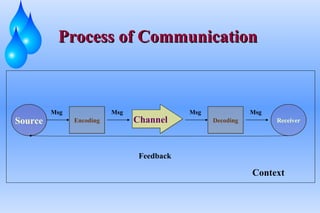
Process of Communication Source Encoding Channel Decoding Receiver Feedback Context Msg Msg Msg Msg
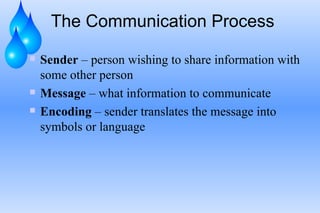
The Communication Process Sender  – person wishing to share information with some other person Message  – what information to communicate Encoding  – sender translates the message into symbols or language
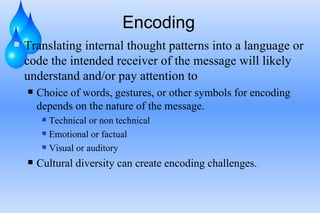
Encoding Translating internal thought patterns into a language or code the intended receiver of the message will likely understand and/or pay attention to Choice of words, gestures, or other symbols for encoding depends on the nature of the message. Technical or non technical Emotional or factual Visual or auditory Cultural diversity can create encoding challenges.
The Communication Process Noise  – refers to anything that hampers any stage of the communication process Receiver  – person or group for which the message is intended Medium  – pathway through which an encoded message is transmitted to a receiver Decoding   - critical point where the receiver interprets and tries to make sense of the message
Decoding Successful decoding depends on the receiver having: A willingness to receive the message Knowledge of the language and terminology used in the message An understanding of the sender’s purpose and background situation
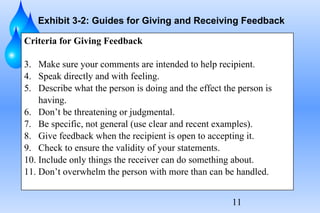
Exhibit 3-2: Guides for Giving and Receiving Feedback Criteria for Giving Feedback Make sure your comments are intended to help recipient. Speak directly and with feeling. Describe what the person is doing and the effect the person is having. Don’t be threatening or judgmental. Be specific, not general (use clear and recent examples). Give feedback when the recipient is open to accepting it. Check to ensure the validity of your statements. Include only things the receiver can do something about. Don’t overwhelm the person with more than can be handled.
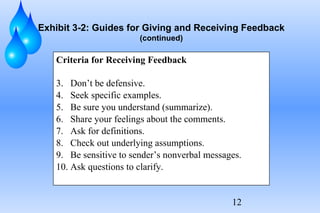
Exhibit 3-2: Guides for Giving and Receiving Feedback (continued) Criteria for Receiving Feedback Don’t be defensive. Seek specific examples. Be sure you understand (summarize). Share your feelings about the comments. Ask for definitions. Check out underlying assumptions. Be sensitive to sender’s nonverbal messages. Ask questions to clarify.
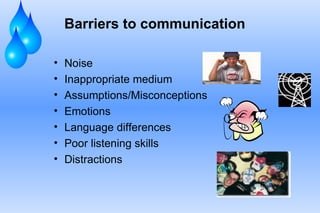
Barriers to communication Noise Inappropriate medium Assumptions/Misconceptions Emotions Language differences Poor listening skills Distractions
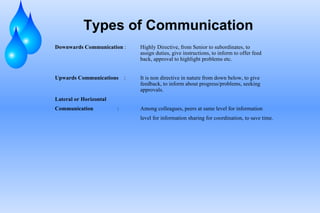
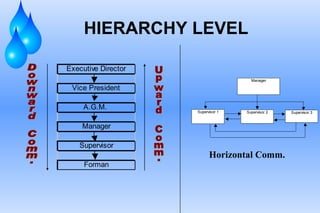
Types of Communication Downwards Communication  : Highly Directive, from Senior to subordinates, to  assign duties, give instructions, to inform to offer feed  back, approval to highlight problems etc. Upwards Communications   : It is non directive in nature from down below, to give  feedback, to inform about progress/problems, seeking  approvals. Lateral or Horizontal  Communication   : Among colleagues, peers at same level for information  level for information sharing for coordination, to save time.
HIERARCHY LEVEL Upward Comm. Downward Comm. Horizontal Comm.
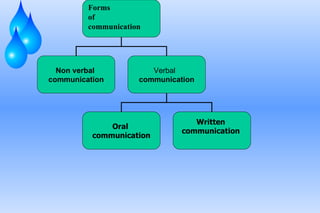
Forms  of  communication Non verbal  communication Verbal  communication Oral  communication Written  communication
Verbal & Nonverbal Communication Verbal Communication The encoding of messages into words, either written or spoken Nonverbal The encoding of messages by means of facial expressions, body language, and styles of dress.
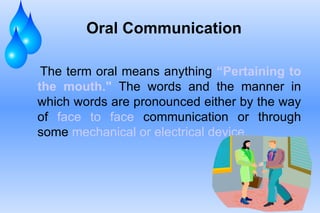
Oral Communication The term oral means anything  “Pertaining   to the mouth."  The words and the manner in which words are pronounced either by the way of  face to face  communication or through some  mechanical or electrical device.
Selecting a Medium Face-to-face conversations Telephone calls E-mails Letters Computer reports Photographs Bulletin boards Meetings News releases Press conferences Advertising
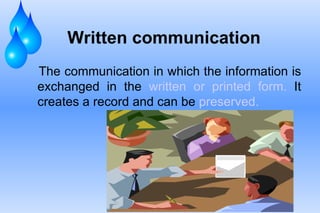
Written communication The communication in which the information is exchanged in the  written or printed form.  It creates a record and can be  preserved.
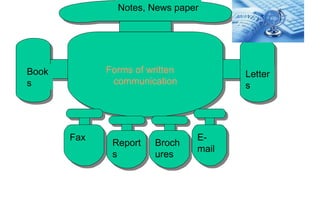
Forms of written communic Forms of written  communication Reports Brochures Letters Notes, News paper Books Fax E-mail
Always think ahead about what you are going to say. Use simple words and phrases that are understood by every body. Increase your knowledge on all subjects you are required to speak. Speak clearly and audibly. Check twice with the listener whether you have been understood accurately or not In case of an interruption, always do a little recap of what has been already said. While listening, always make notes of important points. Always ask for clarification if you have failed to grasp other’s point of view. Repeat what the speaker has said to check whether you have understood accurately. ESSENTIALS OF COMMUNICATION Dos
ESSENTIALS OF COMMUNICATION DON’Ts Do not instantly react and mutter something in anger. Do not use technical terms & terminologies not understood by majority of people. Do not speak too fast or too slow. Do not speak in inaudible surroundings, as you won’t be heard. Do not assume that every body understands you. Do not interrupt the speaker. Do not jump to the conclusion that you have understood every thing.
How to Improve Existing Level of COMMUNICATION? IMPROVE LANGUAGE. IMPROVE PRONUNCIATIOON. WORK ON VOICE MODULATION. WORK ON BODY LANGUAGE. READ MORE LISTEN MORE AVOID READING OR WATCHING OR LISTENING UNWANTED LITERATURE, GOSSIP, MEDIA  PRESENTATION ETC. INTERACT WITH QUALITATIVE PEOPLE. IMPROVE ON YOU TOPIC OF DISCUSSION, PRACTICE MEDITATION & GOOD THOUGHTS. THINK AND SPEAK. DO NOT SPEAK TOO FAST. USE SIMPLE VOCABULARY. DO NOT SPEAK ONLY TO IMPRESS SOMEONE. LOOK PRESENTABLE AND CONFIDENT.
… in the new global and diverse workplace requires excellent communication skills!   Success for YOU…
Questions

Communication skills1

  • 1.
  • 2.
    Objectives Define andunderstand communication and the communication process List and overcome the filters/barriers in a communication process Practice active listening Tips to improve verbal and non verbal communication
  • 3.
    What is Communication?COMMUNICATION IS THE ART OF TRANSMITTING INFORMATION, IDEAS AND ATTITUDES FROM ONE PERSON TO ANOTHER.COMMUNICATION IS THE PROCESS OF MEANINGFUL INTERACTION AMONG HUMAN BEINGS. ITS ESSENCES : PERSONAL PROCESS OCCURS BETWEEN PEOPLE INVOLVES CHANGE IN BEHAVIOUR MEANS TO INFLUENCE OTHERS EXPRESSION OF THOUGHTS AND EMOTIONS THROUGH WORDS & ACTIONS. TOOLS FOR CONTROLLING AND MOTIVATING PEOPLE. IT IS A SOCIAL AND EMOTIONAL PROCESS.
  • 4.
    What are themost common ways we communicate? Spoken Word Written Word Visual Images Body Language
  • 5.
    The Communication ProcessPhases of the Communication Process: Transmission phase in which information is shared by two or more people. Feedback phase in which a common understanding is assured.
  • 6.
    Process of CommunicationSource Encoding Channel Decoding Receiver Feedback Context Msg Msg Msg Msg
  • 7.
    The Communication ProcessSender – person wishing to share information with some other person Message – what information to communicate Encoding – sender translates the message into symbols or language
  • 8.
    Encoding Translating internalthought patterns into a language or code the intended receiver of the message will likely understand and/or pay attention to Choice of words, gestures, or other symbols for encoding depends on the nature of the message. Technical or non technical Emotional or factual Visual or auditory Cultural diversity can create encoding challenges.
  • 9.
    The Communication ProcessNoise – refers to anything that hampers any stage of the communication process Receiver – person or group for which the message is intended Medium – pathway through which an encoded message is transmitted to a receiver Decoding - critical point where the receiver interprets and tries to make sense of the message
  • 10.
    Decoding Successful decodingdepends on the receiver having: A willingness to receive the message Knowledge of the language and terminology used in the message An understanding of the sender’s purpose and background situation
  • 11.
    Exhibit 3-2: Guidesfor Giving and Receiving Feedback Criteria for Giving Feedback Make sure your comments are intended to help recipient. Speak directly and with feeling. Describe what the person is doing and the effect the person is having. Don’t be threatening or judgmental. Be specific, not general (use clear and recent examples). Give feedback when the recipient is open to accepting it. Check to ensure the validity of your statements. Include only things the receiver can do something about. Don’t overwhelm the person with more than can be handled.
  • 12.
    Exhibit 3-2: Guidesfor Giving and Receiving Feedback (continued) Criteria for Receiving Feedback Don’t be defensive. Seek specific examples. Be sure you understand (summarize). Share your feelings about the comments. Ask for definitions. Check out underlying assumptions. Be sensitive to sender’s nonverbal messages. Ask questions to clarify.
  • 13.
    Barriers to communicationNoise Inappropriate medium Assumptions/Misconceptions Emotions Language differences Poor listening skills Distractions
  • 14.
    Types of CommunicationDownwards Communication : Highly Directive, from Senior to subordinates, to assign duties, give instructions, to inform to offer feed back, approval to highlight problems etc. Upwards Communications : It is non directive in nature from down below, to give feedback, to inform about progress/problems, seeking approvals. Lateral or Horizontal Communication : Among colleagues, peers at same level for information level for information sharing for coordination, to save time.
  • 15.
    HIERARCHY LEVEL UpwardComm. Downward Comm. Horizontal Comm.
  • 16.
    Forms of communication Non verbal communication Verbal communication Oral communication Written communication
  • 17.
    Verbal & NonverbalCommunication Verbal Communication The encoding of messages into words, either written or spoken Nonverbal The encoding of messages by means of facial expressions, body language, and styles of dress.
  • 18.
    Oral Communication Theterm oral means anything “Pertaining to the mouth." The words and the manner in which words are pronounced either by the way of face to face communication or through some mechanical or electrical device.
  • 19.
    Selecting a MediumFace-to-face conversations Telephone calls E-mails Letters Computer reports Photographs Bulletin boards Meetings News releases Press conferences Advertising
  • 20.
    Written communication Thecommunication in which the information is exchanged in the written or printed form. It creates a record and can be preserved.
  • 21.
    Forms of writtencommunic Forms of written communication Reports Brochures Letters Notes, News paper Books Fax E-mail
  • 22.
    Always think aheadabout what you are going to say. Use simple words and phrases that are understood by every body. Increase your knowledge on all subjects you are required to speak. Speak clearly and audibly. Check twice with the listener whether you have been understood accurately or not In case of an interruption, always do a little recap of what has been already said. While listening, always make notes of important points. Always ask for clarification if you have failed to grasp other’s point of view. Repeat what the speaker has said to check whether you have understood accurately. ESSENTIALS OF COMMUNICATION Dos
  • 23.
    ESSENTIALS OF COMMUNICATIONDON’Ts Do not instantly react and mutter something in anger. Do not use technical terms & terminologies not understood by majority of people. Do not speak too fast or too slow. Do not speak in inaudible surroundings, as you won’t be heard. Do not assume that every body understands you. Do not interrupt the speaker. Do not jump to the conclusion that you have understood every thing.
  • 24.
    How to ImproveExisting Level of COMMUNICATION? IMPROVE LANGUAGE. IMPROVE PRONUNCIATIOON. WORK ON VOICE MODULATION. WORK ON BODY LANGUAGE. READ MORE LISTEN MORE AVOID READING OR WATCHING OR LISTENING UNWANTED LITERATURE, GOSSIP, MEDIA PRESENTATION ETC. INTERACT WITH QUALITATIVE PEOPLE. IMPROVE ON YOU TOPIC OF DISCUSSION, PRACTICE MEDITATION & GOOD THOUGHTS. THINK AND SPEAK. DO NOT SPEAK TOO FAST. USE SIMPLE VOCABULARY. DO NOT SPEAK ONLY TO IMPRESS SOMEONE. LOOK PRESENTABLE AND CONFIDENT.
  • 25.
    … in thenew global and diverse workplace requires excellent communication skills! Success for YOU…
  • 26.

Editor's Notes