Physical Pharmaceutics-I
Unit-IV
Complexation
Classical bonding theory – It includes:-
Covalent bonds
Vander wall forces
Dipole dipole
interaction
Hydrogen bond
Co-ordinate bond
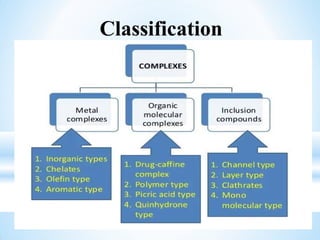
Classification
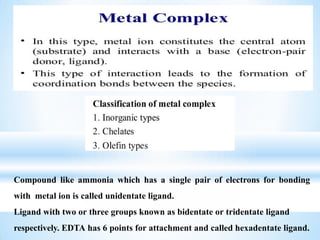
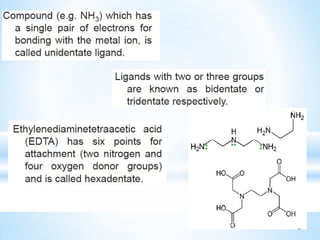
Compound like ammonia which has a single pair of electrons for bonding
with metal ion is called unidentate ligand.
Ligand with two or three groups known as bidentate or tridentate ligand
respectively. EDTA has 6 points for attachment and called hexadentate ligand.
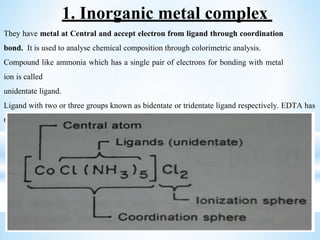
They have metal at Central and accept electron from ligand through coordination
bond. It is used to analyse chemical composition through colorimetric analysis.
Compound like ammonia which has a single pair of electrons for bonding with metal
ion is called
unidentate ligand.
Ligand with two or three groups known as bidentate or tridentate ligand respectively. EDTA has
6 points for attachment and called hexadentate ligand
1. Inorganic metal complex
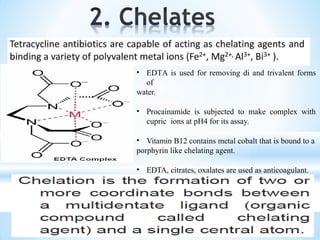
• EDTA is used for removing di and trivalent forms
of
water.
• Procainamide is subjected to make complex with
cupric ions at pH4 for its assay.
• Vitamin B12 contains metal cobalt that is bound to a
porphyrin like chelating agent.
• EDTA, citrates, oxalates are used as anticoagulant.
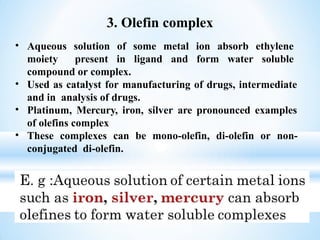
• Aqueous solution of some metal ion absorb ethylene
moiety present in ligand and form water soluble
compound or complex.
• Used as catalyst for manufacturing of drugs, intermediate
and in analysis of drugs.
• Platinum, Mercury, iron, silver are pronounced examples
of olefins complex
• These complexes can be mono-olefin, di-olefin or non-
conjugated di-olefin.
3. Olefin complex
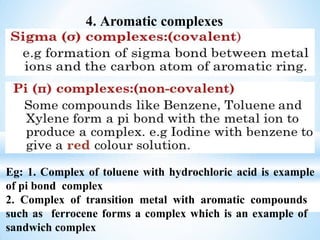
4. Aromatic complexes
Eg: 1. Complex of toluene with hydrochloric acid is example
of pi bond complex
2. Complex of transition metal with aromatic compounds
such as ferrocene forms a complex which is an example of
sandwich complex
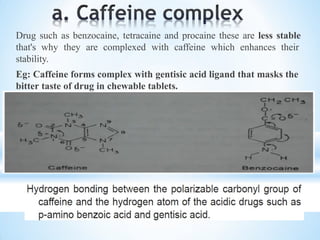
Drug such as benzocaine, tetracaine and procaine these are less stable
that's why they are complexed with caffeine which enhances their
stability.
Eg: Caffeine forms complex with gentisic acid ligand that masks the
bitter taste of drug in chewable tablets.
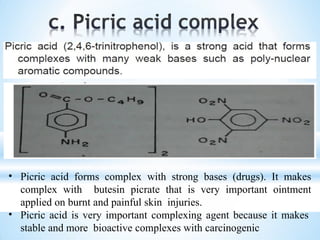
• Picric acid forms complex with strong bases (drugs). It makes
complex with butesin picrate that is very important ointment
applied on burnt and painful skin injuries.
• Picric acid is very important complexing agent because it makes
stable and more bioactive complexes with carcinogenic
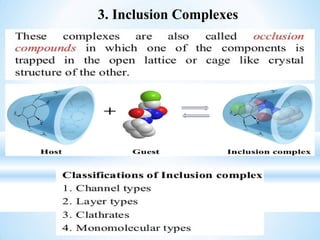
3. Inclusion Complexes
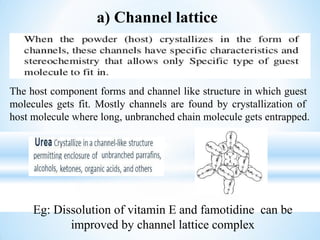
a) Channel lattice
The host component forms and channel like structure in which guest
molecules gets fit. Mostly channels are found by crystallization of
host molecule where long, unbranched chain molecule gets entrapped.
Eg: Dissolution of vitamin E and famotidine can be
improved by channel lattice complex
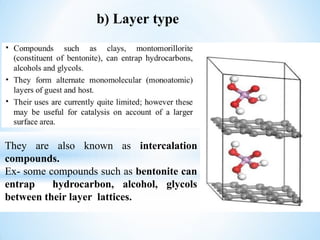
b) Layer type
They are also known as intercalation
compounds.
Ex- some compounds such as bentonite can
entrap hydrocarbon, alcohol, glycols
between their layer lattices.
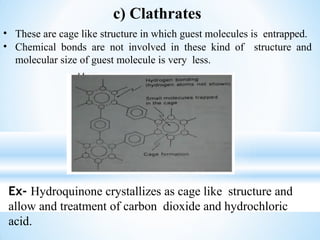
c) Clathrates
• These are cage like structure in which guest molecules is entrapped.
• Chemical bonds are not involved in these kind of structure and
molecular size of guest molecule is very less.
Ex- Hydroquinone crystallizes as cage like structure and
allow and treatment of carbon dioxide and hydrochloric
acid.
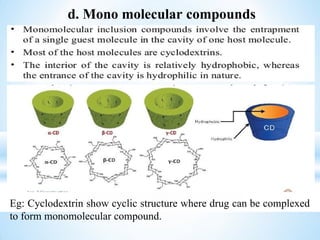
d. Mono molecular compounds
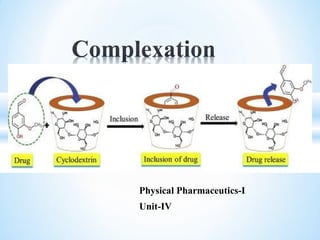
Eg: Cyclodextrin show cyclic structure where drug can be complexed
to form monomolecular compound.
Unit 4 Complexation Physical Pharmaceutics- I.pptx

Unit 4 Complexation Physical Pharmaceutics- I.pptx

  • 1.
  • 2.
    Complexation Classical bonding theory– It includes:- Covalent bonds Vander wall forces Dipole dipole interaction Hydrogen bond Co-ordinate bond
  • 4.
  • 5.
    Compound like ammoniawhich has a single pair of electrons for bonding with metal ion is called unidentate ligand. Ligand with two or three groups known as bidentate or tridentate ligand respectively. EDTA has 6 points for attachment and called hexadentate ligand.
  • 6.
    They have metalat Central and accept electron from ligand through coordination bond. It is used to analyse chemical composition through colorimetric analysis. Compound like ammonia which has a single pair of electrons for bonding with metal ion is called unidentate ligand. Ligand with two or three groups known as bidentate or tridentate ligand respectively. EDTA has 6 points for attachment and called hexadentate ligand 1. Inorganic metal complex
  • 8.
    • EDTA isused for removing di and trivalent forms of water. • Procainamide is subjected to make complex with cupric ions at pH4 for its assay. • Vitamin B12 contains metal cobalt that is bound to a porphyrin like chelating agent. • EDTA, citrates, oxalates are used as anticoagulant.
  • 9.
    • Aqueous solutionof some metal ion absorb ethylene moiety present in ligand and form water soluble compound or complex. • Used as catalyst for manufacturing of drugs, intermediate and in analysis of drugs. • Platinum, Mercury, iron, silver are pronounced examples of olefins complex • These complexes can be mono-olefin, di-olefin or non- conjugated di-olefin. 3. Olefin complex
  • 10.
    4. Aromatic complexes Eg:1. Complex of toluene with hydrochloric acid is example of pi bond complex 2. Complex of transition metal with aromatic compounds such as ferrocene forms a complex which is an example of sandwich complex
  • 12.
    Drug such asbenzocaine, tetracaine and procaine these are less stable that's why they are complexed with caffeine which enhances their stability. Eg: Caffeine forms complex with gentisic acid ligand that masks the bitter taste of drug in chewable tablets.
  • 14.
    • Picric acidforms complex with strong bases (drugs). It makes complex with butesin picrate that is very important ointment applied on burnt and painful skin injuries. • Picric acid is very important complexing agent because it makes stable and more bioactive complexes with carcinogenic
  • 16.
  • 17.
    a) Channel lattice Thehost component forms and channel like structure in which guest molecules gets fit. Mostly channels are found by crystallization of host molecule where long, unbranched chain molecule gets entrapped. Eg: Dissolution of vitamin E and famotidine can be improved by channel lattice complex
  • 18.
    b) Layer type Theyare also known as intercalation compounds. Ex- some compounds such as bentonite can entrap hydrocarbon, alcohol, glycols between their layer lattices.
  • 19.
    c) Clathrates • Theseare cage like structure in which guest molecules is entrapped. • Chemical bonds are not involved in these kind of structure and molecular size of guest molecule is very less. Ex- Hydroquinone crystallizes as cage like structure and allow and treatment of carbon dioxide and hydrochloric acid.
  • 20.
    d. Mono molecularcompounds Eg: Cyclodextrin show cyclic structure where drug can be complexed to form monomolecular compound.