Mrs. JILSHA G
Assistant Professor
Department of Pharmaceutics
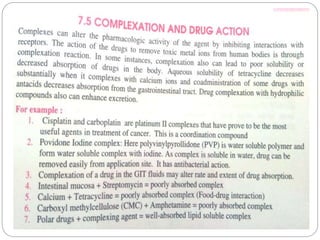
Sanjo College of Pharmaceutical Studies
Vellapara, Palakkad
Complex compounds are defined as those molecules in which
most of the bonding structures can be described by
classical theories of valency b/w atoms
 Complex compounds result from some type of interaction
b/w diff. chemical species
 Intermolecular forces involved in formation of complexes
are:
 Covalent/ coordinated bonds
 Van der Waals forces of dispersion
 Ion- dipole, dipole- dipole, dipole- induced dipole type
 H2 bonding etc………..
Complexation is the association b/w 2 or more molecules to
form a non bonded entity wth a well defines stoichiometry.
Application of complexes in pharmacy
1. Physical state: conversion of liq. subs to solid
complex & improve its characteristics
Eg: nitroglycerine transformed to crystalline inclusion
complex
2. Volatility: to stabilize a system/ to overcome
unpleasant odour – make a complex
Eg: iodine complex with polyvinylpyrrolidone (PVP)
3. Solid state stability: Solid state stability of drugs can
be enhanced by complexation
Eg: β- cyclodextrin complexes of vit A & D are
stabilised chemically
4. Chemical stability: complex formation alter chemical
reactivity
Eg: rate of hydrolysis of benzocaine reduced by
complexing with caffeine
5. Solubility: complexation enhances solubility
Eg: caffeine enhances solubility of p- aminobenzoic acid
(PABA)
6. Dissolution: solubility ses, dissolution rate also ses
Eg: dissolution rate of phenobarbital enhanced by
cyclodextrin inclusion complexes
7. Partition coefficient: permanganate ions transferred
to benzene phase from water by complexation with
crown ether
8. Absorption & bioavailability: Absorption &
bioavailability of tetracyclines reduced when
administered with Ca, Mg, Al
β- cyclodextrin complexes of indomethacin, barbiturates
enhance drug bioavailability
9. Reduced toxicity: Cyclodextrins reduce ulcerogenic
effect of indomethacin & local tissue toxicity of
chlorpromazine
10. Antidote for metal poisoning: toxic metal ions like
arsenic, mercury etc bind to –SH group of various
enzymes & interfere with normal func. Compounds
like dimercaprol form water soluble complex with
metal ions & eliminate from body
11. Drug action through metal poisoning: 8-
hydroxyquinoline complex with iron, penetrate thru
cell membrane of malarial parasite, leading to
accumulate excess metal in body & provide better
antimalarial action
12. Antibacterial activity: antitubercular drug, p-
aminosalicylic acid (PAS) form cupri complex &
chelate. Cupric chelate show greater in vivo
antitubercular activity in mice than cupric complex
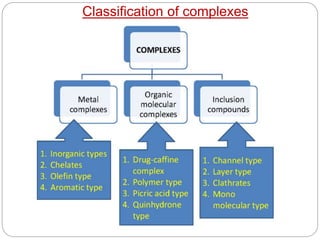
Classification of complexes
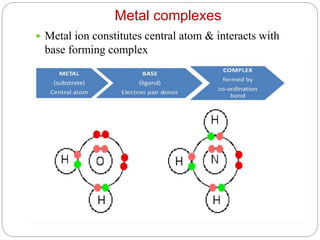
Metal complexes
 Metal ion constitutes central atom & interacts with
base forming complex
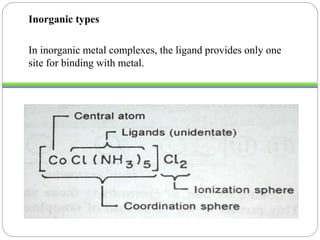
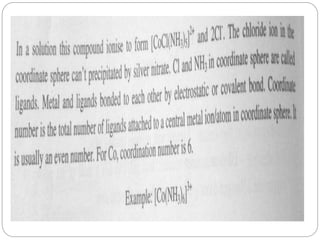
Inorganic types
In inorganic metal complexes, the ligand provides only one
site for binding with metal.
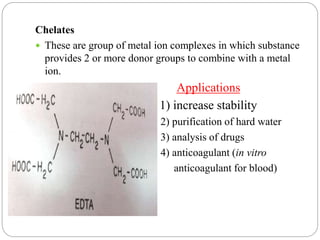
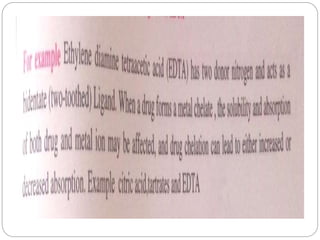
Chelates
 These are group of metal ion complexes in which substance
provides 2 or more donor groups to combine with a metal
ion.
Applications
1) increase stability
2) purification of hard water
3) analysis of drugs
4) anticoagulant (in vitro
anticoagulant for blood)
Organic molecular complex
 These type of complexes are formed by noncovalent
interaction b/w ligand and substrate held together by
weaker forces or hydrogen bonding.
Organic molecular complexes
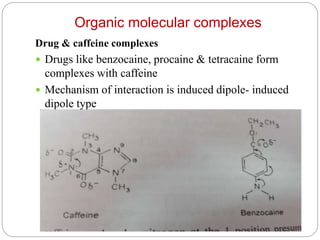
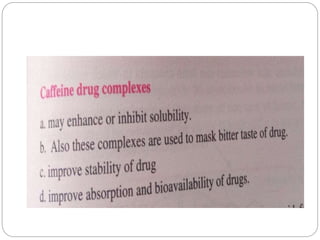
Drug & caffeine complexes
 Drugs like benzocaine, procaine & tetracaine form
complexes with caffeine
 Mechanism of interaction is induced dipole- induced
dipole type
Polymer complexes
 PEG, CMC contain nucleophilic oxygen, this form complexes
with various drugs
Eg;- Polymer: carbowaxes, pluronics
Drugs: salicylic acid, tannic acid, phenols
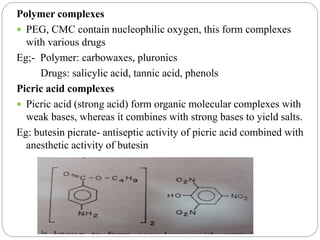
Picric acid complexes
 Picric acid (strong acid) form organic molecular complexes with
weak bases, whereas it combines with strong bases to yield salts.
Eg: butesin picrate- antiseptic activity of picric acid combined with
anesthetic activity of butesin
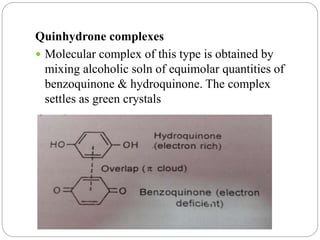
Quinhydrone complexes
 Molecular complex of this type is obtained by
mixing alcoholic soln of equimolar quantities of
benzoquinone & hydroquinone. The complex
settles as green crystals
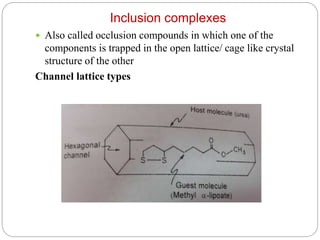
Inclusion complexes
 Also called occlusion compounds in which one of the
components is trapped in the open lattice/ cage like crystal
structure of the other
Channel lattice types
Eg:
Channel forming substance (host): deoxycholic acid,
urea, thiourea, amylose etc..
Guest agents: paraffins, esters, acids, ethyl alcohol etc…
Applications: For separation of optical isomers
Layer types
Compds like clay, montomorillorite, can entrap
hydrocarbons, alcohols & glycols. They form alternate
monomelecular layers of guest & host.
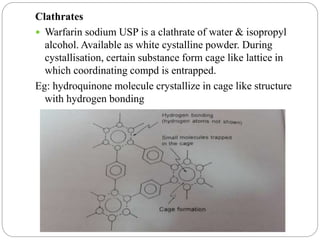
Clathrates
 Warfarin sodium USP is a clathrate of water & isopropyl
alcohol. Available as white cystalline powder. During
cystallisation, certain substance form cage like lattice in
which coordinating compd is entrapped.
Eg: hydroquinone molecule crystallize in cage like structure
with hydrogen bonding
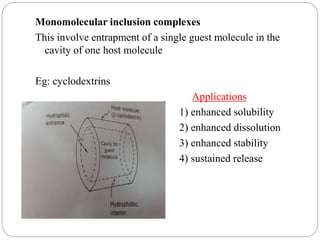
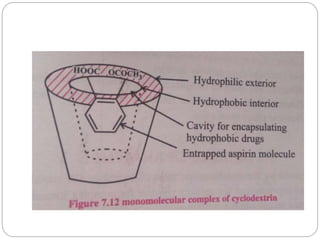
Monomolecular inclusion complexes
This involve entrapment of a single guest molecule in the
cavity of one host molecule
Eg: cyclodextrins
Applications
1) enhanced solubility
2) enhanced dissolution
3) enhanced stability
4) sustained release
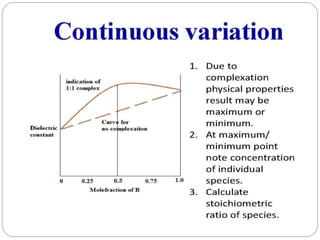
1. Method of continuous variation / JOB’S method of
continuous variation
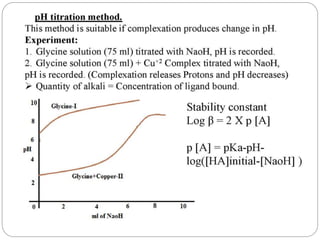
2. pH titration method
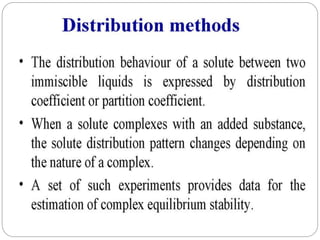
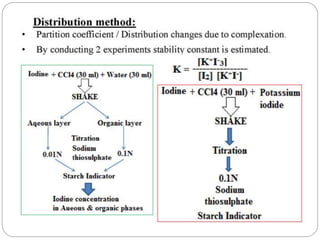
3. Distribution method
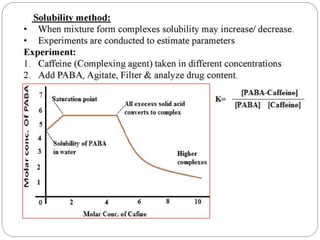
4. Solubility method
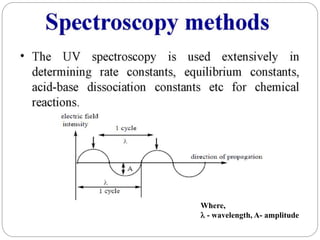
5. Spectroscopy and charge transfer complexation
6. Miscellaneous method
Where,
 - wavelength, A- amplitude
Miscellaneous methods
 Several other methods are available for the analysis of
complexes like NMR and IR spectroscopy,
polarography, circular dicromism, kinetics, X- ray
diffraction and electron diffraction.
•The phenomenon of complex formation of drug with protein is called
as protein binding of drug
•As a protein bound drug is neither metabolized nor excreted hence it
is pharmacologically inactivedue to its pharmacokinetic and
Pharmacodynamic inertness.
Protein + drug ⇌Protein-drug complex
Protein binding may be divided into:
1. Intracellular binding.
2. Extracellular binding.
PROTEIN BINDING
MECHANISMS OF PROTEIN DRUG BINDING:
• Binding of drugs to proteins is generally of reversible &irreversible.
• Reversible generally involves weak chemical bond such as:
1. Hydrogen bonds
2. Hydrophobic bonds
3. Ionic bonds
4. Van der waal’s forces.
• Irreversible drug binding, though rare, arises as a result of covalent
binding and is often a reason for the carcinogenicity or tissue
toxicity of the drug.
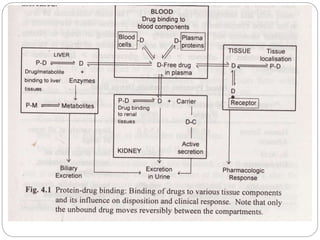
1. BINDING OF DRUG TO BLOOD COMPONENTS
A. Plasma protein-drug binding:-
•
•
The binding of drugs to plasma proteins is reversible.
The extent or order of binding of drug to plasma proteins is:
Albumin ›ὰ1-Acid glycoprotein ›Lipoproteins ›Globulins.
1. Binding of drug to human serumAlbumin.
• It is the most abundant plasma protein (59%), having M.W. of
65,000 with large drug binding capacity.
• Both endogenous compounds such as fatty acid, bilirubin as well
as drug binds to HSA.
• Four diff. sites on HSA for drug binding.
Site I: warfarin & azapropazone binding site.
Site II: diazepam binding site.
Site III: digitoxin binding site.
Site IV: tamoxifen binding site.
2. Binding of drug to α1-Acid glycoprotein: (orosomucoid)
It has a M.W. 44,000 and plasma conc. range of 0.04 to 0.1 g%. It
binds to no. of basic drugs like imipramine, lidocaine, propranolol,
quinidine.
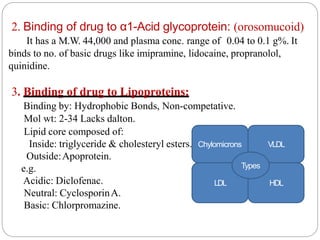
3. Binding of drug to Lipoproteins:
Binding by: Hydrophobic Bonds, Non-competative.
Mol wt: 2-34 Lacks dalton.
Lipid core composed of:
Inside: triglyceride & cholesteryl esters.
Outside:Apoprotein.
e.g.
Acidic: Diclofenac.
Neutral: CyclosporinA.
Basic: Chlorpromazine.
LDL HDL
VLDLChylomicrons
Types
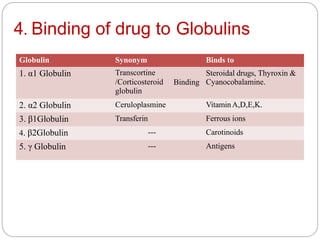
4. Binding of drug to Globulins
Globulin Synonym Binds to
1. α1 Globulin Transcortine
/Corticosteroid
globulin
Binding
Steroidal drugs, Thyroxin &
Cyanocobalamine.
2. α2 Globulin Ceruloplasmine VitaminA,D,E,K.
3. β1Globulin Transferin Ferrous ions
4. β2Globulin --- Carotinoids
5. γ Globulin --- Antigens
B. BINDING OF DRUG TO BLOOD CELLS
•In blood 40% of blood cells of which major component is RBC
(95%).
•The RBC is 500 times in diameter as the albumin.
•The rate & extent of entry into RBC is more for lipophilic drugs.
•The RBC comprises of 3 components.
a) Haemoglobin: It has a M.W. of 64,500 Dal. Drugs like
phenytoin, pentobarbital bind to haemoglobin.
b) Carbonic anhydrase: Carbonic anhydrase inhibitors drugs are
bind to it like acetazolamide & chlorthalidone.
c) Cell membrane: Imipramine & chlorpromazine are reported to
bind with the RBC membrane.
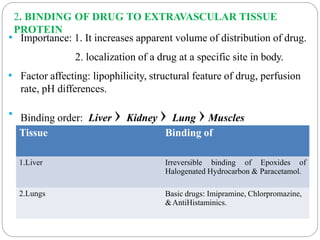
2. BINDING OF DRUG TO EXTRAVASCULAR TISSUE
PROTEIN
•
• Importance: 1. It increases apparent volume of distribution of drug.
2. localization of a drug at a specific site in body.
• Factor affecting: lipophilicity, structural feature of drug, perfusion
rate, pH differences.
Binding order: Liver › Kidney › Lung ›Muscles
Tissue Binding of
1.Liver Irreversible binding of Epoxides of
Halogenated Hydrocarbon & Paracetamol.
2.Lungs Basic drugs: Imipramine, Chlorpromazine,
&AntiHistaminics.
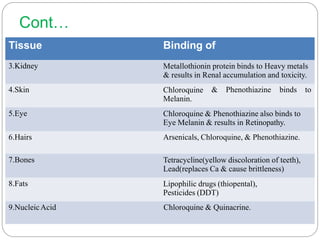
Cont…
Tissue Binding of
3.Kidney Metallothionin protein binds to Heavy metals
& results in Renal accumulation and toxicity.
4.Skin Chloroquine
Melanin.
& Phenothiazine binds to
5.Eye Chloroquine & Phenothiazine also binds to
Eye Melanin & results in Retinopathy.
6.Hairs Arsenicals, Chloroquine, & Phenothiazine.
7.Bones Tetracycline(yellow discoloration of teeth),
Lead(replaces Ca & cause brittleness)
8.Fats Lipophilic drugs (thiopental),
Pesticides (DDT)
9.NucleicAcid Chloroquine & Quinacrine.
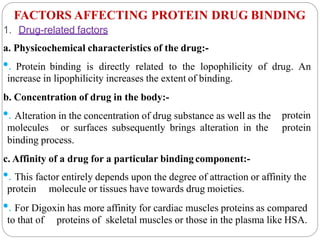
FACTORS AFFECTING PROTEIN DRUG BINDING
1. Drug-related factors
a. Physicochemical characteristics of the drug:-
•. Protein binding is directly related to the lopophilicity of drug. An
increase in lipophilicity increases the extent of binding.
b. Concentration of drug in the body:-
protein
protein
•. Alteration in the concentration of drug substance as well as the
molecules or surfaces subsequently brings alteration in the
binding process.
c. Affinity of a drug for a particular bindingcomponent:-
•. This factor entirely depends upon the degree of attraction or affinity the
protein molecule or tissues have towards drug moieties.
•. For Digoxin has more affinity for cardiac muscles proteins as compared
to that of proteins of skeletal muscles or those in the plasma like HSA.
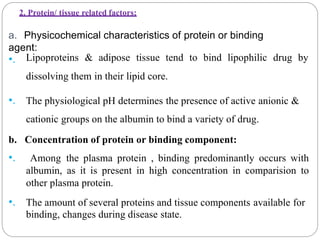
2. Protein/ tissue related factors:
a. Physicochemical characteristics of protein or binding
agent:
•. Lipoproteins & adipose tissue tend to bind lipophilic drug by
dissolving them in their lipid core.
•. The physiological pH determines the presence of active anionic &
cationic groups on the albumin to bind a variety of drug.
b. Concentration of protein or binding component:
•. Among the plasma protein , binding predominantly occurs with
albumin, as it is present in high concentration in comparision to
other plasma protein.
•. The amount of several proteins and tissue components available for
binding, changes during disease state.
3. Drug interactions
drugs for the binding sites[ Displacementa. Competition between
interactions]:-
D2
D1+P D2+P
D1: Displaced drug. D2: Displacer drug.
e.g. Administration of phenylbutazone to a patient on Warfarin therapy results
in Hemorrhagic reaction.
b. Competition between drug & normal body constituents:-
The free fatty acids are known to interact with a no. of drugs that binds
primarily to HSA. the free fatty acid level increase in physiological, pathological
condition.
c. Allosteric changes in protein molecule:-
• The process involves alteration of the protein structure by the drug
or it’s metabolite thereby modifying its binding capacity.
• e.g. aspirin acetylates lysine fraction of albumin thereby modifying
its capacity to bind NSAIDs like phenylbutazone.
4. Patient-related factors
a. Age:
1.Neonates: Low albumin content: More free drug.
2.Young infants: High dose of Digoxin due to large renal
clearance.
3.Elderly:Low albumin: So more free drug.
b. Intersubject variability: Due to genetics & environmental factors.
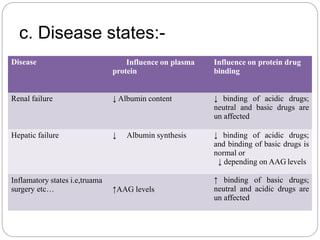
c. Disease states:-
Disease Influence on plasma
protein
Influence on protein drug
binding
Renal failure ↓ Albumin content ↓ binding of acidic drugs;
neutral and basic drugs are
un affected
Hepatic failure ↓ Albumin synthesis ↓ binding of acidic drugs;
and binding of basic drugs is
normal or
↓ depending on AAG levels
Inflamatory states i.e,truama
surgery etc… ↑AAG levels
↑ binding of basic drugs;
neutral and acidic drugs are
un affected
SIGNIFICANCE OF PROTEIN/TISSUE BINDING OFDRUG
a. Absorption-
• As we know the conventional dosage form follow first order kinetics.
So when there is more protein binding then it disturbs the absorption
equilibrium.
b. Distribution-
• A protein bound drug in particular does not cross the BBB, the
placental barrier, the glomerulus.
• Thus protein binding decreases the distribution of drugs.
c. Metabolism-
• Protein binding decreases the metabolism of drugs & enhances the
biological half life.
• Only unbound fraction get metabolized.
• e.g. Phenylbutazone & Sulfonamide.
d. Elimination
•
•
•
Only the unbound drug is capable of being eliminated.
Protein binding prevent the entry of drug to the metabolizing organ
(liver ) & to glomerulus filtration.
e.g. Tetracycline is eliminated mainly by glomerular filtration.
e. Systemic solubility of drug
• Lipoprotein act as vehicle for hydrophobic drugs like steroids, heparin,
oil soluble vit.
f. Drug action-
• Protein binding inactivates the drugs because sufficient concentration of
drug can not be build up in the receptor site for action.
• e.g. Naphthoquinone
g. Sustain release-
• The complex of drug protein in the blood act as a reservoir &
continuously supply the free drug.
• e.g. Suramin sodium-protein binding for antitrypanosomal action.
h. Diagnosis-
• The chlorine atom of chloroquine replaced with radiolabeled I-
131 can be used to visualize-melanomas of eye & disorders of
thyroid gland.
Applications of protein binding
1. Drug distribution: protein binding ses distribution of
drugs.
2. Metabolism: protein binding ses metabolism of drugs &
enhances biological half life.
3. Excretion: protein binding ses renal excretion of drugs &
enhances biological half life.
4. Drug action: protein binding inactivates drug, because
sufficient conc of drug cannot built up the receptor site of
action.
5. Sustained release: complex of drug- protein in blood acts as
reservoir & continuously supply free drug for its action.
6. Carrier system: protein- drug complex act as transport
system to carry drugs to site of action.
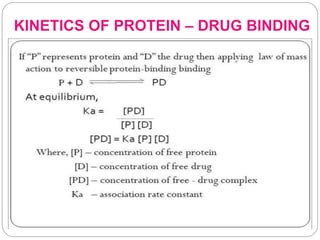
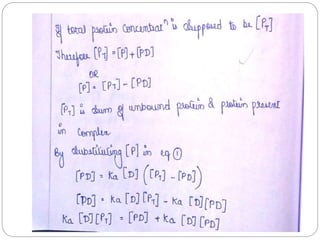
KINETICS OF PROTEIN – DRUG BINDING
Methods for studying drug- protein
binding
1. Equilibrium Dialysis Method
 Used in determining extent of protein binding of
drugs
 Complexation of metal ions with macromolecules
can also be studied
 This method is inconvenient to use over a wide range
of temp.
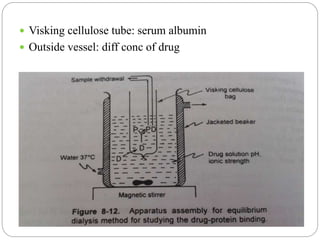
 Visking cellulose tube: serum albumin
 Outside vessel: diff conc of drug
2. Dynamic dialysis method
 Its an economical method
 Quick method to establish drug- protein binding
 This method is based on the rate of disappearance
of drug from dialysis bag which is proportional to
conc of unbound drug
 Dialysis process follows rate law,
d[Dt]/dt = k[Df]
[Dt] ------ conc of total drug
[Df] ------ conc of free(unbound) drug in bag
k --------- first order rate constant/ apparent
permeability rate constant
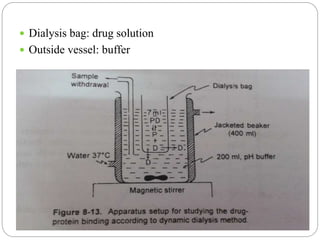
 Dialysis bag: drug solution
 Outside vessel: buffer
References
1. Physical Pharmaceutics I by Dr. Shalini Sharma and
Dr. Surajj Sarode.
2. Text Book of Physical Pharmaceutics by CVS
Subrahmanyam.
THANK YOU

Complexation & protein binding

  • 1.
    Mrs. JILSHA G AssistantProfessor Department of Pharmaceutics Sanjo College of Pharmaceutical Studies Vellapara, Palakkad
  • 2.
    Complex compounds aredefined as those molecules in which most of the bonding structures can be described by classical theories of valency b/w atoms  Complex compounds result from some type of interaction b/w diff. chemical species  Intermolecular forces involved in formation of complexes are:  Covalent/ coordinated bonds  Van der Waals forces of dispersion  Ion- dipole, dipole- dipole, dipole- induced dipole type  H2 bonding etc……….. Complexation is the association b/w 2 or more molecules to form a non bonded entity wth a well defines stoichiometry.
  • 3.
    Application of complexesin pharmacy 1. Physical state: conversion of liq. subs to solid complex & improve its characteristics Eg: nitroglycerine transformed to crystalline inclusion complex 2. Volatility: to stabilize a system/ to overcome unpleasant odour – make a complex Eg: iodine complex with polyvinylpyrrolidone (PVP) 3. Solid state stability: Solid state stability of drugs can be enhanced by complexation Eg: β- cyclodextrin complexes of vit A & D are stabilised chemically
  • 4.
    4. Chemical stability:complex formation alter chemical reactivity Eg: rate of hydrolysis of benzocaine reduced by complexing with caffeine 5. Solubility: complexation enhances solubility Eg: caffeine enhances solubility of p- aminobenzoic acid (PABA) 6. Dissolution: solubility ses, dissolution rate also ses Eg: dissolution rate of phenobarbital enhanced by cyclodextrin inclusion complexes 7. Partition coefficient: permanganate ions transferred to benzene phase from water by complexation with crown ether
  • 5.
    8. Absorption &bioavailability: Absorption & bioavailability of tetracyclines reduced when administered with Ca, Mg, Al β- cyclodextrin complexes of indomethacin, barbiturates enhance drug bioavailability 9. Reduced toxicity: Cyclodextrins reduce ulcerogenic effect of indomethacin & local tissue toxicity of chlorpromazine 10. Antidote for metal poisoning: toxic metal ions like arsenic, mercury etc bind to –SH group of various enzymes & interfere with normal func. Compounds like dimercaprol form water soluble complex with metal ions & eliminate from body
  • 6.
    11. Drug actionthrough metal poisoning: 8- hydroxyquinoline complex with iron, penetrate thru cell membrane of malarial parasite, leading to accumulate excess metal in body & provide better antimalarial action 12. Antibacterial activity: antitubercular drug, p- aminosalicylic acid (PAS) form cupri complex & chelate. Cupric chelate show greater in vivo antitubercular activity in mice than cupric complex
  • 7.
  • 8.
    Metal complexes  Metalion constitutes central atom & interacts with base forming complex
  • 9.
    Inorganic types In inorganicmetal complexes, the ligand provides only one site for binding with metal.
  • 11.
    Chelates  These aregroup of metal ion complexes in which substance provides 2 or more donor groups to combine with a metal ion. Applications 1) increase stability 2) purification of hard water 3) analysis of drugs 4) anticoagulant (in vitro anticoagulant for blood)
  • 15.
    Organic molecular complex These type of complexes are formed by noncovalent interaction b/w ligand and substrate held together by weaker forces or hydrogen bonding.
  • 16.
    Organic molecular complexes Drug& caffeine complexes  Drugs like benzocaine, procaine & tetracaine form complexes with caffeine  Mechanism of interaction is induced dipole- induced dipole type
  • 18.
    Polymer complexes  PEG,CMC contain nucleophilic oxygen, this form complexes with various drugs Eg;- Polymer: carbowaxes, pluronics Drugs: salicylic acid, tannic acid, phenols Picric acid complexes  Picric acid (strong acid) form organic molecular complexes with weak bases, whereas it combines with strong bases to yield salts. Eg: butesin picrate- antiseptic activity of picric acid combined with anesthetic activity of butesin
  • 19.
    Quinhydrone complexes  Molecularcomplex of this type is obtained by mixing alcoholic soln of equimolar quantities of benzoquinone & hydroquinone. The complex settles as green crystals
  • 20.
    Inclusion complexes  Alsocalled occlusion compounds in which one of the components is trapped in the open lattice/ cage like crystal structure of the other Channel lattice types
  • 21.
    Eg: Channel forming substance(host): deoxycholic acid, urea, thiourea, amylose etc.. Guest agents: paraffins, esters, acids, ethyl alcohol etc… Applications: For separation of optical isomers Layer types Compds like clay, montomorillorite, can entrap hydrocarbons, alcohols & glycols. They form alternate monomelecular layers of guest & host.
  • 22.
    Clathrates  Warfarin sodiumUSP is a clathrate of water & isopropyl alcohol. Available as white cystalline powder. During cystallisation, certain substance form cage like lattice in which coordinating compd is entrapped. Eg: hydroquinone molecule crystallize in cage like structure with hydrogen bonding
  • 23.
    Monomolecular inclusion complexes Thisinvolve entrapment of a single guest molecule in the cavity of one host molecule Eg: cyclodextrins Applications 1) enhanced solubility 2) enhanced dissolution 3) enhanced stability 4) sustained release
  • 26.
    1. Method ofcontinuous variation / JOB’S method of continuous variation 2. pH titration method 3. Distribution method 4. Solubility method 5. Spectroscopy and charge transfer complexation 6. Miscellaneous method
  • 34.
  • 35.
    Miscellaneous methods  Severalother methods are available for the analysis of complexes like NMR and IR spectroscopy, polarography, circular dicromism, kinetics, X- ray diffraction and electron diffraction.
  • 37.
    •The phenomenon ofcomplex formation of drug with protein is called as protein binding of drug •As a protein bound drug is neither metabolized nor excreted hence it is pharmacologically inactivedue to its pharmacokinetic and Pharmacodynamic inertness. Protein + drug ⇌Protein-drug complex Protein binding may be divided into: 1. Intracellular binding. 2. Extracellular binding. PROTEIN BINDING
  • 38.
    MECHANISMS OF PROTEINDRUG BINDING: • Binding of drugs to proteins is generally of reversible &irreversible. • Reversible generally involves weak chemical bond such as: 1. Hydrogen bonds 2. Hydrophobic bonds 3. Ionic bonds 4. Van der waal’s forces. • Irreversible drug binding, though rare, arises as a result of covalent binding and is often a reason for the carcinogenicity or tissue toxicity of the drug.
  • 40.
    1. BINDING OFDRUG TO BLOOD COMPONENTS A. Plasma protein-drug binding:- • • The binding of drugs to plasma proteins is reversible. The extent or order of binding of drug to plasma proteins is: Albumin ›ὰ1-Acid glycoprotein ›Lipoproteins ›Globulins.
  • 41.
    1. Binding ofdrug to human serumAlbumin. • It is the most abundant plasma protein (59%), having M.W. of 65,000 with large drug binding capacity. • Both endogenous compounds such as fatty acid, bilirubin as well as drug binds to HSA. • Four diff. sites on HSA for drug binding. Site I: warfarin & azapropazone binding site. Site II: diazepam binding site. Site III: digitoxin binding site. Site IV: tamoxifen binding site.
  • 42.
    2. Binding ofdrug to α1-Acid glycoprotein: (orosomucoid) It has a M.W. 44,000 and plasma conc. range of 0.04 to 0.1 g%. It binds to no. of basic drugs like imipramine, lidocaine, propranolol, quinidine. 3. Binding of drug to Lipoproteins: Binding by: Hydrophobic Bonds, Non-competative. Mol wt: 2-34 Lacks dalton. Lipid core composed of: Inside: triglyceride & cholesteryl esters. Outside:Apoprotein. e.g. Acidic: Diclofenac. Neutral: CyclosporinA. Basic: Chlorpromazine. LDL HDL VLDLChylomicrons Types
  • 43.
    4. Binding ofdrug to Globulins Globulin Synonym Binds to 1. α1 Globulin Transcortine /Corticosteroid globulin Binding Steroidal drugs, Thyroxin & Cyanocobalamine. 2. α2 Globulin Ceruloplasmine VitaminA,D,E,K. 3. β1Globulin Transferin Ferrous ions 4. β2Globulin --- Carotinoids 5. γ Globulin --- Antigens
  • 44.
    B. BINDING OFDRUG TO BLOOD CELLS •In blood 40% of blood cells of which major component is RBC (95%). •The RBC is 500 times in diameter as the albumin. •The rate & extent of entry into RBC is more for lipophilic drugs. •The RBC comprises of 3 components. a) Haemoglobin: It has a M.W. of 64,500 Dal. Drugs like phenytoin, pentobarbital bind to haemoglobin. b) Carbonic anhydrase: Carbonic anhydrase inhibitors drugs are bind to it like acetazolamide & chlorthalidone. c) Cell membrane: Imipramine & chlorpromazine are reported to bind with the RBC membrane.
  • 45.
    2. BINDING OFDRUG TO EXTRAVASCULAR TISSUE PROTEIN • • Importance: 1. It increases apparent volume of distribution of drug. 2. localization of a drug at a specific site in body. • Factor affecting: lipophilicity, structural feature of drug, perfusion rate, pH differences. Binding order: Liver › Kidney › Lung ›Muscles Tissue Binding of 1.Liver Irreversible binding of Epoxides of Halogenated Hydrocarbon & Paracetamol. 2.Lungs Basic drugs: Imipramine, Chlorpromazine, &AntiHistaminics.
  • 46.
    Cont… Tissue Binding of 3.KidneyMetallothionin protein binds to Heavy metals & results in Renal accumulation and toxicity. 4.Skin Chloroquine Melanin. & Phenothiazine binds to 5.Eye Chloroquine & Phenothiazine also binds to Eye Melanin & results in Retinopathy. 6.Hairs Arsenicals, Chloroquine, & Phenothiazine. 7.Bones Tetracycline(yellow discoloration of teeth), Lead(replaces Ca & cause brittleness) 8.Fats Lipophilic drugs (thiopental), Pesticides (DDT) 9.NucleicAcid Chloroquine & Quinacrine.
  • 47.
    FACTORS AFFECTING PROTEINDRUG BINDING 1. Drug-related factors a. Physicochemical characteristics of the drug:- •. Protein binding is directly related to the lopophilicity of drug. An increase in lipophilicity increases the extent of binding. b. Concentration of drug in the body:- protein protein •. Alteration in the concentration of drug substance as well as the molecules or surfaces subsequently brings alteration in the binding process. c. Affinity of a drug for a particular bindingcomponent:- •. This factor entirely depends upon the degree of attraction or affinity the protein molecule or tissues have towards drug moieties. •. For Digoxin has more affinity for cardiac muscles proteins as compared to that of proteins of skeletal muscles or those in the plasma like HSA.
  • 48.
    2. Protein/ tissuerelated factors: a. Physicochemical characteristics of protein or binding agent: •. Lipoproteins & adipose tissue tend to bind lipophilic drug by dissolving them in their lipid core. •. The physiological pH determines the presence of active anionic & cationic groups on the albumin to bind a variety of drug. b. Concentration of protein or binding component: •. Among the plasma protein , binding predominantly occurs with albumin, as it is present in high concentration in comparision to other plasma protein. •. The amount of several proteins and tissue components available for binding, changes during disease state.
  • 49.
    3. Drug interactions drugsfor the binding sites[ Displacementa. Competition between interactions]:- D2 D1+P D2+P D1: Displaced drug. D2: Displacer drug. e.g. Administration of phenylbutazone to a patient on Warfarin therapy results in Hemorrhagic reaction. b. Competition between drug & normal body constituents:- The free fatty acids are known to interact with a no. of drugs that binds primarily to HSA. the free fatty acid level increase in physiological, pathological condition.
  • 50.
    c. Allosteric changesin protein molecule:- • The process involves alteration of the protein structure by the drug or it’s metabolite thereby modifying its binding capacity. • e.g. aspirin acetylates lysine fraction of albumin thereby modifying its capacity to bind NSAIDs like phenylbutazone. 4. Patient-related factors a. Age: 1.Neonates: Low albumin content: More free drug. 2.Young infants: High dose of Digoxin due to large renal clearance. 3.Elderly:Low albumin: So more free drug. b. Intersubject variability: Due to genetics & environmental factors.
  • 51.
    c. Disease states:- DiseaseInfluence on plasma protein Influence on protein drug binding Renal failure ↓ Albumin content ↓ binding of acidic drugs; neutral and basic drugs are un affected Hepatic failure ↓ Albumin synthesis ↓ binding of acidic drugs; and binding of basic drugs is normal or ↓ depending on AAG levels Inflamatory states i.e,truama surgery etc… ↑AAG levels ↑ binding of basic drugs; neutral and acidic drugs are un affected
  • 52.
    SIGNIFICANCE OF PROTEIN/TISSUEBINDING OFDRUG a. Absorption- • As we know the conventional dosage form follow first order kinetics. So when there is more protein binding then it disturbs the absorption equilibrium. b. Distribution- • A protein bound drug in particular does not cross the BBB, the placental barrier, the glomerulus. • Thus protein binding decreases the distribution of drugs. c. Metabolism- • Protein binding decreases the metabolism of drugs & enhances the biological half life. • Only unbound fraction get metabolized. • e.g. Phenylbutazone & Sulfonamide.
  • 53.
    d. Elimination • • • Only theunbound drug is capable of being eliminated. Protein binding prevent the entry of drug to the metabolizing organ (liver ) & to glomerulus filtration. e.g. Tetracycline is eliminated mainly by glomerular filtration. e. Systemic solubility of drug • Lipoprotein act as vehicle for hydrophobic drugs like steroids, heparin, oil soluble vit. f. Drug action- • Protein binding inactivates the drugs because sufficient concentration of drug can not be build up in the receptor site for action. • e.g. Naphthoquinone
  • 54.
    g. Sustain release- •The complex of drug protein in the blood act as a reservoir & continuously supply the free drug. • e.g. Suramin sodium-protein binding for antitrypanosomal action. h. Diagnosis- • The chlorine atom of chloroquine replaced with radiolabeled I- 131 can be used to visualize-melanomas of eye & disorders of thyroid gland.
  • 55.
    Applications of proteinbinding 1. Drug distribution: protein binding ses distribution of drugs. 2. Metabolism: protein binding ses metabolism of drugs & enhances biological half life. 3. Excretion: protein binding ses renal excretion of drugs & enhances biological half life. 4. Drug action: protein binding inactivates drug, because sufficient conc of drug cannot built up the receptor site of action. 5. Sustained release: complex of drug- protein in blood acts as reservoir & continuously supply free drug for its action. 6. Carrier system: protein- drug complex act as transport system to carry drugs to site of action.
  • 56.
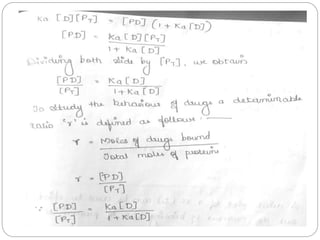
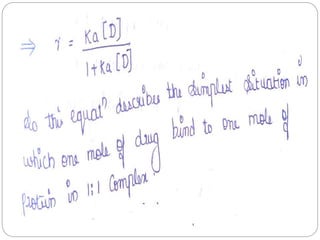
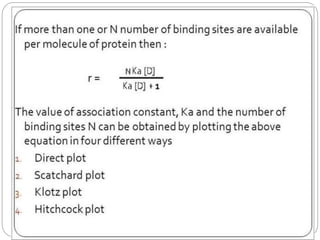
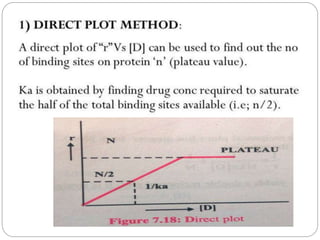
    KINETICS OF PROTEIN– DRUG BINDING
  • 68.
    Methods for studyingdrug- protein binding 1. Equilibrium Dialysis Method  Used in determining extent of protein binding of drugs  Complexation of metal ions with macromolecules can also be studied  This method is inconvenient to use over a wide range of temp.
  • 69.
     Visking cellulosetube: serum albumin  Outside vessel: diff conc of drug
  • 70.
    2. Dynamic dialysismethod  Its an economical method  Quick method to establish drug- protein binding  This method is based on the rate of disappearance of drug from dialysis bag which is proportional to conc of unbound drug  Dialysis process follows rate law, d[Dt]/dt = k[Df] [Dt] ------ conc of total drug [Df] ------ conc of free(unbound) drug in bag k --------- first order rate constant/ apparent permeability rate constant
  • 71.
     Dialysis bag:drug solution  Outside vessel: buffer
  • 74.
    References 1. Physical PharmaceuticsI by Dr. Shalini Sharma and Dr. Surajj Sarode. 2. Text Book of Physical Pharmaceutics by CVS Subrahmanyam.
  • 75.