COMPLEXATION AND
PROTEIN BINDING
COMPLEXATION . THIS IS A PROCESS OR TECHINQUE OF ASSOCIATION OR
COMBINATION OGF TWO OR MORE IONS MOLECULES ATOMS TO FROM COMPLEX.
COMPEX: ARE THE COMPOUND HAVING TWO COMPOUND 1 DONOR 2 ACCEPTOR
LIGNAND IS A COMPOUND CONTAIN THE LONE PAIR OF ELECTRONS ACCEPT THE
METAL ION TO FORM A COMPLEX
MECHANISM
• 1DONOR –ACCEPTOR MECHANISM EG O2 , N2
• 2 WEAK BOND AND HYDROGEN BOND ATTACHMENT
• 3 PHYSICAL INTERACTION
• COMPLEXTION IN PHARMACEUTICS USED TO PHYSIOCHEMICAL
PROPERTIES ( CHEMICAL , PH) FORMULATIONS ( STABILITY , SOLUBILITY)N
• ADME PROCESS
• COMPENTS OF COMPLEXATION
• substrate ( acceptor) metal ion
• Ligand ; monodenatate 1 Bidanate 2 polydenote3
• Protein binding: protein + drug = complex
• By drug co-sehive by zero order.
CLASSIFICATION OF COMPLEXATION
• 1 . METAL ION COMPLEX 2 ORAGNIC COMPLEX 3 INCLUSSION 
• 1.METAL IONCOMPEX ;
• 1 INO RGANIC TYPE .they mostly provided one attachment side eg
ammonia metal+ inorganic lignand
• 2 chelates. The chelates are compound more than one attachment of
metal ion eg edta
• 3 olefin type . These are the alkenes compex thes are oliy compunds .
Aqsoln metal ion + lignand = complex mostly used as catalylst.
• 4 AROMATIC TYPE ; metal ion combine with aromatic type like benzene
toluene eg fenocence
Organic complex
Organic complex : Also called as addition complex because of molecules of
hydrogen are oxygen interaction of hydrogen bond covalent bond dipole moment.
Picric acid complex: the picric acid is a organic compound to use for the complex
with many drugs and any drugs it is the strongest acid also called as charge
transfer complex S1 to s2 higher electronic negativity to lower electronegativity
example. Butisin
applications :stability purpose ,new compound estimation of ceratin study
caffeine complex : organic compound used for the organic complex with acid
compound caffeine +acid compound
example Procaine
Applications: increase the stability of drugs, increases solubility of drug
polymer complex& Quinine hydrone
• poloymer complex : This are the organic compounds polymers are
pharmaceutical additives
• Example. PEG utilisation of CMC polymer additives +drugs
• examples tanic acid
• applications: drugs slow release by 0 order
• Quinin hydrone complex :it is organic compound used for the
formation of complex with organic molecules and other HQ +
• benzoquinun alcohol solution
• applications increase the stability of drugs
inclusion type complex
inclusion type complex: Also called as entrapment complex This has two molecules systems 1 host
molecule 2 ghost molecule
Base of attachment by physical attraction
1.Channel type complex: those molecules form a channels the gas molecules enter traped in the channel.
example urea molecules
2. Clathrates type complex: host molecule form a cage in the gas entrapped . The cage like structure and
guest traped with the host molecule interaction example k +
3 layer type complex :host molecules form a layer guest molecules are entrapped example hydrocarbon
4.Monomolecular type complex: single guest molecule is trapped Asprin as guest molecule
5.Micromolecular type complex multiple type of guest molecules entrapped
Applications of complexation &methods of
analysis
Physical state of compound liquid to solid change ,
reduction of volatility eg iodine
increase the stability of drugs, increase the solubility of ,drugs increase
the chemical stability of drug
Methods of analysis: measurement of complex formation is expersed in
mathematically represents by k ,k = DC D/c .k =equal to stability
constant. DC complex drug, D = uncomplex drug, c= uncomplex agent ,
Methods 1. continues variation method 2. ph titration method
3 . Solubility method 4 .distribution method 5. spectroscopic method
continuous variation method
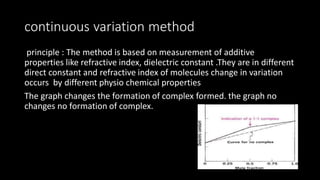
principle : The method is based on measurement of additive
properties like refractive index, dielectric constant .They are in different
direct constant and refractive index of molecules change in variation
occurs by different physio chemical properties
The graph changes the formation of complex formed. the graph no
changes no formation of complex.
PH TITRATION METHOD
• Based on pH change it is very useful to analysis complex .
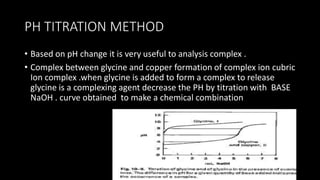
• Complex between glycine and copper formation of complex ion cubric
Ion complex .when glycine is added to form a complex to release
glycine is a complexing agent decrease the PH by titration with BASE
NaOH . curve obtained to make a chemical combination
Solubility method& Distribution method &
Spectroscopy method
• Solubility method: presence of complexing agent PABA+ caffeine
Complexing agent is added to with combine drugs to form a complex.
Decreases solubility (pABA + caffeine)/ PABA+ caffeine.
• Distribution method : Based on distribution of solute with between
two immiscible liquids in constant eg .i2 + ki = ki3
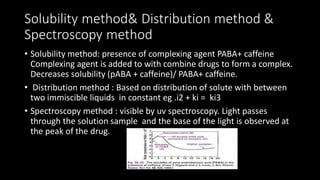
• Spectroscopy method : visible by uv spectroscopy. Light passes
through the solution sample and the base of the light is observed at
the peak of the drug.
Protein binding.
• IT is a process of complexation . Drug + protein = drug protein
complex. Protein bound drugs : bind with protein neither
metabolism nor excerted pharmalogical inactive.
• Proteins : 1. albumin. 2. alpha acid glycoprotein 3 lipoprotein 4
globulin.
• Protein binding : 1 reversible = weak bond
• 2 irreversible = strong bond = toxicity produced .
• 1 ALBUMIN : FOR BIND SITE . MOST OF DRUGS I phase major
component of plasma protein. synthesis in liver .
PROTEINS
• 2 .ALPHA - ACID GLYCOPROTEIN .
• BASIC DRUG CHLOZMAZINE , ACIDIC ; DICLOFANC NEUTRAL;
CYCLOPAM
• 3 . Globulin : alpha steroids alpha 2 vitm ADK
• 4 BLOOD CELLS ; RBC BLOOD 40% BLOOD CELLS 95% RBC &
HEOMOGLOBIN .
• SIGINFANCE : ADME , DIAGONSIS
FACTORS EFFECT OF PB & COMPLEXATION
AND action
• 1 drug related ; properties physio chemical con”c of drug .
• 2 . Protein related : physiochemical binding . Protein low .
• 3 drug interactions : displacement reaction bw drug
4 patient related factor
• CM .ACTION ; Thermodynamically that constant enhances ,inhibit
solubility low action, absorption high, pvd ,stability related , polar
distribution.
THANK YOU ALL BEST
•THANK YOU
• S . KALYAN B PHARM

COMPLEXATION AND PROTEIN BINDING. B.pharm

  • 1.
    COMPLEXATION AND PROTEIN BINDING COMPLEXATION. THIS IS A PROCESS OR TECHINQUE OF ASSOCIATION OR COMBINATION OGF TWO OR MORE IONS MOLECULES ATOMS TO FROM COMPLEX. COMPEX: ARE THE COMPOUND HAVING TWO COMPOUND 1 DONOR 2 ACCEPTOR LIGNAND IS A COMPOUND CONTAIN THE LONE PAIR OF ELECTRONS ACCEPT THE METAL ION TO FORM A COMPLEX
  • 2.
    MECHANISM • 1DONOR –ACCEPTORMECHANISM EG O2 , N2 • 2 WEAK BOND AND HYDROGEN BOND ATTACHMENT • 3 PHYSICAL INTERACTION • COMPLEXTION IN PHARMACEUTICS USED TO PHYSIOCHEMICAL PROPERTIES ( CHEMICAL , PH) FORMULATIONS ( STABILITY , SOLUBILITY)N • ADME PROCESS • COMPENTS OF COMPLEXATION • substrate ( acceptor) metal ion • Ligand ; monodenatate 1 Bidanate 2 polydenote3 • Protein binding: protein + drug = complex • By drug co-sehive by zero order.
  • 3.
    CLASSIFICATION OF COMPLEXATION •1 . METAL ION COMPLEX 2 ORAGNIC COMPLEX 3 INCLUSSION • 1.METAL IONCOMPEX ; • 1 INO RGANIC TYPE .they mostly provided one attachment side eg ammonia metal+ inorganic lignand • 2 chelates. The chelates are compound more than one attachment of metal ion eg edta • 3 olefin type . These are the alkenes compex thes are oliy compunds . Aqsoln metal ion + lignand = complex mostly used as catalylst. • 4 AROMATIC TYPE ; metal ion combine with aromatic type like benzene toluene eg fenocence
  • 4.
    Organic complex Organic complex: Also called as addition complex because of molecules of hydrogen are oxygen interaction of hydrogen bond covalent bond dipole moment. Picric acid complex: the picric acid is a organic compound to use for the complex with many drugs and any drugs it is the strongest acid also called as charge transfer complex S1 to s2 higher electronic negativity to lower electronegativity example. Butisin applications :stability purpose ,new compound estimation of ceratin study caffeine complex : organic compound used for the organic complex with acid compound caffeine +acid compound example Procaine Applications: increase the stability of drugs, increases solubility of drug
  • 5.
    polymer complex& Quininehydrone • poloymer complex : This are the organic compounds polymers are pharmaceutical additives • Example. PEG utilisation of CMC polymer additives +drugs • examples tanic acid • applications: drugs slow release by 0 order • Quinin hydrone complex :it is organic compound used for the formation of complex with organic molecules and other HQ + • benzoquinun alcohol solution • applications increase the stability of drugs
  • 6.
    inclusion type complex inclusiontype complex: Also called as entrapment complex This has two molecules systems 1 host molecule 2 ghost molecule Base of attachment by physical attraction 1.Channel type complex: those molecules form a channels the gas molecules enter traped in the channel. example urea molecules 2. Clathrates type complex: host molecule form a cage in the gas entrapped . The cage like structure and guest traped with the host molecule interaction example k + 3 layer type complex :host molecules form a layer guest molecules are entrapped example hydrocarbon 4.Monomolecular type complex: single guest molecule is trapped Asprin as guest molecule 5.Micromolecular type complex multiple type of guest molecules entrapped
  • 7.
    Applications of complexation&methods of analysis Physical state of compound liquid to solid change , reduction of volatility eg iodine increase the stability of drugs, increase the solubility of ,drugs increase the chemical stability of drug Methods of analysis: measurement of complex formation is expersed in mathematically represents by k ,k = DC D/c .k =equal to stability constant. DC complex drug, D = uncomplex drug, c= uncomplex agent , Methods 1. continues variation method 2. ph titration method 3 . Solubility method 4 .distribution method 5. spectroscopic method
  • 8.
    continuous variation method principle: The method is based on measurement of additive properties like refractive index, dielectric constant .They are in different direct constant and refractive index of molecules change in variation occurs by different physio chemical properties The graph changes the formation of complex formed. the graph no changes no formation of complex.
  • 9.
    PH TITRATION METHOD •Based on pH change it is very useful to analysis complex . • Complex between glycine and copper formation of complex ion cubric Ion complex .when glycine is added to form a complex to release glycine is a complexing agent decrease the PH by titration with BASE NaOH . curve obtained to make a chemical combination
  • 10.
    Solubility method& Distributionmethod & Spectroscopy method • Solubility method: presence of complexing agent PABA+ caffeine Complexing agent is added to with combine drugs to form a complex. Decreases solubility (pABA + caffeine)/ PABA+ caffeine. • Distribution method : Based on distribution of solute with between two immiscible liquids in constant eg .i2 + ki = ki3 • Spectroscopy method : visible by uv spectroscopy. Light passes through the solution sample and the base of the light is observed at the peak of the drug.
  • 11.
    Protein binding. • ITis a process of complexation . Drug + protein = drug protein complex. Protein bound drugs : bind with protein neither metabolism nor excerted pharmalogical inactive. • Proteins : 1. albumin. 2. alpha acid glycoprotein 3 lipoprotein 4 globulin. • Protein binding : 1 reversible = weak bond • 2 irreversible = strong bond = toxicity produced . • 1 ALBUMIN : FOR BIND SITE . MOST OF DRUGS I phase major component of plasma protein. synthesis in liver .
  • 12.
    PROTEINS • 2 .ALPHA- ACID GLYCOPROTEIN . • BASIC DRUG CHLOZMAZINE , ACIDIC ; DICLOFANC NEUTRAL; CYCLOPAM • 3 . Globulin : alpha steroids alpha 2 vitm ADK • 4 BLOOD CELLS ; RBC BLOOD 40% BLOOD CELLS 95% RBC & HEOMOGLOBIN . • SIGINFANCE : ADME , DIAGONSIS
  • 13.
    FACTORS EFFECT OFPB & COMPLEXATION AND action • 1 drug related ; properties physio chemical con”c of drug . • 2 . Protein related : physiochemical binding . Protein low . • 3 drug interactions : displacement reaction bw drug 4 patient related factor • CM .ACTION ; Thermodynamically that constant enhances ,inhibit solubility low action, absorption high, pvd ,stability related , polar distribution.
  • 14.
    THANK YOU ALLBEST •THANK YOU • S . KALYAN B PHARM