
Pediatric Arrhythmia 台大醫院小兒部 邱舜南醫師
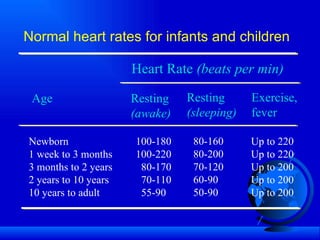
Newborn 1 week to 3 months 3 months to 2 years 2 years to 10 years 10 years to adult 100-180 100-220 80-170 70-110 55-90 80-160 80-200 70-120 60-90 50-90 Up to 220 Up to 220 Up to 200 Up to 200 Up to 200 Age Resting (awake) Resting (sleeping) Exercise, fever Heart Rate  (beats per min) Normal heart rates for infants and children
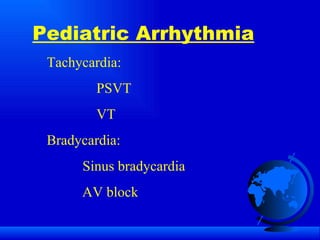
Pediatric Arrhythmia Tachycardia:  PSVT VT Bradycardia:  Sinus bradycardia   AV block
Paroxysmal  supraventricular tachycardia
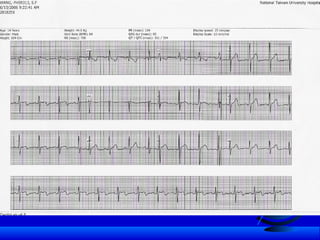
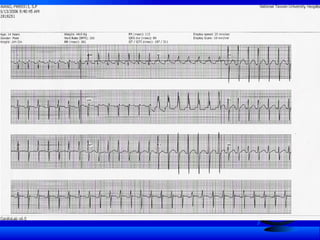
Supraventricular tachycardia in pediatric patients * HR 215-350  (mean 280)  in infants * 98% narrow QRS * Atrial fibrillation 0.4% 1-4% in infants with preexcitation
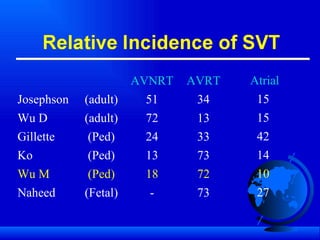
Josephson Wu D Gillette Ko Wu M Naheed (adult) (adult) (Ped) (Ped) (Ped) (Fetal) AVNRT 51 72 24 13 18 - AVRT 34 13 33 73 72 73 Atrial 15 15 42 14 10 27
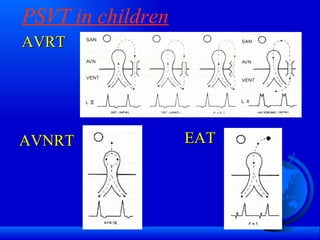
PSVT in children AVRT AVNRT EAT
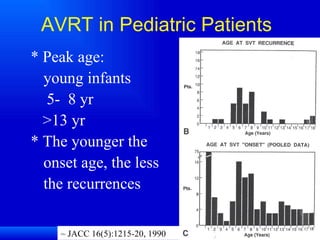
AVRT in Pediatric Patients * Peak age:  young infants 5-  8 yr >13 yr * The younger the onset age, the less the recurrences ~ JACC 16(5):1215-20, 1990
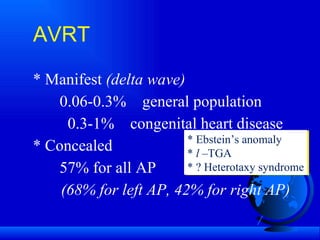
AVRT * Manifest  (delta wave) 0.06-0.3%  general population   0.3-1%  congenital heart disease * Concealed 57% for all AP   (68% for left AP, 42% for right AP) * Ebstein’s anomaly *  l  –TGA * ? Heterotaxy syndrome
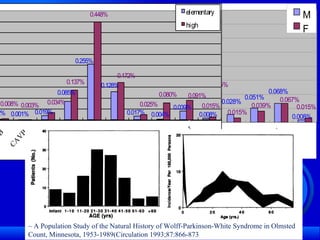
WPW WPW ~ A Population Study of the Natural History of Wolff-Parkinson-White Syndrome in Olmsted Count, Minnesota, 1953-1989(Circulation 1993;87:866-873
Preexcitation and Wolff-Parkinson-White Syndrome Bundle branch block with short PR interval in healthy young people prone to paroxysmal tachycardia  Wolff L, Parkinson J, White PD. Am Heart J 1930:5:686-692.
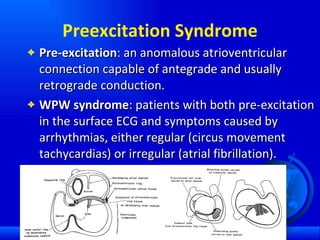
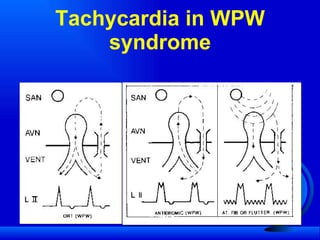
Preexcitation Syndrome Pre-excitation : an anomalous atrioventricular connection capable of antegrade and usually retrograde conduction.  WPW syndrome : patients with both pre-excitation in the surface ECG and symptoms caused by arrhythmias, either regular (circus movement tachycardias) or irregular (atrial fibrillation).
Tachycardia in WPW syndrome
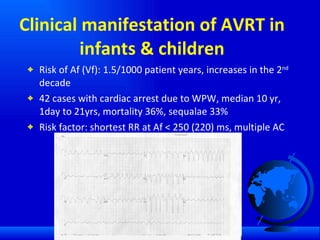
Clinical manifestation of AVRT in infants & children Risk of Af (Vf): 1.5/1000 patient years, increases in the 2 nd  decade 42 cases with cardiac arrest due to WPW, median 10 yr, 1day to 21yrs, mortality 36%, sequalae 33% Risk factor: shortest RR at Af < 250 (220) ms, multiple AC ,
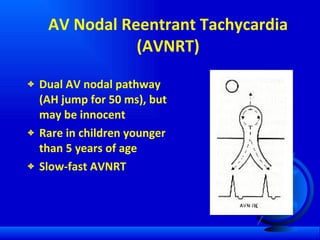
AV Nodal Reentrant Tachycardia (AVNRT) Dual AV nodal pathway (AH jump for 50 ms), but may be innocent Rare in children younger than 5 years of age Slow-fast AVNRT
 
 
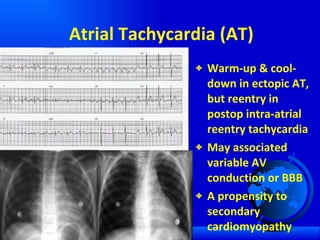
Atrial Tachycardia (AT) Warm-up & cool-down in ectopic AT, but reentry in postop intra-atrial reentry tachycardia May associated variable AV conduction or BBB A propensity to secondary cardiomyopathy
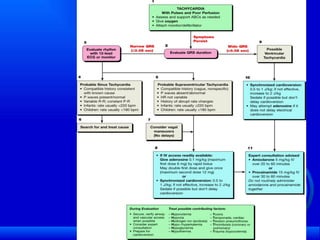
Management of SVT Vagal maneuver Adenosine Rapid flush from IV cath nearest to heart 0.1 then 0.2mg/kg (max. 6 then 12mg) Verapamil : 0.1 mg/kg,  contraindicate  in infant, use careful in young child, not use in manifest WPW Digoxin, ß-blocker, Procainamide, Amiodarone  Cardioversion if hemodaynamically unstable
 
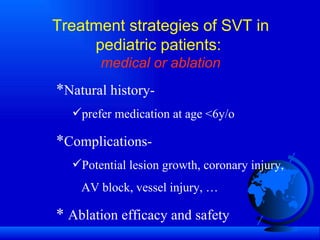
Treatment strategies of SVT in pediatric patients:  medical or ablation * Natural history-  prefer medication at age <6y/o * Complications- Potential lesion growth, coronary injury,    AV block, vessel injury, … *  Ablation efficacy and safety
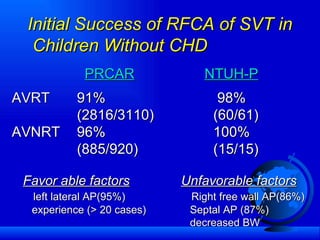
Initial Success of RFCA of SVT in  Children Without CHD AVRT   91%   (2816/3110) AVNRT   96%   (885/920) 98% (60/61) 100% (15/15) PRCAR NTUH-P Favor able factors left lateral AP(95%) experience (> 20 cases) Unfavorable factors Right free wall AP(86%) Septal AP (87%) decreased BW
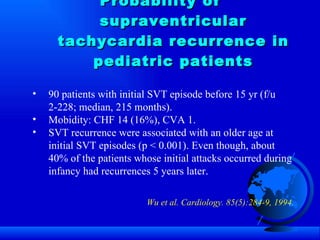
Probability of supraventricular tachycardia recurrence in pediatric patients Wu et al. Cardiology. 85(5):284-9, 1994. 90 patients with initial SVT episode before 15 yr (f/u 2-228; median, 215 months).  Mobidity: CHF 14 (16%), CVA 1.  SVT recurrence were associated with an older age at initial SVT episodes (p < 0.001). Even though, about 40% of the patients whose initial attacks occurred during infancy had recurrences 5 years later.
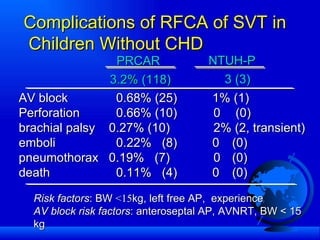
Complications of RFCA of SVT in  Children Without CHD AV block   0.68% (25)   1% (1) Perforation   0.66% (10)   0   (0) brachial palsy  0.27% (10)   2% (2, transient) emboli   0.22%  (8)   0  (0) pneumothorax  0.19%  (7)   0  (0) death    0.11%  (4)   0 (0) Risk factors : BW  <15 kg, left free AP,  experience AV block risk factors : anteroseptal AP, AVNRT, BW < 15 kg PRCAR NTUH-P 3.2% (118) 3 (3)
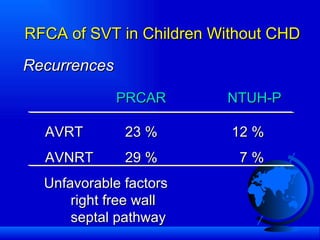
RFCA of SVT in Children Without CHD Recurrences AVRT 23 % 12 % AVNRT 29 %   7 % Unfavorable factors right free wall septal pathway PRCAR NTUH-P
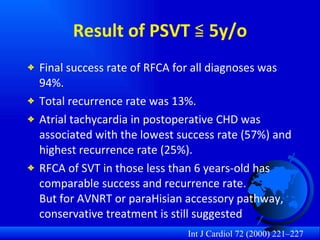
Result of PSVT  ≦  5y/o Final success rate of RFCA for all diagnoses was 94%. Total recurrence rate was 13%. Atrial tachycardia in postoperative CHD was associated with the lowest success rate (57%) and highest recurrence rate (25%). RFCA of SVT in those less than 6 years-old has comparable success and recurrence rate.  But for AVNRT or paraHisian accessory pathway, conservative treatment is still suggested  Int J Cardiol 72 (2000) 221–227
Ventricular Tachycardia
Etiology Relative rare in pediatric patients.   Congenital-  congenital long QT syndrome, Brugada syndrome?,  Arrhythmogenic RV dysplasia Idiopathic VT Acquired Myocarditis, HCM, DCM hypoxemia, acidosis, e- imbalance, toxin CHD postoperatively as TOF s/p  Myocardial tumor
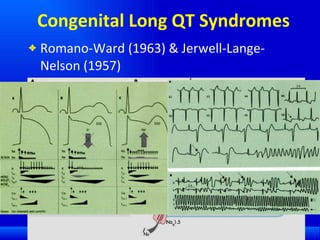
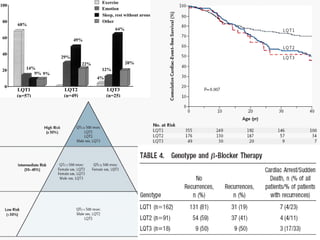
Congenital Long QT Syndromes Romano-Ward (1963) & Jerwell-Lange-Nelson (1957) Ion channel defects
ß-blocker therapy Left cardiac sympathetic denervation ICD implantation
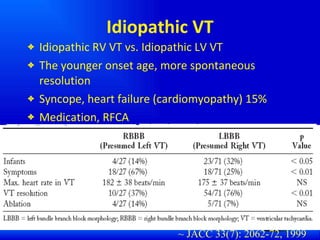
Idiopathic VT Idiopathic RV VT vs. Idiopathic LV VT The younger onset age, more spontaneous resolution Syncope, heart failure (cardiomyopathy) 15% Medication, RFCA ~ JACC 33(7): 2062-72, 1999
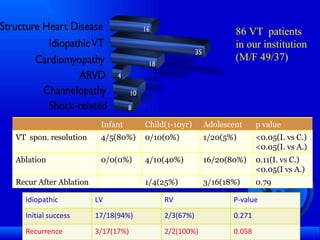
86 VT  patients in our institution (M/F 49/37) Infant Child(1-10yr) Adolescent p value VT  spon. resolution 4/5(80%) 0/10(0%) 1/20(5%) <0.05(I. vs C.) <0.05(I. vs A.) Ablation 0/0(0%) 4/10(40%) 16/20(80%) 0.11(I. vs C.) <0.05(I vs A.) Recur After Ablation 1/4(25%) 3/16(18%) 0.79 Idiopathic LV RV P-value Initial success 17/18(94%) 2/3(67%) 0.271 Recurrence 3/17(17%) 2/2(100%) 0.058
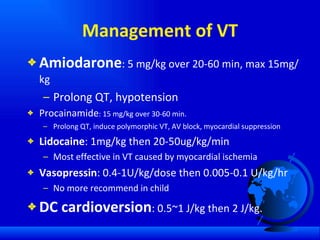
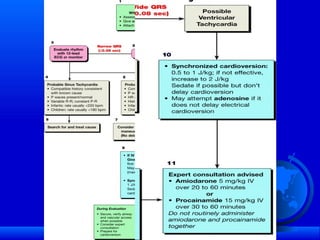
Management of VT Amiodarone : 5 mg/kg over 20-60 min, max 15mg/kg Prolong QT, hypotension Procainamide : 15 mg/kg over 30-60 min.  Prolong QT, induce polymorphic VT, AV block, myocardial suppression Lidocaine : 1mg/kg then 20-50ug/kg/min Most effective in VT caused by myocardial ischemia Vasopressin : 0.4-1U/kg/dose then 0.005-0.1 U/kg/hr No more recommend in child DC cardioversion : 0.5~1 J/kg then 2 J/kg.
 
 
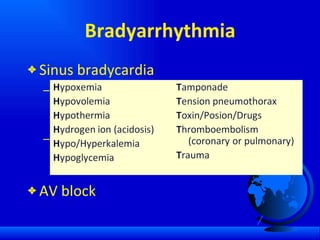
Bradyarrhythmia Sinus bradycardia Sinus node dysfunction (SSS) rare in children except CHD postoperatively (Senning, TCPC) Hypoxemia, hypothermia, acidosis, e- imbalance, toxin, … AV block
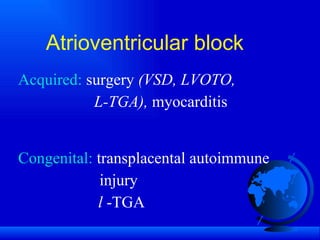
Atrioventricular block Acquired:  surgery  (VSD, LVOTO,  L-TGA),  myocarditis Congenital:  transplacental autoimmune   injury l  -TGA
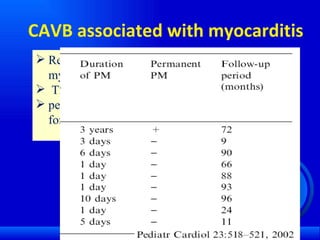
CAVB associated with myocarditis Return of AV conduction in 67% of young myocarditis with advanced AV block patients. The average time of recovery is 3.3 ± 2.8 days. persistent AV block > 1 week indicates the need for permanent cardiac pacing. ~  Pediatr Cardiol 24:495–497, 2003
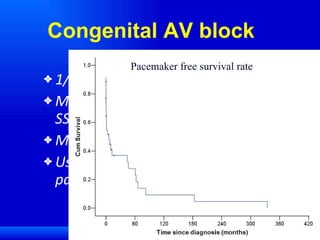
Congenital AV block 1/15,000 –20,000 live birth Maternal SLE with SSA/anti-Ro, SSB/anti-La (+) May associated with LQTS Usually irreversible and need a pacemaker  Pacemaker free survival rate
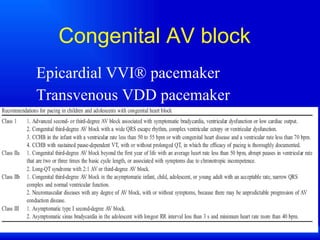
Congenital AV block Epicardial VVI® pacemaker Transvenous VDD pacemaker
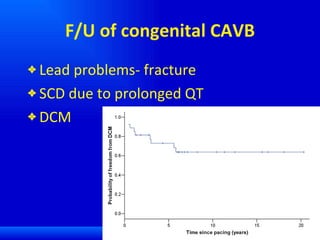
F/U of congenital CAVB Lead problems- fracture SCD due to prolonged QT DCM
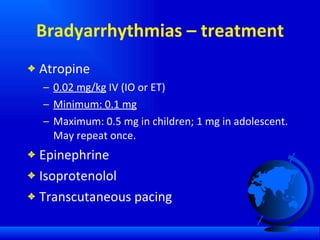
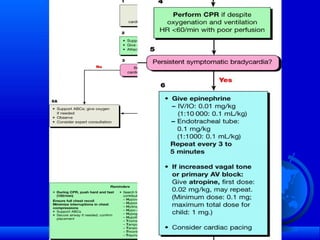
Bradyarrhythmias – treatment Atropine 0.02 mg/kg  IV (IO or ET) Minimum: 0.1 mg Maximum: 0.5 mg in children; 1 mg in adolescent. May repeat once. Epinephrine Isoprotenolol Transcutaneous pacing
 
Thanks for your attention!

Pediatric arrhythmia

  • 1.
  • 2.
    Newborn 1 weekto 3 months 3 months to 2 years 2 years to 10 years 10 years to adult 100-180 100-220 80-170 70-110 55-90 80-160 80-200 70-120 60-90 50-90 Up to 220 Up to 220 Up to 200 Up to 200 Up to 200 Age Resting (awake) Resting (sleeping) Exercise, fever Heart Rate (beats per min) Normal heart rates for infants and children
  • 3.
    Pediatric Arrhythmia Tachycardia: PSVT VT Bradycardia: Sinus bradycardia AV block
  • 4.
  • 5.
    Supraventricular tachycardia inpediatric patients * HR 215-350 (mean 280) in infants * 98% narrow QRS * Atrial fibrillation 0.4% 1-4% in infants with preexcitation
  • 6.
    Josephson Wu DGillette Ko Wu M Naheed (adult) (adult) (Ped) (Ped) (Ped) (Fetal) AVNRT 51 72 24 13 18 - AVRT 34 13 33 73 72 73 Atrial 15 15 42 14 10 27
  • 7.
    PSVT in childrenAVRT AVNRT EAT
  • 8.
    AVRT in PediatricPatients * Peak age: young infants 5- 8 yr >13 yr * The younger the onset age, the less the recurrences ~ JACC 16(5):1215-20, 1990
  • 9.
    AVRT * Manifest (delta wave) 0.06-0.3% general population 0.3-1% congenital heart disease * Concealed 57% for all AP (68% for left AP, 42% for right AP) * Ebstein’s anomaly * l –TGA * ? Heterotaxy syndrome
  • 10.
    WPW WPW ~A Population Study of the Natural History of Wolff-Parkinson-White Syndrome in Olmsted Count, Minnesota, 1953-1989(Circulation 1993;87:866-873
  • 11.
    Preexcitation and Wolff-Parkinson-WhiteSyndrome Bundle branch block with short PR interval in healthy young people prone to paroxysmal tachycardia Wolff L, Parkinson J, White PD. Am Heart J 1930:5:686-692.
  • 12.
    Preexcitation Syndrome Pre-excitation: an anomalous atrioventricular connection capable of antegrade and usually retrograde conduction. WPW syndrome : patients with both pre-excitation in the surface ECG and symptoms caused by arrhythmias, either regular (circus movement tachycardias) or irregular (atrial fibrillation).
  • 13.
  • 14.
    Clinical manifestation ofAVRT in infants & children Risk of Af (Vf): 1.5/1000 patient years, increases in the 2 nd decade 42 cases with cardiac arrest due to WPW, median 10 yr, 1day to 21yrs, mortality 36%, sequalae 33% Risk factor: shortest RR at Af < 250 (220) ms, multiple AC ,
  • 15.
    AV Nodal ReentrantTachycardia (AVNRT) Dual AV nodal pathway (AH jump for 50 ms), but may be innocent Rare in children younger than 5 years of age Slow-fast AVNRT
  • 16.
  • 17.
  • 18.
    Atrial Tachycardia (AT)Warm-up & cool-down in ectopic AT, but reentry in postop intra-atrial reentry tachycardia May associated variable AV conduction or BBB A propensity to secondary cardiomyopathy
  • 19.
    Management of SVTVagal maneuver Adenosine Rapid flush from IV cath nearest to heart 0.1 then 0.2mg/kg (max. 6 then 12mg) Verapamil : 0.1 mg/kg, contraindicate in infant, use careful in young child, not use in manifest WPW Digoxin, ß-blocker, Procainamide, Amiodarone Cardioversion if hemodaynamically unstable
  • 20.
  • 21.
    Treatment strategies ofSVT in pediatric patients: medical or ablation * Natural history- prefer medication at age <6y/o * Complications- Potential lesion growth, coronary injury, AV block, vessel injury, … * Ablation efficacy and safety
  • 22.
    Initial Success ofRFCA of SVT in Children Without CHD AVRT 91% (2816/3110) AVNRT 96% (885/920) 98% (60/61) 100% (15/15) PRCAR NTUH-P Favor able factors left lateral AP(95%) experience (> 20 cases) Unfavorable factors Right free wall AP(86%) Septal AP (87%) decreased BW
  • 23.
    Probability of supraventriculartachycardia recurrence in pediatric patients Wu et al. Cardiology. 85(5):284-9, 1994. 90 patients with initial SVT episode before 15 yr (f/u 2-228; median, 215 months). Mobidity: CHF 14 (16%), CVA 1. SVT recurrence were associated with an older age at initial SVT episodes (p < 0.001). Even though, about 40% of the patients whose initial attacks occurred during infancy had recurrences 5 years later.
  • 24.
    Complications of RFCAof SVT in Children Without CHD AV block 0.68% (25) 1% (1) Perforation 0.66% (10) 0 (0) brachial palsy 0.27% (10) 2% (2, transient) emboli 0.22% (8) 0 (0) pneumothorax 0.19% (7) 0 (0) death 0.11% (4) 0 (0) Risk factors : BW <15 kg, left free AP, experience AV block risk factors : anteroseptal AP, AVNRT, BW < 15 kg PRCAR NTUH-P 3.2% (118) 3 (3)
  • 25.
    RFCA of SVTin Children Without CHD Recurrences AVRT 23 % 12 % AVNRT 29 % 7 % Unfavorable factors right free wall septal pathway PRCAR NTUH-P
  • 26.
    Result of PSVT ≦ 5y/o Final success rate of RFCA for all diagnoses was 94%. Total recurrence rate was 13%. Atrial tachycardia in postoperative CHD was associated with the lowest success rate (57%) and highest recurrence rate (25%). RFCA of SVT in those less than 6 years-old has comparable success and recurrence rate. But for AVNRT or paraHisian accessory pathway, conservative treatment is still suggested Int J Cardiol 72 (2000) 221–227
  • 27.
  • 28.
    Etiology Relative rarein pediatric patients. Congenital- congenital long QT syndrome, Brugada syndrome?, Arrhythmogenic RV dysplasia Idiopathic VT Acquired Myocarditis, HCM, DCM hypoxemia, acidosis, e- imbalance, toxin CHD postoperatively as TOF s/p Myocardial tumor
  • 29.
    Congenital Long QTSyndromes Romano-Ward (1963) & Jerwell-Lange-Nelson (1957) Ion channel defects
  • 30.
    ß-blocker therapy Leftcardiac sympathetic denervation ICD implantation
  • 31.
    Idiopathic VT IdiopathicRV VT vs. Idiopathic LV VT The younger onset age, more spontaneous resolution Syncope, heart failure (cardiomyopathy) 15% Medication, RFCA ~ JACC 33(7): 2062-72, 1999
  • 32.
    86 VT patients in our institution (M/F 49/37) Infant Child(1-10yr) Adolescent p value VT spon. resolution 4/5(80%) 0/10(0%) 1/20(5%) <0.05(I. vs C.) <0.05(I. vs A.) Ablation 0/0(0%) 4/10(40%) 16/20(80%) 0.11(I. vs C.) <0.05(I vs A.) Recur After Ablation 1/4(25%) 3/16(18%) 0.79 Idiopathic LV RV P-value Initial success 17/18(94%) 2/3(67%) 0.271 Recurrence 3/17(17%) 2/2(100%) 0.058
  • 33.
    Management of VTAmiodarone : 5 mg/kg over 20-60 min, max 15mg/kg Prolong QT, hypotension Procainamide : 15 mg/kg over 30-60 min. Prolong QT, induce polymorphic VT, AV block, myocardial suppression Lidocaine : 1mg/kg then 20-50ug/kg/min Most effective in VT caused by myocardial ischemia Vasopressin : 0.4-1U/kg/dose then 0.005-0.1 U/kg/hr No more recommend in child DC cardioversion : 0.5~1 J/kg then 2 J/kg.
  • 34.
  • 35.
  • 36.
    Bradyarrhythmia Sinus bradycardiaSinus node dysfunction (SSS) rare in children except CHD postoperatively (Senning, TCPC) Hypoxemia, hypothermia, acidosis, e- imbalance, toxin, … AV block
  • 37.
    Atrioventricular block Acquired: surgery (VSD, LVOTO, L-TGA), myocarditis Congenital: transplacental autoimmune injury l -TGA
  • 38.
    CAVB associated withmyocarditis Return of AV conduction in 67% of young myocarditis with advanced AV block patients. The average time of recovery is 3.3 ± 2.8 days. persistent AV block > 1 week indicates the need for permanent cardiac pacing. ~ Pediatr Cardiol 24:495–497, 2003
  • 39.
    Congenital AV block1/15,000 –20,000 live birth Maternal SLE with SSA/anti-Ro, SSB/anti-La (+) May associated with LQTS Usually irreversible and need a pacemaker Pacemaker free survival rate
  • 40.
    Congenital AV blockEpicardial VVI® pacemaker Transvenous VDD pacemaker
  • 41.
    F/U of congenitalCAVB Lead problems- fracture SCD due to prolonged QT DCM
  • 42.
    Bradyarrhythmias – treatmentAtropine 0.02 mg/kg IV (IO or ET) Minimum: 0.1 mg Maximum: 0.5 mg in children; 1 mg in adolescent. May repeat once. Epinephrine Isoprotenolol Transcutaneous pacing
  • 43.
  • 44.
    Thanks for yourattention!

Editor's Notes

  • #9 Onset at infant stage, disappear in 93%, but 31% recur at average 8 y/o. Onset age &gt;5y/o, persist in 78%.
  • #29 &lt;10% of terminal rhythm is VT in pediatric pt.
  • #30 &lt;=1 low, 2~3 intermediate, &gt;=4 high probability
  • #32 RVOT origin, LBBB with inf axis, sensitive to beta-blocker
  • #40 Mortality high when associate with CHD (5~8% vs. 29~40%) at previous reports (prior to NB pacemaker) V rate &lt;55bpm, wide QRS associate with mortality
  • #41 Risk factor DCM: Z score of average pacing rate (Z&gt;0.4) p=0.02, and age of pacemaker requirement, DCM- LVEDD&gt; 2SD or LVEF&lt;45% Epicardial- previous &lt;5y/o, &lt;30kg , now &lt;1y/o, &lt;8kg, vein occlusion, lead problem