
Multiplying Polynomials Fast

 Why do we need Complex
       Numbers?
The Problem


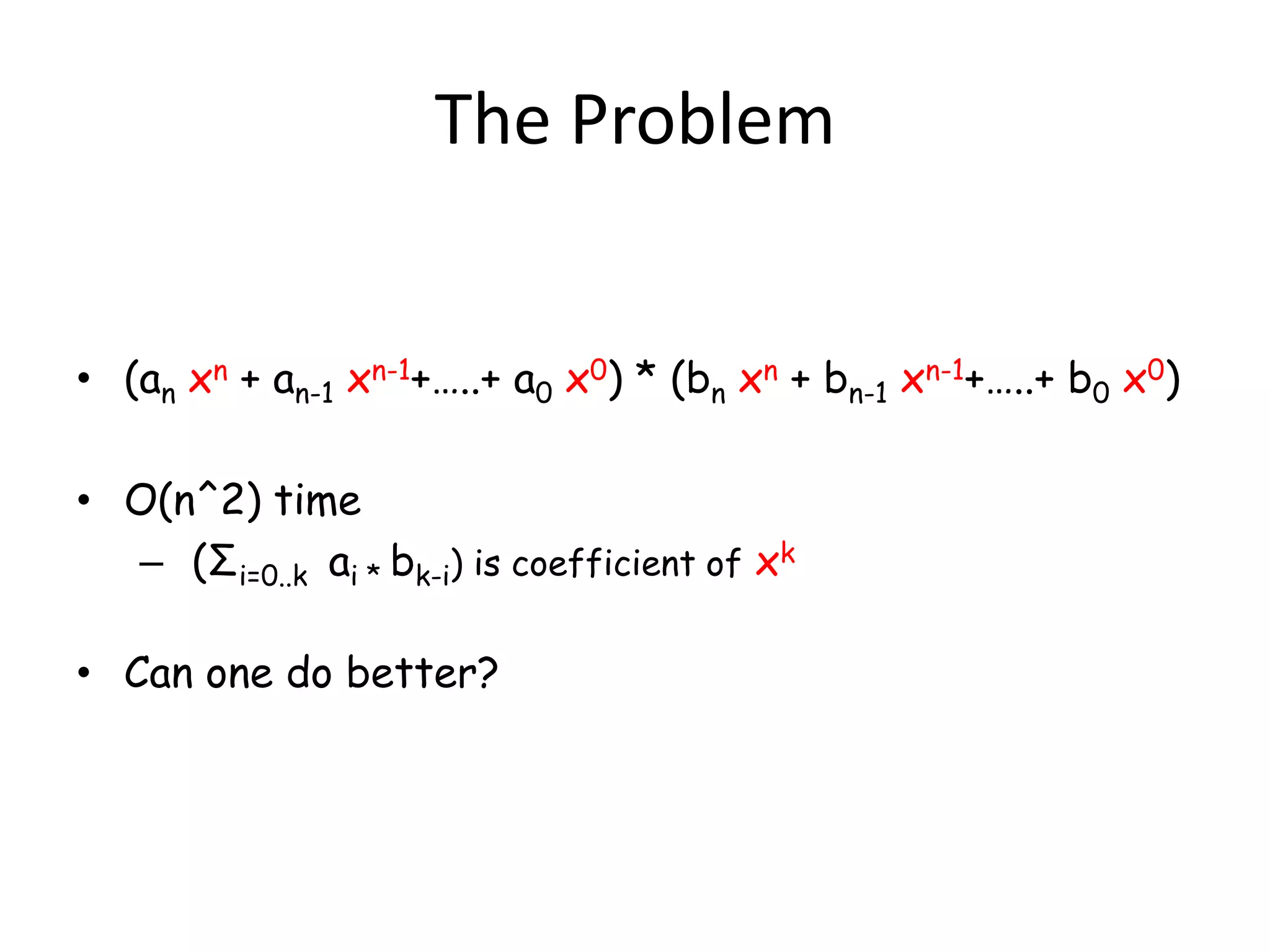
• (an xn + an-1 xn-1+…..+ a0 x0) * (bn xn + bn-1 xn-1+…..+ b0 x0)

• O(n^2) time
  – (Σi=0..k ai * bk-i) is coefficient of xk

• Can one do better?
Applications

• Where all does a pattern string P appear in a text string
  T?

   – P 0’s, 1’s and don’t cares.

   – T 0’s and 1’s


• Easy in O(|P|*|T|) time

   – Can one do better?
Conversion to Polynomial
                    Multiplication
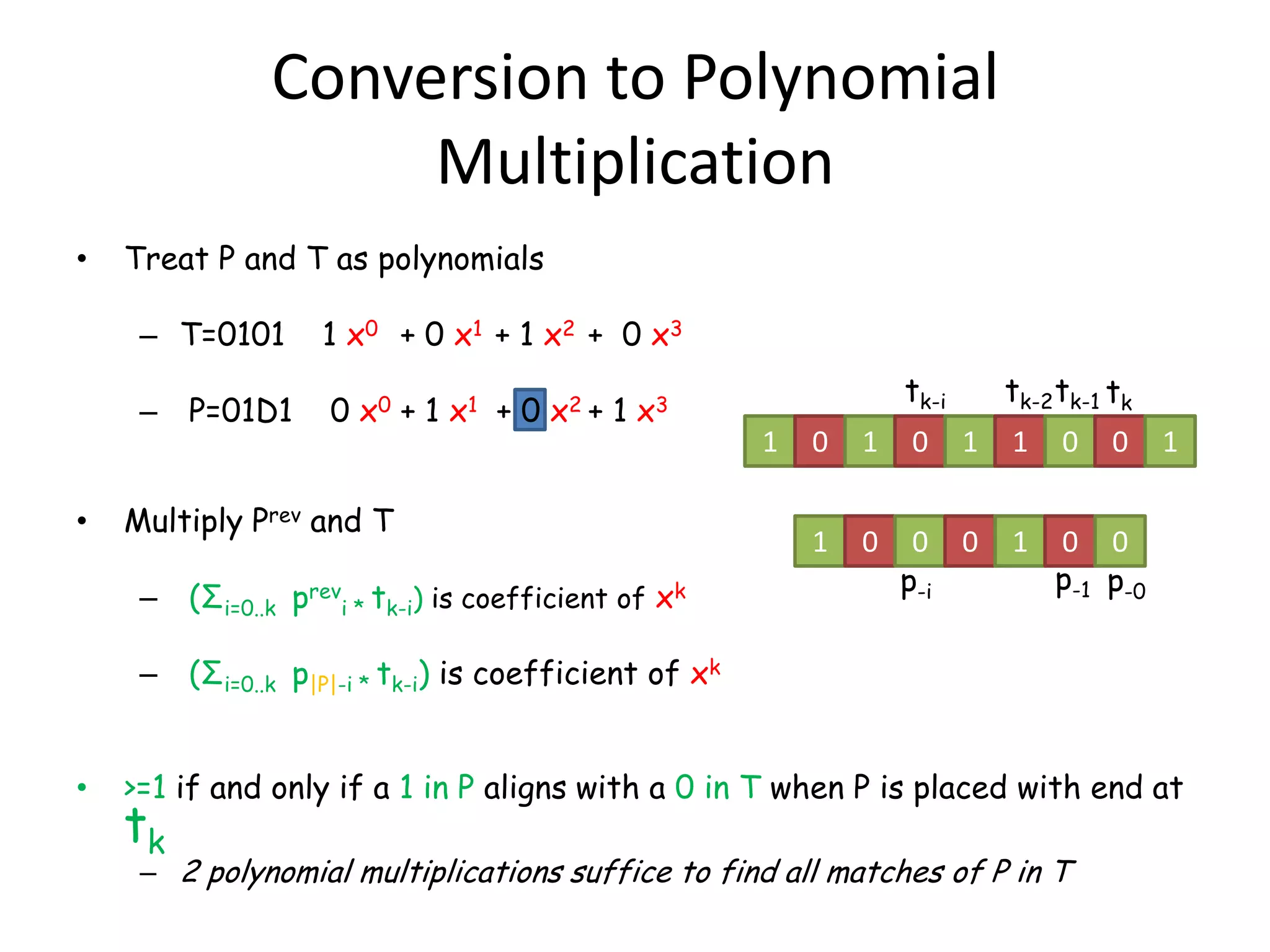
•   Treat P and T as polynomials

     – T=0101       1 x0 + 0 x1 + 1 x2 + 0 x3
                                                                  tk-i       tk-2 tk-1 tk
     – P=01D1       0 x0 + 1 x1 + 0 x2 + 1 x3
                                                      1   0   1   0      1   1    0    0    1

•   Multiply Prev and T
                                                          1   0    0 0       1   0 0
                                                                  p-i            p-1 p-0
     – (Σi=0..k previ * tk-i) is coefficient of xk

     – (Σi=0..k p|P|-i * tk-i) is coefficient of xk


•   >=1 if and only if a 1 in P aligns with a 0 in T when P is placed with end at
    tk
     – 2 polynomial multiplications suffice to find all matches of P in T
Other Applications

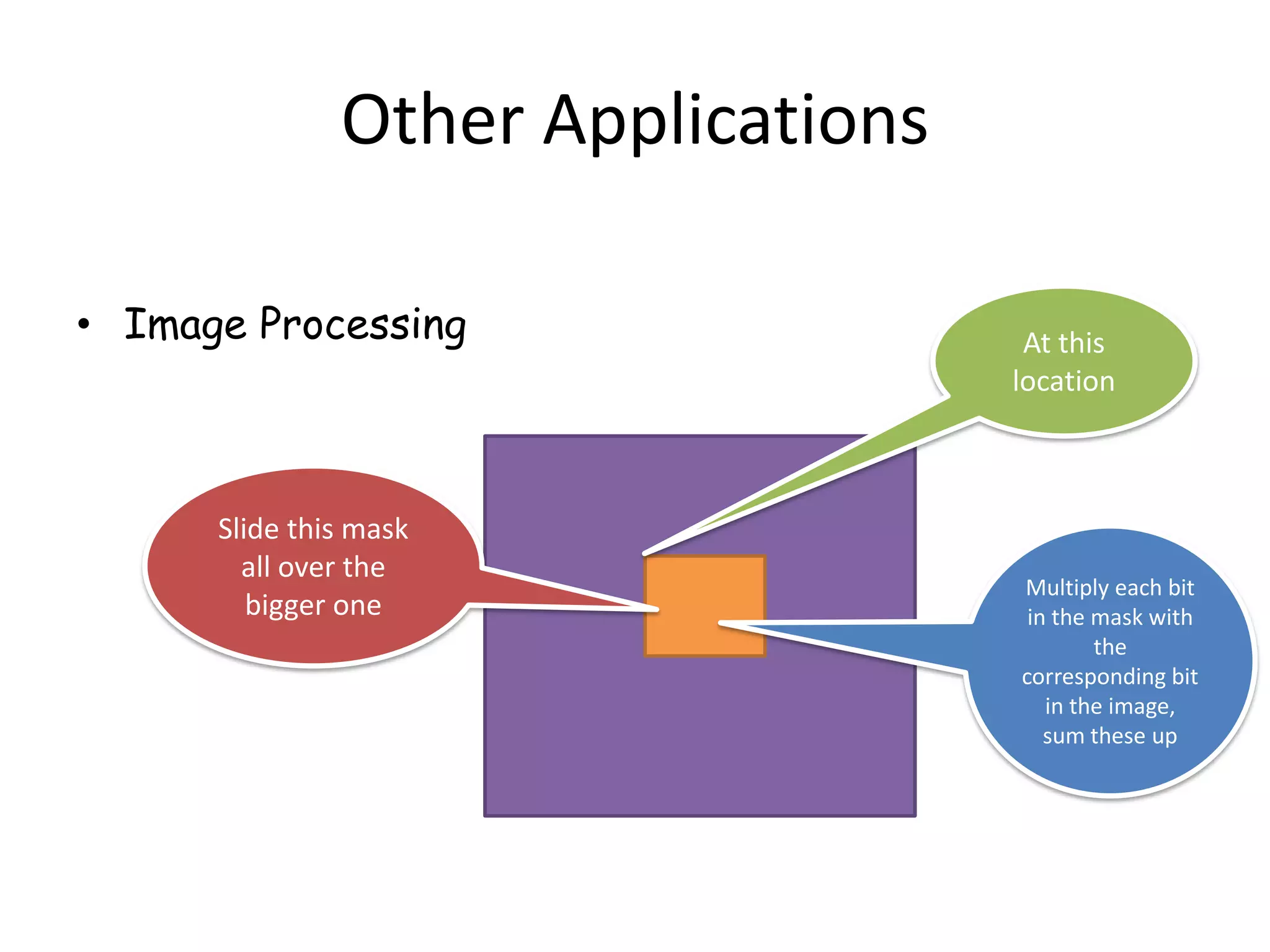
• Image Processing                   At this
                                    location


      Slide this mask
        all over the
                                    Multiply each bit
         bigger one                  in the mask with
                                            the
                                    corresponding bit
                                       in the image,
                                       sum these up
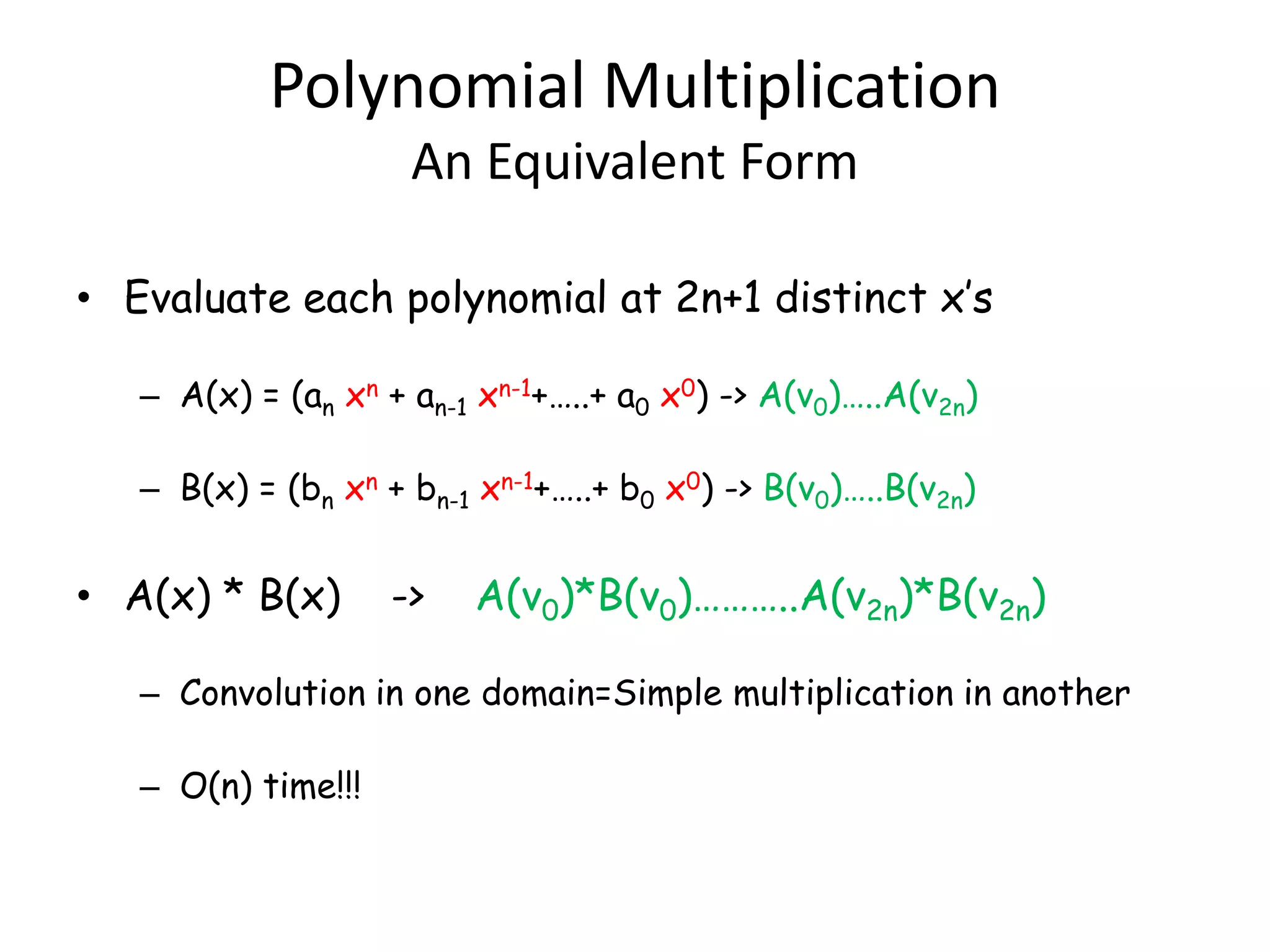
Polynomial Multiplication
                     An Equivalent Form

• Evaluate each polynomial at 2n+1 distinct x’s

   – A(x) = (an xn + an-1 xn-1+…..+ a0 x0) -> A(v0)…..A(v2n)

   – B(x) = (bn xn + bn-1 xn-1+…..+ b0 x0) -> B(v0)…..B(v2n)


• A(x) * B(x)       ->   A(v0)*B(v0)………..A(v2n)*B(v2n)

   – Convolution in one domain=Simple multiplication in another

   – O(n) time!!!
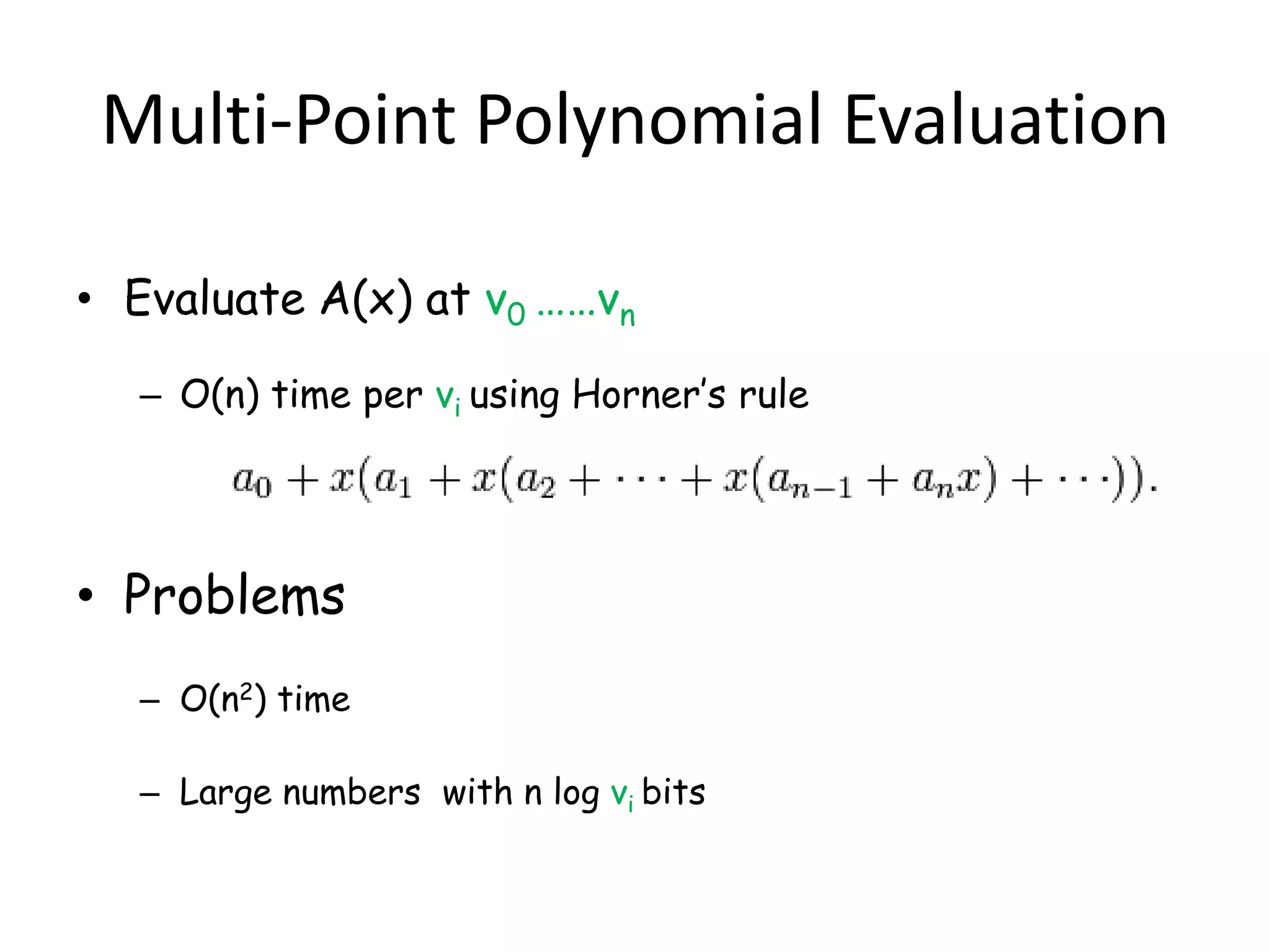
Multi-Point Polynomial Evaluation

• Evaluate A(x) at v0 ……vn

  – O(n) time per vi using Horner’s rule


• Problems
  – O(n2) time

  – Large numbers with n log vi bits
Multi-Point Polynomial Evaluation
                Speed Up
• A(x) mod (x-v)

   – A(v)

   – O(n) time using high school polynomial division


• A’(x) = A(x) mod (x-v0) (x-v1)         [how fast?]
   – A’(x) mod (x-v0) = A(v0)   [O(1)]

   – A’(x) mod (x-v1) = A(v1)   [O(1)]

   – 2 expensive polynomial divisions could potentially be replaced by 1
Fast Multi-Point Polynomial Evaluation

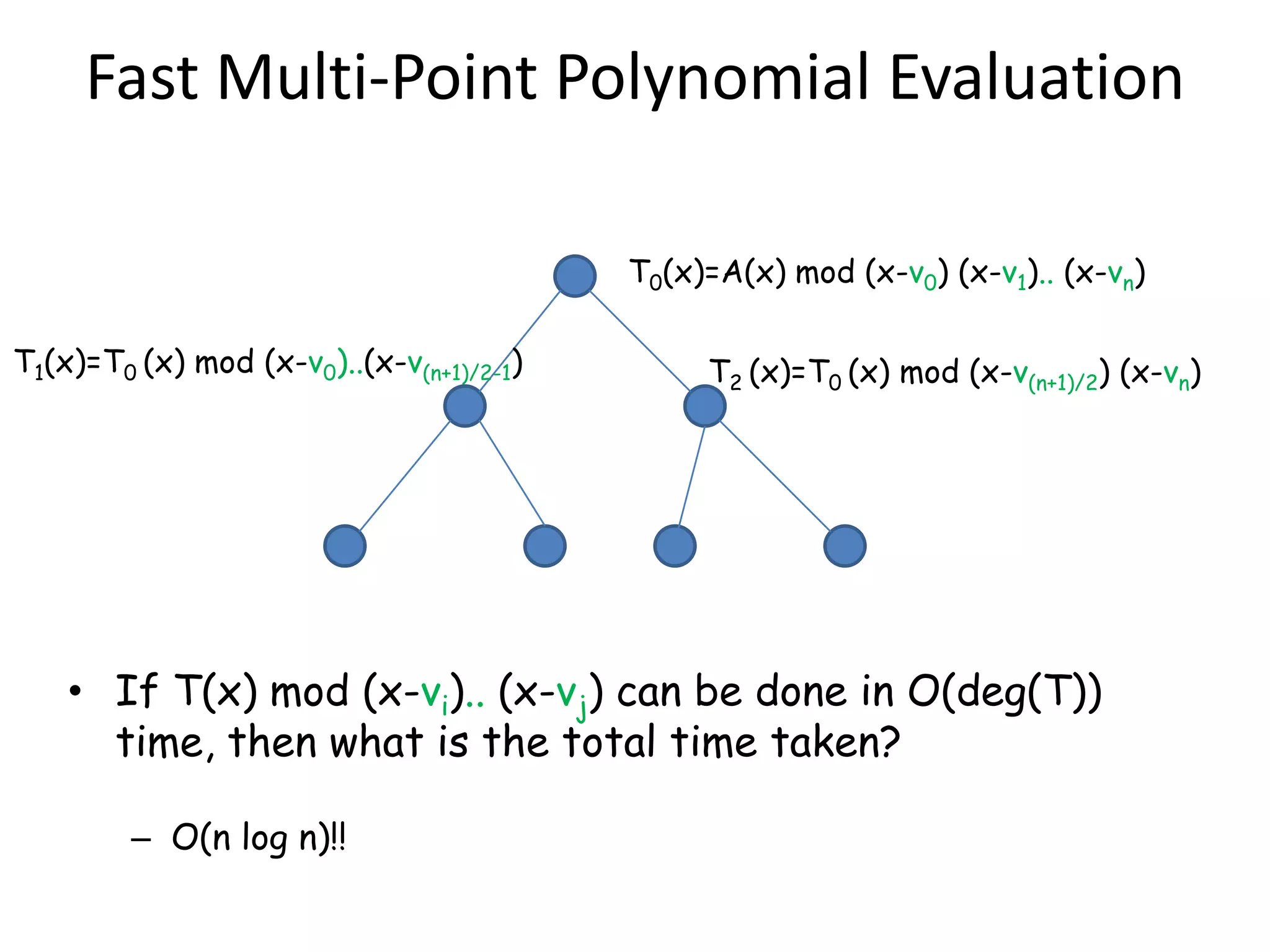
                                          T0(x)=A(x) mod (x-v0) (x-v1).. (x-vn)

T1(x)=T0 (x) mod (x-v0)..(x-v(n+1)/2-1)        T2 (x)=T0 (x) mod (x-v(n+1)/2) (x-vn)


    • If T(x) mod (x-vi).. (x-vj) can be done in O(deg(T))
      time, then what is the total time taken?

         – O(n log n)!!
Computing T(x) mod (x-v1).. (x-vk)

•   High school algorithm

    – Time taken: O( deg(T) * k )

    – How do we make this faster?


• Stroke of genius
       • Can we choose vi’s so (x-v1).. (x-vk) = xk-v?

       • Then we get O(deg(T) ) time
Choosing vi’s
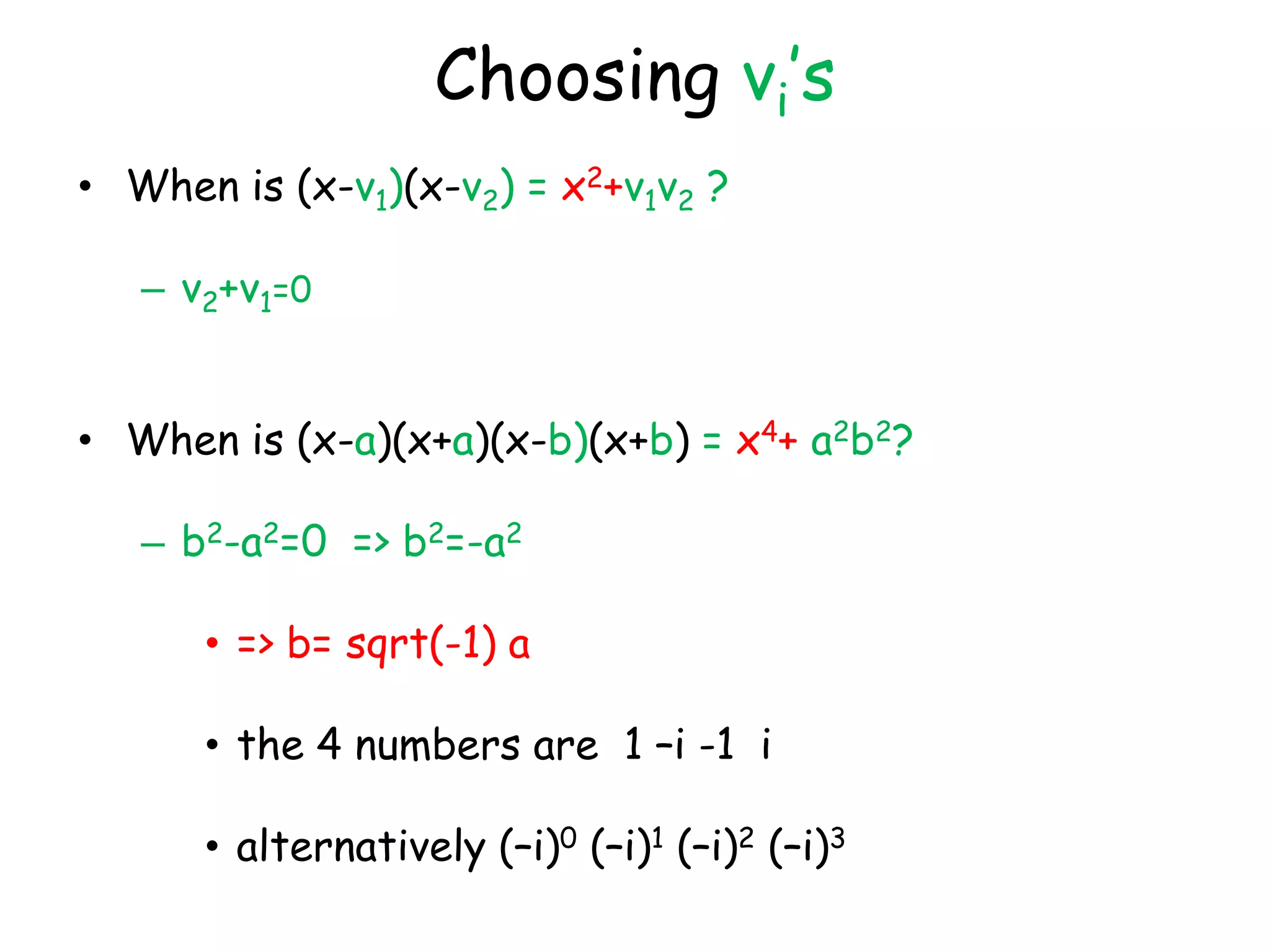
• When is (x-v1)(x-v2) = x2+v1v2 ?

   – v2+v1=0


• When is (x-a)(x+a)(x-b)(x+b) = x4+ a2b2?

   – b2-a2=0 => b2=-a2

      • => b= sqrt(-1) a

      • the 4 numbers are 1 –i -1 i

      • alternatively (–i)0 (–i)1 (–i)2 (–i)3
Choosing vi’s


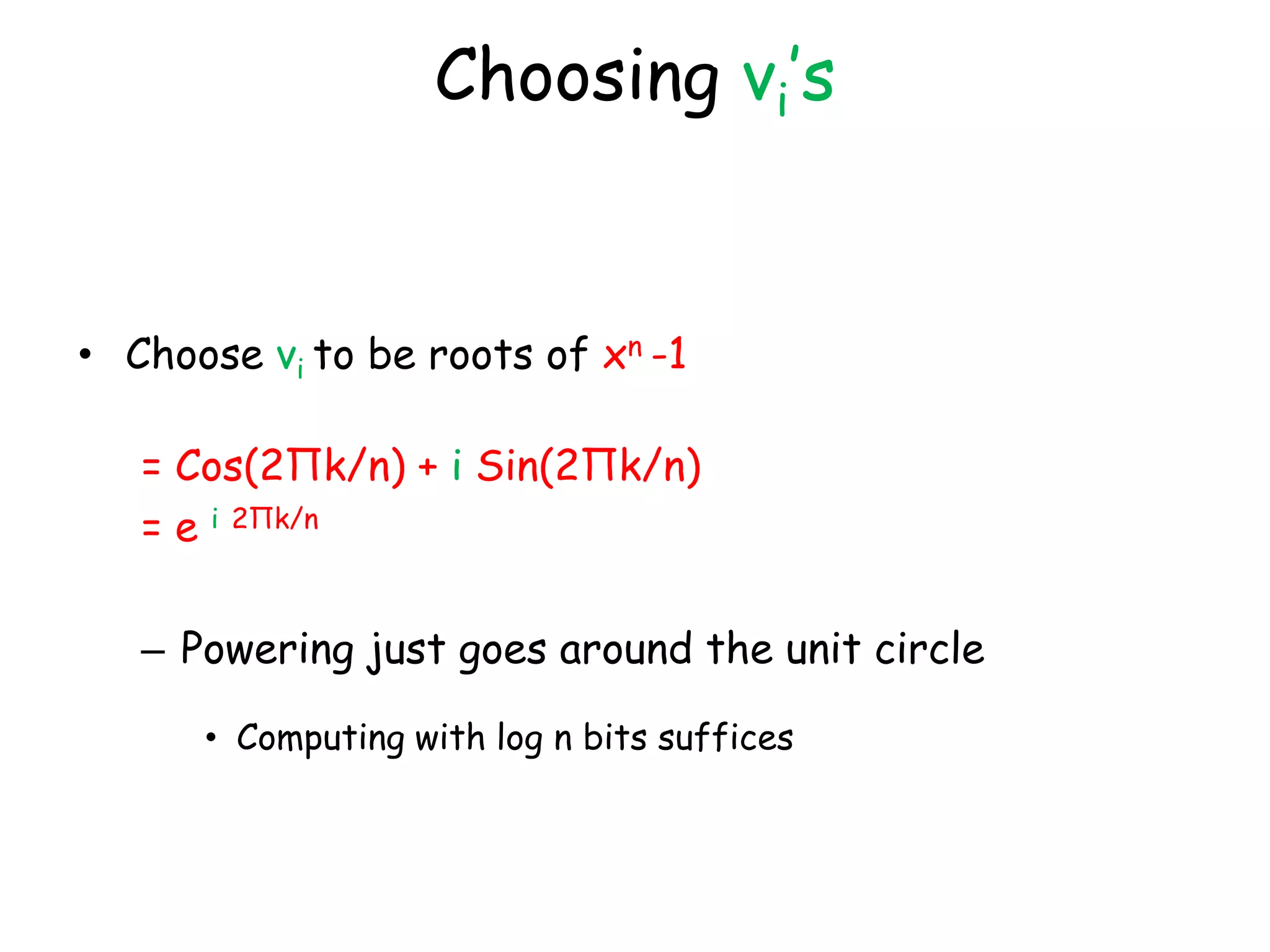
• Choose vi to be roots of xn -1

   = Cos(2Πk/n) + i Sin(2Πk/n)
   = e i 2Πk/n

   – Powering just goes around the unit circle

      • Computing with log n bits suffices
Exercise


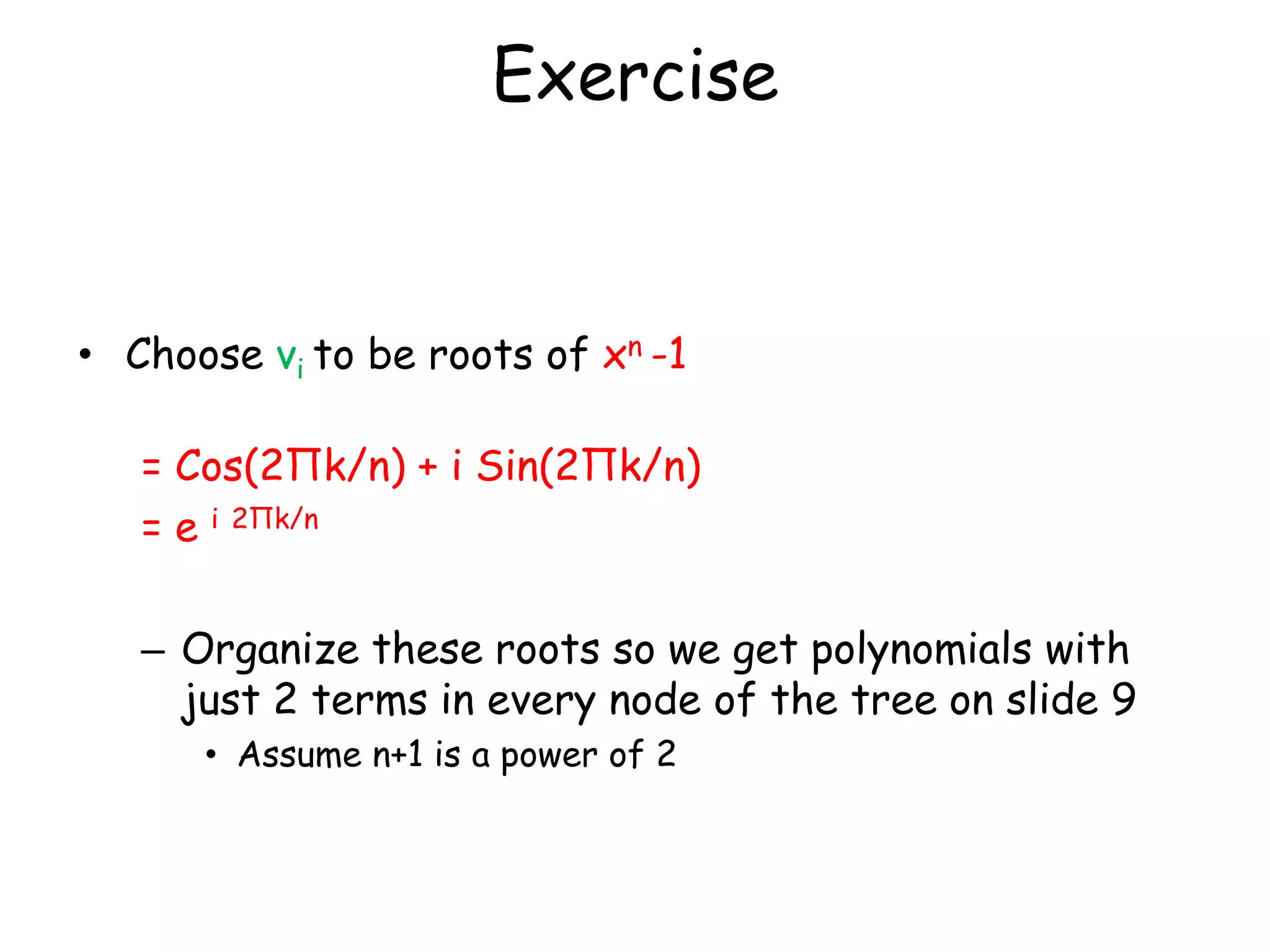
• Choose vi to be roots of xn -1

   = Cos(2Πk/n) + i Sin(2Πk/n)
   = e i 2Πk/n

   – Organize these roots so we get polynomials with
     just 2 terms in every node of the tree on slide 9
      • Assume n+1 is a power of 2
Conclusion


• Also called : Fast Fourier Transform

• Complex Numbers are interesting!

     • Reality can be explained elegantly only with
       complex numbers!!

Complex numbers polynomial multiplication

  • 1.
    Multiplying Polynomials Fast Why do we need Complex Numbers?
  • 2.
    The Problem • (anxn + an-1 xn-1+…..+ a0 x0) * (bn xn + bn-1 xn-1+…..+ b0 x0) • O(n^2) time – (Σi=0..k ai * bk-i) is coefficient of xk • Can one do better?
  • 3.
    Applications • Where alldoes a pattern string P appear in a text string T? – P 0’s, 1’s and don’t cares. – T 0’s and 1’s • Easy in O(|P|*|T|) time – Can one do better?
  • 4.
    Conversion to Polynomial Multiplication • Treat P and T as polynomials – T=0101 1 x0 + 0 x1 + 1 x2 + 0 x3 tk-i tk-2 tk-1 tk – P=01D1 0 x0 + 1 x1 + 0 x2 + 1 x3 1 0 1 0 1 1 0 0 1 • Multiply Prev and T 1 0 0 0 1 0 0 p-i p-1 p-0 – (Σi=0..k previ * tk-i) is coefficient of xk – (Σi=0..k p|P|-i * tk-i) is coefficient of xk • >=1 if and only if a 1 in P aligns with a 0 in T when P is placed with end at tk – 2 polynomial multiplications suffice to find all matches of P in T
  • 5.
    Other Applications • ImageProcessing At this location Slide this mask all over the Multiply each bit bigger one in the mask with the corresponding bit in the image, sum these up
  • 6.
    Polynomial Multiplication An Equivalent Form • Evaluate each polynomial at 2n+1 distinct x’s – A(x) = (an xn + an-1 xn-1+…..+ a0 x0) -> A(v0)…..A(v2n) – B(x) = (bn xn + bn-1 xn-1+…..+ b0 x0) -> B(v0)…..B(v2n) • A(x) * B(x) -> A(v0)*B(v0)………..A(v2n)*B(v2n) – Convolution in one domain=Simple multiplication in another – O(n) time!!!
  • 7.
    Multi-Point Polynomial Evaluation •Evaluate A(x) at v0 ……vn – O(n) time per vi using Horner’s rule • Problems – O(n2) time – Large numbers with n log vi bits
  • 8.
    Multi-Point Polynomial Evaluation Speed Up • A(x) mod (x-v) – A(v) – O(n) time using high school polynomial division • A’(x) = A(x) mod (x-v0) (x-v1) [how fast?] – A’(x) mod (x-v0) = A(v0) [O(1)] – A’(x) mod (x-v1) = A(v1) [O(1)] – 2 expensive polynomial divisions could potentially be replaced by 1
  • 9.
    Fast Multi-Point PolynomialEvaluation T0(x)=A(x) mod (x-v0) (x-v1).. (x-vn) T1(x)=T0 (x) mod (x-v0)..(x-v(n+1)/2-1) T2 (x)=T0 (x) mod (x-v(n+1)/2) (x-vn) • If T(x) mod (x-vi).. (x-vj) can be done in O(deg(T)) time, then what is the total time taken? – O(n log n)!!
  • 10.
    Computing T(x) mod(x-v1).. (x-vk) • High school algorithm – Time taken: O( deg(T) * k ) – How do we make this faster? • Stroke of genius • Can we choose vi’s so (x-v1).. (x-vk) = xk-v? • Then we get O(deg(T) ) time
  • 11.
    Choosing vi’s • Whenis (x-v1)(x-v2) = x2+v1v2 ? – v2+v1=0 • When is (x-a)(x+a)(x-b)(x+b) = x4+ a2b2? – b2-a2=0 => b2=-a2 • => b= sqrt(-1) a • the 4 numbers are 1 –i -1 i • alternatively (–i)0 (–i)1 (–i)2 (–i)3
  • 12.
    Choosing vi’s • Choosevi to be roots of xn -1 = Cos(2Πk/n) + i Sin(2Πk/n) = e i 2Πk/n – Powering just goes around the unit circle • Computing with log n bits suffices
  • 13.
    Exercise • Choose vito be roots of xn -1 = Cos(2Πk/n) + i Sin(2Πk/n) = e i 2Πk/n – Organize these roots so we get polynomials with just 2 terms in every node of the tree on slide 9 • Assume n+1 is a power of 2
  • 14.
    Conclusion • Also called: Fast Fourier Transform • Complex Numbers are interesting! • Reality can be explained elegantly only with complex numbers!!