Small updates of matrix functions
used for network centrality
Francesco Tudisco
joint work with Stefano Pozza (Charles University in Prague)
Department of Mathematics and Statistics, University of Strathclyde, UK
IMA Conf. Numerical Linear Algebra and Optimization
Birmingham June 28, 2018
Introduction
Results
Examples
Notation: graphs and matrices
Motivations and goal
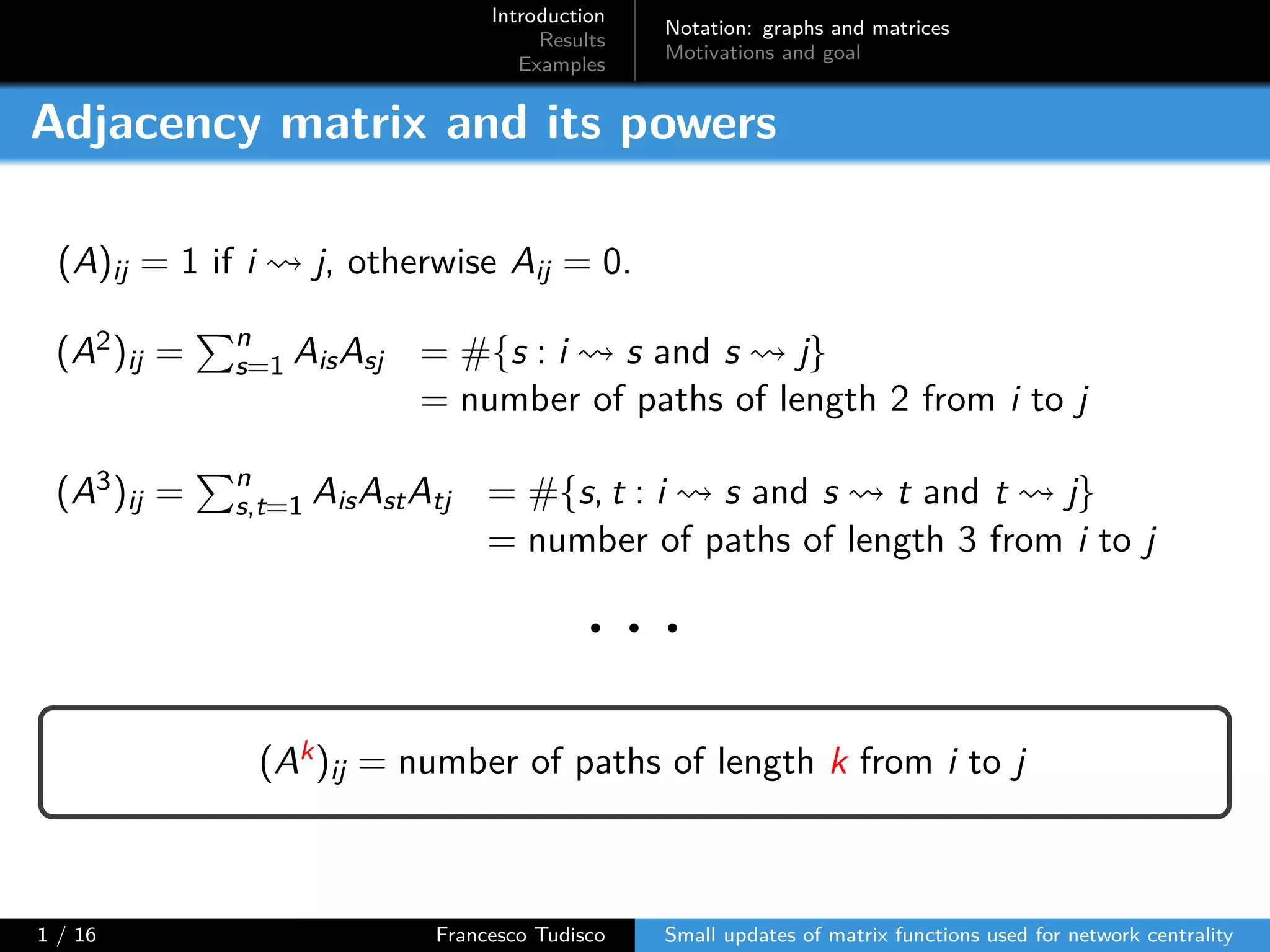
Adjacency matrix and its powers
(A)ij = 1 if i ⇝ j, otherwise Aij = 0.
(A2)ij = n
s=1 AisAsj = #{s : i ⇝ s and s ⇝ j}
= number of paths of length 2 from i to j
(A3)ij = n
s,t=1 AisAstAtj = #{s, t : i ⇝ s and s ⇝ t and t ⇝ j}
= number of paths of length 3 from i to j
· · ·
(Ak)ij = number of paths of length k from i to j
1 / 16 Francesco Tudisco Small updates of matrix functions used for network centrality
Introduction
Results
Examples
Notation: graphs and matrices
Motivations and goal
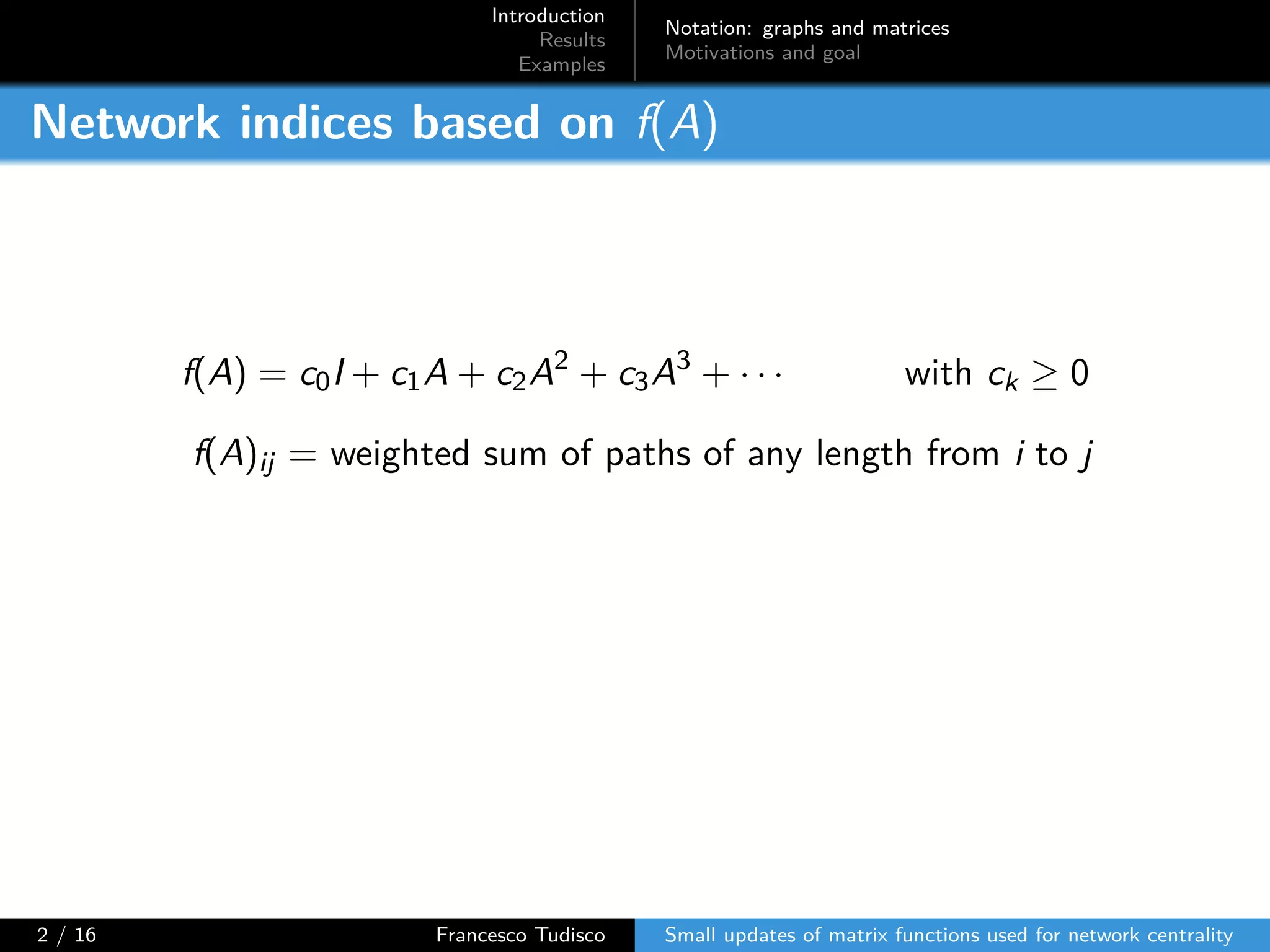
Network indices based on f(A)
f(A) = c0I + c1A + c2A2
+ c3A3
+ · · · with ck ≥ 0
f(A)ij = weighted sum of paths of any length from i to j
2 / 16 Francesco Tudisco Small updates of matrix functions used for network centrality
Introduction
Results
Examples
Notation: graphs and matrices
Motivations and goal
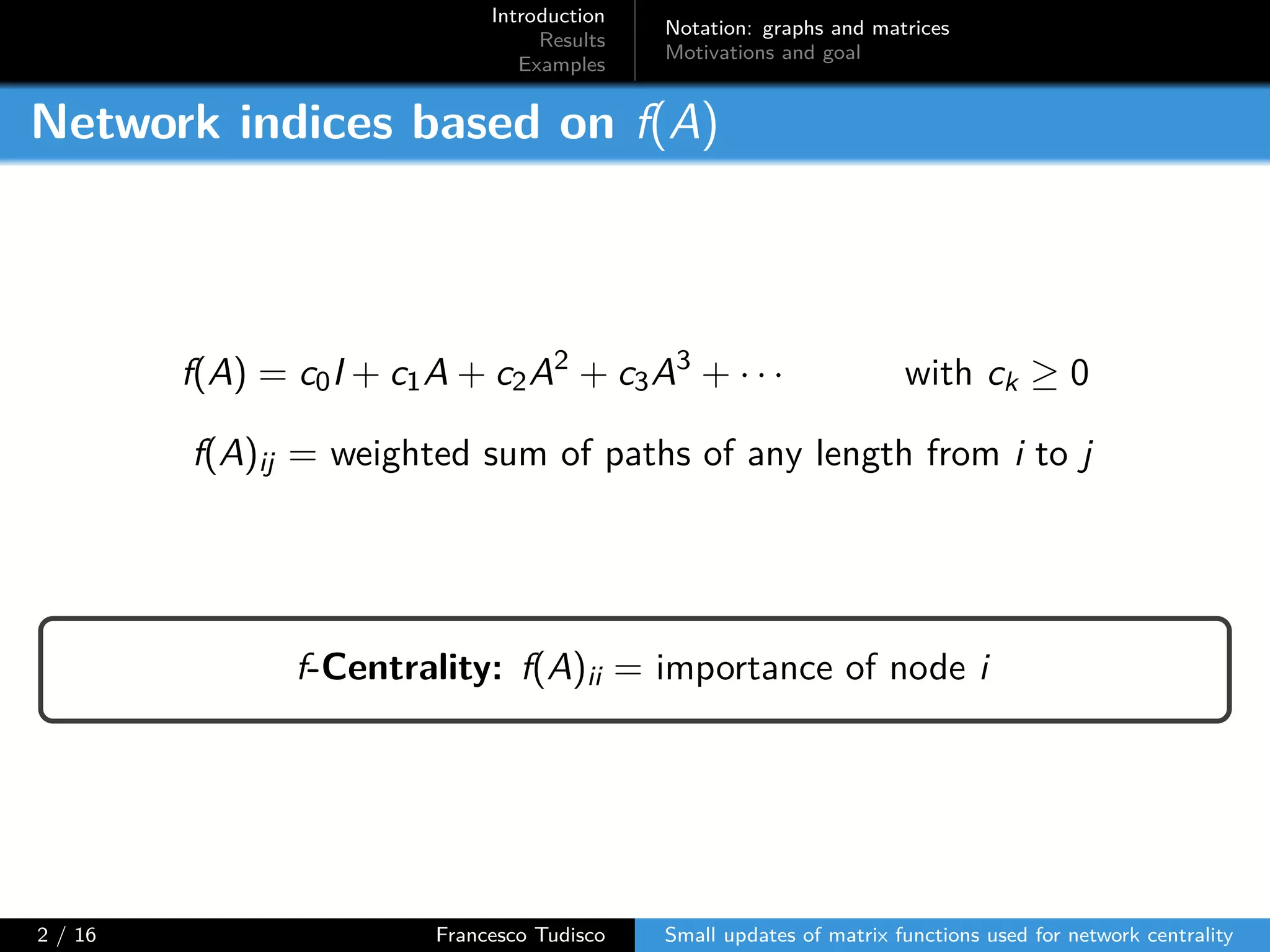
Network indices based on f(A)
f(A) = c0I + c1A + c2A2
+ c3A3
+ · · · with ck ≥ 0
f(A)ij = weighted sum of paths of any length from i to j
f-Centrality: f(A)ii = importance of node i
2 / 16 Francesco Tudisco Small updates of matrix functions used for network centrality
Introduction
Results
Examples
Notation: graphs and matrices
Motivations and goal
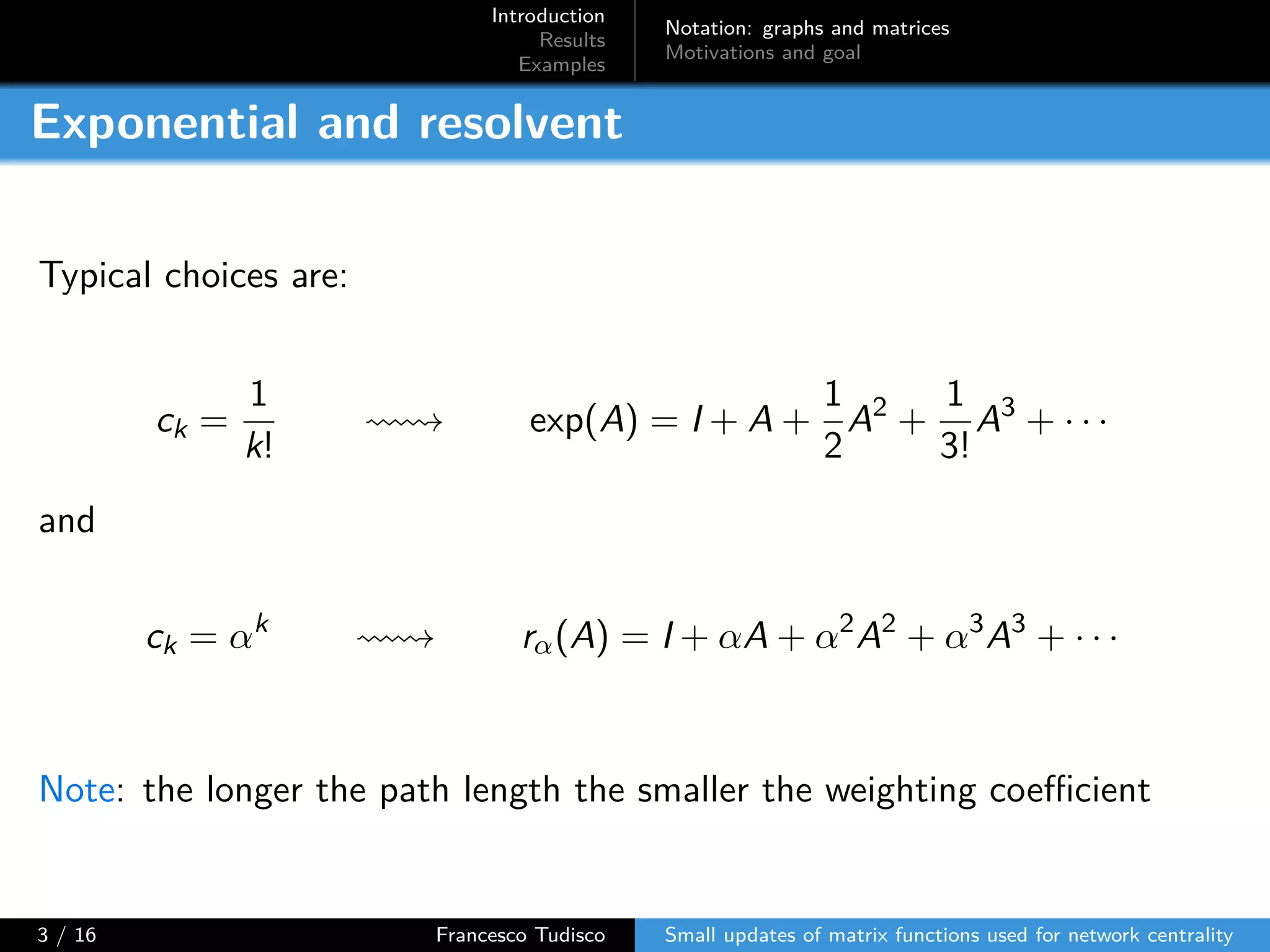
Exponential and resolvent
Typical choices are:
ck =
1
k!
exp(A) = I + A +
1
2
A2
+
1
3!
A3
+ · · ·
and
ck = αk
rα(A) = I + αA + α2
A2
+ α3
A3
+ · · ·
Note: the longer the path length the smaller the weighting coefficient
3 / 16 Francesco Tudisco Small updates of matrix functions used for network centrality
Introduction
Results
Examples
Notation: graphs and matrices
Motivations and goal
Problem setting
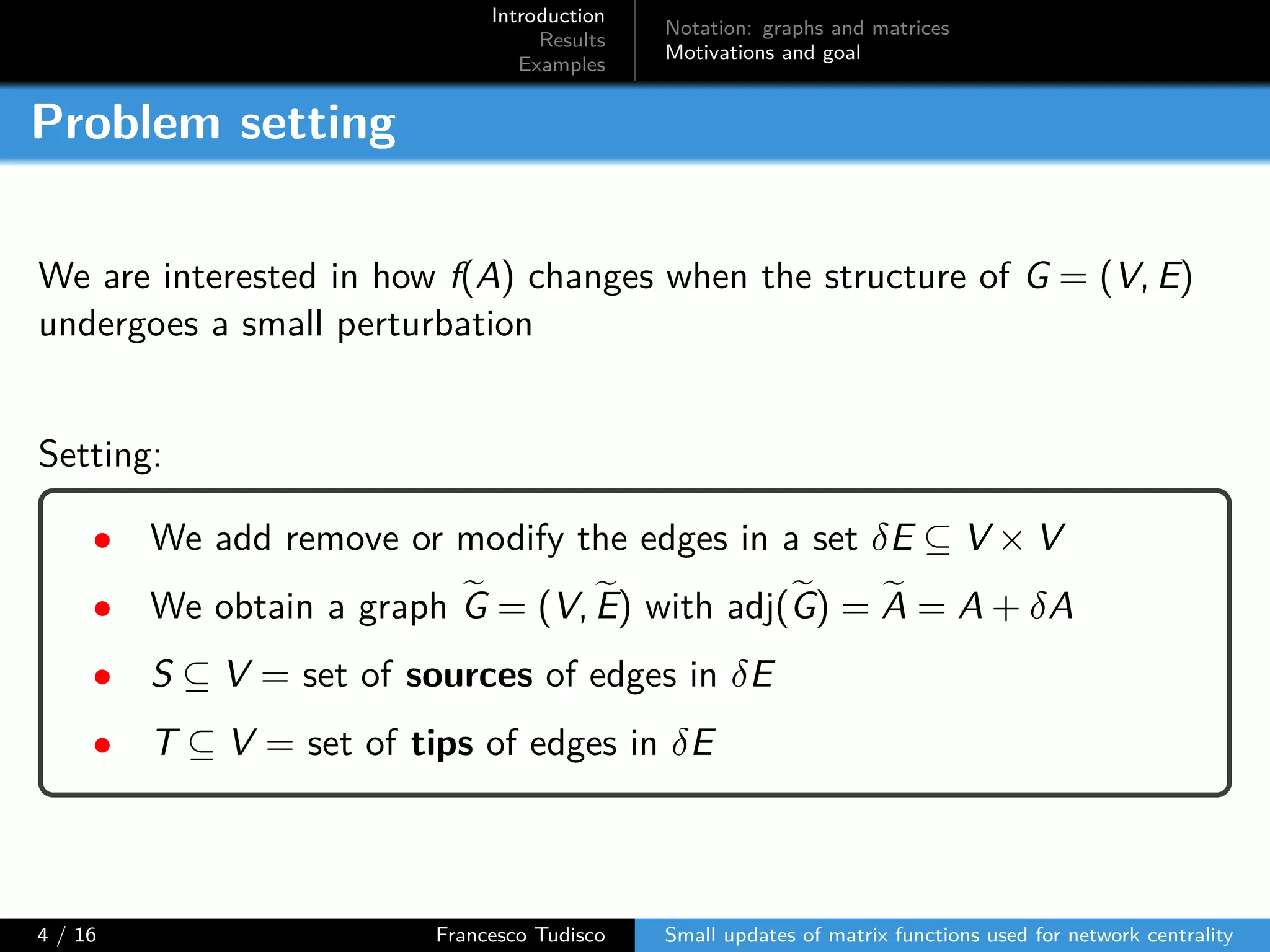
We are interested in how f(A) changes when the structure of G = (V, E)
undergoes a small perturbation
Setting:
• We add remove or modify the edges in a set δE ⊆ V × V
• We obtain a graph G = (V, E) with adj(G) = A = A + δA
• S ⊆ V = set of sources of edges in δE
• T ⊆ V = set of tips of edges in δE
4 / 16 Francesco Tudisco Small updates of matrix functions used for network centrality
Introduction
Results
Examples
Notation: graphs and matrices
Motivations and goal
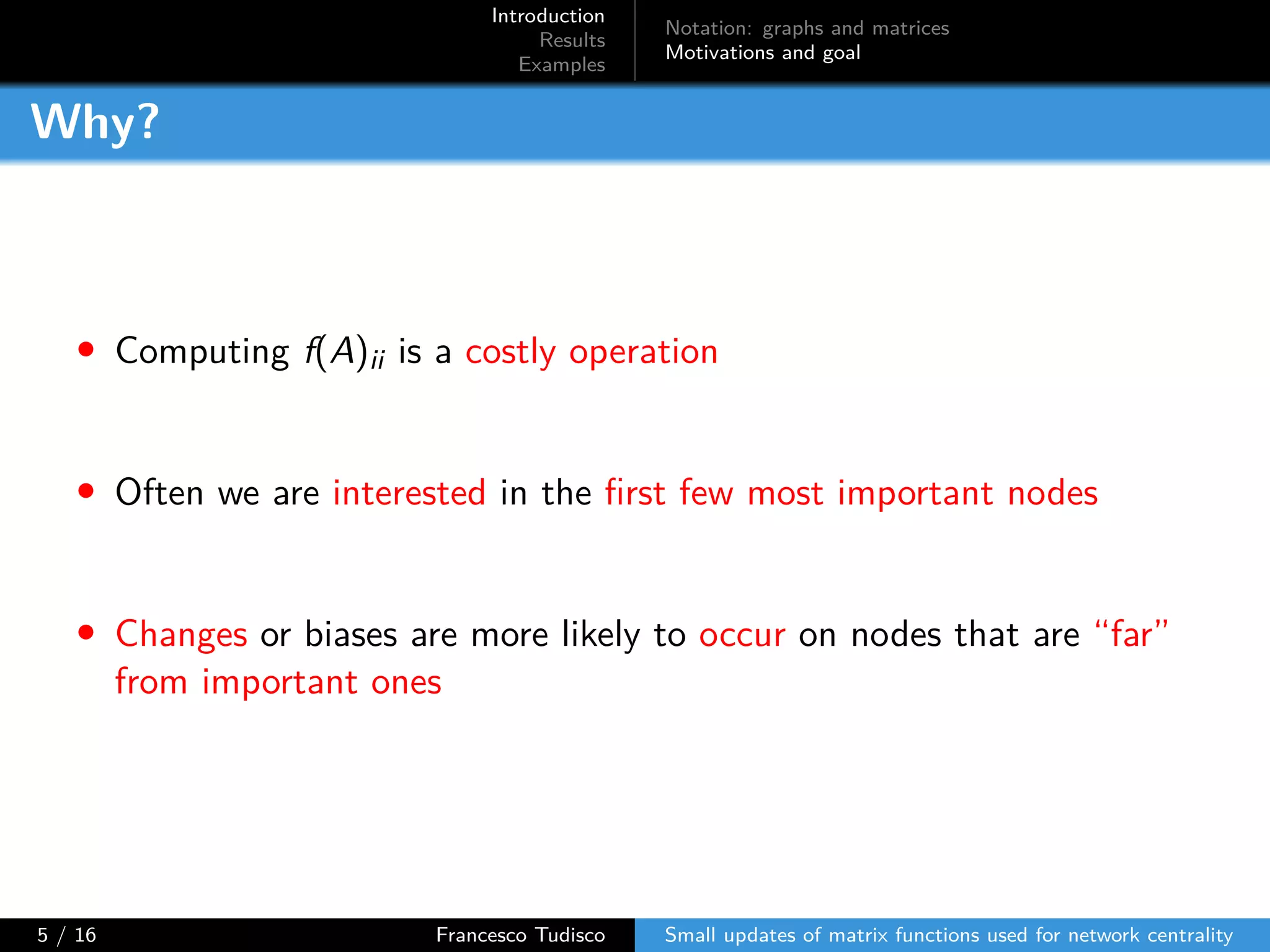
Why?
• Computing f(A)ii is a costly operation
• Often we are interested in the first few most important nodes
• Changes or biases are more likely to occur on nodes that are “far”
from important ones
5 / 16 Francesco Tudisco Small updates of matrix functions used for network centrality
Introduction
Results
Examples
Notation: graphs and matrices
Motivations and goal
Related work: f(A + small rank)
Important issue: Computing f(A + δA) from f(A) when δA = small rank
6 / 16 Francesco Tudisco Small updates of matrix functions used for network centrality
Introduction
Results
Examples
Notation: graphs and matrices
Motivations and goal
Related work: f(A + small rank)
Important issue: Computing f(A + δA) from f(A) when δA = small rank
• f(x) = x−1 −→ Sherman–Morrison–Woodbury formula
6 / 16 Francesco Tudisco Small updates of matrix functions used for network centrality
Introduction
Results
Examples
Notation: graphs and matrices
Motivations and goal
Related work: f(A + small rank)
Important issue: Computing f(A + δA) from f(A) when δA = small rank
• f(x) = x−1 −→ Sherman–Morrison–Woodbury formula
• f(x) is rational
Bernstein, Van Loan, SIMAX, 2010
6 / 16 Francesco Tudisco Small updates of matrix functions used for network centrality
Introduction
Results
Examples
Notation: graphs and matrices
Motivations and goal
Related work: f(A + small rank)
Important issue: Computing f(A + δA) from f(A) when δA = small rank
• f(x) = x−1 −→ Sherman–Morrison–Woodbury formula
• f(x) is rational
Bernstein, Van Loan, SIMAX, 2010
• f(x) is analytic
Beckermann, Kressner, Schweitzer, SIMAX, 2018
6 / 16 Francesco Tudisco Small updates of matrix functions used for network centrality
Introduction
Results
Examples
Notation: graphs and matrices
Motivations and goal
Related work: f(A + small rank)
Important issue: Computing f(A + δA) from f(A) when δA = small rank
• f(x) = x−1 −→ Sherman–Morrison–Woodbury formula
• f(x) is rational
Bernstein, Van Loan, SIMAX, 2010
• f(x) is analytic
Beckermann, Kressner, Schweitzer, SIMAX, 2018
We derive a-priori bounds of the type
|f(A)ii − f(A)ii| = O
1
Mδ
with δ ≈ distance i ←→ δE
6 / 16 Francesco Tudisco Small updates of matrix functions used for network centrality
Introduction
Results
Examples
Notation: graphs and matrices
Motivations and goal
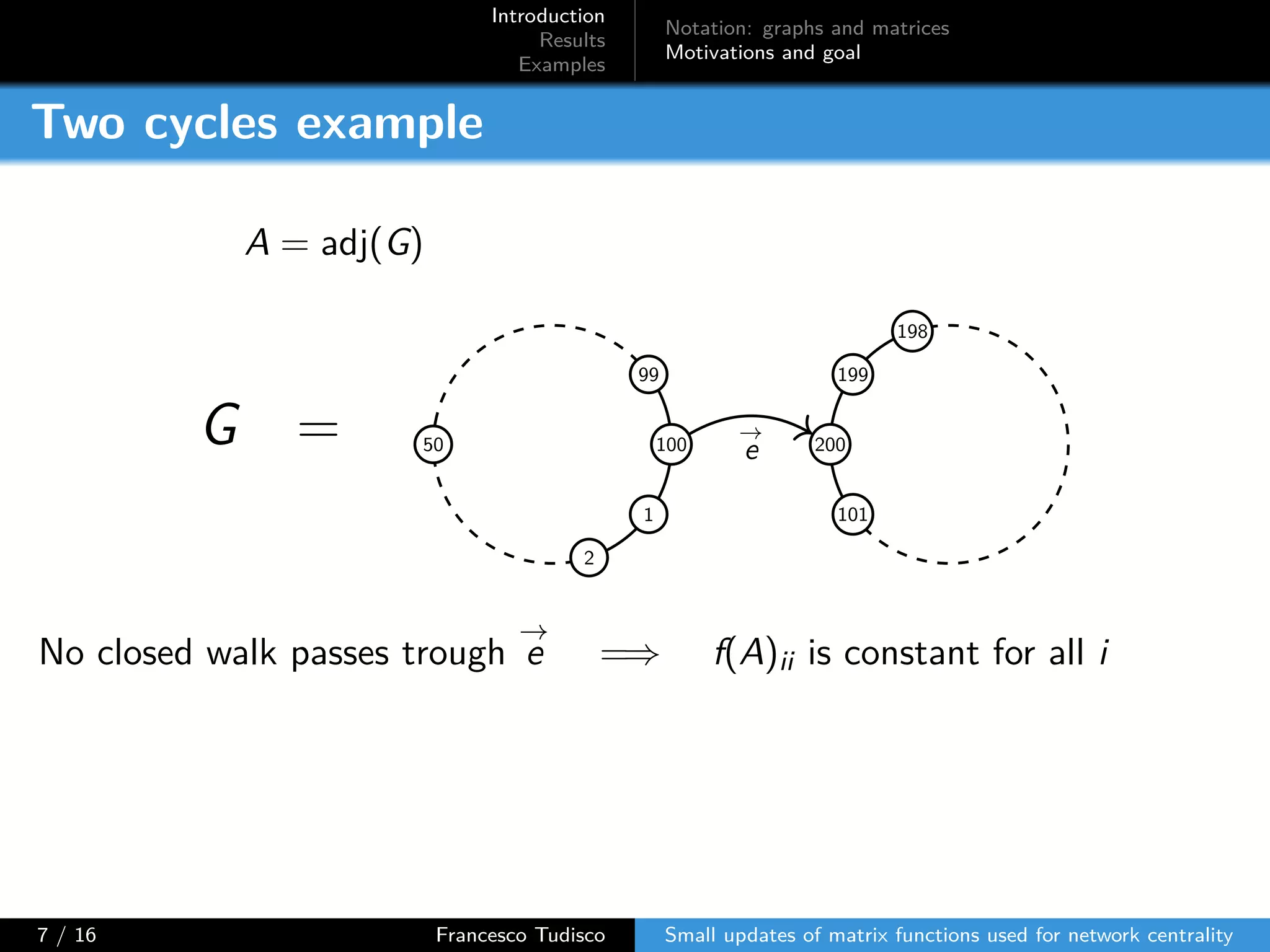
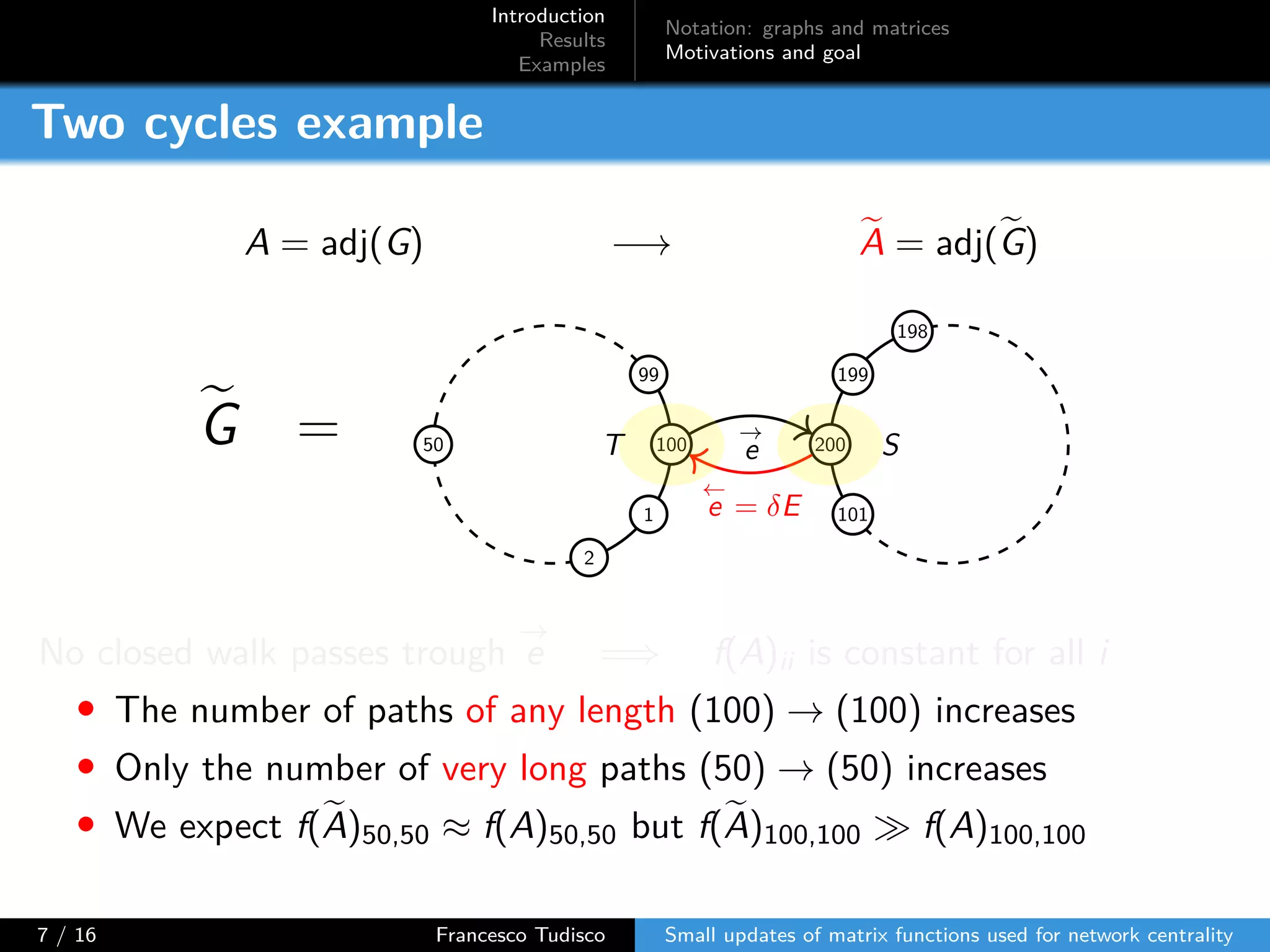
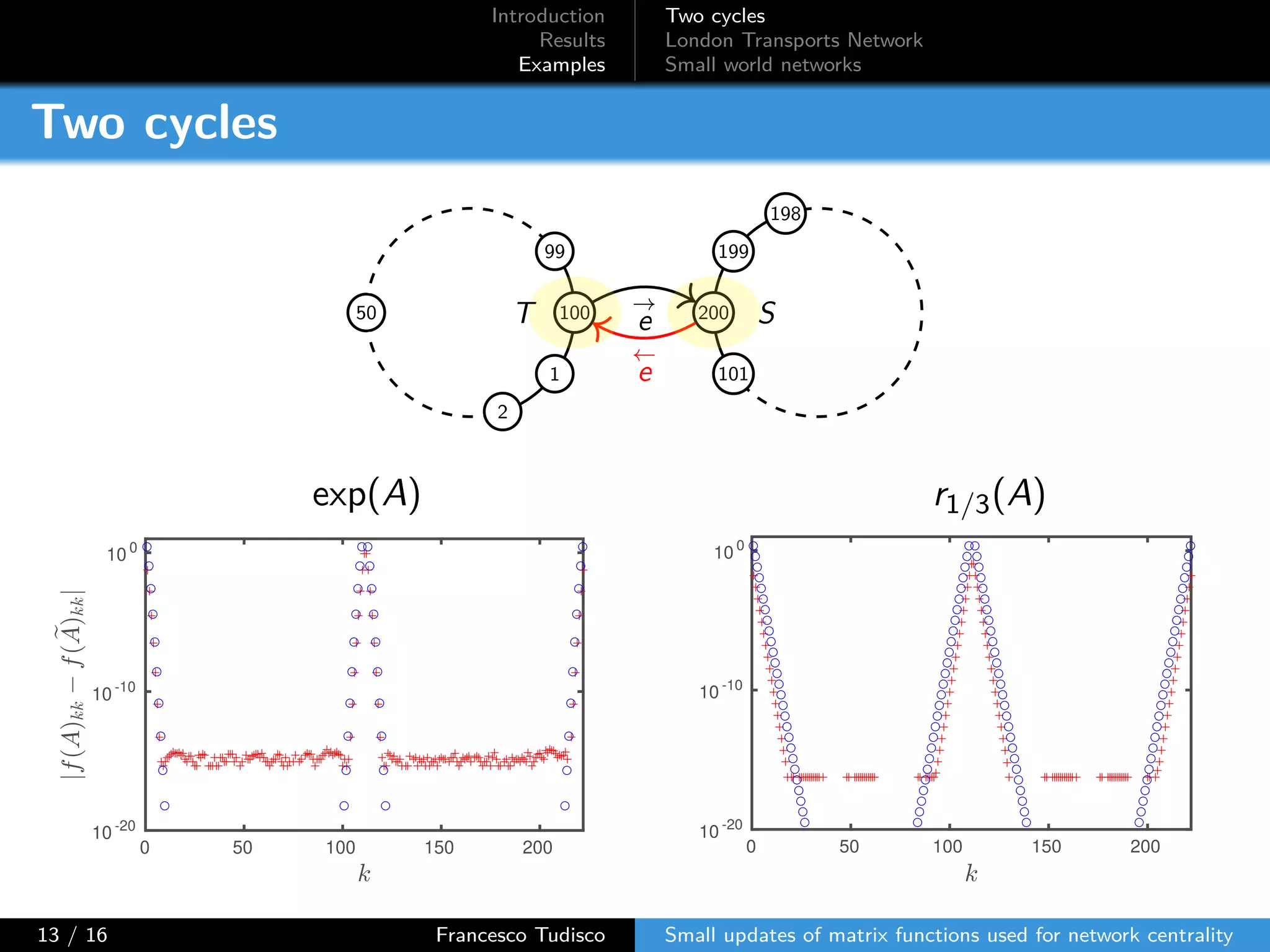
Two cycles example
A = adj(G)
G = 100
99
1
2
50 200
199
198
101
→
e
No closed walk passes trough
→
e =⇒ f(A)ii is constant for all i
7 / 16 Francesco Tudisco Small updates of matrix functions used for network centrality
Introduction
Results
Examples
Notation: graphs and matrices
Motivations and goal
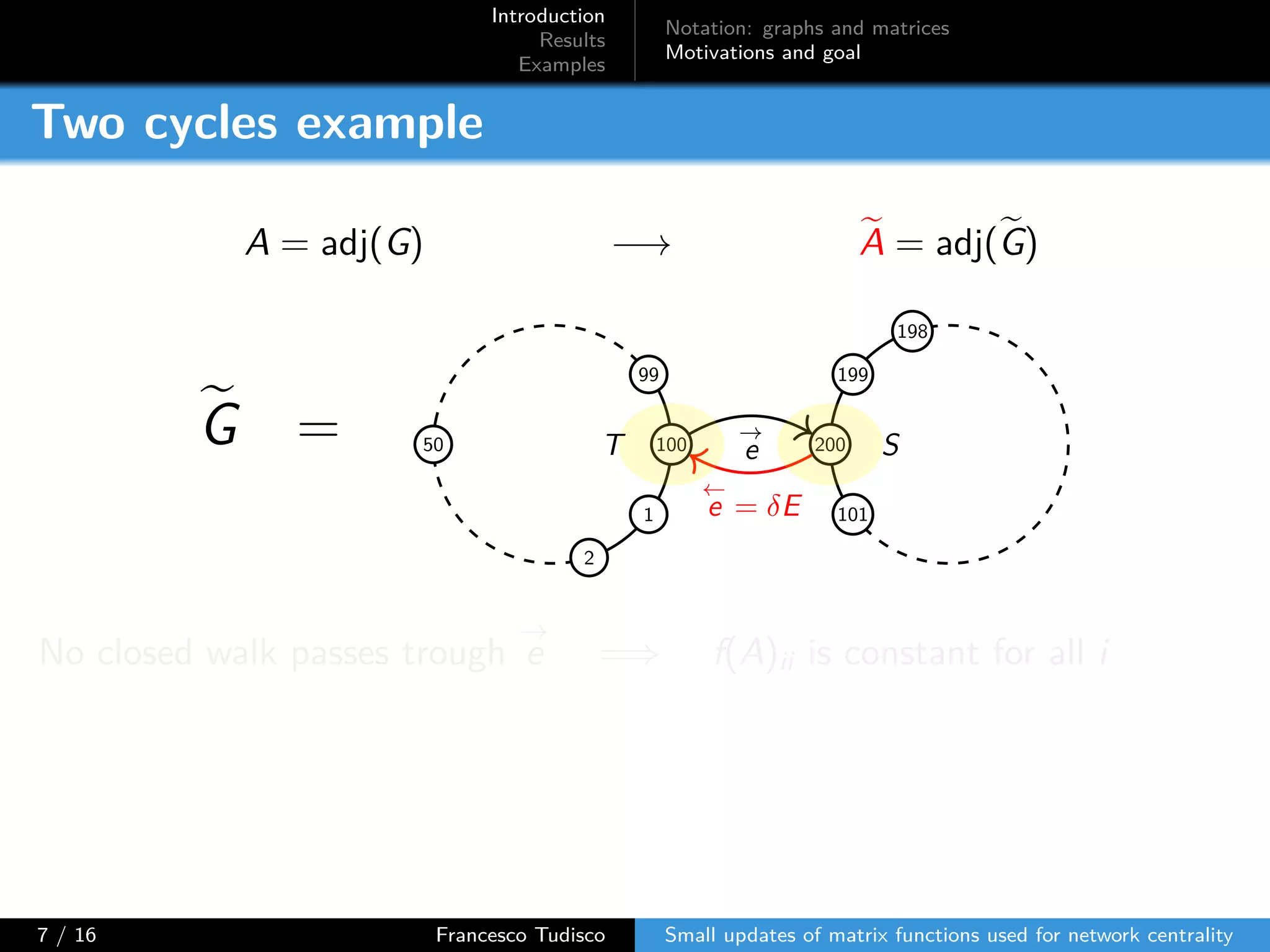
Two cycles example
A = adj(G) −→ A = adj(G)
G = 100
99
1
2
50 200
199
198
101
→
e
←
e = δE
T S
No closed walk passes trough
→
e =⇒ f(A)ii is constant for all i
7 / 16 Francesco Tudisco Small updates of matrix functions used for network centrality
Introduction
Results
Examples
Notation: graphs and matrices
Motivations and goal
Two cycles example
A = adj(G) −→ A = adj(G)
G = 100
99
1
2
50 200
199
198
101
→
e
←
e = δE
T S
No closed walk passes trough
→
e =⇒ f(A)ii is constant for all i
• The number of paths of any length (100) → (100) increases
• Only the number of very long paths (50) → (50) increases
• We expect f(A)50,50 ≈ f(A)50,50 but f(A)100,100 ≫ f(A)100,100
7 / 16 Francesco Tudisco Small updates of matrix functions used for network centrality
Introduction
Results
Examples
Bounds
Algorithm
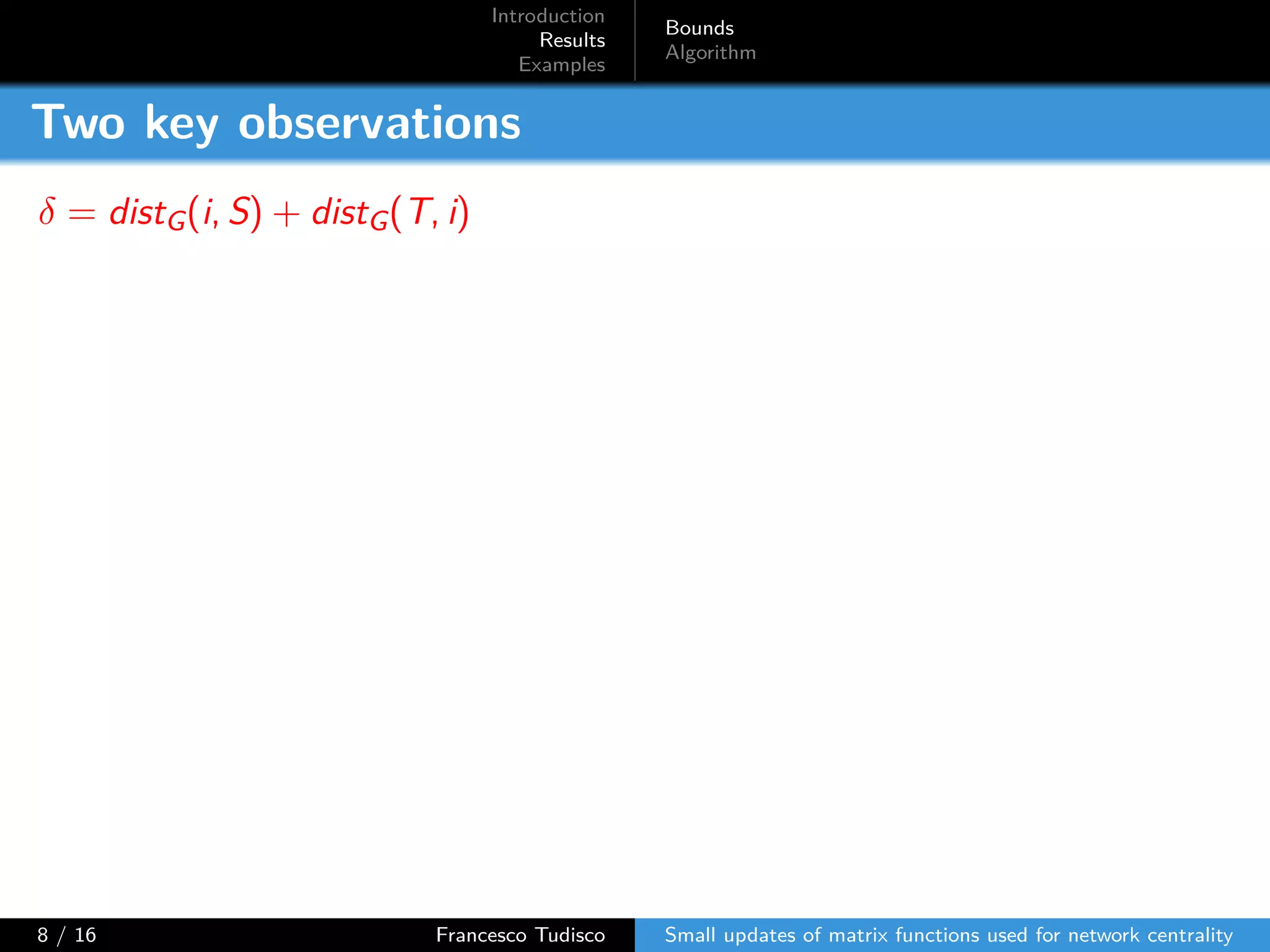
Two key observations
δ = distG(i, S) + distG(T, i)
8 / 16 Francesco Tudisco Small updates of matrix functions used for network centrality
Introduction
Results
Examples
Bounds
Algorithm
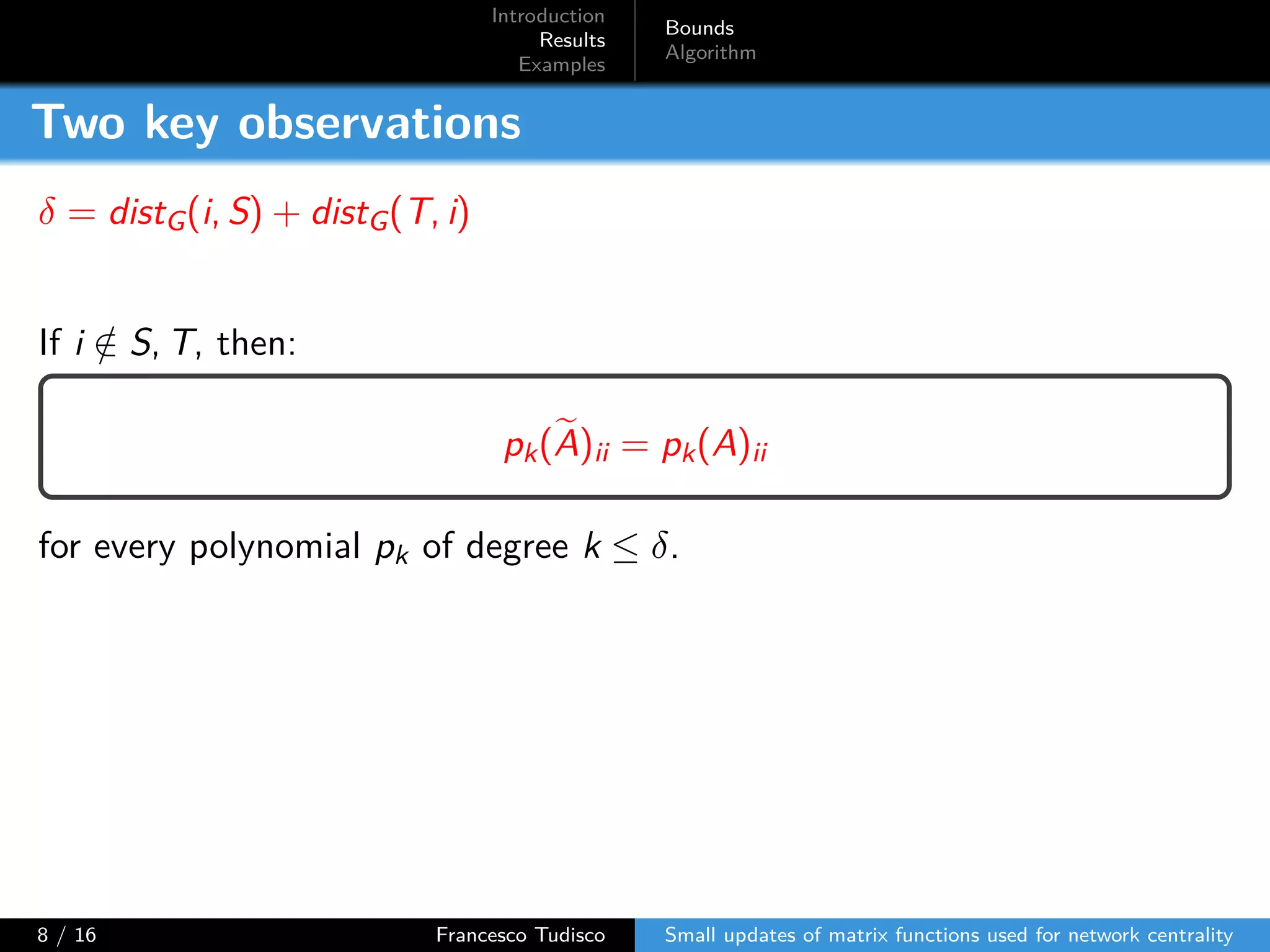
Two key observations
δ = distG(i, S) + distG(T, i)
If i /∈ S, T, then:
pk(A)ii = pk(A)ii
for every polynomial pk of degree k ≤ δ.
8 / 16 Francesco Tudisco Small updates of matrix functions used for network centrality
Introduction
Results
Examples
Bounds
Algorithm
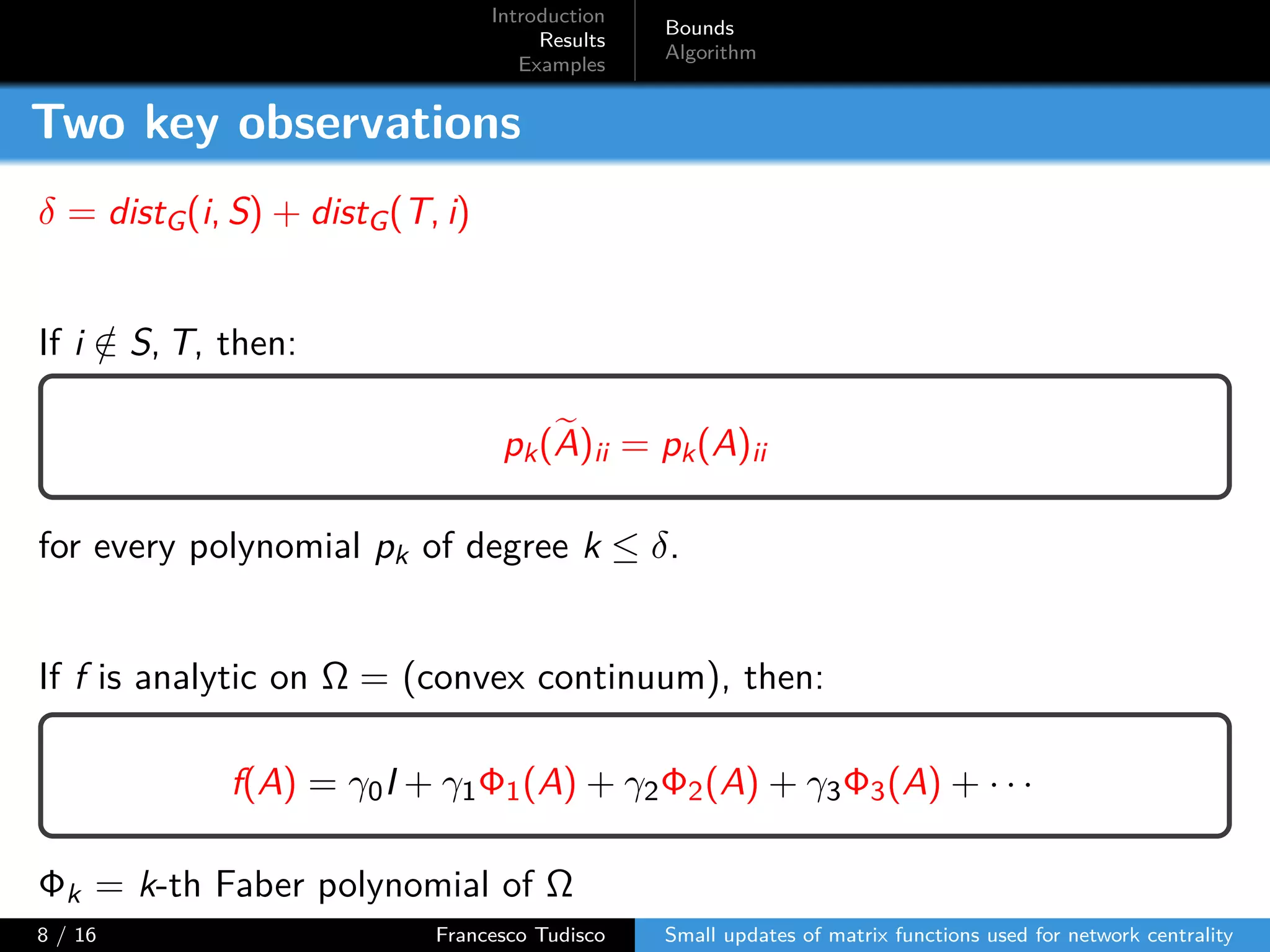
Two key observations
δ = distG(i, S) + distG(T, i)
If i /∈ S, T, then:
pk(A)ii = pk(A)ii
for every polynomial pk of degree k ≤ δ.
If f is analytic on Ω = (convex continuum), then:
f(A) = γ0I + γ1Φ1(A) + γ2Φ2(A) + γ3Φ3(A) + · · ·
Φk = k-th Faber polynomial of Ω
8 / 16 Francesco Tudisco Small updates of matrix functions used for network centrality
Introduction
Results
Examples
Bounds
Algorithm
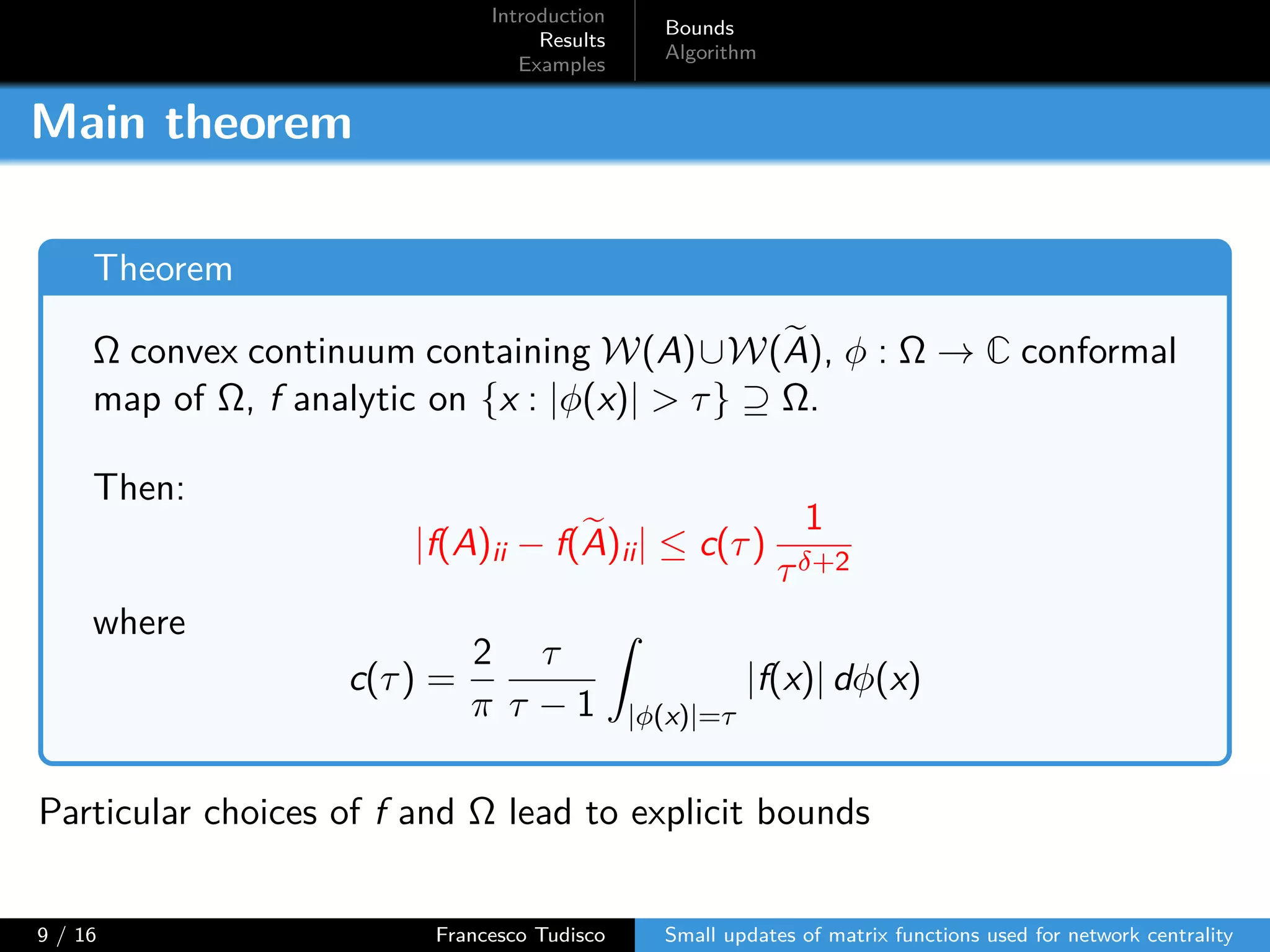
Main theorem
Theorem
Ω convex continuum containing W(A)∪W(A), ϕ : Ω → C conformal
map of Ω, f analytic on {x : |ϕ(x)| > τ} ⊇ Ω.
Then:
|f(A)ii − f(A)ii| ≤ c(τ)
1
τδ+2
where
c(τ) =
2
π
τ
τ − 1 |ϕ(x)|=τ
|f(x)| dϕ(x)
Particular choices of f and Ω lead to explicit bounds
9 / 16 Francesco Tudisco Small updates of matrix functions used for network centrality
Introduction
Results
Examples
Bounds
Algorithm
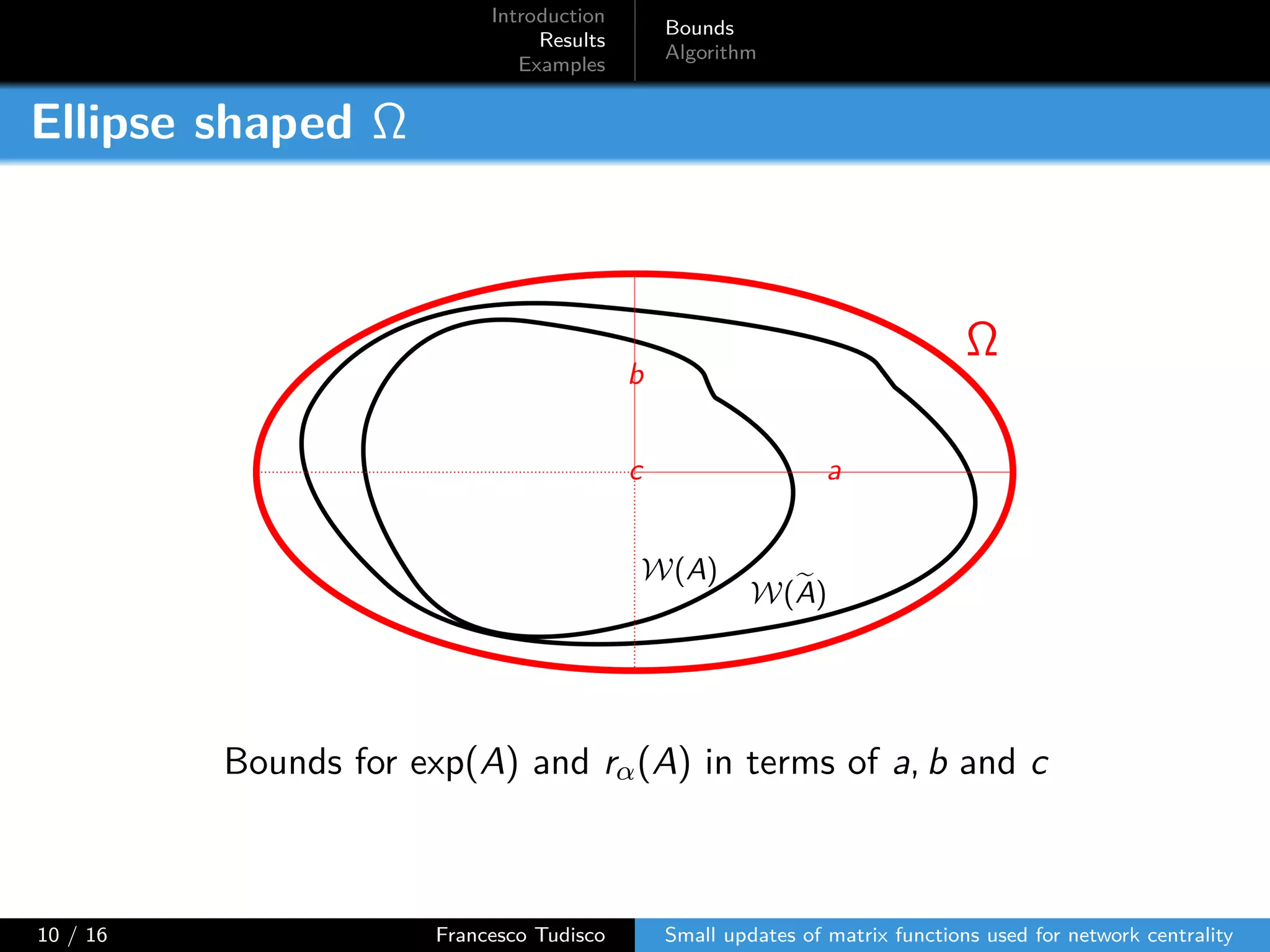
Ellipse shaped Ω
W(A)
W(A)
Ω
c a
b
Bounds for exp(A) and rα(A) in terms of a, b and c
10 / 16 Francesco Tudisco Small updates of matrix functions used for network centrality
Introduction
Results
Examples
Bounds
Algorithm
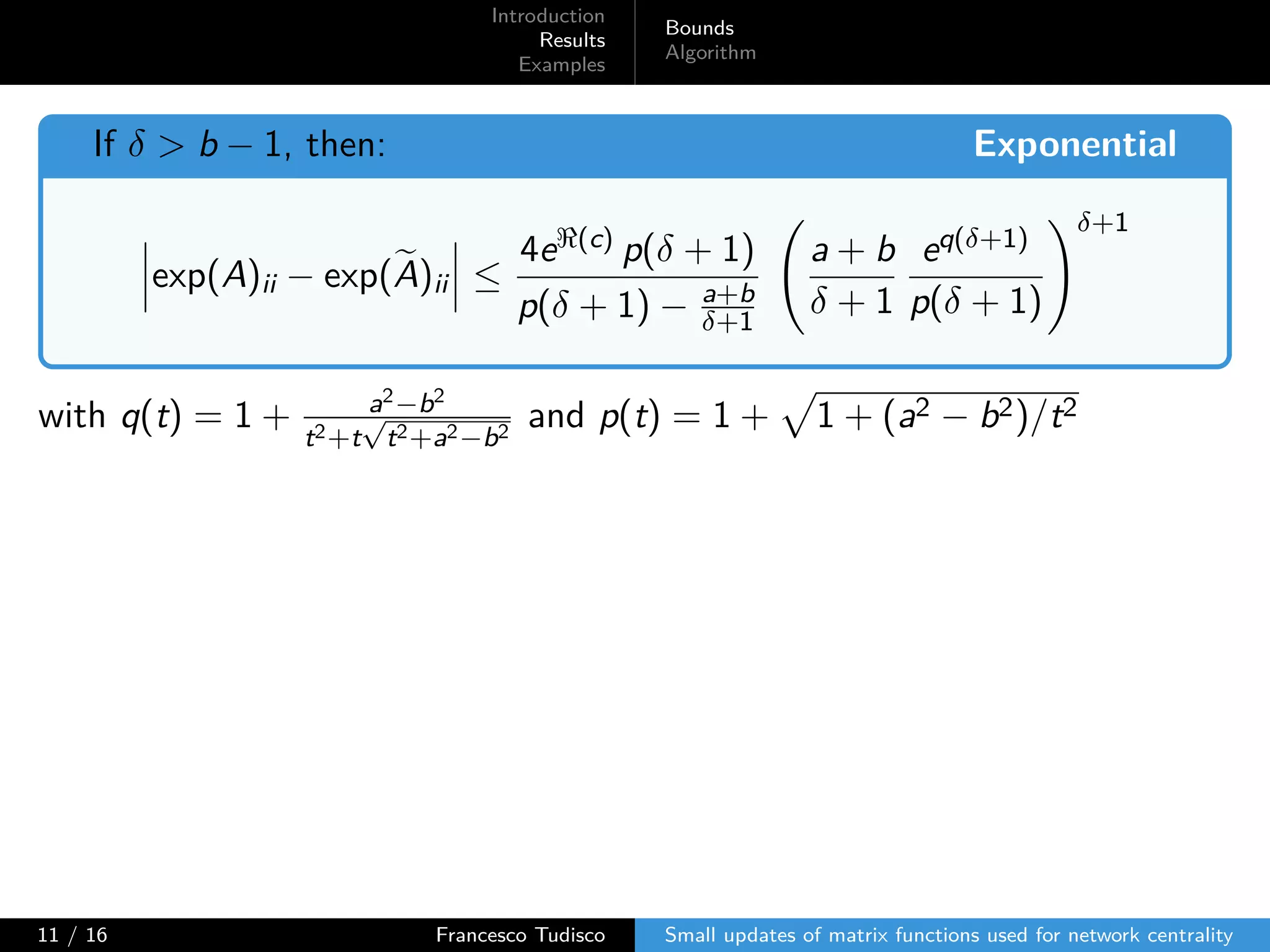
If δ > b − 1, then: Exponential
exp(A)ii − exp(A)ii ≤
4eℜ(c) p(δ + 1)
p(δ + 1) − a+b
δ+1
a + b
δ + 1
eq(δ+1)
p(δ + 1)
δ+1
with q(t) = 1 + a2−b2
t2+t
√
t2+a2−b2
and p(t) = 1 + 1 + (a2 − b2)/t2
11 / 16 Francesco Tudisco Small updates of matrix functions used for network centrality
Introduction
Results
Examples
Bounds
Algorithm
If δ > b − 1, then: Exponential
exp(A)ii − exp(A)ii ≤
4eℜ(c) p(δ + 1)
p(δ + 1) − a+b
δ+1
a + b
δ + 1
eq(δ+1)
p(δ + 1)
δ+1
with q(t) = 1 + a2−b2
t2+t
√
t2+a2−b2
and p(t) = 1 + 1 + (a2 − b2)/t2
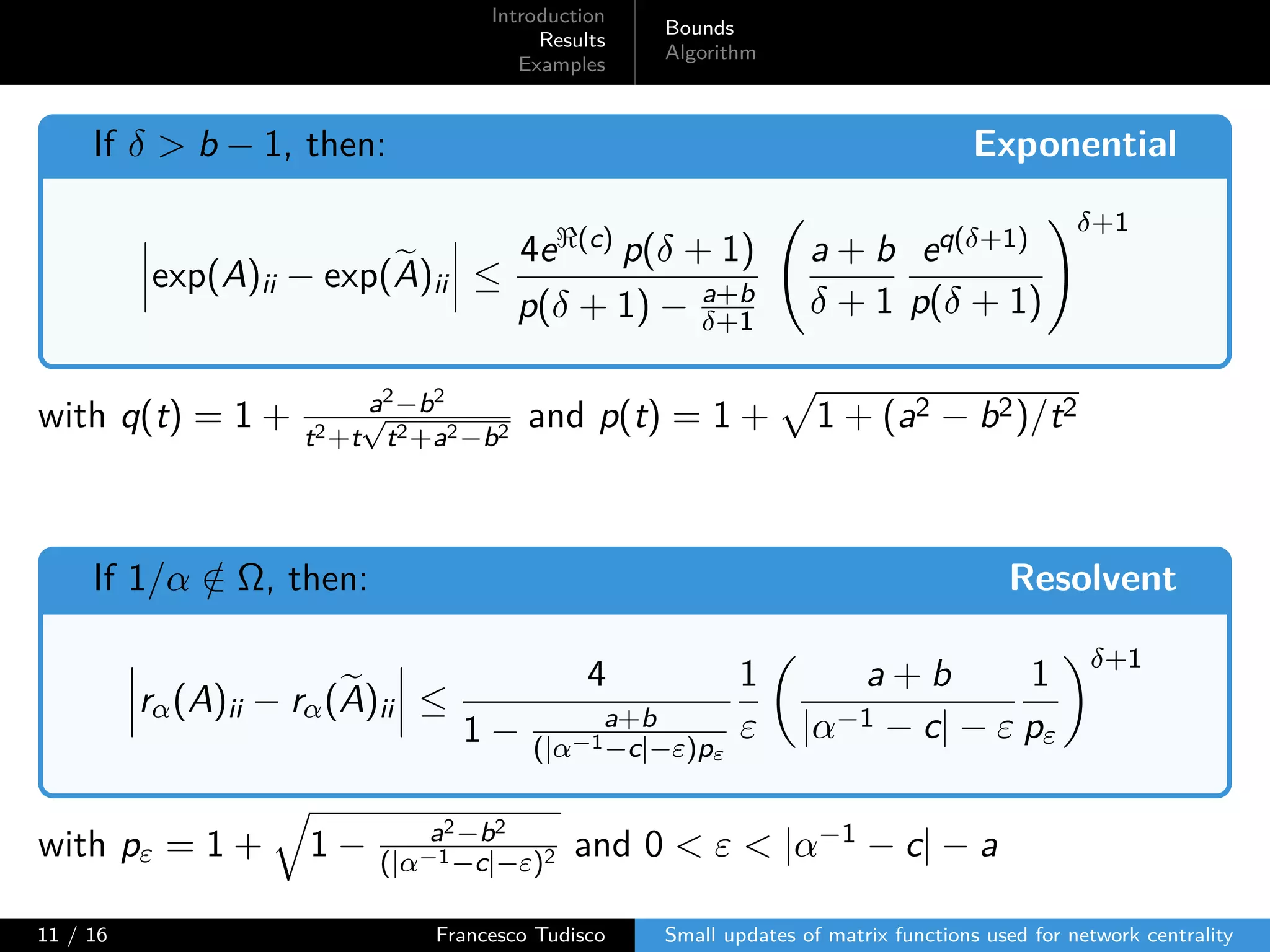
If 1/α /∈ Ω, then: Resolvent
rα(A)ii − rα(A)ii ≤
4
1 − a+b
(|α−1−c|−ε)pε
1
ε
a + b
|α−1 − c| − ε
1
pε
δ+1
with pε = 1 + 1 − a2−b2
(|α−1−c|−ε)2 and 0 < ε < |α−1 − c| − a
11 / 16 Francesco Tudisco Small updates of matrix functions used for network centrality
Introduction
Results
Examples
Bounds
Algorithm
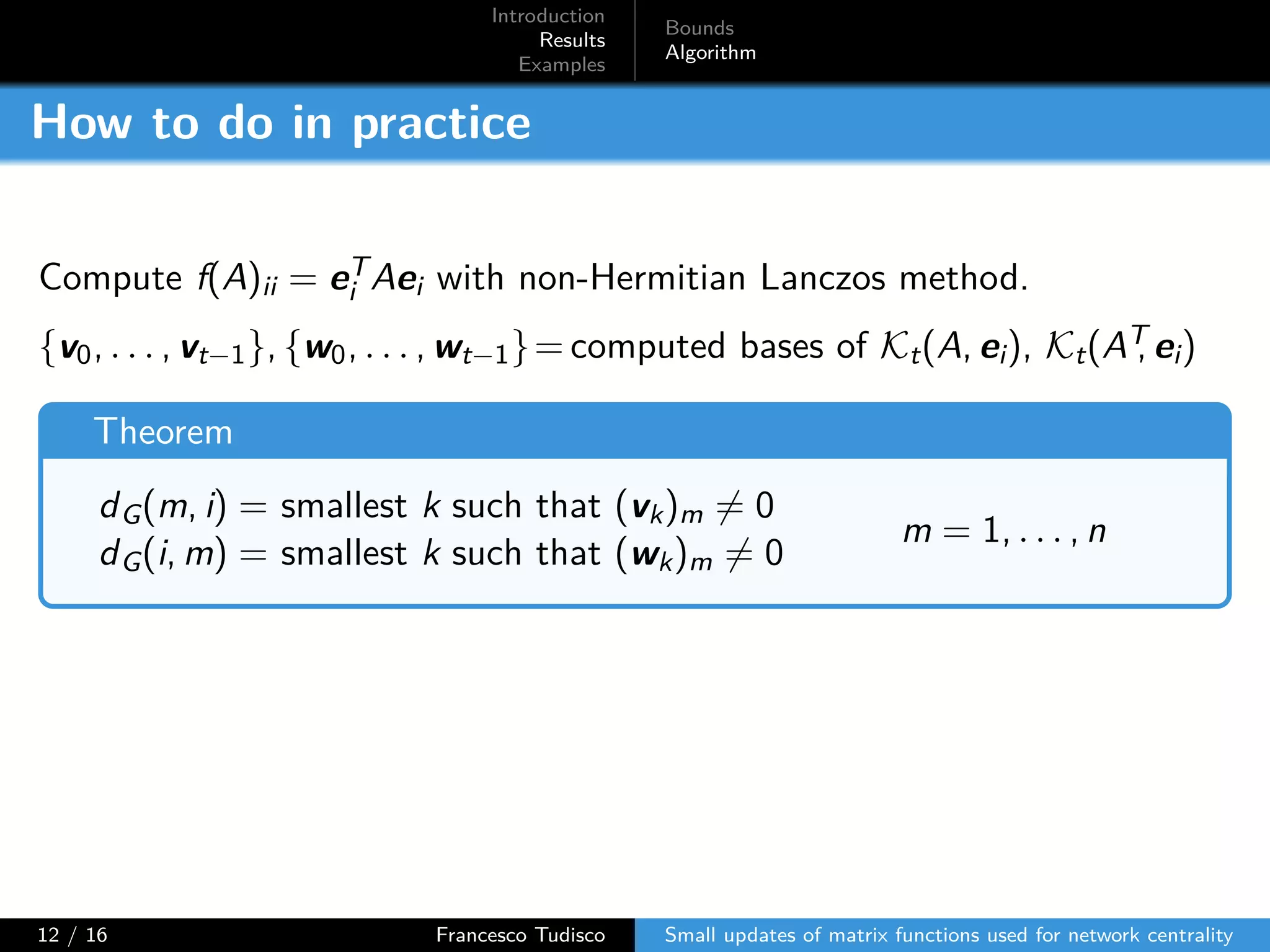
How to do in practice
Compute f(A)ii = eT
i Aei with non-Hermitian Lanczos method.
{v0, . . . , vt−1}, {w0, . . . , wt−1}= computed bases of Kt(A, ei), Kt(AT, ei)
Theorem
dG(m, i) = smallest k such that (vk)m ̸= 0
dG(i, m) = smallest k such that (wk)m ̸= 0
m = 1, . . . , n
12 / 16 Francesco Tudisco Small updates of matrix functions used for network centrality
Introduction
Results
Examples
Bounds
Algorithm
How to do in practice
Compute f(A)ii = eT
i Aei with non-Hermitian Lanczos method.
{v0, . . . , vt−1}, {w0, . . . , wt−1}= computed bases of Kt(A, ei), Kt(AT, ei)
Theorem
dG(m, i) = smallest k such that (vk)m ̸= 0
dG(i, m) = smallest k such that (wk)m ̸= 0
m = 1, . . . , n
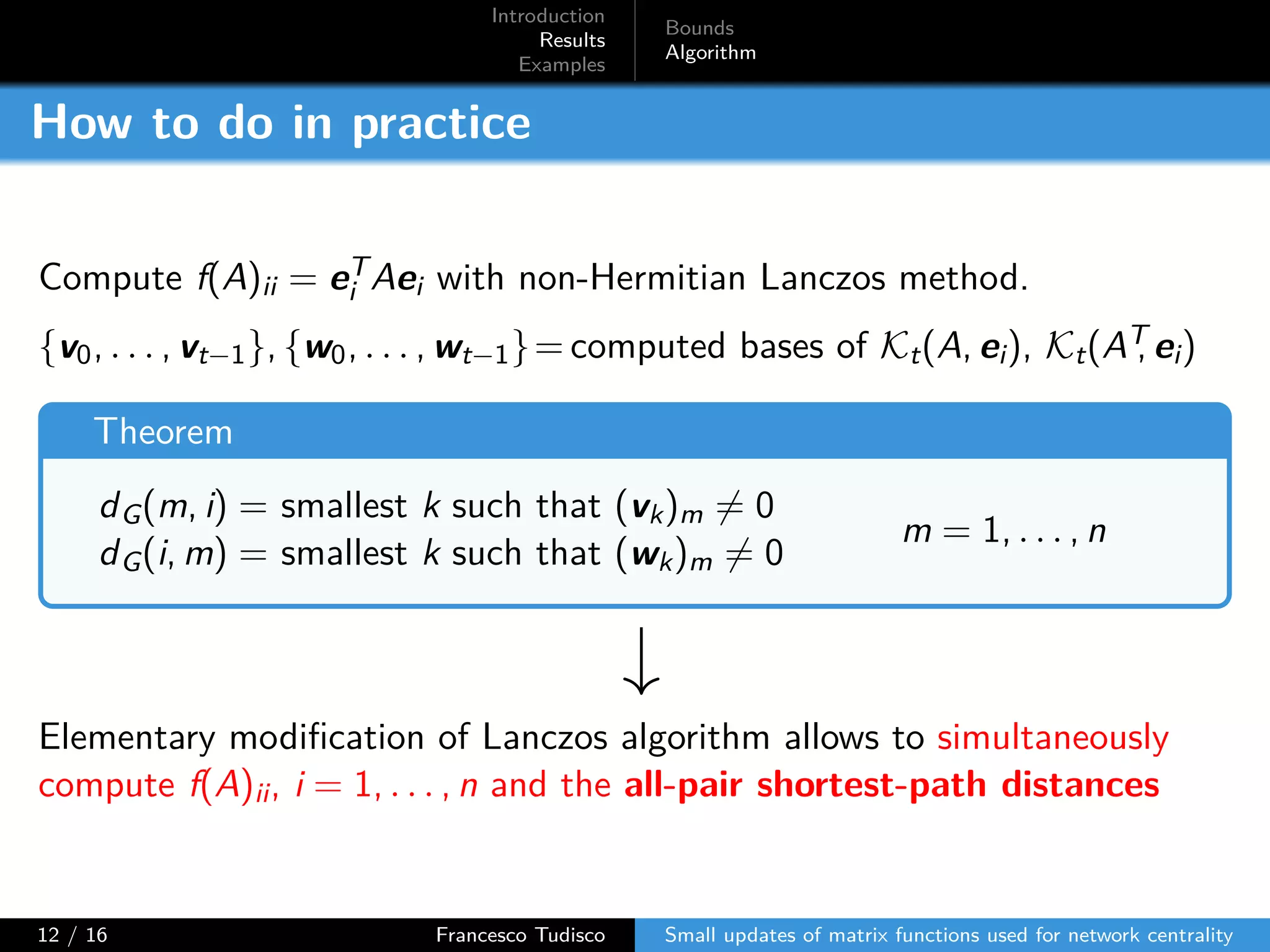
Elementary modification of Lanczos algorithm allows to simultaneously
compute f(A)ii, i = 1, . . . , n and the all-pair shortest-path distances
12 / 16 Francesco Tudisco Small updates of matrix functions used for network centrality
Introduction
Results
Examples
Two cycles
London Transports Network
Small world networks
Two cycles
100
99
1
2
50 200
199
198
101
→
e
←
e
T S
exp(A) r1/3(A)
0 50 100 150 200
10 -20
10 -10
10 0
0 50 100 150 200
10 -20
10 -10
10 0
13 / 16 Francesco Tudisco Small updates of matrix functions used for network centrality
Introduction
Results
Examples
Two cycles
London Transports Network
Small world networks
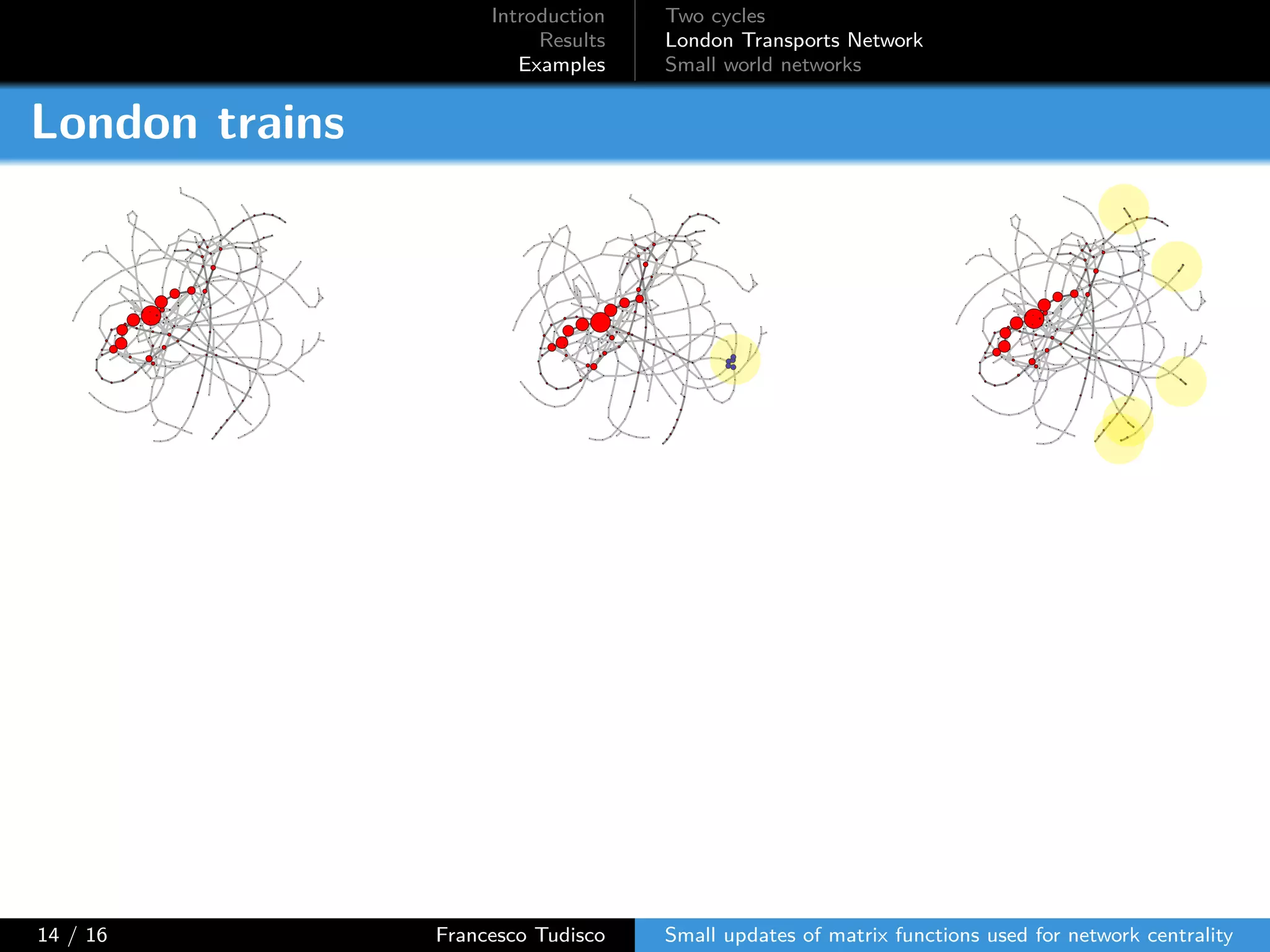
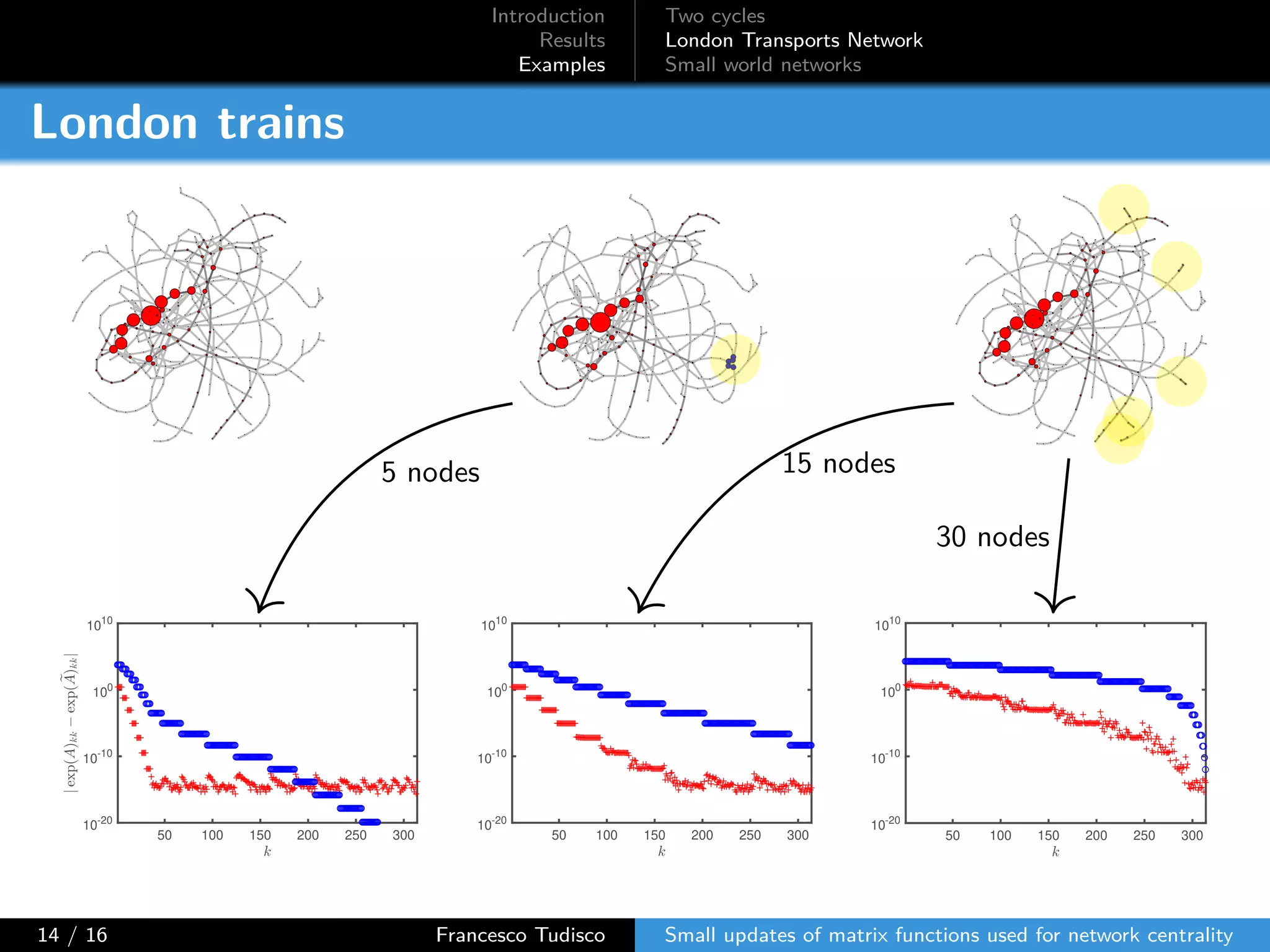
London trains
14 / 16 Francesco Tudisco Small updates of matrix functions used for network centrality
Introduction
Results
Examples
Two cycles
London Transports Network
Small world networks
London trains
50 100 150 200 250 300
10-20
10-10
100
1010
50 100 150 200 250 300
10-20
10-10
100
1010
50 100 150 200 250 300
10-20
10-10
100
1010
5 nodes 15 nodes
30 nodes
14 / 16 Francesco Tudisco Small updates of matrix functions used for network centrality
Introduction
Results
Examples
Two cycles
London Transports Network
Small world networks
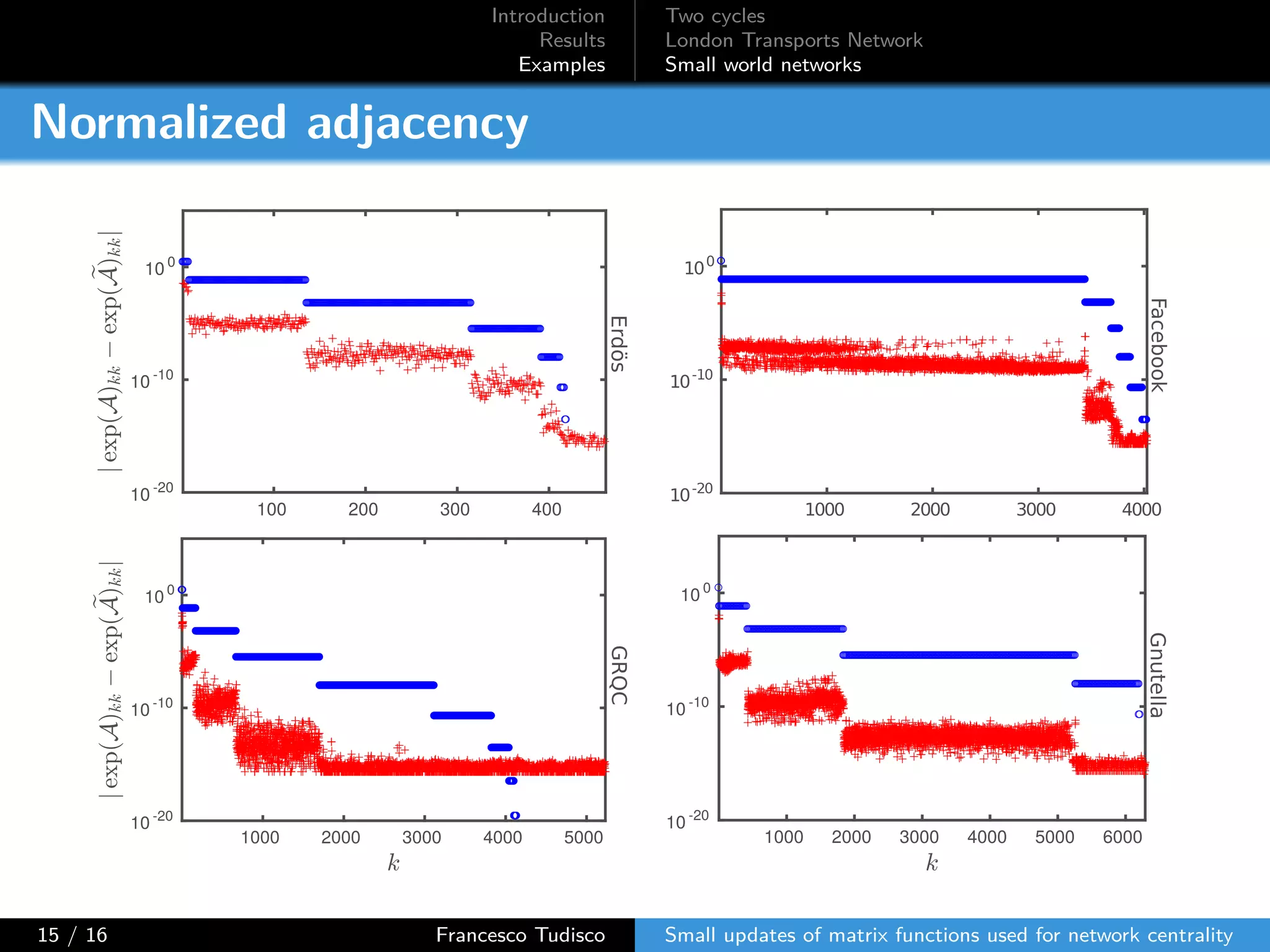
Normalized adjacency
100 200 300 400
10 -20
10 -10
10 0
Erdös
1000 2000 3000 4000
10-20
10-10
100
Facebook
1000 2000 3000 4000 5000
10 -20
10 -10
10 0
GRQC
1000 2000 3000 4000 5000 6000
10 -20
10 -10
10 0
Gnutella
15 / 16 Francesco Tudisco Small updates of matrix functions used for network centrality
Introduction
Results
Examples
Two cycles
London Transports Network
Small world networks
Reference
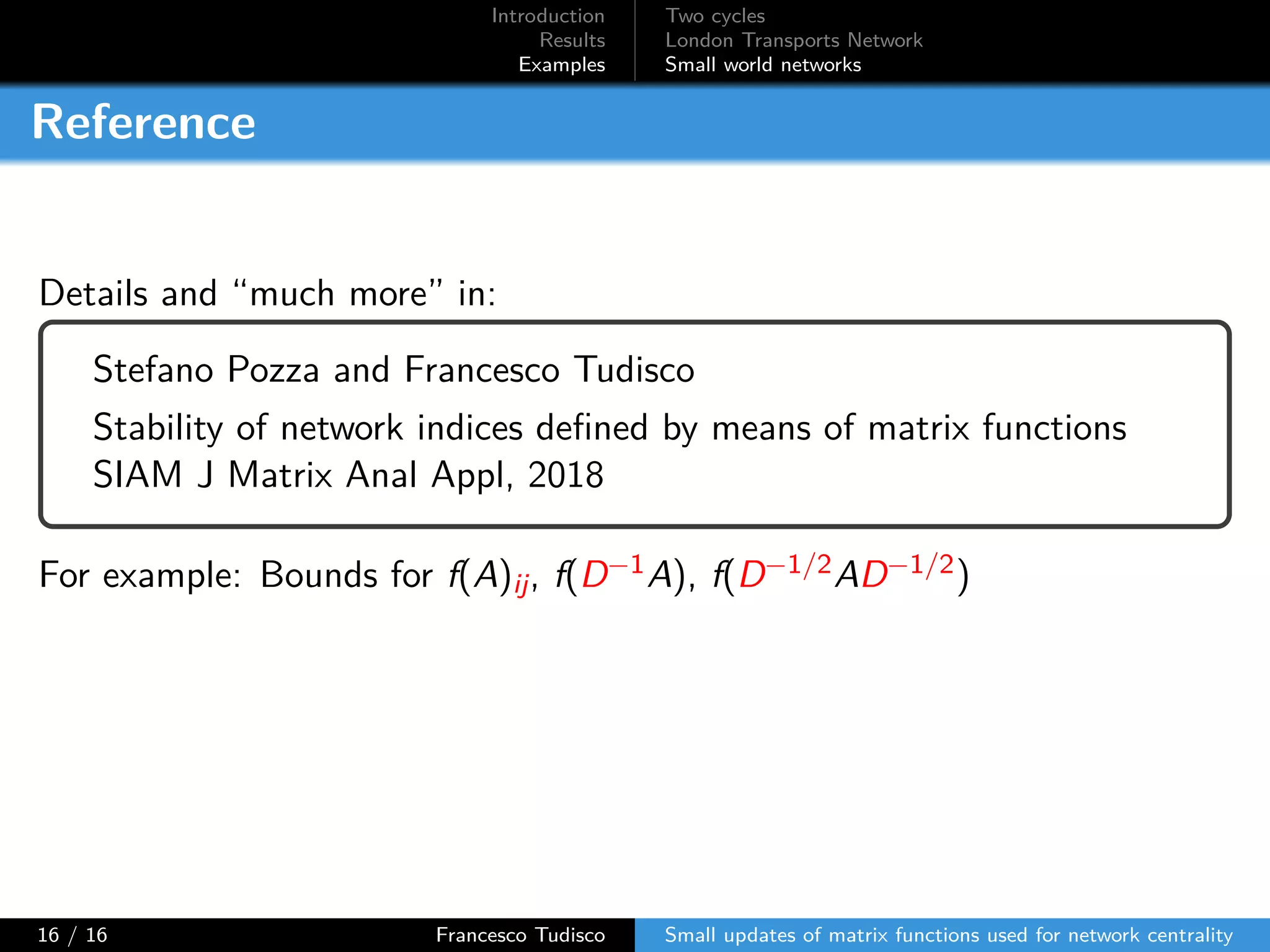
Details and “much more” in:
Stefano Pozza and Francesco Tudisco
Stability of network indices defined by means of matrix functions
SIAM J Matrix Anal Appl, 2018
For example: Bounds for f(A)ij, f(D−1A), f(D−1/2AD−1/2)
16 / 16 Francesco Tudisco Small updates of matrix functions used for network centrality
Introduction
Results
Examples
Two cycles
London Transports Network
Small world networks
Reference
Details and “much more” in:
Stefano Pozza and Francesco Tudisco
Stability of network indices defined by means of matrix functions
SIAM J Matrix Anal Appl, 2018
For example: Bounds for f(A)ij, f(D−1A), f(D−1/2AD−1/2)
Thank you for your attention!
16 / 16 Francesco Tudisco Small updates of matrix functions used for network centrality

Small updates of matrix functions used for network centrality

  • 1.
    Small updates ofmatrix functions used for network centrality Francesco Tudisco joint work with Stefano Pozza (Charles University in Prague) Department of Mathematics and Statistics, University of Strathclyde, UK IMA Conf. Numerical Linear Algebra and Optimization Birmingham June 28, 2018
  • 2.
    Introduction Results Examples Notation: graphs andmatrices Motivations and goal Adjacency matrix and its powers (A)ij = 1 if i ⇝ j, otherwise Aij = 0. (A2)ij = n s=1 AisAsj = #{s : i ⇝ s and s ⇝ j} = number of paths of length 2 from i to j (A3)ij = n s,t=1 AisAstAtj = #{s, t : i ⇝ s and s ⇝ t and t ⇝ j} = number of paths of length 3 from i to j · · · (Ak)ij = number of paths of length k from i to j 1 / 16 Francesco Tudisco Small updates of matrix functions used for network centrality
  • 3.
    Introduction Results Examples Notation: graphs andmatrices Motivations and goal Network indices based on f(A) f(A) = c0I + c1A + c2A2 + c3A3 + · · · with ck ≥ 0 f(A)ij = weighted sum of paths of any length from i to j 2 / 16 Francesco Tudisco Small updates of matrix functions used for network centrality
  • 4.
    Introduction Results Examples Notation: graphs andmatrices Motivations and goal Network indices based on f(A) f(A) = c0I + c1A + c2A2 + c3A3 + · · · with ck ≥ 0 f(A)ij = weighted sum of paths of any length from i to j f-Centrality: f(A)ii = importance of node i 2 / 16 Francesco Tudisco Small updates of matrix functions used for network centrality
  • 5.
    Introduction Results Examples Notation: graphs andmatrices Motivations and goal Exponential and resolvent Typical choices are: ck = 1 k! exp(A) = I + A + 1 2 A2 + 1 3! A3 + · · · and ck = αk rα(A) = I + αA + α2 A2 + α3 A3 + · · · Note: the longer the path length the smaller the weighting coefficient 3 / 16 Francesco Tudisco Small updates of matrix functions used for network centrality
  • 6.
    Introduction Results Examples Notation: graphs andmatrices Motivations and goal Problem setting We are interested in how f(A) changes when the structure of G = (V, E) undergoes a small perturbation Setting: • We add remove or modify the edges in a set δE ⊆ V × V • We obtain a graph G = (V, E) with adj(G) = A = A + δA • S ⊆ V = set of sources of edges in δE • T ⊆ V = set of tips of edges in δE 4 / 16 Francesco Tudisco Small updates of matrix functions used for network centrality
  • 7.
    Introduction Results Examples Notation: graphs andmatrices Motivations and goal Why? • Computing f(A)ii is a costly operation • Often we are interested in the first few most important nodes • Changes or biases are more likely to occur on nodes that are “far” from important ones 5 / 16 Francesco Tudisco Small updates of matrix functions used for network centrality
  • 8.
    Introduction Results Examples Notation: graphs andmatrices Motivations and goal Related work: f(A + small rank) Important issue: Computing f(A + δA) from f(A) when δA = small rank 6 / 16 Francesco Tudisco Small updates of matrix functions used for network centrality
  • 9.
    Introduction Results Examples Notation: graphs andmatrices Motivations and goal Related work: f(A + small rank) Important issue: Computing f(A + δA) from f(A) when δA = small rank • f(x) = x−1 −→ Sherman–Morrison–Woodbury formula 6 / 16 Francesco Tudisco Small updates of matrix functions used for network centrality
  • 10.
    Introduction Results Examples Notation: graphs andmatrices Motivations and goal Related work: f(A + small rank) Important issue: Computing f(A + δA) from f(A) when δA = small rank • f(x) = x−1 −→ Sherman–Morrison–Woodbury formula • f(x) is rational Bernstein, Van Loan, SIMAX, 2010 6 / 16 Francesco Tudisco Small updates of matrix functions used for network centrality
  • 11.
    Introduction Results Examples Notation: graphs andmatrices Motivations and goal Related work: f(A + small rank) Important issue: Computing f(A + δA) from f(A) when δA = small rank • f(x) = x−1 −→ Sherman–Morrison–Woodbury formula • f(x) is rational Bernstein, Van Loan, SIMAX, 2010 • f(x) is analytic Beckermann, Kressner, Schweitzer, SIMAX, 2018 6 / 16 Francesco Tudisco Small updates of matrix functions used for network centrality
  • 12.
    Introduction Results Examples Notation: graphs andmatrices Motivations and goal Related work: f(A + small rank) Important issue: Computing f(A + δA) from f(A) when δA = small rank • f(x) = x−1 −→ Sherman–Morrison–Woodbury formula • f(x) is rational Bernstein, Van Loan, SIMAX, 2010 • f(x) is analytic Beckermann, Kressner, Schweitzer, SIMAX, 2018 We derive a-priori bounds of the type |f(A)ii − f(A)ii| = O 1 Mδ with δ ≈ distance i ←→ δE 6 / 16 Francesco Tudisco Small updates of matrix functions used for network centrality
  • 13.
    Introduction Results Examples Notation: graphs andmatrices Motivations and goal Two cycles example A = adj(G) G = 100 99 1 2 50 200 199 198 101 → e No closed walk passes trough → e =⇒ f(A)ii is constant for all i 7 / 16 Francesco Tudisco Small updates of matrix functions used for network centrality
  • 14.
    Introduction Results Examples Notation: graphs andmatrices Motivations and goal Two cycles example A = adj(G) −→ A = adj(G) G = 100 99 1 2 50 200 199 198 101 → e ← e = δE T S No closed walk passes trough → e =⇒ f(A)ii is constant for all i 7 / 16 Francesco Tudisco Small updates of matrix functions used for network centrality
  • 15.
    Introduction Results Examples Notation: graphs andmatrices Motivations and goal Two cycles example A = adj(G) −→ A = adj(G) G = 100 99 1 2 50 200 199 198 101 → e ← e = δE T S No closed walk passes trough → e =⇒ f(A)ii is constant for all i • The number of paths of any length (100) → (100) increases • Only the number of very long paths (50) → (50) increases • We expect f(A)50,50 ≈ f(A)50,50 but f(A)100,100 ≫ f(A)100,100 7 / 16 Francesco Tudisco Small updates of matrix functions used for network centrality
  • 16.
    Introduction Results Examples Bounds Algorithm Two key observations δ= distG(i, S) + distG(T, i) 8 / 16 Francesco Tudisco Small updates of matrix functions used for network centrality
  • 17.
    Introduction Results Examples Bounds Algorithm Two key observations δ= distG(i, S) + distG(T, i) If i /∈ S, T, then: pk(A)ii = pk(A)ii for every polynomial pk of degree k ≤ δ. 8 / 16 Francesco Tudisco Small updates of matrix functions used for network centrality
  • 18.
    Introduction Results Examples Bounds Algorithm Two key observations δ= distG(i, S) + distG(T, i) If i /∈ S, T, then: pk(A)ii = pk(A)ii for every polynomial pk of degree k ≤ δ. If f is analytic on Ω = (convex continuum), then: f(A) = γ0I + γ1Φ1(A) + γ2Φ2(A) + γ3Φ3(A) + · · · Φk = k-th Faber polynomial of Ω 8 / 16 Francesco Tudisco Small updates of matrix functions used for network centrality
  • 19.
    Introduction Results Examples Bounds Algorithm Main theorem Theorem Ω convexcontinuum containing W(A)∪W(A), ϕ : Ω → C conformal map of Ω, f analytic on {x : |ϕ(x)| > τ} ⊇ Ω. Then: |f(A)ii − f(A)ii| ≤ c(τ) 1 τδ+2 where c(τ) = 2 π τ τ − 1 |ϕ(x)|=τ |f(x)| dϕ(x) Particular choices of f and Ω lead to explicit bounds 9 / 16 Francesco Tudisco Small updates of matrix functions used for network centrality
  • 20.
    Introduction Results Examples Bounds Algorithm Ellipse shaped Ω W(A) W(A) Ω ca b Bounds for exp(A) and rα(A) in terms of a, b and c 10 / 16 Francesco Tudisco Small updates of matrix functions used for network centrality
  • 21.
    Introduction Results Examples Bounds Algorithm If δ >b − 1, then: Exponential exp(A)ii − exp(A)ii ≤ 4eℜ(c) p(δ + 1) p(δ + 1) − a+b δ+1 a + b δ + 1 eq(δ+1) p(δ + 1) δ+1 with q(t) = 1 + a2−b2 t2+t √ t2+a2−b2 and p(t) = 1 + 1 + (a2 − b2)/t2 11 / 16 Francesco Tudisco Small updates of matrix functions used for network centrality
  • 22.
    Introduction Results Examples Bounds Algorithm If δ >b − 1, then: Exponential exp(A)ii − exp(A)ii ≤ 4eℜ(c) p(δ + 1) p(δ + 1) − a+b δ+1 a + b δ + 1 eq(δ+1) p(δ + 1) δ+1 with q(t) = 1 + a2−b2 t2+t √ t2+a2−b2 and p(t) = 1 + 1 + (a2 − b2)/t2 If 1/α /∈ Ω, then: Resolvent rα(A)ii − rα(A)ii ≤ 4 1 − a+b (|α−1−c|−ε)pε 1 ε a + b |α−1 − c| − ε 1 pε δ+1 with pε = 1 + 1 − a2−b2 (|α−1−c|−ε)2 and 0 < ε < |α−1 − c| − a 11 / 16 Francesco Tudisco Small updates of matrix functions used for network centrality
  • 23.
    Introduction Results Examples Bounds Algorithm How to doin practice Compute f(A)ii = eT i Aei with non-Hermitian Lanczos method. {v0, . . . , vt−1}, {w0, . . . , wt−1}= computed bases of Kt(A, ei), Kt(AT, ei) Theorem dG(m, i) = smallest k such that (vk)m ̸= 0 dG(i, m) = smallest k such that (wk)m ̸= 0 m = 1, . . . , n 12 / 16 Francesco Tudisco Small updates of matrix functions used for network centrality
  • 24.
    Introduction Results Examples Bounds Algorithm How to doin practice Compute f(A)ii = eT i Aei with non-Hermitian Lanczos method. {v0, . . . , vt−1}, {w0, . . . , wt−1}= computed bases of Kt(A, ei), Kt(AT, ei) Theorem dG(m, i) = smallest k such that (vk)m ̸= 0 dG(i, m) = smallest k such that (wk)m ̸= 0 m = 1, . . . , n Elementary modification of Lanczos algorithm allows to simultaneously compute f(A)ii, i = 1, . . . , n and the all-pair shortest-path distances 12 / 16 Francesco Tudisco Small updates of matrix functions used for network centrality
  • 25.
    Introduction Results Examples Two cycles London TransportsNetwork Small world networks Two cycles 100 99 1 2 50 200 199 198 101 → e ← e T S exp(A) r1/3(A) 0 50 100 150 200 10 -20 10 -10 10 0 0 50 100 150 200 10 -20 10 -10 10 0 13 / 16 Francesco Tudisco Small updates of matrix functions used for network centrality
  • 26.
    Introduction Results Examples Two cycles London TransportsNetwork Small world networks London trains 14 / 16 Francesco Tudisco Small updates of matrix functions used for network centrality
  • 27.
    Introduction Results Examples Two cycles London TransportsNetwork Small world networks London trains 50 100 150 200 250 300 10-20 10-10 100 1010 50 100 150 200 250 300 10-20 10-10 100 1010 50 100 150 200 250 300 10-20 10-10 100 1010 5 nodes 15 nodes 30 nodes 14 / 16 Francesco Tudisco Small updates of matrix functions used for network centrality
  • 28.
    Introduction Results Examples Two cycles London TransportsNetwork Small world networks Normalized adjacency 100 200 300 400 10 -20 10 -10 10 0 Erdös 1000 2000 3000 4000 10-20 10-10 100 Facebook 1000 2000 3000 4000 5000 10 -20 10 -10 10 0 GRQC 1000 2000 3000 4000 5000 6000 10 -20 10 -10 10 0 Gnutella 15 / 16 Francesco Tudisco Small updates of matrix functions used for network centrality
  • 29.
    Introduction Results Examples Two cycles London TransportsNetwork Small world networks Reference Details and “much more” in: Stefano Pozza and Francesco Tudisco Stability of network indices defined by means of matrix functions SIAM J Matrix Anal Appl, 2018 For example: Bounds for f(A)ij, f(D−1A), f(D−1/2AD−1/2) 16 / 16 Francesco Tudisco Small updates of matrix functions used for network centrality
  • 30.
    Introduction Results Examples Two cycles London TransportsNetwork Small world networks Reference Details and “much more” in: Stefano Pozza and Francesco Tudisco Stability of network indices defined by means of matrix functions SIAM J Matrix Anal Appl, 2018 For example: Bounds for f(A)ij, f(D−1A), f(D−1/2AD−1/2) Thank you for your attention! 16 / 16 Francesco Tudisco Small updates of matrix functions used for network centrality