Cryptography and Data
Security

   Number Theory (2 of 2)


   (presented by Aleksandr Yampolskiy)
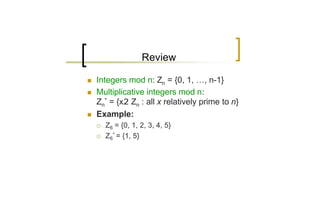
Review

n   Integers mod n: Zn = {0, 1, …, n-1}
n   Multiplicative integers mod n:
    Zn* = {x2 Zn : all x relatively prime to n}
n   Example:
    ¡   Z6 = {0, 1, 2, 3, 4, 5}
    ¡   Z6* = {1, 5}
Review (cont.)
n   Euler’s totient function: φ (n) = |Zn*|
    ¡ φ(mn) = φ(m)¢ φ(n)

    ¡ φ(pk) = pk – pk-1

n   In general, φ(∏i piei) = ∏i(piei – piei-1)
n   Q: How many integers in [0, 12] are relatively
    prime to 12?
    A: Four. They are {1, 5, 7, 11}.
        φ(12) = φ(22¢3) = (22 – 21)(31 – 30) = 4.
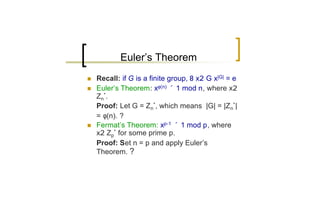
Euler’s Theorem
n   Recall: if G is a finite group, 8 x2 G x|G| = e
n   Euler’s Theorem: xφ(n) ´ 1 mod n, where x2
    Z n* .
    Proof: Let G = Zn*, which means |G| = |Z n* |
    = φ(n). ?
n   Fermat’s Theorem: xp-1 ´ 1 mod p, where
    x2 Zp* for some prime p.
    Proof: Set n = p and apply Euler’s
    Theorem. ?
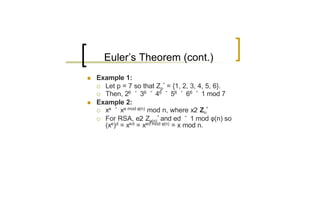
Euler’s Theorem (cont.)
n   Example 1:
    ¡ Let p = 7 so that Zp* = {1, 2, 3, 4, 5, 6}.
    ¡ Then, 26 ´ 36 ´ 46 ´ 56 ´ 66 ´ 1 mod 7
n   Example 2:
    ¡ xa ´ xa mod φ(n) mod n, where x2 Zn*
    ¡ For RSA, e2 Zφ(n)* and ed ´ 1 mod φ(n) so
      (xe)d = xed = xed mod φ(n) = x mod n.
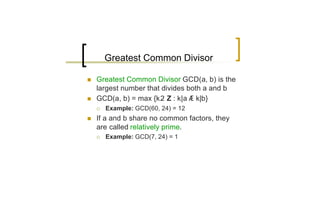
Greatest Common Divisor

n   Greatest Common Divisor GCD(a, b) is the
    largest number that divides both a and b
n   GCD(a, b) = max {k2 Z : k|a Æ k|b}
    ¡   Example: GCD(60, 24) = 12
n   If a and b share no common factors, they
    are called relatively prime.
    ¡   Example: GCD(7, 24) = 1
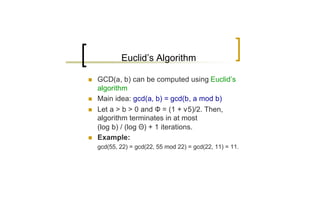
Euclid’s Algorithm

n   GCD(a, b) can be computed using Euclid’s
    algorithm
n   Main idea: gcd(a, b) = gcd(b, a mod b)
n   Let a > b > 0 and Φ = (1 + v5)/2. Then,
    algorithm terminates in at most
    (log b) / (log Θ) + 1 iterations.
n   Example:
    gcd(55, 22) = gcd(22, 55 mod 22) = gcd(22, 11) = 11.
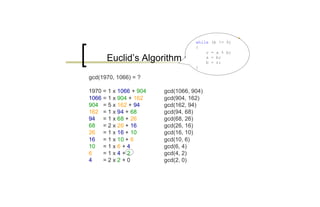
while   (b != 0)
                                   {
                                       r   = a % b;
      Euclid’s Algorithm (cont.)       a
                                       b
                                           = b;
                                           = r;
                                   }

gcd(1970, 1066) = ?

1970 = 1 x 1066 + 904   gcd(1066, 904)
1066 = 1 x 904 + 162    gcd(904, 162)
904 = 5 x 162 + 94      gcd(162, 94)
162 = 1 x 94 + 68       gcd(94, 68)
94 = 1 x 68 + 26        gcd(68, 26)
68 = 2 x 26 + 16        gcd(26, 16)
26 = 1 x 16 + 10        gcd(16, 10)
16 = 1 x 10 + 6         gcd(10, 6)
10 = 1 x 6 + 4          gcd(6, 4)
6    =1x4+2             gcd(4, 2)
4    =2x2+0             gcd(2, 0)
Euclid’s Algorithm (cont.)

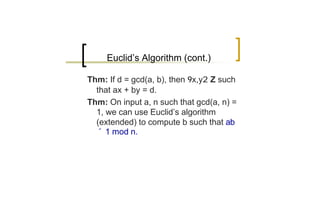
Thm: If d = gcd(a, b), then 9x,y2 Z such
  that ax + by = d.
Thm: On input a, n such that gcd(a, n) =
  1, we can use Euclid’s algorithm
  (extended) to compute b such that ab
  ´ 1 mod n.
Finding Inverses
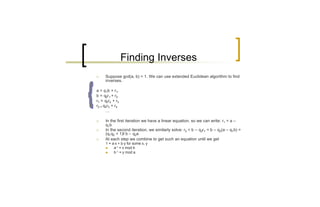
¡    Suppose gcd(a, b) = 1. We can use extended Euclidean algorithm to find
     inverses.

a = q1b + r1.
b = q2r 1 + r2
r1 = q3r2 + r3
r2 = q4r3 + r4
      …

¡    In the first iteration we have a linear equation, so we can write: r1 = a –
     q1 b
¡    In the second iteration, we similarly solve: r2 = b – q2r1 = b – q2(a – q1 b) =
     (q1 q2 + 1)¢ b – q2a
¡    At each step we combine to get such an equation until we get
     1 = a·x + b·y for some x, y
     n    a-1 = x mod b
     n    b-1 = y mod a
Polynomials over fields
n   Let f(x)= an·xn + an-1·xn-1 + … + a1·x + a0 be
    a polynomial of degree n in one variable x
    over a field F (namely, an, an-1,…, a0 ∈ F).
n   Polynomials over F, denoted as F[x]
n   Theorem: The equation f(x)=0 has at most
    n solutions in F.
n   However, the theorem does not hold over
    rings with identity.
    ¡   E.g., in Z24 the equation 6·x = 0 has six
        solutions (0,4,8,12,16,20).
Polynomials over fields (cont.)

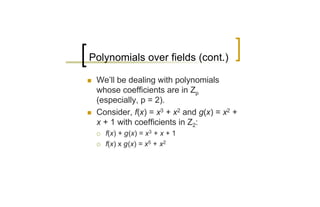
n   We’ll be dealing with polynomials
    whose coefficients are in Zp
    (especially, p = 2).
n   Consider, f(x) = x3 + x2 and g(x) = x2 +
    x + 1 with coefficients in Z2:
    ¡   f(x) + g(x) = x3 + x + 1
    ¡   f(x) x g(x) = x5 + x2
Polynomials over fields (cont.)
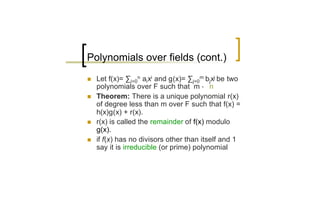
n   Let f(x)= ∑i=0n ai xi and g(x)= ∑j=0m bjxj be two
    polynomials over F such that m · n
n   Theorem: There is a unique polynomial r(x)
    of degree less than m over F such that f(x) =
    h(x)g(x) + r(x).
n   r(x) is called the remainder of f(x) modulo
    g(x).
n   if f(x) has no divisors other than itself and 1
    say it is irreducible (or prime) polynomial
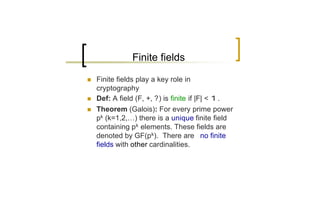
Finite fields

n   Finite fields play a key role in
    cryptography
n   Def: A field (F, +, ?) is finite if |F| < 1.
n   Theorem (Galois): For every prime power
    pk (k=1,2,…) there is a unique finite field
    containing pk elements. These fields are
    denoted by GF(p k). There are no finite
    fields with other cardinalities.
Finite fields (cont.)
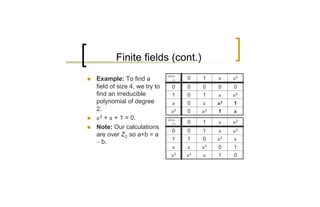
                                 GF(4)
n   Example: To find a              (·)   0    1    a    a2
    field of size 4, we try to      0     0    0    0    0
    find an irreducible             1     0    1    a    a2
    polynomial of degree            a     0    a    a2   1
    2.                              a2    0    a2   1    a
n   a 2 + a + 1 = 0.             GF(4)
                                    (+)   0    1    a    a2
n   Note: Our calculations
                                    0     0    1    a    a2
    are over Z2 so a+b = a
                                    1     1    0    a2   a
    – b.
                                    a     a    a2   0    1
                                    a2    a2   a    1    0

Number theory lecture (part 2)

  • 1.
    Cryptography and Data Security Number Theory (2 of 2) (presented by Aleksandr Yampolskiy)
  • 2.
    Review n Integers mod n: Zn = {0, 1, …, n-1} n Multiplicative integers mod n: Zn* = {x2 Zn : all x relatively prime to n} n Example: ¡ Z6 = {0, 1, 2, 3, 4, 5} ¡ Z6* = {1, 5}
  • 3.
    Review (cont.) n Euler’s totient function: φ (n) = |Zn*| ¡ φ(mn) = φ(m)¢ φ(n) ¡ φ(pk) = pk – pk-1 n In general, φ(∏i piei) = ∏i(piei – piei-1) n Q: How many integers in [0, 12] are relatively prime to 12? A: Four. They are {1, 5, 7, 11}. φ(12) = φ(22¢3) = (22 – 21)(31 – 30) = 4.
  • 4.
    Euler’s Theorem n Recall: if G is a finite group, 8 x2 G x|G| = e n Euler’s Theorem: xφ(n) ´ 1 mod n, where x2 Z n* . Proof: Let G = Zn*, which means |G| = |Z n* | = φ(n). ? n Fermat’s Theorem: xp-1 ´ 1 mod p, where x2 Zp* for some prime p. Proof: Set n = p and apply Euler’s Theorem. ?
  • 5.
    Euler’s Theorem (cont.) n Example 1: ¡ Let p = 7 so that Zp* = {1, 2, 3, 4, 5, 6}. ¡ Then, 26 ´ 36 ´ 46 ´ 56 ´ 66 ´ 1 mod 7 n Example 2: ¡ xa ´ xa mod φ(n) mod n, where x2 Zn* ¡ For RSA, e2 Zφ(n)* and ed ´ 1 mod φ(n) so (xe)d = xed = xed mod φ(n) = x mod n.
  • 6.
    Greatest Common Divisor n Greatest Common Divisor GCD(a, b) is the largest number that divides both a and b n GCD(a, b) = max {k2 Z : k|a Æ k|b} ¡ Example: GCD(60, 24) = 12 n If a and b share no common factors, they are called relatively prime. ¡ Example: GCD(7, 24) = 1
  • 7.
    Euclid’s Algorithm n GCD(a, b) can be computed using Euclid’s algorithm n Main idea: gcd(a, b) = gcd(b, a mod b) n Let a > b > 0 and Φ = (1 + v5)/2. Then, algorithm terminates in at most (log b) / (log Θ) + 1 iterations. n Example: gcd(55, 22) = gcd(22, 55 mod 22) = gcd(22, 11) = 11.
  • 8.
    while (b != 0) { r = a % b; Euclid’s Algorithm (cont.) a b = b; = r; } gcd(1970, 1066) = ? 1970 = 1 x 1066 + 904 gcd(1066, 904) 1066 = 1 x 904 + 162 gcd(904, 162) 904 = 5 x 162 + 94 gcd(162, 94) 162 = 1 x 94 + 68 gcd(94, 68) 94 = 1 x 68 + 26 gcd(68, 26) 68 = 2 x 26 + 16 gcd(26, 16) 26 = 1 x 16 + 10 gcd(16, 10) 16 = 1 x 10 + 6 gcd(10, 6) 10 = 1 x 6 + 4 gcd(6, 4) 6 =1x4+2 gcd(4, 2) 4 =2x2+0 gcd(2, 0)
  • 9.
    Euclid’s Algorithm (cont.) Thm:If d = gcd(a, b), then 9x,y2 Z such that ax + by = d. Thm: On input a, n such that gcd(a, n) = 1, we can use Euclid’s algorithm (extended) to compute b such that ab ´ 1 mod n.
  • 10.
    Finding Inverses ¡ Suppose gcd(a, b) = 1. We can use extended Euclidean algorithm to find inverses. a = q1b + r1. b = q2r 1 + r2 r1 = q3r2 + r3 r2 = q4r3 + r4 … ¡ In the first iteration we have a linear equation, so we can write: r1 = a – q1 b ¡ In the second iteration, we similarly solve: r2 = b – q2r1 = b – q2(a – q1 b) = (q1 q2 + 1)¢ b – q2a ¡ At each step we combine to get such an equation until we get 1 = a·x + b·y for some x, y n a-1 = x mod b n b-1 = y mod a
  • 11.
    Polynomials over fields n Let f(x)= an·xn + an-1·xn-1 + … + a1·x + a0 be a polynomial of degree n in one variable x over a field F (namely, an, an-1,…, a0 ∈ F). n Polynomials over F, denoted as F[x] n Theorem: The equation f(x)=0 has at most n solutions in F. n However, the theorem does not hold over rings with identity. ¡ E.g., in Z24 the equation 6·x = 0 has six solutions (0,4,8,12,16,20).
  • 12.
    Polynomials over fields(cont.) n We’ll be dealing with polynomials whose coefficients are in Zp (especially, p = 2). n Consider, f(x) = x3 + x2 and g(x) = x2 + x + 1 with coefficients in Z2: ¡ f(x) + g(x) = x3 + x + 1 ¡ f(x) x g(x) = x5 + x2
  • 13.
    Polynomials over fields(cont.) n Let f(x)= ∑i=0n ai xi and g(x)= ∑j=0m bjxj be two polynomials over F such that m · n n Theorem: There is a unique polynomial r(x) of degree less than m over F such that f(x) = h(x)g(x) + r(x). n r(x) is called the remainder of f(x) modulo g(x). n if f(x) has no divisors other than itself and 1 say it is irreducible (or prime) polynomial
  • 14.
    Finite fields n Finite fields play a key role in cryptography n Def: A field (F, +, ?) is finite if |F| < 1. n Theorem (Galois): For every prime power pk (k=1,2,…) there is a unique finite field containing pk elements. These fields are denoted by GF(p k). There are no finite fields with other cardinalities.
  • 15.
    Finite fields (cont.) GF(4) n Example: To find a (·) 0 1 a a2 field of size 4, we try to 0 0 0 0 0 find an irreducible 1 0 1 a a2 polynomial of degree a 0 a a2 1 2. a2 0 a2 1 a n a 2 + a + 1 = 0. GF(4) (+) 0 1 a a2 n Note: Our calculations 0 0 1 a a2 are over Z2 so a+b = a 1 1 0 a2 a – b. a a a2 0 1 a2 a2 a 1 0