How to do:  Lattice Multiplication Created by Lilian Patrick 2009
What is lattice multiplication and when would we use it? Lattice multiplication is a way to multiply larger numbers (bigger than a 1-digit number times another 1-digit number) You can use lattice multiplication with any big multiplication problem as long as you can draw a big enough grid!
Sounds great! How do we get started?
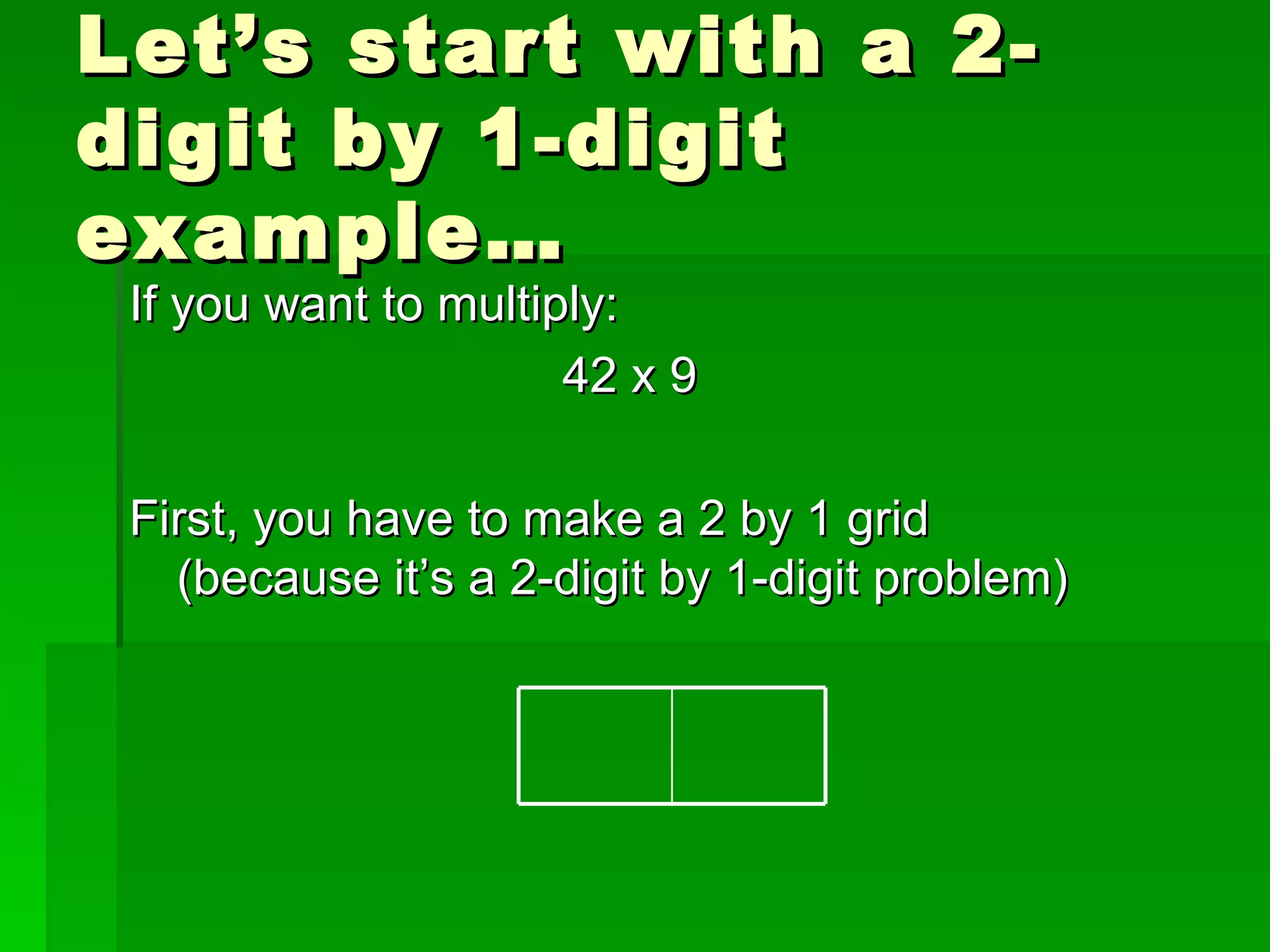
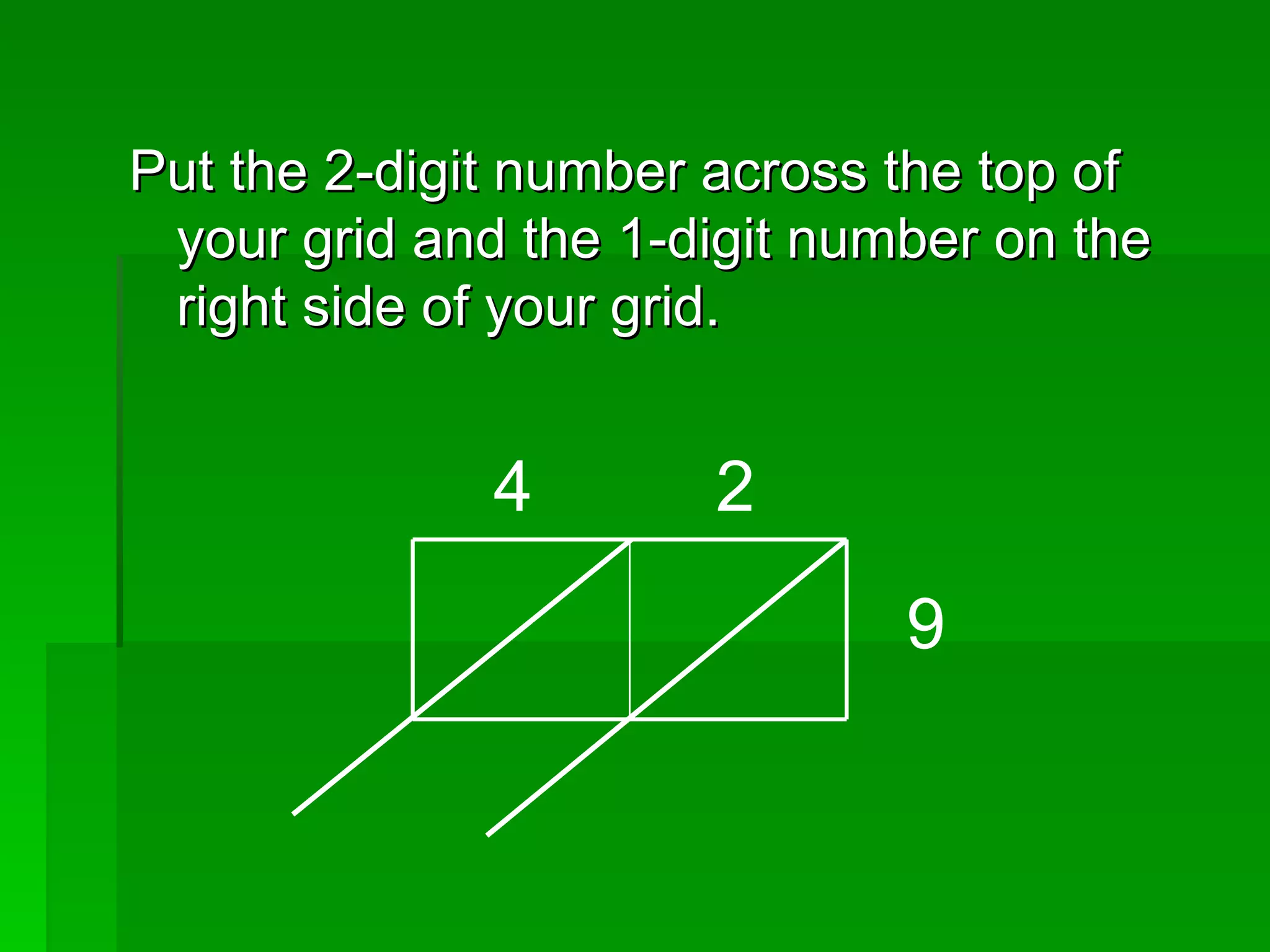
Let’s start with a 2-digit by 1-digit example… If you want to multiply: 42 x 9 First, you have to make a 2 by 1 grid (because it’s a 2-digit by 1-digit problem)
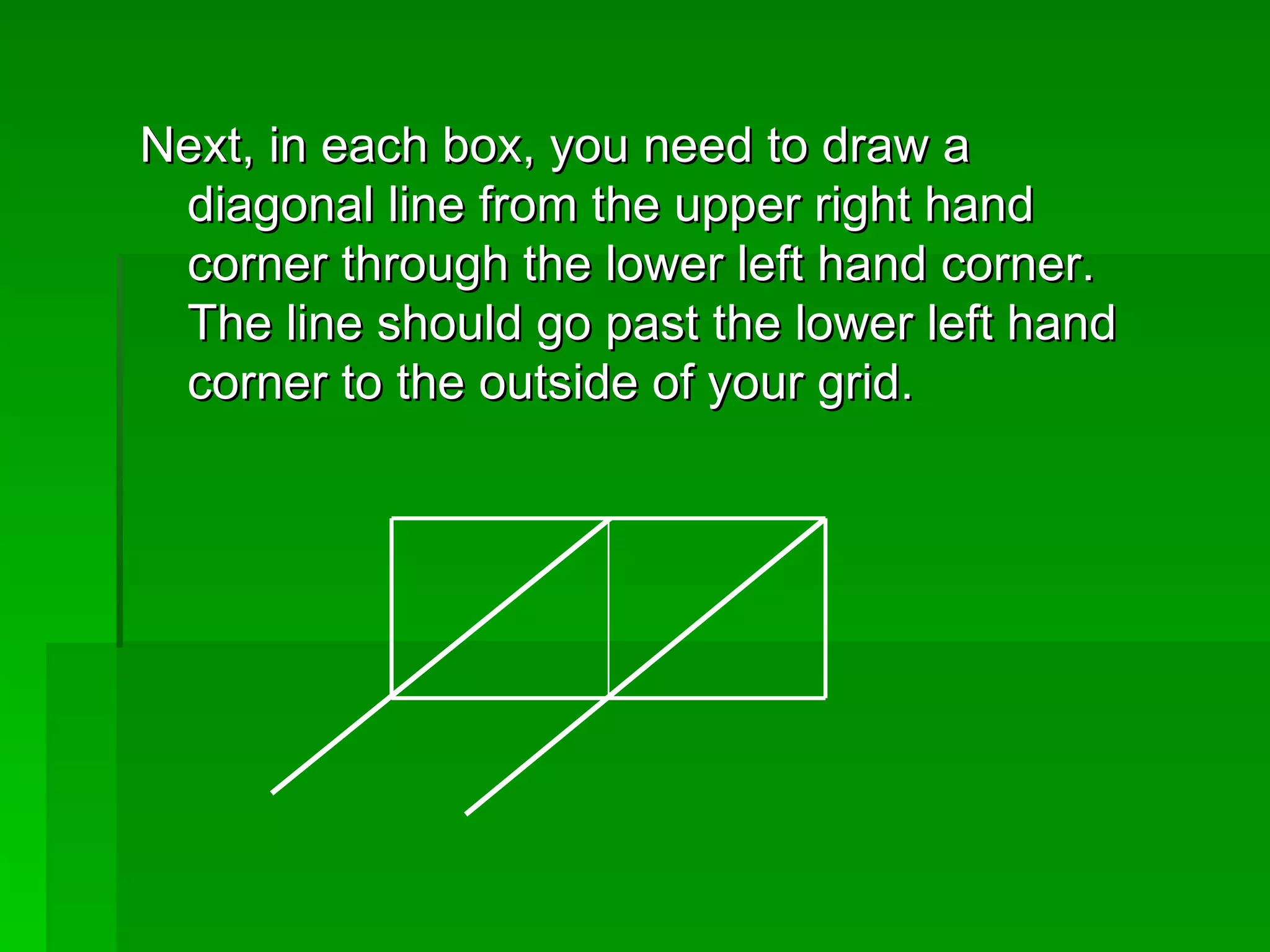
Next, in each box, you need to draw a diagonal line from the upper right hand corner through the lower left hand corner.  The line should go past the lower left hand corner to the outside of your grid.
Put the 2-digit number across the top of your grid and the 1-digit number on the right side of your grid. 4 2 9
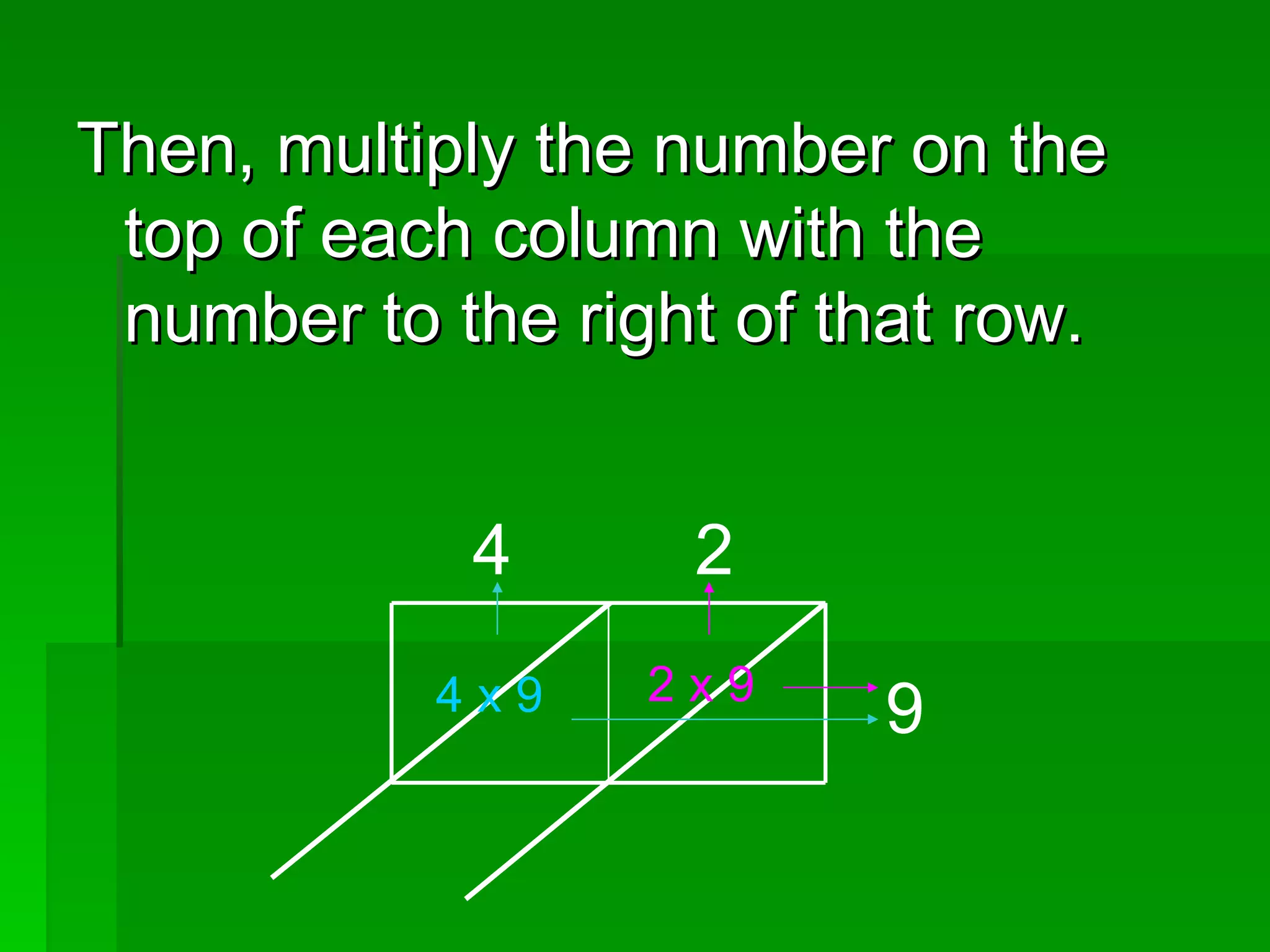
Then, multiply the number on the top of each column with the number to the right of that row.  4 2 9 2 x 9   4 x 9
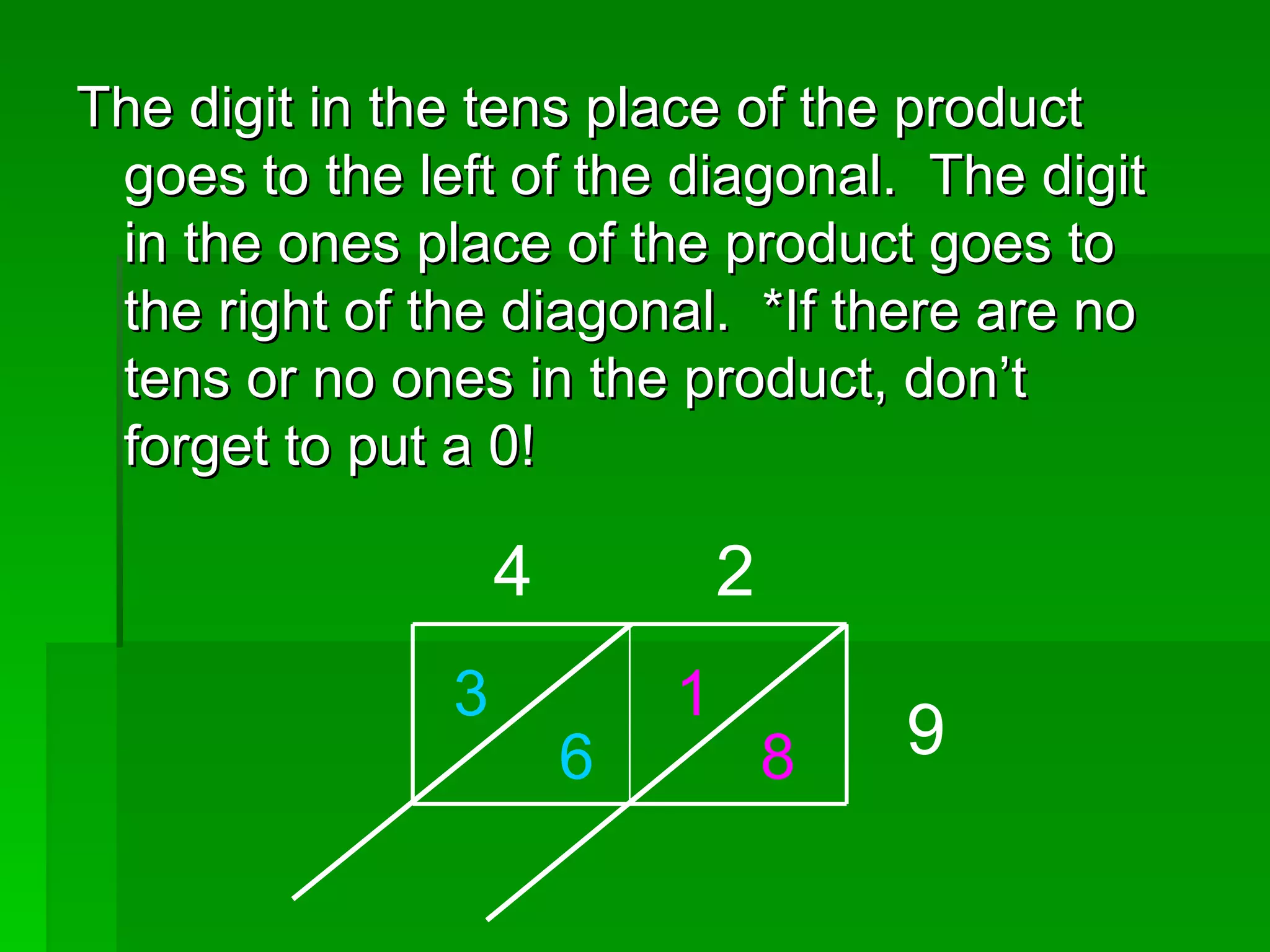
The digit in the tens place of the product goes to the left of the diagonal.  The digit in the ones place of the product goes to the right of the diagonal.  *If there are no tens or no ones in the product, don’t forget to put a 0! 4 2 9 1 8 3 6
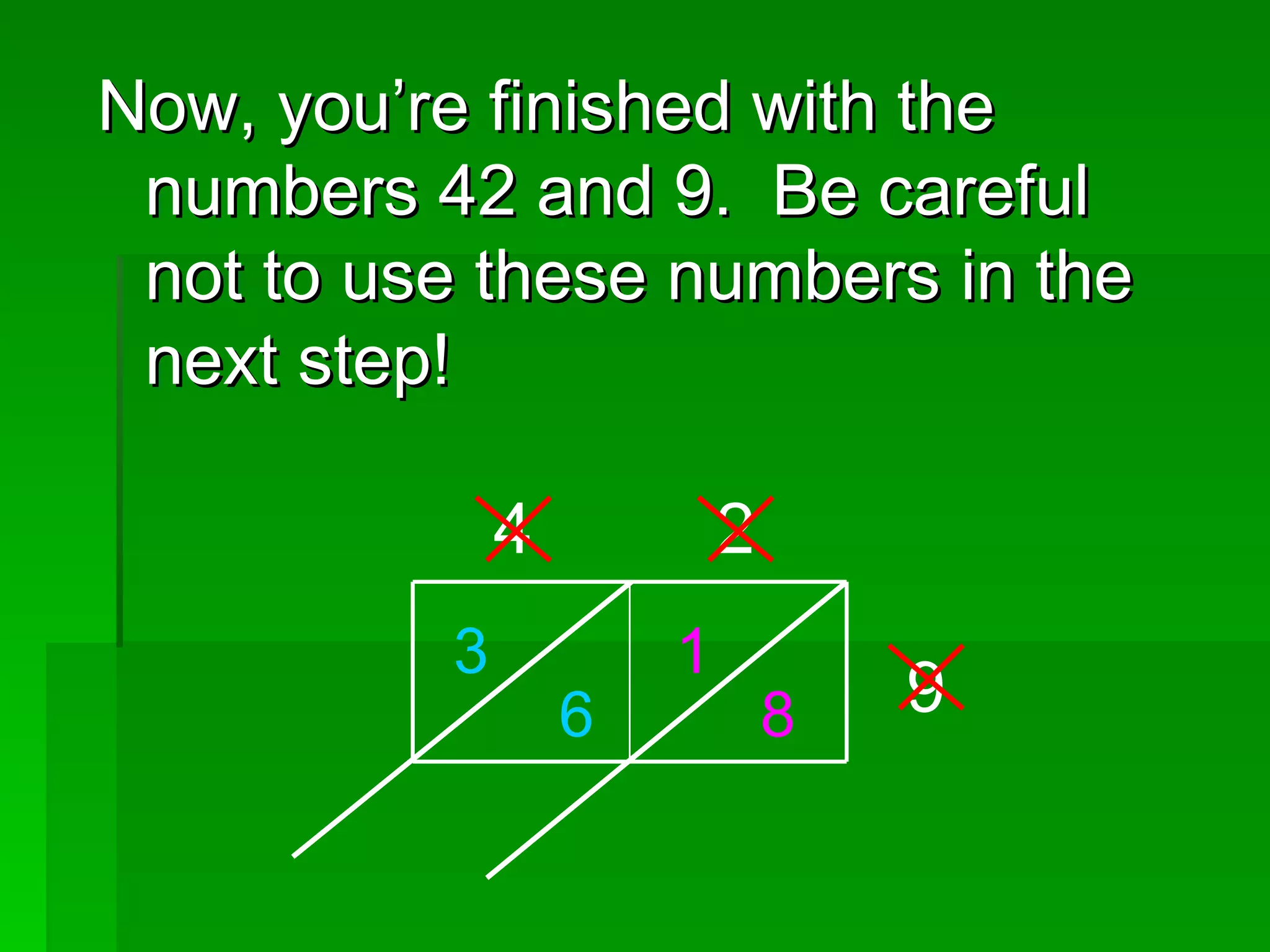
Now, you’re finished with the numbers 42 and 9.  Be careful not to use these numbers in the next step! 4 2 9 1 8 3 6
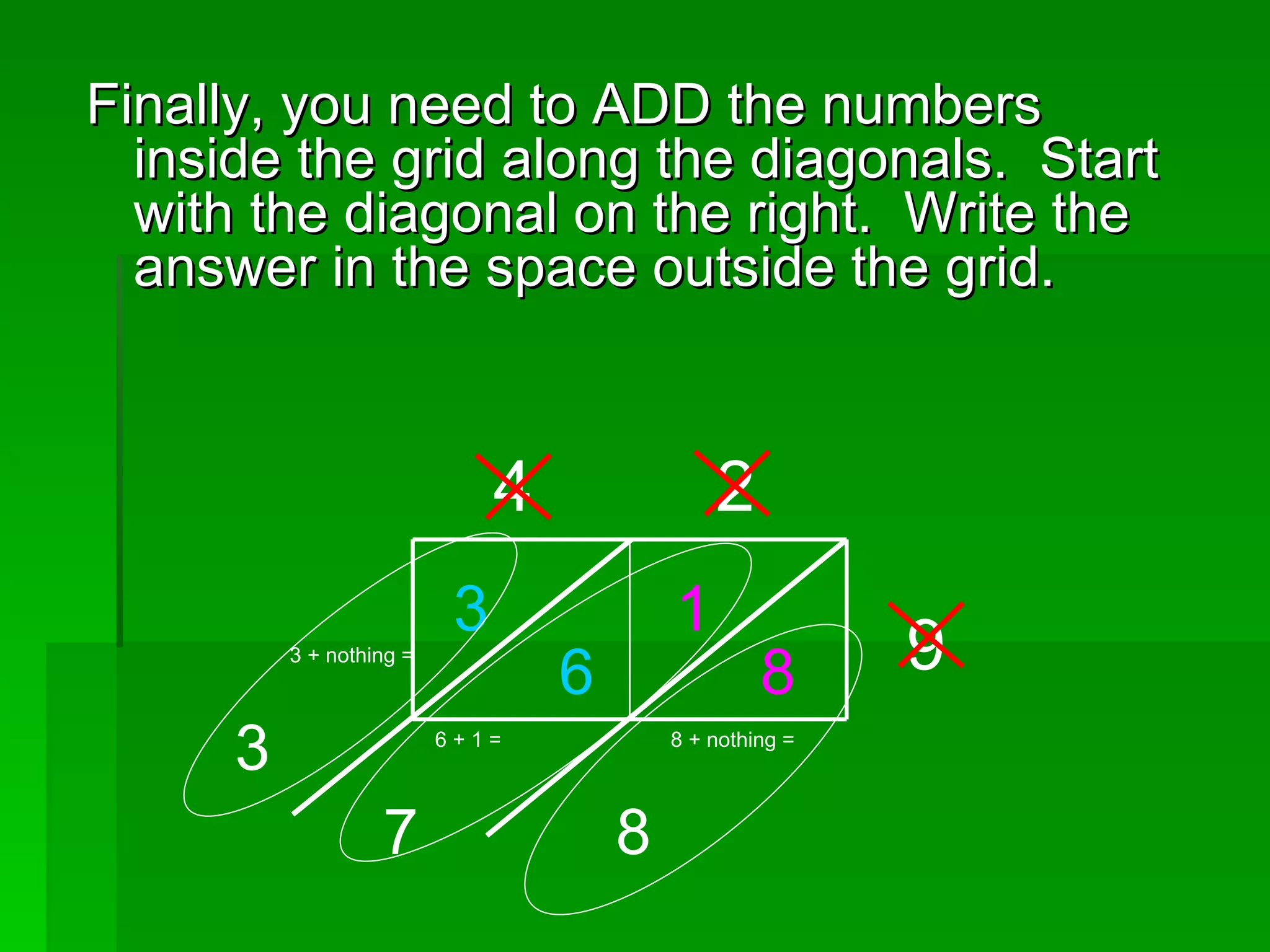
Finally, you need to ADD the numbers inside the grid along the diagonals.  Start with the diagonal on the right.  Write the answer in the space outside the grid. 4 2 9 1 8 3 6 8 + nothing =  8 6 + 1 =  7 3 + nothing =  3
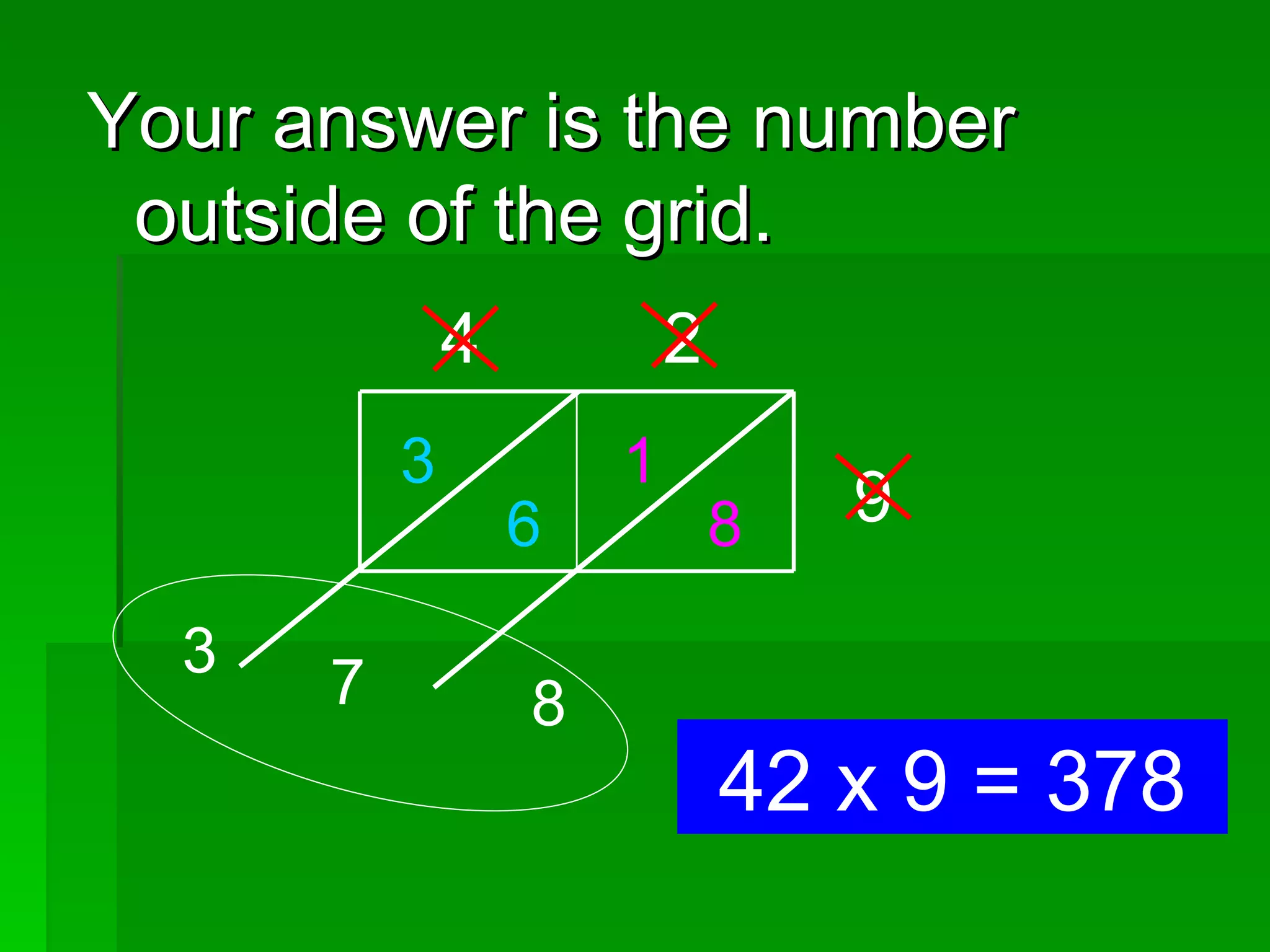
Your answer is the number outside of the grid. 4 2 9 1 8 3 6 8 7 3 42 x 9 = 378
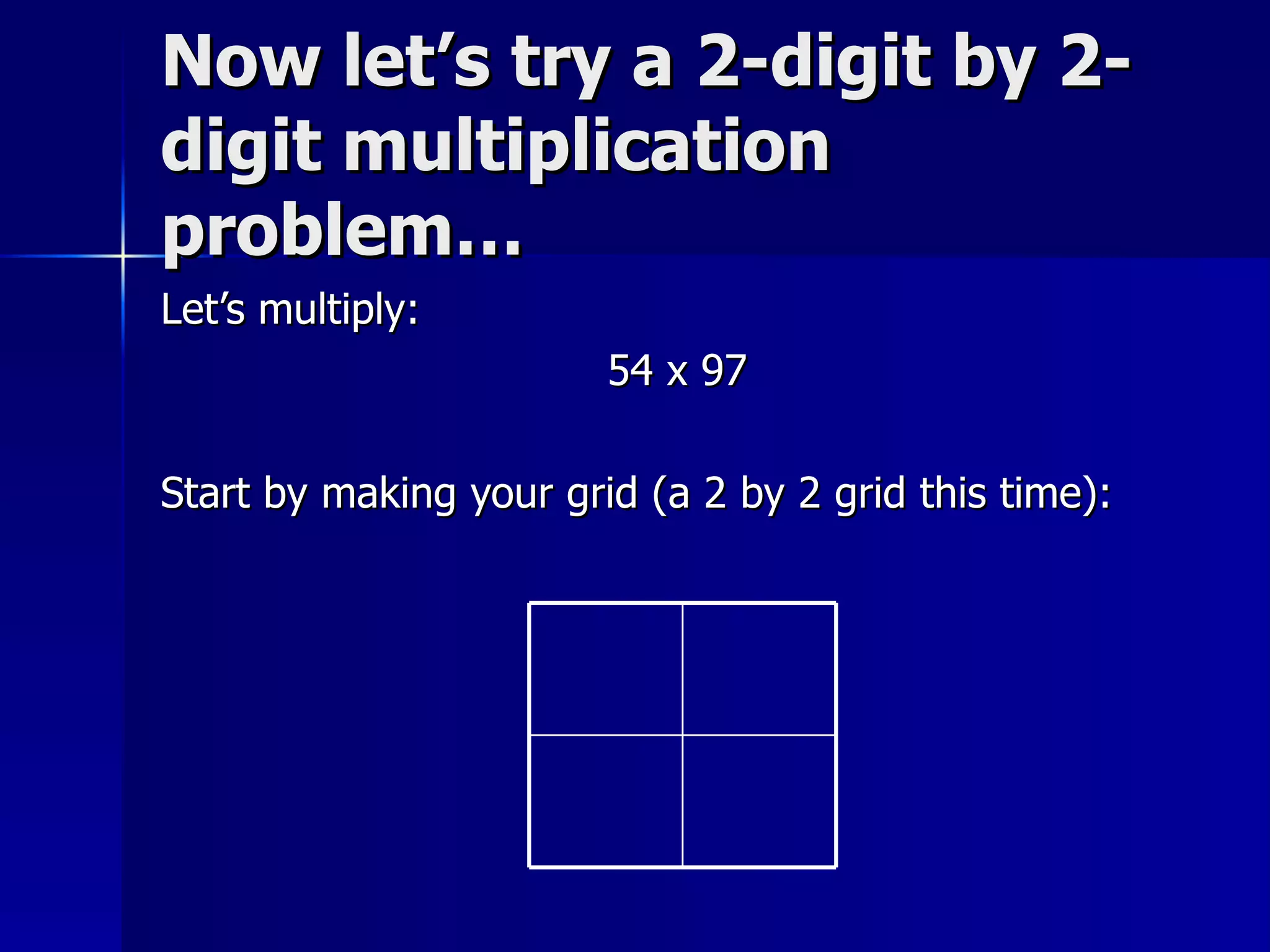
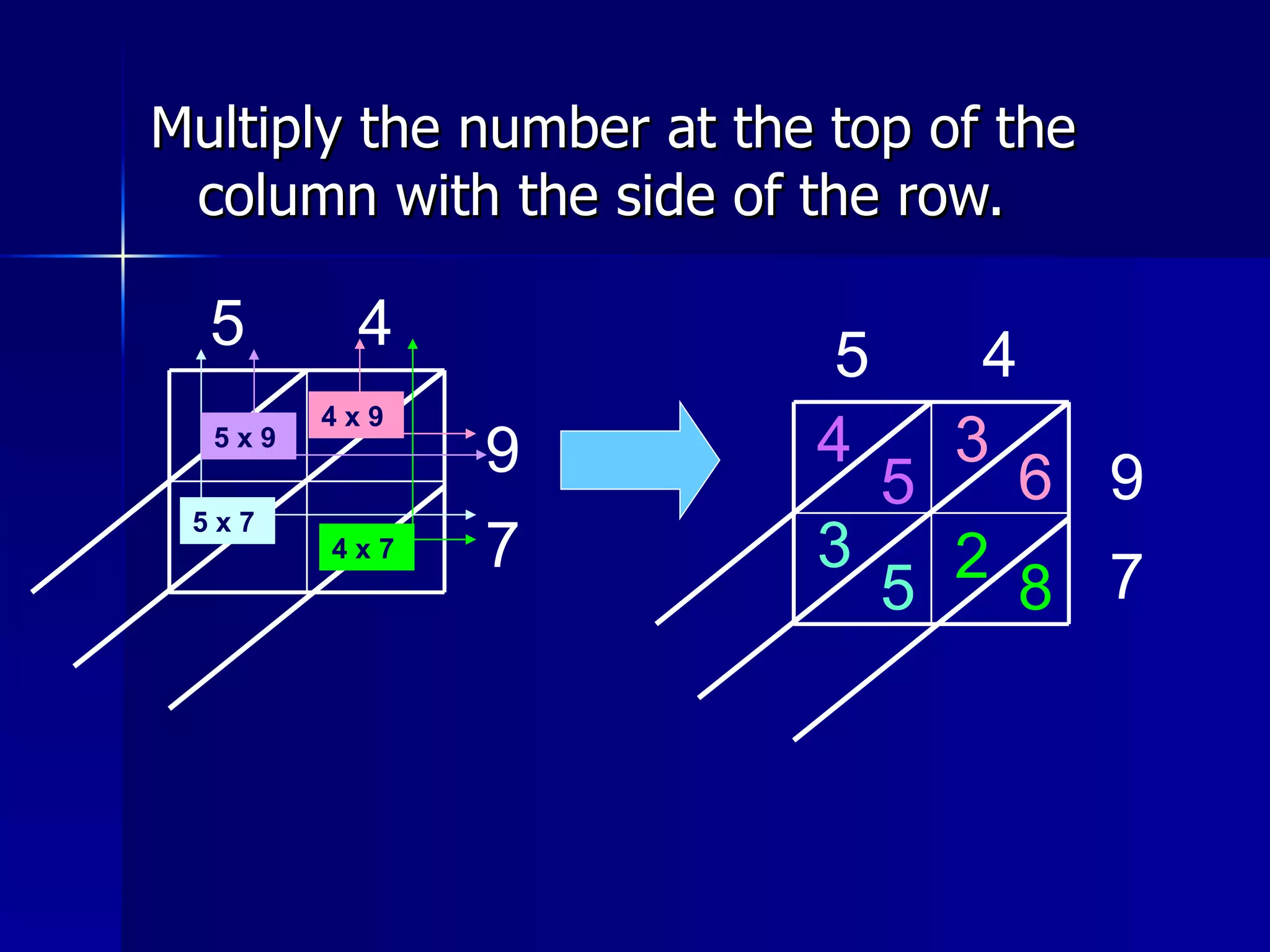
Now let’s try a 2-digit by 2-digit multiplication problem…  Let’s multiply: 54 x 97 Start by making your grid (a 2 by 2 grid this time):
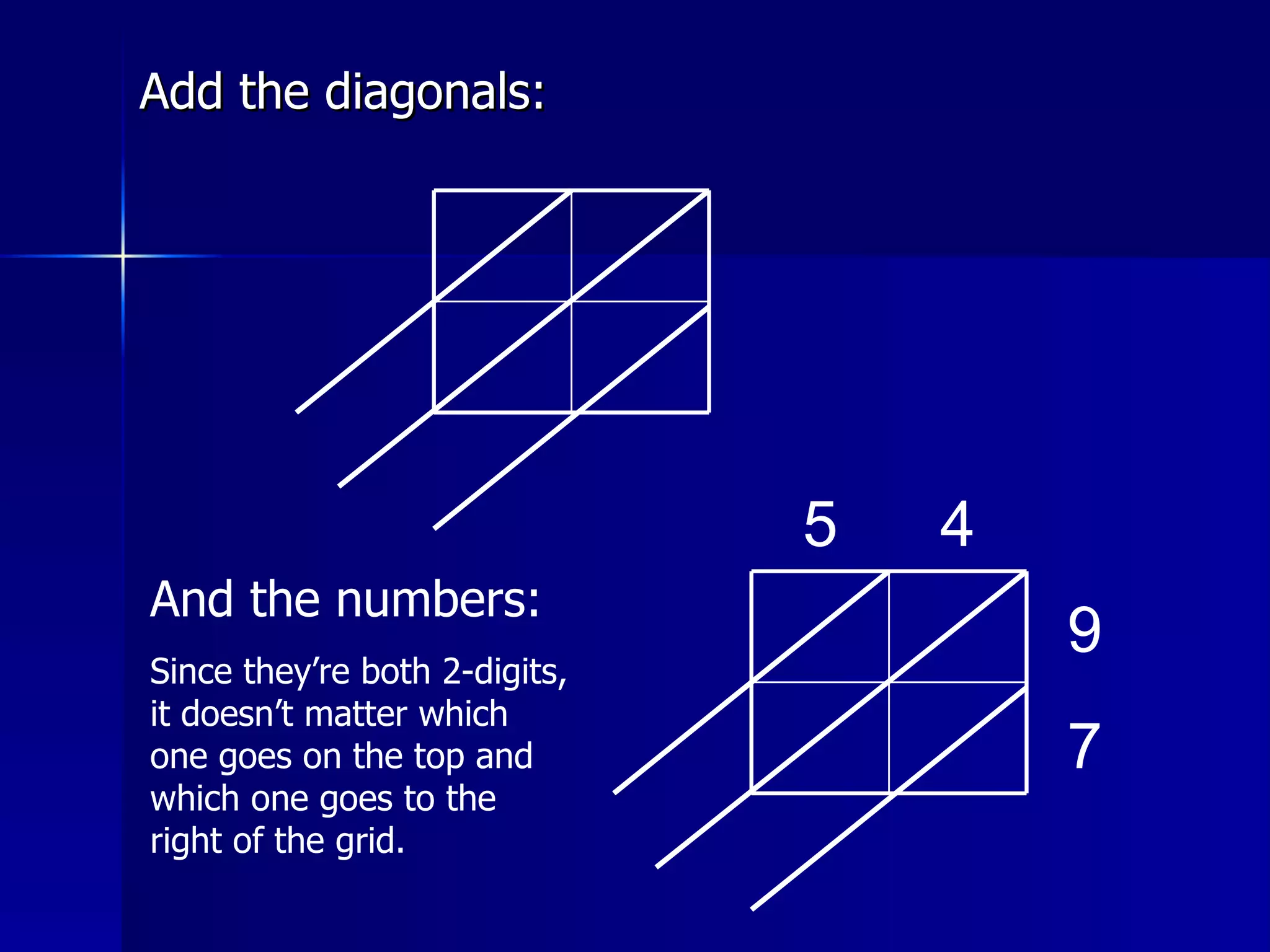
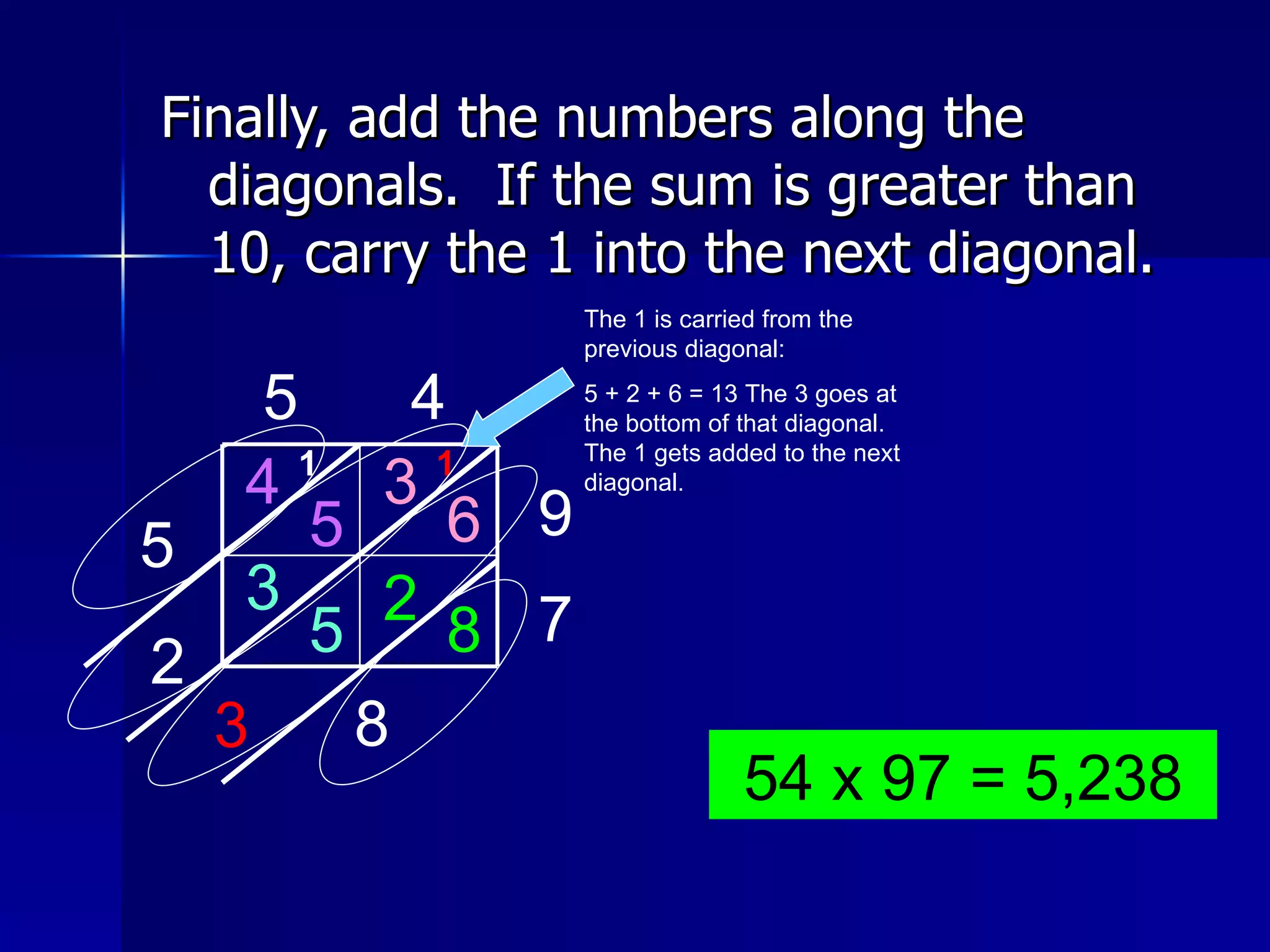
Add the diagonals: And the numbers: Since they’re both 2-digits, it doesn’t matter which one goes on the top and which one goes to the right of the grid. 5 4 9 7
Multiply the number at the top of the column with the side of the row. 5 4 7 4 x 9 4 x 7 5 x 9 5 x 7 5 4 9 7 3 6 2 8 4 5 3 5 9
Finally, add the numbers along the diagonals.  If the sum is greater than 10, carry the 1 into the next diagonal. 5 4 9 7 3 6 2 8 4 5 3 5 8 3 1 The 1 is carried from the previous diagonal:  5 + 2 + 6 = 13 The 3 goes at the bottom of that diagonal.  The 1 gets added to the next diagonal. 2 5 1 54 x 97 = 5,238
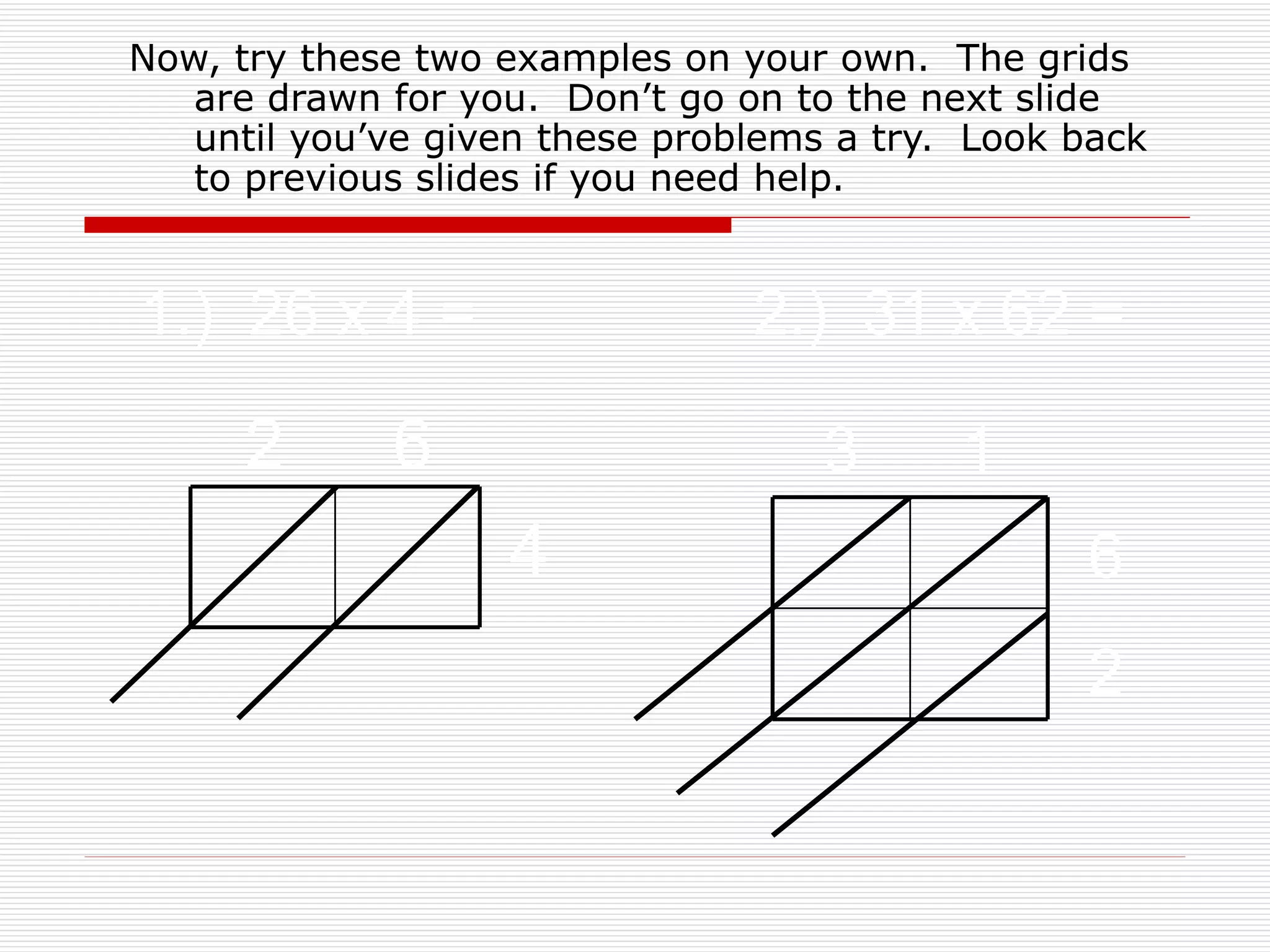
Now, try these two examples on your own.  The grids are drawn for you.  Don’t go on to the next slide until you’ve given these problems a try.  Look back to previous slides if you need help. 1.)  26 x 4 = 2 6 4 2.)  31 x 62 = 3 1 6 2
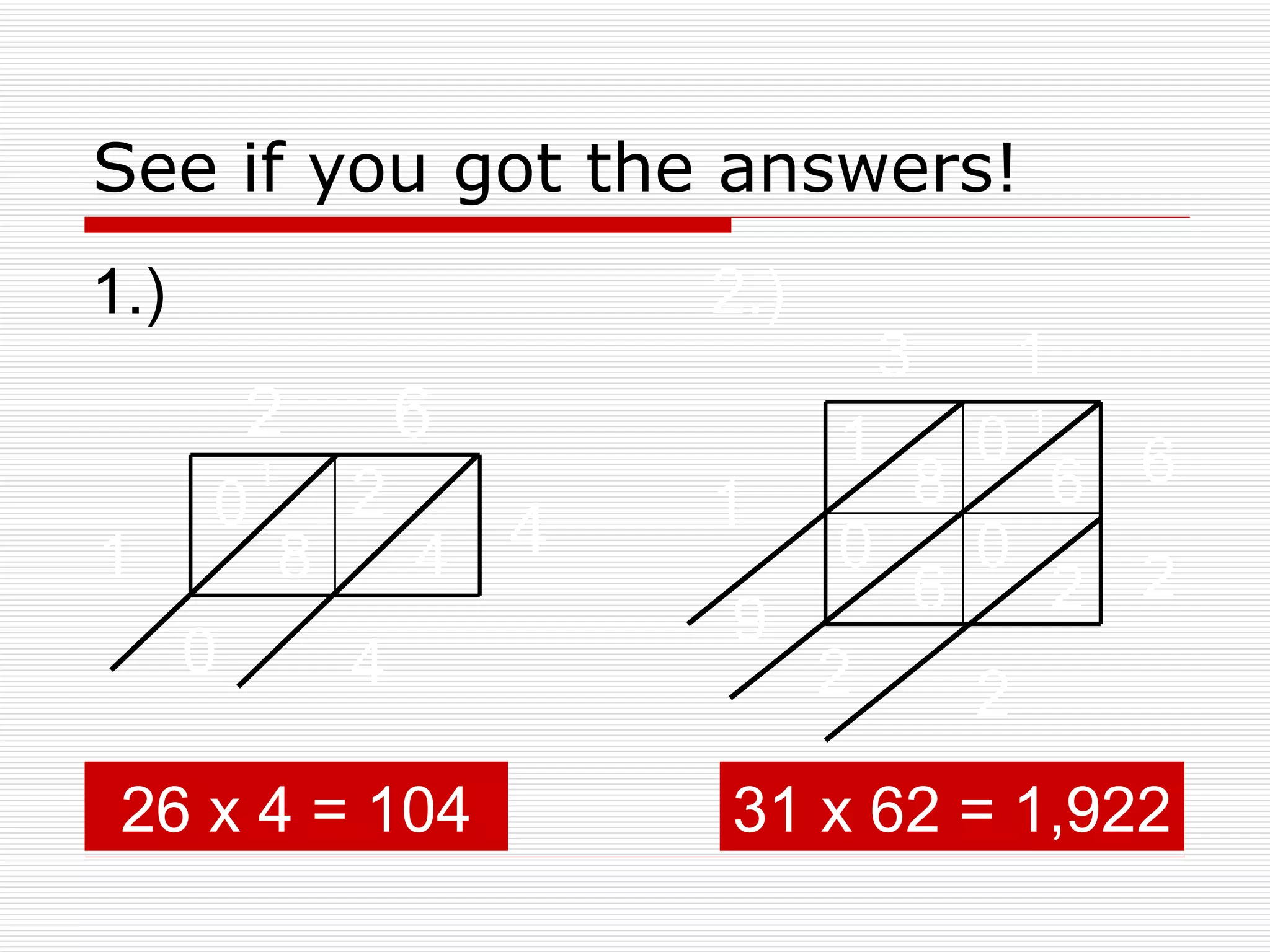
See if you got the answers! 1.)   2 6 4 2 4 8 0 1 0 4 1 3 1 6 2 2.) 1 8 0 6 0 0 6 2 9 1 2 2 1 26 x 4 = 104 31 x 62 = 1,922
Now that you’ve learned lattice multiplication, you can practice with any numbers of your choice!  Good luck!

Lattice Multiplication

  • 1.
    How to do: Lattice Multiplication Created by Lilian Patrick 2009
  • 2.
    What is latticemultiplication and when would we use it? Lattice multiplication is a way to multiply larger numbers (bigger than a 1-digit number times another 1-digit number) You can use lattice multiplication with any big multiplication problem as long as you can draw a big enough grid!
  • 3.
    Sounds great! Howdo we get started?
  • 4.
    Let’s start witha 2-digit by 1-digit example… If you want to multiply: 42 x 9 First, you have to make a 2 by 1 grid (because it’s a 2-digit by 1-digit problem)
  • 5.
    Next, in eachbox, you need to draw a diagonal line from the upper right hand corner through the lower left hand corner. The line should go past the lower left hand corner to the outside of your grid.
  • 6.
    Put the 2-digitnumber across the top of your grid and the 1-digit number on the right side of your grid. 4 2 9
  • 7.
    Then, multiply thenumber on the top of each column with the number to the right of that row. 4 2 9 2 x 9 4 x 9
  • 8.
    The digit inthe tens place of the product goes to the left of the diagonal. The digit in the ones place of the product goes to the right of the diagonal. *If there are no tens or no ones in the product, don’t forget to put a 0! 4 2 9 1 8 3 6
  • 9.
    Now, you’re finishedwith the numbers 42 and 9. Be careful not to use these numbers in the next step! 4 2 9 1 8 3 6
  • 10.
    Finally, you needto ADD the numbers inside the grid along the diagonals. Start with the diagonal on the right. Write the answer in the space outside the grid. 4 2 9 1 8 3 6 8 + nothing = 8 6 + 1 = 7 3 + nothing = 3
  • 11.
    Your answer isthe number outside of the grid. 4 2 9 1 8 3 6 8 7 3 42 x 9 = 378
  • 12.
    Now let’s trya 2-digit by 2-digit multiplication problem… Let’s multiply: 54 x 97 Start by making your grid (a 2 by 2 grid this time):
  • 13.
    Add the diagonals:And the numbers: Since they’re both 2-digits, it doesn’t matter which one goes on the top and which one goes to the right of the grid. 5 4 9 7
  • 14.
    Multiply the numberat the top of the column with the side of the row. 5 4 7 4 x 9 4 x 7 5 x 9 5 x 7 5 4 9 7 3 6 2 8 4 5 3 5 9
  • 15.
    Finally, add thenumbers along the diagonals. If the sum is greater than 10, carry the 1 into the next diagonal. 5 4 9 7 3 6 2 8 4 5 3 5 8 3 1 The 1 is carried from the previous diagonal: 5 + 2 + 6 = 13 The 3 goes at the bottom of that diagonal. The 1 gets added to the next diagonal. 2 5 1 54 x 97 = 5,238
  • 16.
    Now, try thesetwo examples on your own. The grids are drawn for you. Don’t go on to the next slide until you’ve given these problems a try. Look back to previous slides if you need help. 1.) 26 x 4 = 2 6 4 2.) 31 x 62 = 3 1 6 2
  • 17.
    See if yougot the answers! 1.) 2 6 4 2 4 8 0 1 0 4 1 3 1 6 2 2.) 1 8 0 6 0 0 6 2 9 1 2 2 1 26 x 4 = 104 31 x 62 = 1,922
  • 18.
    Now that you’velearned lattice multiplication, you can practice with any numbers of your choice! Good luck!