GREEN THEOREM
(TRANSFORMATION OF DOUBLE INTEGRALS TO LINE INTEGRALS)
COMPLEX VARIABLE AND LAPLACE TRANSFORM
PRESENTED BY: Sarwan Ahmed Ursani (18CH101)
ASSIGNED BY: Sir Ayaz Siyal
INTRODUCTION
 This law was proposed by George Green in 1828 A.D. and is named after him.
 In mathematics, Green's theorem gives the relationship between a line integral around,
a simple closed curve C and a double integral over the plane region D bounded by C.
 The Green theorem is used to transform double integrals over a plane region into line integral
over the boundary of the region.
 Identities derived from Green's theorem play a key role in reciprocity in electromagnetism
 It makes the contour integral easier.
NOTE: In the mathematical field of complex analysis, contour integration is a method of
evaluating certain integrals along paths in the complex plane.
STATEMENT OF GREEN THEOREM
 Let R be a closed bounded region in the xy- plane, whose boundary C consists of finitely many
smooth curves.
 Let P(x,y) and Q(x,y) be the continuous function having continuous partial derivative.
In region R and on its boundary C, Green theorem states that
(𝑃 𝑑𝑥 + 𝑄 𝑑𝑦) = (
𝜕𝑄
𝜕𝑥
−
𝜕𝑃
𝜕𝑦
)dy dx
𝜕𝑄
𝜕𝑥
+
𝜕𝑃
𝜕𝑦
PROOF OF GREEN THEOREM
 Consider a simple closed curve C bounding the region R as show in figure. Let
us divide the curve C into two parts ACB and ADB and let us suppose that the
equations of these curves be y= f1(x) and y = f2(x) respectively.
Now R is the region bounded by C, hence
𝜕𝑃
𝜕𝑦
dy dx = =
= 𝑎
𝑏
[𝑃 ( 𝑥, 𝑓1 𝑥 ) − 𝑃 (𝑥, 𝑓2 𝑥 )]𝑑𝑥
= − 𝑎
𝑏
𝑃 𝑥, 𝑓1 𝑥 𝑑𝑥 − 𝑏
𝑎
𝑃 (𝑥, 𝑓2 𝑥 )𝑑𝑥
= - 𝑃 𝑑𝑥
Hence
𝜕𝑃
𝜕𝑦
dy dx =− 𝑃 𝑑𝑥 … … … (𝑖)
Now consider the curve CAD and CBD. Let their equations be y = g1(x) and y = g2(x) this implies
that x = g1
-1(y) = G1(y) and x = g2
-2 (y) = G2(y)
𝜕𝑄
𝜕𝑥
dy dx = 𝑑𝑦 = 𝑑𝑦
= 𝐶
𝑑
[𝑄 (𝐺2 𝑦 , 𝑦) − 𝑄 (𝐺1 𝑦 , 𝑦)]𝑑𝑦
=
𝐶
𝑑
𝑄 𝐺2 𝑦 , 𝑦 𝑑𝑦 −
𝑑
𝑐
𝑄 𝐺1 𝑦 , 𝑦 𝑑𝑦
=
𝑑
𝑐
𝑄 𝐺1 𝑦 , 𝑦 𝑑𝑦 +
𝑐
𝑑
𝑄 𝐺2 𝑦 , 𝑦 𝑑𝑦
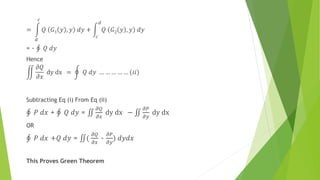
= - 𝑄 𝑑𝑦
Hence
𝜕𝑄
𝜕𝑥
dy dx = 𝑄 𝑑𝑦 … … … … … (𝑖𝑖)
Subtracting Eq (i) From Eq (ii)
𝑃 𝑑𝑥 + 𝑄 𝑑𝑦 =
𝜕𝑄
𝜕𝑥
dy dx −
𝜕𝑃
𝜕𝑦
dy dx
OR
𝑃 𝑑𝑥 +𝑄 𝑑𝑦 = (
𝜕𝑄
𝜕𝑥
-
𝜕𝑃
𝜕𝑦
) 𝑑𝑦𝑑𝑥
This Proves Green Theorem
Exercise Problem
Q: Verify the Green’s theorem for 𝟐𝒙𝒚 − 𝒙𝟐 𝒅𝒙 + 𝒙 + 𝒚𝟐 𝒅𝒚 where C is simple closed curve enclosed by
the parabolas y = x2 and x = y2 .
First we will solve this problem by contour integration.
We have two equation,
y = x2 …(i) and x = y2 …(ii)
x4 = x
x4 – x = 0
x(x3-1) = 0
We get
x = 0, x = 1
Now when x =0 , y = 0 & x= 1, y = 1.
We can say that the point of intersection between the two given curve are (0,0) and
(1,1).
Along C1
y = x2 so that dy = 2x and x varies from 0 to 1
=
0
1
[ 2𝑥. 𝑥2 − 𝑥2 𝑑𝑥 + (𝑥 + 𝑥4)(2𝑥𝑑𝑥)]
=
0
1
[ 2𝑥3 − 𝑥2 + (2𝑥2 + 2𝑥5) ]𝑑𝑥
=
0
1
(2𝑥5 + 2𝑥3 + 𝑥2 ]𝑑𝑥
=
1
3
+
1
2
+
1
3
=
2 + 3 + 2
6
=
7
6
Along C2
x = y2 so that dx = 2y and y varies from 1 to 0
=
1
0
[ 2𝑦. 𝑦2 − 𝑦4 2𝑦𝑑𝑦 + (𝑦2 + 𝑦2)(𝑑𝑦)]
=
1
0
[ 4𝑦4 − 2𝑦5 + 2𝑦2 𝑑𝑦
= [ 0 − (
4
5
−
1
3
+
2
3
) =
5 − 12 − 10
15
= −
17
15
Now, C = C1 + C2
=
7
6
−
17
15
=
35 − 34
30
=
1
30
Now, using Green Theorem
We can solve this problem easily
Here P = 2𝑥𝑦 − 𝑥2 & Q = 𝑥 + 𝑦2
A/C to Green Theorem
𝑃 𝑑𝑥 +𝑄 𝑑𝑦 = (
𝜕𝑄
𝜕𝑥
-
𝜕𝑃
𝜕𝑦
) 𝑑𝑦𝑑𝑥
𝜕𝑄
𝜕𝑥
= 𝟏 &
𝜕𝑃
𝜕𝑦
= 2𝑥
0
1
(√𝑥 − 𝑥2)(1−2x) dx
=
2
3
−
4
5
−
1
3
+
1
2
=
20 − 24 − 10 + 15
30
=
1
30
This is proves the green theorem for the given contour integral over the region R.
Green Theorem

Green Theorem

  • 1.
    GREEN THEOREM (TRANSFORMATION OFDOUBLE INTEGRALS TO LINE INTEGRALS) COMPLEX VARIABLE AND LAPLACE TRANSFORM PRESENTED BY: Sarwan Ahmed Ursani (18CH101) ASSIGNED BY: Sir Ayaz Siyal
  • 2.
    INTRODUCTION  This lawwas proposed by George Green in 1828 A.D. and is named after him.  In mathematics, Green's theorem gives the relationship between a line integral around, a simple closed curve C and a double integral over the plane region D bounded by C.  The Green theorem is used to transform double integrals over a plane region into line integral over the boundary of the region.  Identities derived from Green's theorem play a key role in reciprocity in electromagnetism  It makes the contour integral easier. NOTE: In the mathematical field of complex analysis, contour integration is a method of evaluating certain integrals along paths in the complex plane.
  • 3.
    STATEMENT OF GREENTHEOREM  Let R be a closed bounded region in the xy- plane, whose boundary C consists of finitely many smooth curves.  Let P(x,y) and Q(x,y) be the continuous function having continuous partial derivative. In region R and on its boundary C, Green theorem states that (𝑃 𝑑𝑥 + 𝑄 𝑑𝑦) = ( 𝜕𝑄 𝜕𝑥 − 𝜕𝑃 𝜕𝑦 )dy dx 𝜕𝑄 𝜕𝑥 + 𝜕𝑃 𝜕𝑦
  • 4.
    PROOF OF GREENTHEOREM  Consider a simple closed curve C bounding the region R as show in figure. Let us divide the curve C into two parts ACB and ADB and let us suppose that the equations of these curves be y= f1(x) and y = f2(x) respectively. Now R is the region bounded by C, hence 𝜕𝑃 𝜕𝑦 dy dx = = = 𝑎 𝑏 [𝑃 ( 𝑥, 𝑓1 𝑥 ) − 𝑃 (𝑥, 𝑓2 𝑥 )]𝑑𝑥 = − 𝑎 𝑏 𝑃 𝑥, 𝑓1 𝑥 𝑑𝑥 − 𝑏 𝑎 𝑃 (𝑥, 𝑓2 𝑥 )𝑑𝑥
  • 5.
    = - 𝑃𝑑𝑥 Hence 𝜕𝑃 𝜕𝑦 dy dx =− 𝑃 𝑑𝑥 … … … (𝑖) Now consider the curve CAD and CBD. Let their equations be y = g1(x) and y = g2(x) this implies that x = g1 -1(y) = G1(y) and x = g2 -2 (y) = G2(y) 𝜕𝑄 𝜕𝑥 dy dx = 𝑑𝑦 = 𝑑𝑦 = 𝐶 𝑑 [𝑄 (𝐺2 𝑦 , 𝑦) − 𝑄 (𝐺1 𝑦 , 𝑦)]𝑑𝑦 = 𝐶 𝑑 𝑄 𝐺2 𝑦 , 𝑦 𝑑𝑦 − 𝑑 𝑐 𝑄 𝐺1 𝑦 , 𝑦 𝑑𝑦
  • 6.
    = 𝑑 𝑐 𝑄 𝐺1 𝑦, 𝑦 𝑑𝑦 + 𝑐 𝑑 𝑄 𝐺2 𝑦 , 𝑦 𝑑𝑦 = - 𝑄 𝑑𝑦 Hence 𝜕𝑄 𝜕𝑥 dy dx = 𝑄 𝑑𝑦 … … … … … (𝑖𝑖) Subtracting Eq (i) From Eq (ii) 𝑃 𝑑𝑥 + 𝑄 𝑑𝑦 = 𝜕𝑄 𝜕𝑥 dy dx − 𝜕𝑃 𝜕𝑦 dy dx OR 𝑃 𝑑𝑥 +𝑄 𝑑𝑦 = ( 𝜕𝑄 𝜕𝑥 - 𝜕𝑃 𝜕𝑦 ) 𝑑𝑦𝑑𝑥 This Proves Green Theorem
  • 7.
    Exercise Problem Q: Verifythe Green’s theorem for 𝟐𝒙𝒚 − 𝒙𝟐 𝒅𝒙 + 𝒙 + 𝒚𝟐 𝒅𝒚 where C is simple closed curve enclosed by the parabolas y = x2 and x = y2 . First we will solve this problem by contour integration. We have two equation, y = x2 …(i) and x = y2 …(ii) x4 = x x4 – x = 0 x(x3-1) = 0 We get x = 0, x = 1 Now when x =0 , y = 0 & x= 1, y = 1. We can say that the point of intersection between the two given curve are (0,0) and (1,1).
  • 8.
    Along C1 y =x2 so that dy = 2x and x varies from 0 to 1 = 0 1 [ 2𝑥. 𝑥2 − 𝑥2 𝑑𝑥 + (𝑥 + 𝑥4)(2𝑥𝑑𝑥)] = 0 1 [ 2𝑥3 − 𝑥2 + (2𝑥2 + 2𝑥5) ]𝑑𝑥 = 0 1 (2𝑥5 + 2𝑥3 + 𝑥2 ]𝑑𝑥 = 1 3 + 1 2 + 1 3 = 2 + 3 + 2 6 = 7 6
  • 9.
    Along C2 x =y2 so that dx = 2y and y varies from 1 to 0 = 1 0 [ 2𝑦. 𝑦2 − 𝑦4 2𝑦𝑑𝑦 + (𝑦2 + 𝑦2)(𝑑𝑦)] = 1 0 [ 4𝑦4 − 2𝑦5 + 2𝑦2 𝑑𝑦 = [ 0 − ( 4 5 − 1 3 + 2 3 ) = 5 − 12 − 10 15 = − 17 15 Now, C = C1 + C2 = 7 6 − 17 15 = 35 − 34 30 = 1 30
  • 10.
    Now, using GreenTheorem We can solve this problem easily Here P = 2𝑥𝑦 − 𝑥2 & Q = 𝑥 + 𝑦2 A/C to Green Theorem 𝑃 𝑑𝑥 +𝑄 𝑑𝑦 = ( 𝜕𝑄 𝜕𝑥 - 𝜕𝑃 𝜕𝑦 ) 𝑑𝑦𝑑𝑥 𝜕𝑄 𝜕𝑥 = 𝟏 & 𝜕𝑃 𝜕𝑦 = 2𝑥 0 1 (√𝑥 − 𝑥2)(1−2x) dx
  • 11.
    = 2 3 − 4 5 − 1 3 + 1 2 = 20 − 24− 10 + 15 30 = 1 30 This is proves the green theorem for the given contour integral over the region R.