


Patel Shrey B.
Batch :- B2
Enrollment No:- 170953119031
Gudied by,
Mr. Sushil Chaurasia
content
 Classification
 Least Count
 Vernier Calipers and Micrometers
 Principle
 Construction and Working
 Reading of measured value
 Types
 Errors and precautions in both instruments
$ɧƦɛƴ ´ƶ 2
Linear Measurement
 Measurement of perpendicular distance Between two points or surfaces.
Designed either for line measurements or end measurements
 Applies to measurement of length, heights, diameters, thicknesses, radius etc.
 Line measuring instruments consists of series of accurately, spaced painted or
marked lines on them
$ɧƦɛƴ ´ƶ 3
Linear Measuring instruments
 (A)Classification based on methods of measurement
l. Direct measuring instruments.
2. Indirect measuring instruments.
Measuring instruments can be further classified as :
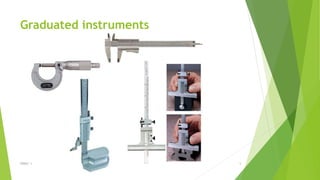
(a) Graduated instruments.
It includes rules, vemier callipers, vernier height gauges, vernier depth gauges,
micromètres, dial indicators etc.
(b) Non-graduated instruments :
It includes callipers,, wire gauges, screw pitch gauges, radius gauges, thickness
gauges, slip gauges etc.
$ɧƦɛƴ ´ƶ 4
Graduated instruments
$ɧƦɛƴ ´ƶ 5
Non-graduated instruments
$ɧƦɛƴ ´ƶ 6
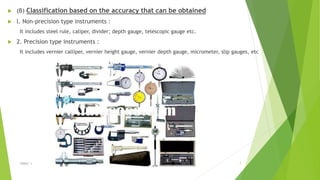
 (B) Classification based on the accuracy that can be obtained
 l. Non-precision type instruments :
It includes steel rule, caliper, divider; depth gauge, telescopic gauge etc.
 2. Precision type instruments :
It includes vernier calliper, vernier height gauge, vernier depth gauge, micrometer, slip gauges, etc
$ɧƦɛƴ ´ƶ 7
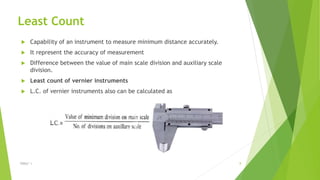
Least Count
 Capability of an instrument to measure minimum distance accurately.
 It represent the accuracy of measurement
 Difference between the value of main scale division and auxiliary scale
division.
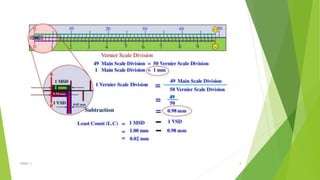
 Least count of vernier instruments
 L.C. of vernier instruments also can be calculated as
$ɧƦɛƴ ´ƶ 8
$ɧƦɛƴ ´ƶ 9
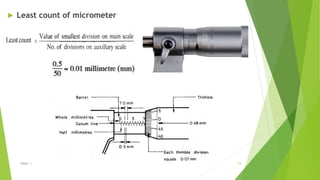
 Least count of micrometer
$ɧƦɛƴ ´ƶ 10
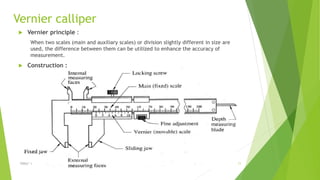
Vernier calliper
 Vernier principle :
When two scales (main and auxiliary scales) or division slightly different in size are
used, the difference between them can be utilized to enhance the accuracy of
measurement.
 Construction :
$ɧƦɛƴ ´ƶ 11
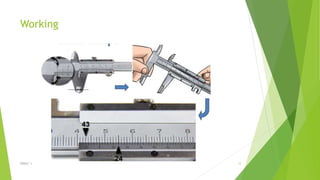
Working
$ɧƦɛƴ ´ƶ 12
$ɧƦɛƴ ´ƶ 13
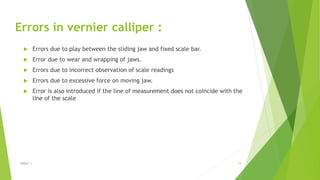
Errors in vernier calliper :
 Errors due to play between the sliding jaw and fixed scale bar.
 Error due to wear and wrapping of jaws.
 Errors due to incorrect observation of scale readings
 Errors due to excessive force on moving jaw.
 Error is also introduced if the line of measurement does not coincide with the
line of the scale
$ɧƦɛƴ ´ƶ 14
Precautions to be taken in use of
vernier calliper :
 No play should be there between sliding and fixed jaws. If play exists then the
accuracy of the vernier calliper will be lost.
 The tips of measuring jaws should not be worn .
 Use the stationary jaw on reference point and obtain measured point by sliding the
movable jaws.
 The vernier calliper must always be properly balanced in hand and held lightly the
sliding jaw through adjusting screw. Do not push the moving jaw, under pressure,
use adjusting screw for fine adjustment.
 In case of measuring an outside diameter, be sure that calliper bar and the plane of
Calliper jaws are truly perpendicular to the work piece's longitudinal centre line
$ɧƦɛƴ ´ƶ 15
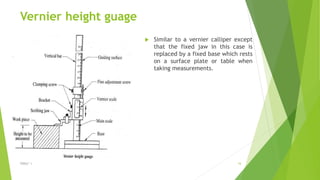
Vernier height guage
 Similar to a vernier calliper except
that the fixed jaw in this case is
replaced by a fixed base which rests
on a surface plate or table when
taking measurements.
$ɧƦɛƴ ´ƶ 16
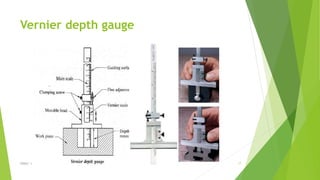
Vernier depth gauge
$ɧƦɛƴ ´ƶ 17
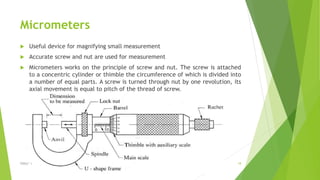
Micrometers
 Useful device for magnifying small measurement
 Accurate screw and nut are used for measurement
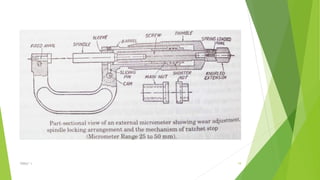
 Micrometers works on the principle of screw and nut. The screw is attached
to a concentric cylinder or thimble the circumference of which is divided into
a number of equal parts. A screw is turned through nut by one revolution, its
axial movement is equal to pitch of the thread of screw.
$ɧƦɛƴ ´ƶ 18
$ɧƦɛƴ ´ƶ 19
$ɧƦɛƴ ´ƶ 20
$ɧƦɛƴ ´ƶ 21
$ɧƦɛƴ ´ƶ 22
Types of micrometers
 Outside micrometer
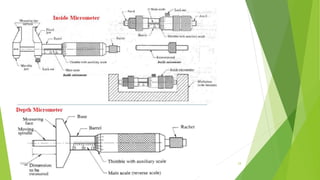
 Inside micrometer
 Vernier micrometer
 Depth micrometer
 Bench micrometer
 Digital micrometer
 Differential screw micrometer
 Micrometer with dial gauge
 Screw thread micrometer
$ɧƦɛƴ ´ƶ 23
$ɧƦɛƴ ´ƶ 24
Vernier micrometers
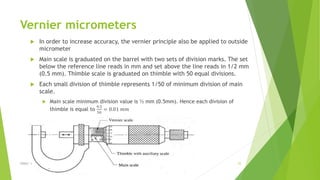
 In order to increase accuracy, the vernier principle also be applied to outside
micrometer
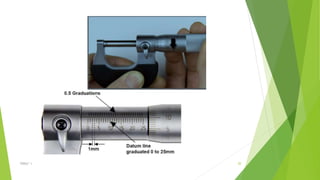
 Main scale is graduated on the barrel with two sets of division marks. The set
below the reference line reads in mm and set above the line reads in 1/2 mm
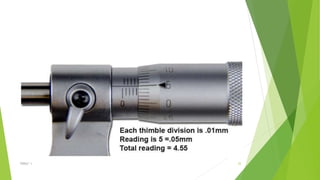
(0.5 mm). Thimble scale is graduated on thimble with 50 equal divisions.
 Each small division of thimble represents 1/50 of minimum division of main
scale.
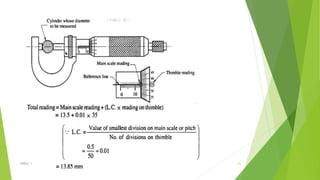
 Main scale minimum division value is ½ mm (0.5mm). Hence each division of
thimble is equal to
0.5
50
= 0.01 𝑚𝑚
$ɧƦɛƴ ´ƶ 25
$ɧƦɛƴ ´ƶ 26

Linear measurement

  • 1.
    Patel Shrey B. Batch:- B2 Enrollment No:- 170953119031 Gudied by, Mr. Sushil Chaurasia
  • 2.
    content  Classification  LeastCount  Vernier Calipers and Micrometers  Principle  Construction and Working  Reading of measured value  Types  Errors and precautions in both instruments $ɧƦɛƴ ´ƶ 2
  • 3.
    Linear Measurement  Measurementof perpendicular distance Between two points or surfaces. Designed either for line measurements or end measurements  Applies to measurement of length, heights, diameters, thicknesses, radius etc.  Line measuring instruments consists of series of accurately, spaced painted or marked lines on them $ɧƦɛƴ ´ƶ 3
  • 4.
    Linear Measuring instruments (A)Classification based on methods of measurement l. Direct measuring instruments. 2. Indirect measuring instruments. Measuring instruments can be further classified as : (a) Graduated instruments. It includes rules, vemier callipers, vernier height gauges, vernier depth gauges, micromètres, dial indicators etc. (b) Non-graduated instruments : It includes callipers,, wire gauges, screw pitch gauges, radius gauges, thickness gauges, slip gauges etc. $ɧƦɛƴ ´ƶ 4
  • 5.
  • 6.
  • 7.
     (B) Classificationbased on the accuracy that can be obtained  l. Non-precision type instruments : It includes steel rule, caliper, divider; depth gauge, telescopic gauge etc.  2. Precision type instruments : It includes vernier calliper, vernier height gauge, vernier depth gauge, micrometer, slip gauges, etc $ɧƦɛƴ ´ƶ 7
  • 8.
    Least Count  Capabilityof an instrument to measure minimum distance accurately.  It represent the accuracy of measurement  Difference between the value of main scale division and auxiliary scale division.  Least count of vernier instruments  L.C. of vernier instruments also can be calculated as $ɧƦɛƴ ´ƶ 8
  • 9.
  • 10.
     Least countof micrometer $ɧƦɛƴ ´ƶ 10
  • 11.
    Vernier calliper  Vernierprinciple : When two scales (main and auxiliary scales) or division slightly different in size are used, the difference between them can be utilized to enhance the accuracy of measurement.  Construction : $ɧƦɛƴ ´ƶ 11
  • 12.
  • 13.
  • 14.
    Errors in verniercalliper :  Errors due to play between the sliding jaw and fixed scale bar.  Error due to wear and wrapping of jaws.  Errors due to incorrect observation of scale readings  Errors due to excessive force on moving jaw.  Error is also introduced if the line of measurement does not coincide with the line of the scale $ɧƦɛƴ ´ƶ 14
  • 15.
    Precautions to betaken in use of vernier calliper :  No play should be there between sliding and fixed jaws. If play exists then the accuracy of the vernier calliper will be lost.  The tips of measuring jaws should not be worn .  Use the stationary jaw on reference point and obtain measured point by sliding the movable jaws.  The vernier calliper must always be properly balanced in hand and held lightly the sliding jaw through adjusting screw. Do not push the moving jaw, under pressure, use adjusting screw for fine adjustment.  In case of measuring an outside diameter, be sure that calliper bar and the plane of Calliper jaws are truly perpendicular to the work piece's longitudinal centre line $ɧƦɛƴ ´ƶ 15
  • 16.
    Vernier height guage Similar to a vernier calliper except that the fixed jaw in this case is replaced by a fixed base which rests on a surface plate or table when taking measurements. $ɧƦɛƴ ´ƶ 16
  • 17.
  • 18.
    Micrometers  Useful devicefor magnifying small measurement  Accurate screw and nut are used for measurement  Micrometers works on the principle of screw and nut. The screw is attached to a concentric cylinder or thimble the circumference of which is divided into a number of equal parts. A screw is turned through nut by one revolution, its axial movement is equal to pitch of the thread of screw. $ɧƦɛƴ ´ƶ 18
  • 19.
  • 20.
  • 21.
  • 22.
  • 23.
    Types of micrometers Outside micrometer  Inside micrometer  Vernier micrometer  Depth micrometer  Bench micrometer  Digital micrometer  Differential screw micrometer  Micrometer with dial gauge  Screw thread micrometer $ɧƦɛƴ ´ƶ 23
  • 24.
  • 25.
    Vernier micrometers  Inorder to increase accuracy, the vernier principle also be applied to outside micrometer  Main scale is graduated on the barrel with two sets of division marks. The set below the reference line reads in mm and set above the line reads in 1/2 mm (0.5 mm). Thimble scale is graduated on thimble with 50 equal divisions.  Each small division of thimble represents 1/50 of minimum division of main scale.  Main scale minimum division value is ½ mm (0.5mm). Hence each division of thimble is equal to 0.5 50 = 0.01 𝑚𝑚 $ɧƦɛƴ ´ƶ 25
  • 26.