
This document is a presentation on mechanics of solids that was prepared by four students and guided by Heena Mam of the civil department. It covers fundamental principles of mechanics including the principle of physical independence of forces, principle of transmissibility, principle of superposition, and resultant forces. Methods for composition of forces such as the parallelogram law, resolution of forces, triangle law, and polygon law are discussed. Lami's theorem is also introduced.
Mechanics of SOLIDS(2130003)
B.E. MECH – Sem III rd
Prepared by,
(1) PATEL SHREY B (170953119031) DD 42
(2) RATHVAYOGESH (170953119036) DD 39
(3) RATHOD DIVYESH (170953119035) DD 50
(4) SINORA SIDDHRAJ (170953119047) DD 28
Guided by,
HEENA MAM (CIVIL DEPTT.)
1$ɧⱤɘλ’ƶ P@TeL @ pshrey_98 #insta#
2.
• Introduction
• FundamentalPrinciple Of Mechanics
o Principle of physical independence of forces
o Principle of transmissibility
o Principle of superposition
o Resultant Forces
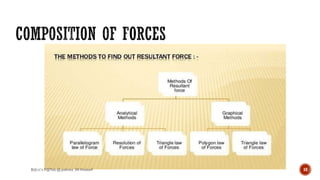
• Composition of Forces Methods
• Parallelogram Law Of Forces
• Resolution Of The Forces
• Triangle Law Of Forces
• PolygonLawOf Forces
• Lami’s Theorem
2$ɧⱤɘλ’ƶ P@TeL @ pshrey_98 #insta#
3.
▪ An agentwhich produces or tends to produce, destroys or tends to destroy
motion of body is called as force.
▪ SI UNIT = Newton
1 N Force :-
A force which can produce an acceleration of 1 m/sec2 in mass of 1 kg is
called 1 N force.
1 kgf Force :-
A force which can produce an acceleration of g m/sec2 in mass of 1 kg is
called 1 kgf force.
3$ɧⱤɘλ’ƶ P@TeL @ pshrey_98 #insta#
4.
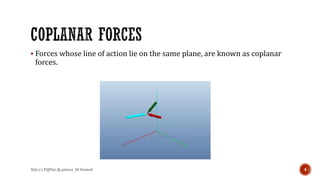
▪ Forces whoseline of action lie on the same plane, are known as coplanar
forces.
4$ɧⱤɘλ’ƶ P@TeL @ pshrey_98 #insta#
5.
▪ The forceswhich meet at one point, are known as concurrent forces.
5$ɧⱤɘλ’ƶ P@TeL @ pshrey_98 #insta#
6.
▪Principle of physicalindependence of forces
▪Principle of transmissibility
▪Principle of superposition
▪Resultant Forces
6$ɧⱤɘλ’ƶ P@TeL @ pshrey_98 #insta#
7.
▪ If numberof forces are acting simultaneously on particle, then the
resultant of these force will have the same effect as produced by all forces .
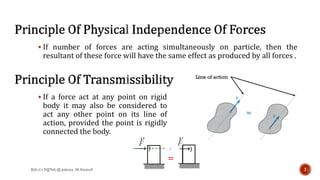
▪ If a force act at any point on rigid
body it may also be considered to
act any other point on its line of
action, provided the point is rigidly
connected the body.
7$ɧⱤɘλ’ƶ P@TeL @ pshrey_98 #insta#
8.
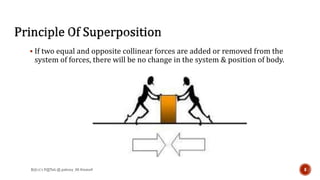
▪ If twoequal and opposite collinear forces are added or removed from the
system of forces, there will be no change in the system & position of body.
8$ɧⱤɘλ’ƶ P@TeL @ pshrey_98 #insta#
9.
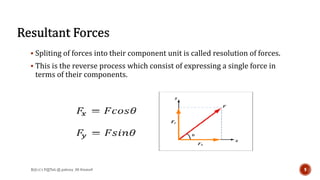
▪ Spliting offorces into their component unit is called resolution of forces.
▪ This is the reverse process which consist of expressing a single force in
terms of their components.
9$ɧⱤɘλ’ƶ P@TeL @ pshrey_98 #insta#
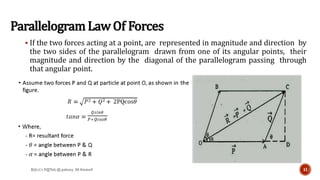
▪ If thetwo forces acting at a point, are represented in magnitude and direction by
the two sides of the parallelogram drawn from one of its angular points, their
magnitude and direction by the diagonal of the parallelogram passing through
that angular point.
Parallelogram Law Of Forces
11$ɧⱤɘλ’ƶ P@TeL @ pshrey_98 #insta#
12.
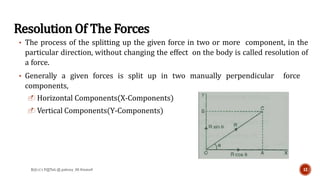
• The processof the splitting up the given force in two or more component, in the
particular direction, without changing the effect on the body is called resolution of
a force.
• Generally a given forces is split up in two manually perpendicular force
components,
Horizontal Components(X-Components)
Vertical Components(Y-Components)
Resolution Of The Forces
12$ɧⱤɘλ’ƶ P@TeL @ pshrey_98 #insta#
13.
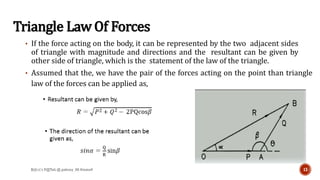
Triangle Law OfForces
• If the force acting on the body, it can be represented by the two adjacent sides
of triangle with magnitude and directions and the resultant can be given by
other side of triangle, which is the statement of the law of the triangle.
• Assumed that the, we have the pair of the forces acting on the point than triangle
law of the forces can be applied as,
13$ɧⱤɘλ’ƶ P@TeL @ pshrey_98 #insta#
14.
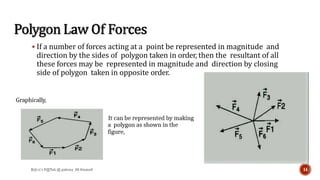
▪ If anumber of forces acting at a point be represented in magnitude and
direction by the sides of polygon taken in order, then the resultant of all
these forces may be represented in magnitude and direction by closing
side of polygon taken in opposite order.
14$ɧⱤɘλ’ƶ P@TeL @ pshrey_98 #insta#
15.
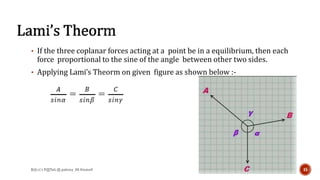
• If thethree coplanar forces acting at a point be in a equilibrium, then each
force proportional to the sine of the angle between other two sides.
• Applying Lami’s Theorm on given figure as shown below :-
15$ɧⱤɘλ’ƶ P@TeL @ pshrey_98 #insta#