Cyber Security (2150003)
B.E. MECH – Sem Vth
Prepared by,
Patel Shrey B.
(170953119031)
Group :- 5B2
Guided by,
Asst. Prof. Ruchi Maheta
(Computer Science Deptt)
CONTENTS
• Brief History
• Reasons For Amending IT Act
• Objectives
• Definition
• Digital Signature And Electronic Signature (Amended - ITAA 2008)
• Various Regulation &Their Section
2$ɧƦɛƴ ´ƶ
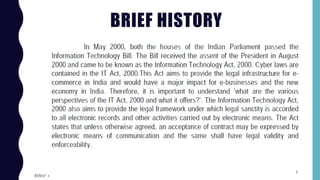
BRIEF HISTORY
$ɧƦɛƴ ´ƶ
3
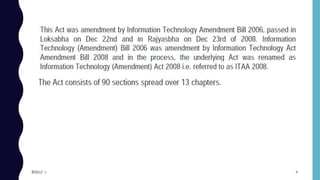
4$ɧƦɛƴ ´ƶ
REASONS FOR AMENDING IT ACT
• To include new types of Cyber-crimes
• To increase protection of personal data & info. for national security, econ.,
public health & safety
• To provide for alternate technology for e-Signatures as per Model Law
UNCITRAL (UN Commission of Intl.Trade laws)
• To authorize Service Providers providing services to SG/CG
5$ɧƦɛƴ ´ƶ
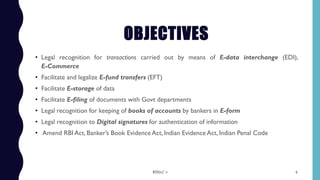
OBJECTIVES
• Legal recognition for transactions carried out by means of E-data interchange (EDI),
E-Commerce
• Facilitate and legalize E-fund transfers (EFT)
• Facilitate E-storage of data
• Facilitate E-filing of documents with Govt departments
• Legal recognition for keeping of books of accounts by bankers in E-form
• Legal recognition to Digital signatures for authentication of information
• Amend RBI Act, Banker’s Book Evidence Act, Indian Evidence Act, Indian Penal Code
$ɧƦɛƴ ´ƶ 6
DEFINITION
• Access means gaining entry into, instructing or communicating with the logical, arithmetical, or memory
function resources of a computer, computer system or computer network
• Addressee means a person who is “intended by the originator to receive” the E-record. Excludes intermediary
• Adjudicating officer (AO) means an adudicating officer appointed under the Act
• Affixing Electronic signature means adoption of any methodology or procedure by a person for
authenticating an E-record via electronic signature
• Asymmetric crypto system means a system of a secure key pair consisting of a private key for creating a digital
signature and a public key to verify the digital signature
• Certifying Authority (CA) means a person who has been granted a licence to issue an ESC under the Act
• Certification practice statement is issued by a CA to specify the practices that it employs in issuing ESCs
• Communication Device means Cell Phones Personal Digital Assistance (PDAs), or combination of both or
any other device used to communicate, send or transmit any text, video, audio, or image
7$ɧƦɛƴ ´ƶ
• Computer (C) means any electronic magnetic, optical or other high-speed data processing device or
system which performs logical, arithmetic, and memory functions by manipulations of electronic, magnetic
or optical impulses, and includes all IPO, storage, computer software, or communication facilities which
are connected or related to the computer in a computer system or computer network
• Computer network (CN) means the interconnection of one or more computers through - o the use of
satellite, microwave, terrestrial line or other communication media o terminals or a complex consisting
of two or more interconnected computers whether or not the interconnection is continuously
maintained
• Computer resource (CR) means computer, computer system, computer network, data, computer data
base or software
• Controller means the Controller of CA appointed under the Act
• Cyber AppellateTribunal (CAT) means the Cyber Appellate Tribunal established under the Act. (X
“Regulation” or CRAT)
• Cyber Café means any facility from where access to the internet is offered by any person in the ordinary
course of business to the members of the public
8$ɧƦɛƴ ´ƶ
• Cyber Security means protecting information, equipment, devices, computer, computer resource,
communication device and information stored therein from unauthorized access, use, disclosure,
disruption, modification or destruction
• Data means a representation of information, knowledge, facts, concepts or instructions which are being
prepared or have been prepared in formalised manner, and is intended to be processed, is being
processed or has been processed in a computer system or computer network, and may be in any form
(including computer printouts magnetic or optical storage media, punched cards, punched tapes) or
stored internally in the memory of the computer
• Digital signature means authentication of any E-record by a subscriber by means of an electronic
method or procedure in accordance with the Act
• Digital Signature Certificate means a Digital Signature Certificate issued under the Act
• Electronic form with reference to information means any information generated, sent, received or
stored in media, magnetic, optical, computer memory, micro film, computer generated micro fiche or
similar device
• Electronic Gazette means the Official Gazette published in the electronic form
9$ɧƦɛƴ ´ƶ
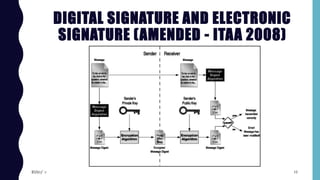
DIGITAL SIGNATURE AND ELECTRONIC
SIGNATURE (AMENDED - ITAA 2008)
10$ɧƦɛƴ ´ƶ
• “Hash function” means an algorithm mapping or translation of one sequence
of bits into another, generally smaller set known as “hash result” such that an
E-record yields the same hash result every time the algorithm is executed with
the same E-record as its input, making it computationally infeasible
– to derive or reconstruct the original E-record from the hash result produced by
the algorithm
– that two E-records can produce the same hash result using the algorithm
11$ɧƦɛƴ ´ƶ
The digital signature is created in two distinct steps.
• First, E-record message digest - by using a mathematical function known as “hash function” which
digitally freezes the E-record thus ensuring the integrity of the content of the E-record.
a) Any tampering with the E-record will invalidate the digital signature
• Secondly, the identity of the person affixing the digital signature is authenticated through the use of a
private key which attaches itself to the message digest and which can be verified by anybody who has the
public key corresponding to such private key.
– It helps to verify whether the E-record is retained intact or has been tampered with
– It helps the person with the public key to identify the originator of the message
• Any subscriber may authenticate an e-record by affixing his Digital Signature.
• The authentication of the e-record shall be effected by the use of asymmetric crypto system and
hash function which envelop and transform the initial e-record into another e-record
• Any person by the use of a public key of the subscriber can verify the e-record
• The private key and the public key are unique to the subscriber and constitute a functioning key pair
12$ɧƦɛƴ ´ƶ
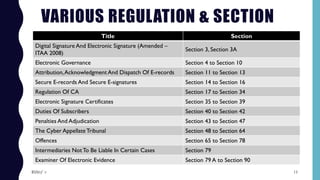
Title Section
Digital Signature And Electronic Signature (Amended –
ITAA 2008)
Section 3, Section 3A
Electronic Governance Section 4 to Section 10
Attribution,Acknowledgment And Dispatch Of E-records Section 11 to Section 13
Secure E-records And Secure E-signatures Section 14 to Section 16
Regulation Of CA Section 17 to Section 34
Electronic Signature Certificates Section 35 to Section 39
Duties Of Subscribers Section 40 to Section 42
Penalties And Adjudication Section 43 to Section 47
The Cyber Appellate Tribunal Section 48 to Section 64
Offences Section 65 to Section 78
Intermediaries NotTo Be Liable In Certain Cases Section 79
Examiner Of Electronic Evidence Section 79 A to Section 90
13$ɧƦɛƴ ´ƶ
VARIOUS REGULATION & SECTION
ANY QUESTION ?
14$ɧƦɛƴ ´ƶ

IT ACT 2008 ALA GTU

  • 1.
    Cyber Security (2150003) B.E.MECH – Sem Vth Prepared by, Patel Shrey B. (170953119031) Group :- 5B2 Guided by, Asst. Prof. Ruchi Maheta (Computer Science Deptt)
  • 2.
    CONTENTS • Brief History •Reasons For Amending IT Act • Objectives • Definition • Digital Signature And Electronic Signature (Amended - ITAA 2008) • Various Regulation &Their Section 2$ɧƦɛƴ ´ƶ
  • 3.
  • 4.
  • 5.
    REASONS FOR AMENDINGIT ACT • To include new types of Cyber-crimes • To increase protection of personal data & info. for national security, econ., public health & safety • To provide for alternate technology for e-Signatures as per Model Law UNCITRAL (UN Commission of Intl.Trade laws) • To authorize Service Providers providing services to SG/CG 5$ɧƦɛƴ ´ƶ
  • 6.
    OBJECTIVES • Legal recognitionfor transactions carried out by means of E-data interchange (EDI), E-Commerce • Facilitate and legalize E-fund transfers (EFT) • Facilitate E-storage of data • Facilitate E-filing of documents with Govt departments • Legal recognition for keeping of books of accounts by bankers in E-form • Legal recognition to Digital signatures for authentication of information • Amend RBI Act, Banker’s Book Evidence Act, Indian Evidence Act, Indian Penal Code $ɧƦɛƴ ´ƶ 6
  • 7.
    DEFINITION • Access meansgaining entry into, instructing or communicating with the logical, arithmetical, or memory function resources of a computer, computer system or computer network • Addressee means a person who is “intended by the originator to receive” the E-record. Excludes intermediary • Adjudicating officer (AO) means an adudicating officer appointed under the Act • Affixing Electronic signature means adoption of any methodology or procedure by a person for authenticating an E-record via electronic signature • Asymmetric crypto system means a system of a secure key pair consisting of a private key for creating a digital signature and a public key to verify the digital signature • Certifying Authority (CA) means a person who has been granted a licence to issue an ESC under the Act • Certification practice statement is issued by a CA to specify the practices that it employs in issuing ESCs • Communication Device means Cell Phones Personal Digital Assistance (PDAs), or combination of both or any other device used to communicate, send or transmit any text, video, audio, or image 7$ɧƦɛƴ ´ƶ
  • 8.
    • Computer (C)means any electronic magnetic, optical or other high-speed data processing device or system which performs logical, arithmetic, and memory functions by manipulations of electronic, magnetic or optical impulses, and includes all IPO, storage, computer software, or communication facilities which are connected or related to the computer in a computer system or computer network • Computer network (CN) means the interconnection of one or more computers through - o the use of satellite, microwave, terrestrial line or other communication media o terminals or a complex consisting of two or more interconnected computers whether or not the interconnection is continuously maintained • Computer resource (CR) means computer, computer system, computer network, data, computer data base or software • Controller means the Controller of CA appointed under the Act • Cyber AppellateTribunal (CAT) means the Cyber Appellate Tribunal established under the Act. (X “Regulation” or CRAT) • Cyber Café means any facility from where access to the internet is offered by any person in the ordinary course of business to the members of the public 8$ɧƦɛƴ ´ƶ
  • 9.
    • Cyber Securitymeans protecting information, equipment, devices, computer, computer resource, communication device and information stored therein from unauthorized access, use, disclosure, disruption, modification or destruction • Data means a representation of information, knowledge, facts, concepts or instructions which are being prepared or have been prepared in formalised manner, and is intended to be processed, is being processed or has been processed in a computer system or computer network, and may be in any form (including computer printouts magnetic or optical storage media, punched cards, punched tapes) or stored internally in the memory of the computer • Digital signature means authentication of any E-record by a subscriber by means of an electronic method or procedure in accordance with the Act • Digital Signature Certificate means a Digital Signature Certificate issued under the Act • Electronic form with reference to information means any information generated, sent, received or stored in media, magnetic, optical, computer memory, micro film, computer generated micro fiche or similar device • Electronic Gazette means the Official Gazette published in the electronic form 9$ɧƦɛƴ ´ƶ
  • 10.
    DIGITAL SIGNATURE ANDELECTRONIC SIGNATURE (AMENDED - ITAA 2008) 10$ɧƦɛƴ ´ƶ
  • 11.
    • “Hash function”means an algorithm mapping or translation of one sequence of bits into another, generally smaller set known as “hash result” such that an E-record yields the same hash result every time the algorithm is executed with the same E-record as its input, making it computationally infeasible – to derive or reconstruct the original E-record from the hash result produced by the algorithm – that two E-records can produce the same hash result using the algorithm 11$ɧƦɛƴ ´ƶ
  • 12.
    The digital signatureis created in two distinct steps. • First, E-record message digest - by using a mathematical function known as “hash function” which digitally freezes the E-record thus ensuring the integrity of the content of the E-record. a) Any tampering with the E-record will invalidate the digital signature • Secondly, the identity of the person affixing the digital signature is authenticated through the use of a private key which attaches itself to the message digest and which can be verified by anybody who has the public key corresponding to such private key. – It helps to verify whether the E-record is retained intact or has been tampered with – It helps the person with the public key to identify the originator of the message • Any subscriber may authenticate an e-record by affixing his Digital Signature. • The authentication of the e-record shall be effected by the use of asymmetric crypto system and hash function which envelop and transform the initial e-record into another e-record • Any person by the use of a public key of the subscriber can verify the e-record • The private key and the public key are unique to the subscriber and constitute a functioning key pair 12$ɧƦɛƴ ´ƶ
  • 13.
    Title Section Digital SignatureAnd Electronic Signature (Amended – ITAA 2008) Section 3, Section 3A Electronic Governance Section 4 to Section 10 Attribution,Acknowledgment And Dispatch Of E-records Section 11 to Section 13 Secure E-records And Secure E-signatures Section 14 to Section 16 Regulation Of CA Section 17 to Section 34 Electronic Signature Certificates Section 35 to Section 39 Duties Of Subscribers Section 40 to Section 42 Penalties And Adjudication Section 43 to Section 47 The Cyber Appellate Tribunal Section 48 to Section 64 Offences Section 65 to Section 78 Intermediaries NotTo Be Liable In Certain Cases Section 79 Examiner Of Electronic Evidence Section 79 A to Section 90 13$ɧƦɛƴ ´ƶ VARIOUS REGULATION & SECTION
  • 14.