Mahatma Gandhi Mission’s 
College of Engineering and Technology. 
Noida, U.P., India 
Technical seminar on 
HEATING VENTILATION AND AIR CONDTIONING 
Under the guidance of Prepared by 
MR. ABHIJIT KULKARNI Krishan Kumar
CONTENT 
• Introduction to HVAC 
• History of HVAC 
• Need of HVAC 
• Heating 
• Ventilation 
• Air conditioning process 
• Types of installation 
• Recent Development in HVAC 
• Advantages & Disadvantages 
• Applications of HVAC 
• Conclusion
WHAT IS HVAC? 
• Heating, Ventilation, and Air Conditioning
WHAT DOES IT DO? 
• HVAC is a basic requirement for your indoor air 
quality, what you breathe, temperature, humidity -- 
in your house. 
• So when you hear the term "HVAC" it means the 
entire air system of your home.
HISTORY OF HVAC 
• IN 1851 Dr John Gorrie was granted U.S. Patent for 
refrigeration machine. 
• In 1880 refrigeration became available for industrial 
purpose. Initially two major uses –freezing meat for 
transport and making ice. 
• Early 1990-new initiative to keep building cool for 
comfort. 
• 1902 cooling the New York stock exchange-one of 
the first comfort cooling system.
NEED OF HVAC SYSTEM 
• Improvement of the air quality 
• Moisture regulation 
• Depression 
• Maintenance of the constant temperature throughout 
the year 
• Energy conservation
HVAC COMPONENTS 
• Furnace 
• Heat exchanger 
• Ducts 
• Vents 
• Air Conditioning Unit 
• Evaporator Coils 
• Condensing Unit
FURNACE 
• As part of the HVAC, the furnace 
heats the air that circulates in the 
home. 
• The quality of air in the home can 
be influenced by how often you 
change the air filter on your unit. 
• Usually the Air Conditioner is 
outside, and the furnace is inside 
the house. 
• The HVAC uses the same venting 
system for both.
WHAT ARE BTU’S AND EER’S 
• BTU or British Thermal Units, are the amount of heat 
required to raise the temp. of one pound of water, 1 
degree Fahrenheit. 1 ton= 12,000BTU. 
• EER is Energy Efficiency Rating and tells you the 
BTU rating over the wattage. The higher the EER, the 
better the energy efficiency, but it will probably cost 
more.
HEATING 
CONVECTION-Collective movement of groups 
of molecules within fluids , through diffusion 
CONDUCTION -Transfer of internal energy by 
microscopic diffusion and collisions of particles within a 
body due to a temperature gradient. 
RADIATION- Electromagnetic waves (EMR) travel 
through a vacuum or through matter-containing media.
GENERATION OF HEAT 
• Heaters exist for various types of fuel, including solid 
fuels, liquids, and gases. 
• Another type of heat source is electricity, typically 
heating ribbons made of high resistance wire. 
• This principle is also used for baseboard heaters and 
portable heaters. 
• Electrical heaters are often used as backup or 
supplemental heat for heat pump systems.
DISTRIBUTION OF HEAT 
• WATER/STEAM - 
• Piping is used to transport the heat to the rooms. 
• Modern hot water boiler heating systems have a 
circulator, which is a pump, to move hot water 
through the distribution system . 
• AIR- 
• Warm air systems distribute heated air through duct 
work systems of supply and return air through metal 
or fiberglass ducts. 
• Many systems use the same ducts to distribute air 
cooled by an evaporator coil for air conditioning.
VENTILATION 
MECHANICAL OR FORCED-Provided 
by an air handler and used to control indoor air 
quality. 
• Excess humidity, odours, and contaminants can often be 
controlled via dilution or replacement with outside air. 
• Kitchens and bathrooms 
NATURAL-ventilation 
of a building with outside air without using fans 
or other mechanical systems. 
-reduces spread of diseases- tuberculosis, common cold.
IMPROVED VENTILATION 
EFFECTIVENESS 
• Effective mixing of ventilation air within space 
• Net positive pressure in the southeast; exhaust from 
appropriate spaces 
• Provide clean outdoor air, avoid: 
– loading docks 
– exhaust vents 
– plumbing stacks 
– waste collection 
– stagnant water
AIR CONDITIONING UNIT 
An air conditioner is like a refrigerator without the 
insulated box. It evaporates a refrigerant, like Freon, to 
provide cooling. 
Most Air Conditioners Have: 
– A compressor 
– An expansion valve 
– A hot coil (on the outside) 
– A chilled coil (on the inside) 
– Two fans 
– A control unit
COMPRESSOR 
• Heart of the system, belt driven pump that fastened to engine. 
• Responsible for compressing and transferring refrigerant. 
Advantages: 
• Very high volumetric efficiency (almost 98%) 
• Lesser Noise and lighter compared to rotary compressor.
CONDENSER 
• Responsible for heat dissipation. The condenser is designed to 
radiate heat. 
• Located in front of the radiator. Require good air flow when 
system is in operation 
• Plate fin type heat exchanger with micro channels used.Very 
compact and better heat transfer capability. 
• Hot compressed refrigerant vapour cools at constant pressure to 
liquid.
EVAPORATOR 
• Heat absorption component. 
• Used remove heat from the inside of vehicle. 
• Secondary benefit - dehumidification. 
• Unconditioned air passes through a filter before entering the 
evaporator. 
• Plate-fin evaporator with micro channels used.
BASIC REFRIGERATION CYCLE
HEAT PUMP (HP) 
• A machine or device that moves heat from one location (the 
source) to another location (the mechanical work) 
• Can produce heating or cooling by reversing the direction of heat 
flow 
• Can be used in: 
– Forced Air System 
– HotWater System 
– Radiant Heat System
TYPES OF INSTALLATION 
• Window unit and packaged terminal 
• Split system 
• Mini Split System -typically produce 9,000–36,000 
BTU(9,500–38,000 KJ) per hour of cooling. 
• Central air conditioning 
• Portable units-easily transported inside a home or 
office ,capacities of about 5,000–60,000 BTU/h 
(1,800–18,000Woutput)
USES OF AIR CONDITIONING 
• Comfort application 
• Domestic use 
• Process application
HVAC SYSTEMS 
Central Forced air system 
Air handling system 
• Hot water system 
• Zone control system 
• Radiant heat
CENTRAL FORCED AIR SYSTEM 
• Most common HVAC system circulates air through or 
around heating and cooling devices. 
• A fan forces air into ducts 
• Supply ducts transport conditioned air into building 
through diffusers or supply registers 
• Air is routed back to heating/cooling device through 
return ducts
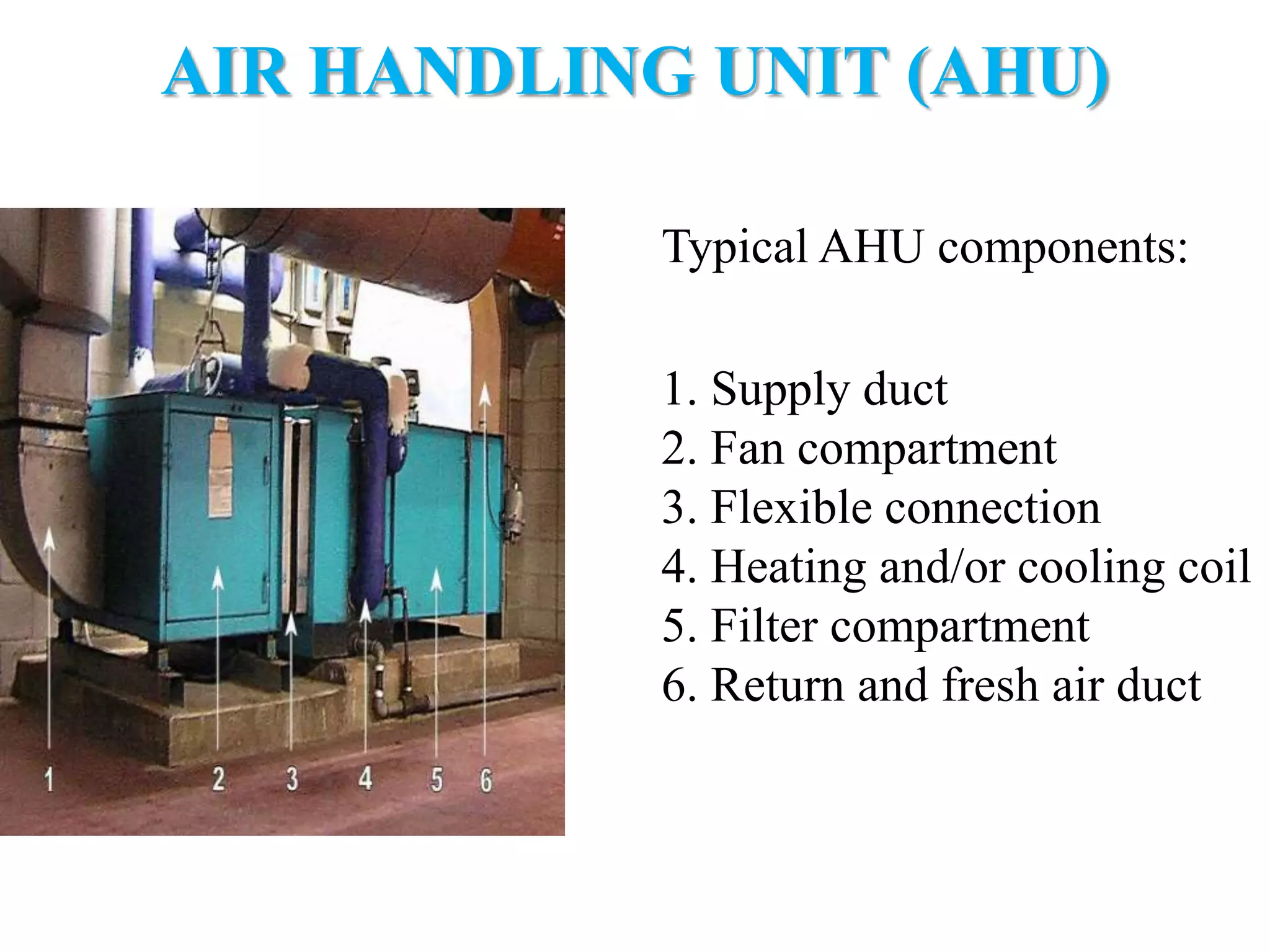
AIR HANDLING UNIT(AHU) 
• Device used to condition and circulate air as 
part of an HVAC system 
• Large metal box containing a blower, heating 
or cooling elements, filter, and sound 
attenuators. 
• Connects to ductwork that distributes the 
conditioned air through the building and 
returns it to the AHU
AIR HANDLING UNIT (AHU) 
• May need to supply heating, cooling, or both 
• A furnace generates heat 
– Fuel oil or natural gas 
– Electric heating elements 
• A refrigeration system absorbs heat 
– Air conditioner 
– Heat pump
AIR HANDLING UNIT (AHU) 
• Smaller air handlers may contain a fuel-burning heater or a 
refrigeration evaporator placed directly in the air stream 
• Large commercial air handling units contain coils that circulate 
water 
– Boiler provides hot water or steam 
– Chiller provides chilled water
AIR HANDLING UNIT (AHU) 
Typical AHU components: 
1. Supply duct 
2. Fan compartment 
3. Flexible connection 
4. Heating and/or cooling coil 
5. Filter compartment 
6. Return and fresh air duct
HOT WATER SYSTEM 
• Water heated in boiler and circulated through pipes to 
radiators 
• Requires plumbing rather than ductwork
ZONE CONTROL SYSTEM 
• One heater and one thermostat per room 
• No ductwork 
• Often used in hotel rooms
RADIANT HEAT 
• Supply heat directly to the floor, wall, or ceiling 
• Hot water pipes or electric heating element runs through 
building component 
• Dependent on radiant heat 
– Heat transferred from hot surface to people and objects
RECENT DEVELOPMENT IN HVAC 
Emerson Climate Technologies Launches E360 
E360 provide a 360-degree view of commercial refrigeration 
issues and advancements by addressing energy efficiency, 
equipment reliability and safety, environmental protection, and 
economic considerations. 
Serves as a means of centralizing all of this information and 
providing us with the tools to interact with industry experts 
and ultimately improve their operations.
RECENT DEVELOPMENT IN HVAC 
DuPont Introduces New HFO Refrigerants for 
Commercial Refrigeration 
Opteon XP40, Opteon XP44, and Opteon XP10. 
Opteon XP40 is designed to effectively replace the refrigerant R- 
404A. 
Opteon XP10 is a lower GWP replacement for R-134a for 
refrigeration 
• Replacements for R-22 are HFC-134a, R-410a, 
R-410b
ADVANTAGES OF HVAC 
1. Conserves Energy 
2. Regulates Moisture 
3. Air Quality Improvement.
DISADVANTAGES OF HVAC 
• Initial installation cost is high. 
• Primary disadvantage of ductless air 
conditioners is their cost.
APPLICATIONS OF HVAC 
• “Free cooling” during moderate temperatures (chiller 
bypass). 
• Thermal storage—isolation of storage tank 
• Water source heat pump pre cooler with isolation 
• Heating potable hot water (instantaneous heater) 
• Waste heat recovery from condenser water
CONCLUSION 
• Proper system design accounts for building type and 
size, layout, surrounding area, the nature of activities 
taking place, the number of occupants, climate and 
other factors, making each situation distinct. 
• Optimizing system operation. 
• Making and analysing certain key measurements is 
essential for optimizing the HVAC system 
performance.
REFERENCES 
1. http://en.wikipedia.org/wiki/HVAC 
2. www.saminfratech .com 
3.http://www.fsec.ucf.edu/en/consumer/buildings/commercial/ 
hvac.htm 
4. Ventilation and Infiltration chapter, Fundamentals volume 
of the ASHRAE Handbook, ASHRAE, Inc., Atlanta, GA, 2005
THANK YOU

Complete hvac ppt by kk 354647.pptx 1234

  • 1.
    Mahatma Gandhi Mission’s College of Engineering and Technology. Noida, U.P., India Technical seminar on HEATING VENTILATION AND AIR CONDTIONING Under the guidance of Prepared by MR. ABHIJIT KULKARNI Krishan Kumar
  • 2.
    CONTENT • Introductionto HVAC • History of HVAC • Need of HVAC • Heating • Ventilation • Air conditioning process • Types of installation • Recent Development in HVAC • Advantages & Disadvantages • Applications of HVAC • Conclusion
  • 3.
    WHAT IS HVAC? • Heating, Ventilation, and Air Conditioning
  • 4.
    WHAT DOES ITDO? • HVAC is a basic requirement for your indoor air quality, what you breathe, temperature, humidity -- in your house. • So when you hear the term "HVAC" it means the entire air system of your home.
  • 5.
    HISTORY OF HVAC • IN 1851 Dr John Gorrie was granted U.S. Patent for refrigeration machine. • In 1880 refrigeration became available for industrial purpose. Initially two major uses –freezing meat for transport and making ice. • Early 1990-new initiative to keep building cool for comfort. • 1902 cooling the New York stock exchange-one of the first comfort cooling system.
  • 6.
    NEED OF HVACSYSTEM • Improvement of the air quality • Moisture regulation • Depression • Maintenance of the constant temperature throughout the year • Energy conservation
  • 7.
    HVAC COMPONENTS •Furnace • Heat exchanger • Ducts • Vents • Air Conditioning Unit • Evaporator Coils • Condensing Unit
  • 8.
    FURNACE • Aspart of the HVAC, the furnace heats the air that circulates in the home. • The quality of air in the home can be influenced by how often you change the air filter on your unit. • Usually the Air Conditioner is outside, and the furnace is inside the house. • The HVAC uses the same venting system for both.
  • 9.
    WHAT ARE BTU’SAND EER’S • BTU or British Thermal Units, are the amount of heat required to raise the temp. of one pound of water, 1 degree Fahrenheit. 1 ton= 12,000BTU. • EER is Energy Efficiency Rating and tells you the BTU rating over the wattage. The higher the EER, the better the energy efficiency, but it will probably cost more.
  • 10.
    HEATING CONVECTION-Collective movementof groups of molecules within fluids , through diffusion CONDUCTION -Transfer of internal energy by microscopic diffusion and collisions of particles within a body due to a temperature gradient. RADIATION- Electromagnetic waves (EMR) travel through a vacuum or through matter-containing media.
  • 11.
    GENERATION OF HEAT • Heaters exist for various types of fuel, including solid fuels, liquids, and gases. • Another type of heat source is electricity, typically heating ribbons made of high resistance wire. • This principle is also used for baseboard heaters and portable heaters. • Electrical heaters are often used as backup or supplemental heat for heat pump systems.
  • 12.
    DISTRIBUTION OF HEAT • WATER/STEAM - • Piping is used to transport the heat to the rooms. • Modern hot water boiler heating systems have a circulator, which is a pump, to move hot water through the distribution system . • AIR- • Warm air systems distribute heated air through duct work systems of supply and return air through metal or fiberglass ducts. • Many systems use the same ducts to distribute air cooled by an evaporator coil for air conditioning.
  • 13.
    VENTILATION MECHANICAL ORFORCED-Provided by an air handler and used to control indoor air quality. • Excess humidity, odours, and contaminants can often be controlled via dilution or replacement with outside air. • Kitchens and bathrooms NATURAL-ventilation of a building with outside air without using fans or other mechanical systems. -reduces spread of diseases- tuberculosis, common cold.
  • 14.
    IMPROVED VENTILATION EFFECTIVENESS • Effective mixing of ventilation air within space • Net positive pressure in the southeast; exhaust from appropriate spaces • Provide clean outdoor air, avoid: – loading docks – exhaust vents – plumbing stacks – waste collection – stagnant water
  • 15.
    AIR CONDITIONING UNIT An air conditioner is like a refrigerator without the insulated box. It evaporates a refrigerant, like Freon, to provide cooling. Most Air Conditioners Have: – A compressor – An expansion valve – A hot coil (on the outside) – A chilled coil (on the inside) – Two fans – A control unit
  • 16.
    COMPRESSOR • Heartof the system, belt driven pump that fastened to engine. • Responsible for compressing and transferring refrigerant. Advantages: • Very high volumetric efficiency (almost 98%) • Lesser Noise and lighter compared to rotary compressor.
  • 17.
    CONDENSER • Responsiblefor heat dissipation. The condenser is designed to radiate heat. • Located in front of the radiator. Require good air flow when system is in operation • Plate fin type heat exchanger with micro channels used.Very compact and better heat transfer capability. • Hot compressed refrigerant vapour cools at constant pressure to liquid.
  • 18.
    EVAPORATOR • Heatabsorption component. • Used remove heat from the inside of vehicle. • Secondary benefit - dehumidification. • Unconditioned air passes through a filter before entering the evaporator. • Plate-fin evaporator with micro channels used.
  • 19.
  • 20.
    HEAT PUMP (HP) • A machine or device that moves heat from one location (the source) to another location (the mechanical work) • Can produce heating or cooling by reversing the direction of heat flow • Can be used in: – Forced Air System – HotWater System – Radiant Heat System
  • 21.
    TYPES OF INSTALLATION • Window unit and packaged terminal • Split system • Mini Split System -typically produce 9,000–36,000 BTU(9,500–38,000 KJ) per hour of cooling. • Central air conditioning • Portable units-easily transported inside a home or office ,capacities of about 5,000–60,000 BTU/h (1,800–18,000Woutput)
  • 22.
    USES OF AIRCONDITIONING • Comfort application • Domestic use • Process application
  • 23.
    HVAC SYSTEMS CentralForced air system Air handling system • Hot water system • Zone control system • Radiant heat
  • 24.
    CENTRAL FORCED AIRSYSTEM • Most common HVAC system circulates air through or around heating and cooling devices. • A fan forces air into ducts • Supply ducts transport conditioned air into building through diffusers or supply registers • Air is routed back to heating/cooling device through return ducts
  • 25.
    AIR HANDLING UNIT(AHU) • Device used to condition and circulate air as part of an HVAC system • Large metal box containing a blower, heating or cooling elements, filter, and sound attenuators. • Connects to ductwork that distributes the conditioned air through the building and returns it to the AHU
  • 26.
    AIR HANDLING UNIT(AHU) • May need to supply heating, cooling, or both • A furnace generates heat – Fuel oil or natural gas – Electric heating elements • A refrigeration system absorbs heat – Air conditioner – Heat pump
  • 27.
    AIR HANDLING UNIT(AHU) • Smaller air handlers may contain a fuel-burning heater or a refrigeration evaporator placed directly in the air stream • Large commercial air handling units contain coils that circulate water – Boiler provides hot water or steam – Chiller provides chilled water
  • 28.
    AIR HANDLING UNIT(AHU) Typical AHU components: 1. Supply duct 2. Fan compartment 3. Flexible connection 4. Heating and/or cooling coil 5. Filter compartment 6. Return and fresh air duct
  • 29.
    HOT WATER SYSTEM • Water heated in boiler and circulated through pipes to radiators • Requires plumbing rather than ductwork
  • 30.
    ZONE CONTROL SYSTEM • One heater and one thermostat per room • No ductwork • Often used in hotel rooms
  • 31.
    RADIANT HEAT •Supply heat directly to the floor, wall, or ceiling • Hot water pipes or electric heating element runs through building component • Dependent on radiant heat – Heat transferred from hot surface to people and objects
  • 32.
    RECENT DEVELOPMENT INHVAC Emerson Climate Technologies Launches E360 E360 provide a 360-degree view of commercial refrigeration issues and advancements by addressing energy efficiency, equipment reliability and safety, environmental protection, and economic considerations. Serves as a means of centralizing all of this information and providing us with the tools to interact with industry experts and ultimately improve their operations.
  • 33.
    RECENT DEVELOPMENT INHVAC DuPont Introduces New HFO Refrigerants for Commercial Refrigeration Opteon XP40, Opteon XP44, and Opteon XP10. Opteon XP40 is designed to effectively replace the refrigerant R- 404A. Opteon XP10 is a lower GWP replacement for R-134a for refrigeration • Replacements for R-22 are HFC-134a, R-410a, R-410b
  • 34.
    ADVANTAGES OF HVAC 1. Conserves Energy 2. Regulates Moisture 3. Air Quality Improvement.
  • 35.
    DISADVANTAGES OF HVAC • Initial installation cost is high. • Primary disadvantage of ductless air conditioners is their cost.
  • 36.
    APPLICATIONS OF HVAC • “Free cooling” during moderate temperatures (chiller bypass). • Thermal storage—isolation of storage tank • Water source heat pump pre cooler with isolation • Heating potable hot water (instantaneous heater) • Waste heat recovery from condenser water
  • 37.
    CONCLUSION • Propersystem design accounts for building type and size, layout, surrounding area, the nature of activities taking place, the number of occupants, climate and other factors, making each situation distinct. • Optimizing system operation. • Making and analysing certain key measurements is essential for optimizing the HVAC system performance.
  • 38.
    REFERENCES 1. http://en.wikipedia.org/wiki/HVAC 2. www.saminfratech .com 3.http://www.fsec.ucf.edu/en/consumer/buildings/commercial/ hvac.htm 4. Ventilation and Infiltration chapter, Fundamentals volume of the ASHRAE Handbook, ASHRAE, Inc., Atlanta, GA, 2005
  • 39.