HEATING, VENTILATING, AND AIR
CONDITIONING SYSTEMS
BBPM2063
Prepared by : Muhammad Faris Nordin
HVAC (HEATING, VENTILATION &
AIR-CONDITIONING)
• The Heating, Ventilating and Air Conditioning Manufacturers
Association (HVAC) has set up an initiative specifically on indoor
air quality.
• It is evaluating research on the subject and is keen to create a
greater understanding about the problems that may occur if air
quality is poor.
• Health problems (such as asthma, eye irritations and nausea)
are known symptoms of poor air.
• There have even been cases of legionnaire’s disease spread by
bacteria in HVAC systems.
• Poor air quality also impacts on productivity in the workplace.
INDOOR AIR QUALITY
• It is estimated that the average person spends up to
90% of their time inside a building. Maintaining air
quality is vital to ensure health and well-being, as well
as maximum productivity in the workplace.
• Yet, despite recent air quality initiatives relating to
external air pollution and the reduction of emissions,
there is currently no legislation and there are no
directives related specifically to indoor air quality.
• When defining air quality, it is important to consider
everything from temperature and humidity to air flow
and cleanliness, as well as the maintenance of any air
conditioning or ventilation equipment used.
WHAT ARE THE REASONS FOR
INDOOR AIR QUALITY PROBLEM?
BASIC PRINCIPLES AND TYPES OF HVAC SYSTEMS
• In AC, the cooling process relies on two fundamental principles:
• When a liquid changes into a gas, it absorbs heat significantly.
• The boiling point of a liquid can be altered by changing the pressure applied to it. In other
words, increasing pressure raises the boiling point, while reducing pressure lowers it.
Refrigerant
• A refrigerant is a compound used in a heat cycle that undergoes a phase change from a
gas to a liquid and back.
• The two main uses of refrigerants are refrigerators/freezers and air conditioners
• The most widely used refrigerants were the halomethanes R-12 and R-22, with R-12 being
more common in automotive air conditioning and small refrigerators, and R-22 being used
for residential and light commercial air conditioning, refrigerators, and freezers.
AIR CONDITIONING COMPONENTS
• 1. compressor
• 2. evaporator
• 3. condenser
• 4. expansion valve
BASIC AIR-COND SYSTEM
1. Low pressure liquid
refrigerant in
evaporator absorbs
heat and changes to a
gas
2. The superheated vapour
enters the compressor where
its pressure is raised
3. The superheated vapour
enters the compressor where
its pressure is raised
4. Liquid passes through
expansion device, which
reduces its pressure and
controls the flow into the
evaporator
AN AIR CYCLE
• An air cycle is the process of distributing the clean air to the particular room to be cooled.
The purpose of cycle is actually removes heat from that room.
• Removed heat in this cycle occurs when the return supply air are absorb at the condenser.
The heat condensing medium using either air or water. So, this cycle have supply
distribution and return distribution.
• The method of this distributing might be using air ducting or cooling water piping.
• Complete system of an air conditioner need the refrigeration cycle and air cycle. In air
cycle there is a few component to be use such as:
• a) Air Handling Unit
• b) Air Filter
• c) Air Ducting
• d) Clean air inlet
• e) Humidification Equipment
• f) Dehumidification Equipment.
AN AIR CYCLE
• a) Air Handling Unit:
• The air handling unit is a central component of an HVAC
system responsible for conditioning and distributing the air
throughout a building.
• It contains components such as the evaporator coil (for
cooling) and the heating coil (for heating), which facilitate
the temperature control of the air.
• b) Air Filter
• Air filters are essential components that remove dust,
particles, and contaminants from the incoming air.
• They are located within the HVAC system to ensure the air
that enters the building is clean and safe to breathe.
• Filters come in various types, including fiberglass, pleated,
electrostatic, and HEPA (High Efficiency Particulate Air)
filters, with different filtration efficiencies.
AN AIR CYCLE
• c) Air Ducting
• Air ducts are a network of channels or pathways that transport
conditioned air throughout the building.
• They connect the AHU to various rooms and spaces, ensuring the
even distribution of heated or cooled air.
• d) Clean air inlet
• an important part of an HVAC system that brings in outdoor air to
maintain indoor air quality.
• It ensures that there is a supply of fresh, oxygen-rich air, especially
in tightly sealed or airtight buildings.
• e) Humidification Equipment & Dehumidification Equipment.
• Humidification and dehumidification components are used to
control the moisture content of the air.
• Humidifiers add moisture to the air when it's too dry, preventing
discomfort and issues like dry skin or respiratory problems.
• Dehumidifiers remove excess moisture from the air when it's too
humid, preventing issues like mold growth and condensation.
WINDOW AIR CONDITIONER
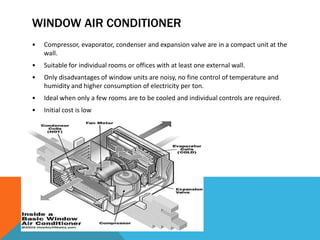
• Compressor, evaporator, condenser and expansion valve are in a compact unit at the
wall.
• Suitable for individual rooms or offices with at least one external wall.
• Only disadvantages of window units are noisy, no fine control of temperature and
humidity and higher consumption of electricity per ton.
• Ideal when only a few rooms are to be cooled and individual controls are required.
• Initial cost is low
SPLIT AIR CONDITIONER UNIT
• Are perfect for those that do not have central air conditioning & do not want to
settle for the noise & inefficiency of window units.
• Offer higher efficiency & reduced noise without a large hole in the wall/ an open
window.
• By separating the compressor & condenser coil from the fan & evaporator coil, the
noisiest component is away from the room.
• The indoor unit will usually have remote control capabilities and a timer to cycle the
system only when needed. The indoor unit is called an air handler because it has the
evaporator coil, blower & controls inside.
• The outdoor unit is called the condenser.
• They are connected together with refrigerant piping & control wiring, similar to a
central system.
• Since mini splits have no ducts, they avoid the energy losses associated with
ductwork of central forced air systems.
• Duct losses can account for a significant portion of energy consumption for space
conditioning, especially if the ducts are in a unconditioned space such as an attic.
• “hot” side( condensing unit): including condensing coil, compressor and fan- situated
outside home.
• Consists of a long, spiral coil cylinder shaped. Inside the coil – fan: blow air through
the coil, along with a weather-resistant compressor and some control logic.
• "cold" side : consists of an expansion valve and a cold coil, and it is usually part of
your furnace or some type of air handler.
• Furnace blows air through an evaporator coil, which cools the air. This cool air is
routed throughout your home by means of a series of air ducts.
CENTRAL AIR CONDITIONING
• It is used for cooling big buildings, houses, offices, entire hotels, gymnasiums, movie
theaters, factories etc.
• If the whole building is to be air conditioned, HVAC engineers find that putting
individuals units in each of the rooms is very expensive initially as well as in the long
run.
• The central air conditioning system is comprised of a huge compressor that has the
capacity to produce hundreds of tons of air conditioning.
• Cooling big halls, malls, huge spaces, galleries etc is usually only feasible with central
conditioning units.
• There are basically two types of package system – air-cooled or water-cooled
• Generally used with ductwork.
AIR HANDLING UNIT
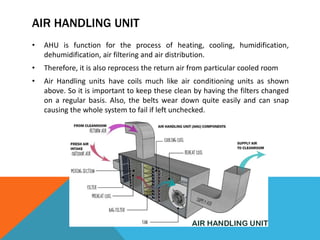
• AHU is function for the process of heating, cooling, humidification,
dehumidification, air filtering and air distribution.
• Therefore, it is also reprocess the return air from particular cooled room
• Air Handling units have coils much like air conditioning units as shown
above. So it is important to keep these clean by having the filters changed
on a regular basis. Also, the belts wear down quite easily and can snap
causing the whole system to fail if left unchecked.
CHILLER
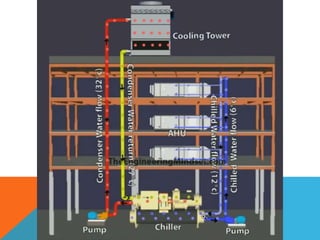
• Unit where chilled water is cooled by the evaporator.
• The chilled water is circulated inside the cooling coil in the AHU, being
warmed and to the chiller.
• Inside the chiller, the low pressure liquid refrigerant inside the evaporator
absorbs heat and flows to the condenser.
• The condenser is either air-cooled or water-cooled.
• This unit is usually installed for central plant system.
COOLING TOWER
• used in central air conditioning systems.
• function - to cool the warm water from the chiller condenser.
• heat from the rooms in a building is transferred to chilled water, then transferred into the
refrigerant, and finally to the cooling water. The cooling tower is at the final point of the heat
transfer. The heat is transferred to the atmosphere.
• heat in the cooling water is removed by letting moving air come into contact with it.
• Water is normally spread out and allowed to drop down by gravity from a height.
• Plastic fillings are arranged so as to increase the wetted surface of the water while it is dropping,
while at the same time provide better contact between the air passages and the water.
AIR COOLED CONDENSER
• Air-cooled condensers utilize ambient air in order to cool and cycle refrigerant.
• These can be readily seen oftentimes outdoors, as they are commonly used in
residential and rooftop cooling systems, and are housed in your standard exterior
unit.
• The advantage of choosing an air-cooled system is that they:
• Are typically lower in initial purchase cost. Though there is a fair debate to be had
on the matter, it is typically true that the initial purchase cost of air-cooled
condenser and chiller systems are somewhat less costly on the overall spectrum.
However, water-cooled systems might win out in longevity-which we will get to here
in a moment.
• Require less overall lifespan maintenance. Air-cooled systems generally require
maintenance services once, maybe twice, in a year in order to perform optimally. A
water cooled system can need routine care considerably more often.
• Do not require a mechanical room. Since the air-cooled condenser is housed
outdoors or in similar spaces, you needn’t find space to store and operate towers
and the rest of the assembly.
The end

CHAP 4 HVAC.pdf

  • 1.
    HEATING, VENTILATING, ANDAIR CONDITIONING SYSTEMS BBPM2063 Prepared by : Muhammad Faris Nordin
  • 2.
    HVAC (HEATING, VENTILATION& AIR-CONDITIONING) • The Heating, Ventilating and Air Conditioning Manufacturers Association (HVAC) has set up an initiative specifically on indoor air quality. • It is evaluating research on the subject and is keen to create a greater understanding about the problems that may occur if air quality is poor. • Health problems (such as asthma, eye irritations and nausea) are known symptoms of poor air. • There have even been cases of legionnaire’s disease spread by bacteria in HVAC systems. • Poor air quality also impacts on productivity in the workplace.
  • 3.
    INDOOR AIR QUALITY •It is estimated that the average person spends up to 90% of their time inside a building. Maintaining air quality is vital to ensure health and well-being, as well as maximum productivity in the workplace. • Yet, despite recent air quality initiatives relating to external air pollution and the reduction of emissions, there is currently no legislation and there are no directives related specifically to indoor air quality. • When defining air quality, it is important to consider everything from temperature and humidity to air flow and cleanliness, as well as the maintenance of any air conditioning or ventilation equipment used.
  • 4.
    WHAT ARE THEREASONS FOR INDOOR AIR QUALITY PROBLEM?
  • 14.
    BASIC PRINCIPLES ANDTYPES OF HVAC SYSTEMS • In AC, the cooling process relies on two fundamental principles: • When a liquid changes into a gas, it absorbs heat significantly. • The boiling point of a liquid can be altered by changing the pressure applied to it. In other words, increasing pressure raises the boiling point, while reducing pressure lowers it. Refrigerant • A refrigerant is a compound used in a heat cycle that undergoes a phase change from a gas to a liquid and back. • The two main uses of refrigerants are refrigerators/freezers and air conditioners • The most widely used refrigerants were the halomethanes R-12 and R-22, with R-12 being more common in automotive air conditioning and small refrigerators, and R-22 being used for residential and light commercial air conditioning, refrigerators, and freezers. AIR CONDITIONING COMPONENTS • 1. compressor • 2. evaporator • 3. condenser • 4. expansion valve
  • 15.
    BASIC AIR-COND SYSTEM 1.Low pressure liquid refrigerant in evaporator absorbs heat and changes to a gas 2. The superheated vapour enters the compressor where its pressure is raised 3. The superheated vapour enters the compressor where its pressure is raised 4. Liquid passes through expansion device, which reduces its pressure and controls the flow into the evaporator
  • 16.
    AN AIR CYCLE •An air cycle is the process of distributing the clean air to the particular room to be cooled. The purpose of cycle is actually removes heat from that room. • Removed heat in this cycle occurs when the return supply air are absorb at the condenser. The heat condensing medium using either air or water. So, this cycle have supply distribution and return distribution. • The method of this distributing might be using air ducting or cooling water piping. • Complete system of an air conditioner need the refrigeration cycle and air cycle. In air cycle there is a few component to be use such as: • a) Air Handling Unit • b) Air Filter • c) Air Ducting • d) Clean air inlet • e) Humidification Equipment • f) Dehumidification Equipment.
  • 17.
    AN AIR CYCLE •a) Air Handling Unit: • The air handling unit is a central component of an HVAC system responsible for conditioning and distributing the air throughout a building. • It contains components such as the evaporator coil (for cooling) and the heating coil (for heating), which facilitate the temperature control of the air. • b) Air Filter • Air filters are essential components that remove dust, particles, and contaminants from the incoming air. • They are located within the HVAC system to ensure the air that enters the building is clean and safe to breathe. • Filters come in various types, including fiberglass, pleated, electrostatic, and HEPA (High Efficiency Particulate Air) filters, with different filtration efficiencies.
  • 18.
    AN AIR CYCLE •c) Air Ducting • Air ducts are a network of channels or pathways that transport conditioned air throughout the building. • They connect the AHU to various rooms and spaces, ensuring the even distribution of heated or cooled air. • d) Clean air inlet • an important part of an HVAC system that brings in outdoor air to maintain indoor air quality. • It ensures that there is a supply of fresh, oxygen-rich air, especially in tightly sealed or airtight buildings. • e) Humidification Equipment & Dehumidification Equipment. • Humidification and dehumidification components are used to control the moisture content of the air. • Humidifiers add moisture to the air when it's too dry, preventing discomfort and issues like dry skin or respiratory problems. • Dehumidifiers remove excess moisture from the air when it's too humid, preventing issues like mold growth and condensation.
  • 20.
    WINDOW AIR CONDITIONER •Compressor, evaporator, condenser and expansion valve are in a compact unit at the wall. • Suitable for individual rooms or offices with at least one external wall. • Only disadvantages of window units are noisy, no fine control of temperature and humidity and higher consumption of electricity per ton. • Ideal when only a few rooms are to be cooled and individual controls are required. • Initial cost is low
  • 22.
    SPLIT AIR CONDITIONERUNIT • Are perfect for those that do not have central air conditioning & do not want to settle for the noise & inefficiency of window units. • Offer higher efficiency & reduced noise without a large hole in the wall/ an open window. • By separating the compressor & condenser coil from the fan & evaporator coil, the noisiest component is away from the room. • The indoor unit will usually have remote control capabilities and a timer to cycle the system only when needed. The indoor unit is called an air handler because it has the evaporator coil, blower & controls inside. • The outdoor unit is called the condenser. • They are connected together with refrigerant piping & control wiring, similar to a central system. • Since mini splits have no ducts, they avoid the energy losses associated with ductwork of central forced air systems. • Duct losses can account for a significant portion of energy consumption for space conditioning, especially if the ducts are in a unconditioned space such as an attic. • “hot” side( condensing unit): including condensing coil, compressor and fan- situated outside home. • Consists of a long, spiral coil cylinder shaped. Inside the coil – fan: blow air through the coil, along with a weather-resistant compressor and some control logic. • "cold" side : consists of an expansion valve and a cold coil, and it is usually part of your furnace or some type of air handler. • Furnace blows air through an evaporator coil, which cools the air. This cool air is routed throughout your home by means of a series of air ducts.
  • 24.
    CENTRAL AIR CONDITIONING •It is used for cooling big buildings, houses, offices, entire hotels, gymnasiums, movie theaters, factories etc. • If the whole building is to be air conditioned, HVAC engineers find that putting individuals units in each of the rooms is very expensive initially as well as in the long run. • The central air conditioning system is comprised of a huge compressor that has the capacity to produce hundreds of tons of air conditioning. • Cooling big halls, malls, huge spaces, galleries etc is usually only feasible with central conditioning units. • There are basically two types of package system – air-cooled or water-cooled • Generally used with ductwork.
  • 25.
    AIR HANDLING UNIT •AHU is function for the process of heating, cooling, humidification, dehumidification, air filtering and air distribution. • Therefore, it is also reprocess the return air from particular cooled room • Air Handling units have coils much like air conditioning units as shown above. So it is important to keep these clean by having the filters changed on a regular basis. Also, the belts wear down quite easily and can snap causing the whole system to fail if left unchecked.
  • 26.
    CHILLER • Unit wherechilled water is cooled by the evaporator. • The chilled water is circulated inside the cooling coil in the AHU, being warmed and to the chiller. • Inside the chiller, the low pressure liquid refrigerant inside the evaporator absorbs heat and flows to the condenser. • The condenser is either air-cooled or water-cooled. • This unit is usually installed for central plant system.
  • 27.
    COOLING TOWER • usedin central air conditioning systems. • function - to cool the warm water from the chiller condenser. • heat from the rooms in a building is transferred to chilled water, then transferred into the refrigerant, and finally to the cooling water. The cooling tower is at the final point of the heat transfer. The heat is transferred to the atmosphere. • heat in the cooling water is removed by letting moving air come into contact with it. • Water is normally spread out and allowed to drop down by gravity from a height. • Plastic fillings are arranged so as to increase the wetted surface of the water while it is dropping, while at the same time provide better contact between the air passages and the water.
  • 29.
    AIR COOLED CONDENSER •Air-cooled condensers utilize ambient air in order to cool and cycle refrigerant. • These can be readily seen oftentimes outdoors, as they are commonly used in residential and rooftop cooling systems, and are housed in your standard exterior unit. • The advantage of choosing an air-cooled system is that they: • Are typically lower in initial purchase cost. Though there is a fair debate to be had on the matter, it is typically true that the initial purchase cost of air-cooled condenser and chiller systems are somewhat less costly on the overall spectrum. However, water-cooled systems might win out in longevity-which we will get to here in a moment. • Require less overall lifespan maintenance. Air-cooled systems generally require maintenance services once, maybe twice, in a year in order to perform optimally. A water cooled system can need routine care considerably more often. • Do not require a mechanical room. Since the air-cooled condenser is housed outdoors or in similar spaces, you needn’t find space to store and operate towers and the rest of the assembly.
  • 37.