SHRI RAMSWAROOP MEMORIAL GROUP OF
PROFESSIONAL COLLEGES, LUCKNOW
SEMINAR ON
HEATING, VENTILATION,ANDAIR CONDITIONING
PREPARED BY
SEMINAR GUIDE
MR.A.K. RATHORE
PROF. P.C. TRIPATHI
PANKAJ GAURAV
1312240141
CONTENT
▶ Introduction to HVAC
▶ Need of HVAC
▶ Heating
▶ Ventilation
▶ Air conditioning process
▶ Types of installation
▶ Advantages & Disadvantages
▶ Applications of HVAC
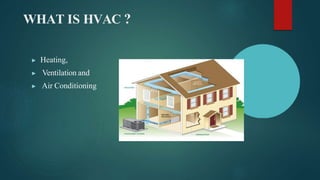
WHAT IS HVAC ?
▶ Heating,
▶ Ventilation and
▶ Air Conditioning
WHAT DOES IT DO?
▶ HVAC is a basic requirement for your indoor air quality, what you
breathe, temperature, humidity in your house.
▶ So when you hear the term "HVAC" it means the entire air system
of your home.
NEED OF HVAC SYSTEM
▶ Improvement of the air quality
▶ Moisture regulation
▶ Maintenance of the constant temperature throughout the year
▶ Energy conservation
HEATING
▶ CONVECTION-Collective movement of groups of molecules within fluids
, through diffusion
▶ CONDUCTION -Transfer of internal energy by microscopic diffusion and
collisions of particles within a body due to a temperature gradient.
▶ RADIATION- Electromagnetic waves (EMR) travel through a vacuum or
through matter-containing media
VENTILATION
▶ Provided by an air handler and used to control indoor air quality.
▶ Excess humidity, odours, and contaminants can often be controlled via
dilution or replacement with outside air.
▶ Kitchens and bathrooms -ventilation of a building with outside air without
using fans or other mechanical systems. -reduces spread of diseases-
tuberculosis, common cold.
AIR CONDITIONING UNIT
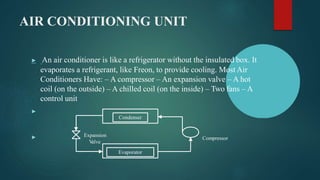
▶ An air conditioner is like a refrigerator without the insulated box. It
evaporates a refrigerant, like Freon, to provide cooling. Most Air
Conditioners Have: – A compressor – An expansion valve – A hot
coil (on the outside) – A chilled coil (on the inside) – Two fans – A
control unit
▶
▶ Compressor
Expansion
V
alve
Evaporator
Condenser
HVAC COMPONENTS
▶ Fans / Blowers
▶ Furnace / Heating unit
▶ Filters
▶ Compressor
▶ Condensing units
▶ Evaporator (cooling coil)
▶ Control System
▶ Air Distribution System
COMPRESSOR
▶ Heart of the system.
▶ Responsible for compressing and transferring refrigerant.
▶ Very high volumetric efficiency (almost 98%)
CONDENSER
▶ Responsible for heat dissipation. The condenser is
designed to radiate heat.
▶Hot compressed refrigerant vapour cools at constant
pressure to liquid.
EVAPORATOR
▶ An evaporator is a device used to turn the liquid form of a chemical
into its gaseous form while absorbing heat in the process.
▶ liquid passes through a filter before entering the evaporator.
TYPES OF INSTALLATION
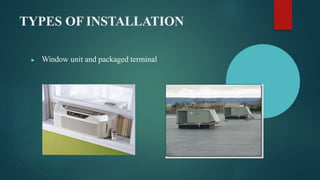
▶ Window unit and packaged terminal
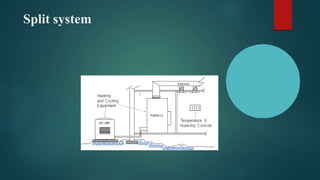
Split system
ADVANTAGES OF HVAC
▶ Conserves Energy
▶ Regulates Moisture
▶ Air Quality Improvement.
DISADVANTAGES OF HVAC
▶ Initial installation cost is high
▶ Primary disadvantage of ductless air conditioners is their cost
APPLICATIONS OF HVAC
▶ Thermal storage—isolation of storage tank
▶ “Free cooling” during moderate temperatures
▶ Water source heat pump pre cooler with isolation
▶ Waste heat recovery from condenser water
Thank you

HVAC and heat transfer.pptx

  • 1.
    SHRI RAMSWAROOP MEMORIALGROUP OF PROFESSIONAL COLLEGES, LUCKNOW SEMINAR ON HEATING, VENTILATION,ANDAIR CONDITIONING PREPARED BY SEMINAR GUIDE MR.A.K. RATHORE PROF. P.C. TRIPATHI PANKAJ GAURAV 1312240141
  • 2.
    CONTENT ▶ Introduction toHVAC ▶ Need of HVAC ▶ Heating ▶ Ventilation ▶ Air conditioning process ▶ Types of installation ▶ Advantages & Disadvantages ▶ Applications of HVAC
  • 3.
    WHAT IS HVAC? ▶ Heating, ▶ Ventilation and ▶ Air Conditioning
  • 4.
    WHAT DOES ITDO? ▶ HVAC is a basic requirement for your indoor air quality, what you breathe, temperature, humidity in your house. ▶ So when you hear the term "HVAC" it means the entire air system of your home.
  • 5.
    NEED OF HVACSYSTEM ▶ Improvement of the air quality ▶ Moisture regulation ▶ Maintenance of the constant temperature throughout the year ▶ Energy conservation
  • 6.
    HEATING ▶ CONVECTION-Collective movementof groups of molecules within fluids , through diffusion ▶ CONDUCTION -Transfer of internal energy by microscopic diffusion and collisions of particles within a body due to a temperature gradient. ▶ RADIATION- Electromagnetic waves (EMR) travel through a vacuum or through matter-containing media
  • 7.
    VENTILATION ▶ Provided byan air handler and used to control indoor air quality. ▶ Excess humidity, odours, and contaminants can often be controlled via dilution or replacement with outside air. ▶ Kitchens and bathrooms -ventilation of a building with outside air without using fans or other mechanical systems. -reduces spread of diseases- tuberculosis, common cold.
  • 8.
    AIR CONDITIONING UNIT ▶An air conditioner is like a refrigerator without the insulated box. It evaporates a refrigerant, like Freon, to provide cooling. Most Air Conditioners Have: – A compressor – An expansion valve – A hot coil (on the outside) – A chilled coil (on the inside) – Two fans – A control unit ▶ ▶ Compressor Expansion V alve Evaporator Condenser
  • 9.
    HVAC COMPONENTS ▶ Fans/ Blowers ▶ Furnace / Heating unit ▶ Filters ▶ Compressor ▶ Condensing units ▶ Evaporator (cooling coil) ▶ Control System ▶ Air Distribution System
  • 10.
    COMPRESSOR ▶ Heart ofthe system. ▶ Responsible for compressing and transferring refrigerant. ▶ Very high volumetric efficiency (almost 98%)
  • 11.
    CONDENSER ▶ Responsible forheat dissipation. The condenser is designed to radiate heat. ▶Hot compressed refrigerant vapour cools at constant pressure to liquid.
  • 12.
    EVAPORATOR ▶ An evaporatoris a device used to turn the liquid form of a chemical into its gaseous form while absorbing heat in the process. ▶ liquid passes through a filter before entering the evaporator.
  • 13.
    TYPES OF INSTALLATION ▶Window unit and packaged terminal
  • 14.
  • 15.
    ADVANTAGES OF HVAC ▶Conserves Energy ▶ Regulates Moisture ▶ Air Quality Improvement.
  • 16.
    DISADVANTAGES OF HVAC ▶Initial installation cost is high ▶ Primary disadvantage of ductless air conditioners is their cost
  • 17.
    APPLICATIONS OF HVAC ▶Thermal storage—isolation of storage tank ▶ “Free cooling” during moderate temperatures ▶ Water source heat pump pre cooler with isolation ▶ Waste heat recovery from condenser water
  • 18.