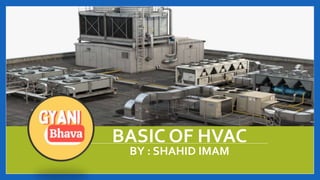
BASIC OF HVAC
BY : SHAHID IMAM
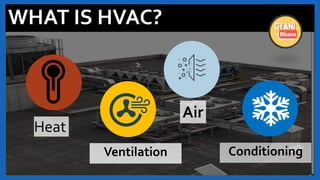
WHAT IS HVAC?
Heat
Ventilation Conditioning
Air
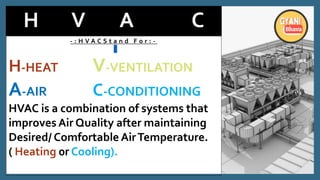
H V A C
- : H V A C S t a n d F o r : -
H-HEAT V-VENTILATION
A-AIR C-CONDITIONING
HVAC is a combination of systems that
improves Air Quality after maintaining
Desired/ Comfortable AirTemperature.
( Heating 0r Cooling).
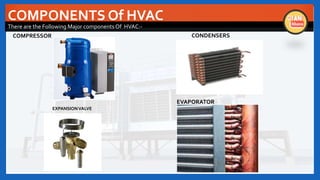
COMPONENTS Of HVAC
There are the Following Major components Of HVAC:-
COMPRESSOR CONDENSERS
EXPANSIONVALVE
EVAPORATOR
WORKING Of HVAC
Major components Of HVACWorks onVapor Compression Refrigeration Cycle
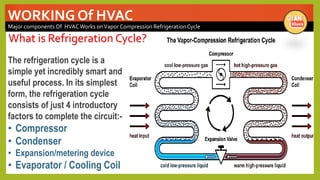
What is Refrigeration Cycle?
The refrigeration cycle is a
simple yet incredibly smart and
useful process. In its simplest
form, the refrigeration cycle
consists of just 4 introductory
factors to complete the circuit:-
• Compressor
• Condenser
• Expansion/metering device
• Evaporator / Cooling Coil
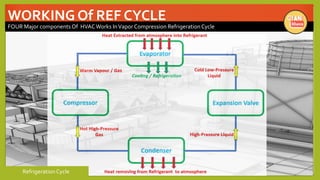
WORKING Of REF CYCLE
FOUR Major components Of HVACWorks InVapor Compression Refrigeration Cycle
Refrigeration Cycle
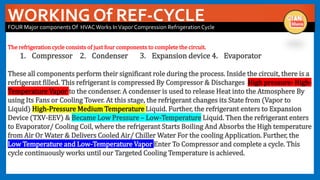
The refrigeration cycle consists of just four components to complete the circuit.
1. Compressor 2. Condenser 3. Expansion device 4. Evaporator
These all components perform their significant role during the process. Inside the circuit, there is a
refrigerant filled. This refrigerant is compressed By Compressor & Discharges High pressure- High-
Temperature Vapor to the condenser. A condenser is used to release Heat into the Atmosphere By
using Its Fans or Cooling Tower. At this stage, the refrigerant changes its State from (Vapor to
Liquid) High-Pressure Medium Temperature Liquid. Further, the refrigerant enters to Expansion
Device (TXV-EEV) & Became Low Pressure – Low-Temperature Liquid. Then the refrigerant enters
to Evaporator/ Cooling Coil, where the refrigerant Starts Boiling And Absorbs the High temperature
from Air Or Water & Delivers Cooled Air/ Chiller Water For the cooling Application. Further, the
Low Temperature and Low-Temperature Vapor Enter To Compressor and complete a cycle. This
cycle continuously works until our Targeted Cooling Temperature is achieved.
WORKING Of REF-CYCLE
FOUR Major components Of HVACWorks InVapor Compression Refrigeration Cycle
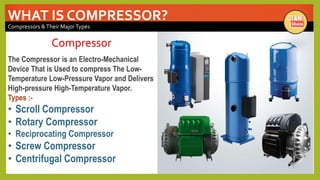
WHAT IS COMPRESSOR?
Compressors &Their MajorTypes
Compressor
The Compressor is an Electro-Mechanical
Device That is Used to compress The Low-
Temperature Low-Pressure Vapor and Delivers
High-pressure High-Temperature Vapor.
Types :-
• Scroll Compressor
• Rotary Compressor
• Reciprocating Compressor
• Screw Compressor
• Centrifugal Compressor
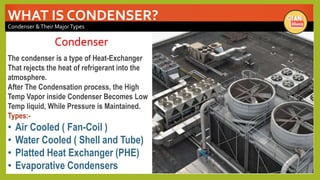
WHAT IS CONDENSER?
Condenser &Their MajorTypes
Condenser
The condenser is a type of Heat-Exchanger
That rejects the heat of refrigerant into the
atmosphere.
After The Condensation process, the High
Temp Vapor inside Condenser Becomes Low
Temp liquid, While Pressure is Maintained.
Types:-
• Air Cooled ( Fan-Coil )
• Water Cooled ( Shell and Tube)
• Platted Heat Exchanger (PHE)
• Evaporative Condensers
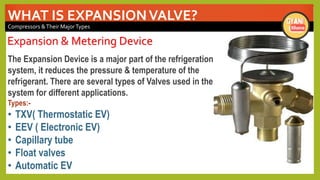
WHAT IS EXPANSIONVALVE?
Compressors &Their MajorTypes
Expansion & Metering Device
The Expansion Device is a major part of the refrigeration
system, it reduces the pressure & temperature of the
refrigerant. There are several types of Valves used in the
system for different applications.
Types:-
• TXV( Thermostatic EV)
• EEV ( Electronic EV)
• Capillary tube
• Float valves
• Automatic EV
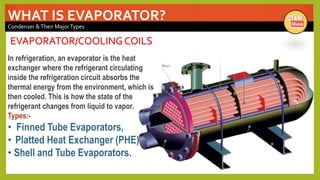
WHAT IS EVAPORATOR?
Condenser &Their MajorTypes
EVAPORATOR/COOLINGCOILS
In refrigeration, an evaporator is the heat
exchanger where the refrigerant circulating
inside the refrigeration circuit absorbs the
thermal energy from the environment, which is
then cooled. This is how the state of the
refrigerant changes from liquid to vapor.
Types:-
• Finned Tube Evaporators,
• Platted Heat Exchanger (PHE)
• Shell and Tube Evaporators.
Important Air-conditioning Processes
There are seven main processes required to achieve full air conditioning and These processes are:
1. Heating — the process of adding thermal energy to the space for the purposes of raising or maintaining the
temperature of the space.
2. Cooling — the process of removing thermal energy from the space for the purposes of lowering or maintaining
the temperature of the space.
3. Humidifying — the process of adding moisture to the air in the space for the purposes of raising or maintaining the
moisture content of the air.
4. Dehumidifying — the process of removing moisture from the air in the space for the purposes of lowering or maintaining
the moisture content of the air.
5. Cleaning — the process of removing particulates and biological contaminants from the air delivered to the space for
the purposes of improving or maintaining the airquality.
6. Ventilation — the process of exchanging air between the outdoors and the conditioned space for the purposes of diluting
the gaseous contaminants in the space.
Ventilation can be achieved either through;
 Natural ventilation: it is driven by natural drafts, like when you open a window.
 Mechanical ventilation. Can be achieved by using fans to draw air in from outside or by fans that exhaust
air from the space to outside.
7. Air Movement — the process of circulating and mixing air through conditioned spaces in the building for the purposes
of achieving proper ventilation and facilitating thermal energy transfer.
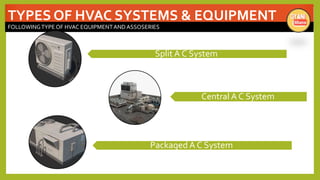
TYPES OF HVAC SYSTEMS & EQUIPMENT
FOLLOWINGTYPE OF HVAC EQUIPMENTAND ASSOSERIES
Split A C System
Central A C System
Packaged A C System
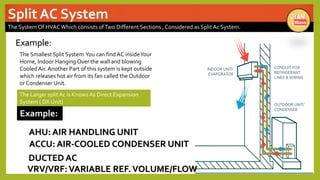
Split AC System
The System Of HVACWhich consists ofTwo Different Sections , Considered as SplitAc System.
Example:
The Smallest Split System You can find AC insideYour
Home, Indoor Hanging Over the wall and blowing
Cooled Air.Another Part of this system is kept outside
which releases hot air from its fan called the Outdoor
or Condenser Unit.
The Larger splitAc is Knows As Direct Expansion
System ( DX Unit)
Example:
AHU: AIR HANDLING UNIT
DUCTED AC
ACCU: AIR-COOLED CONDENSER UNIT
VRV/VRF:VARIABLE REF.VOLUME/FLOW
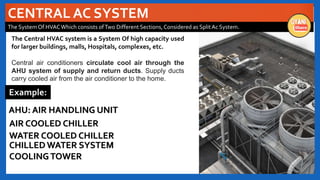
CENTRAL AC SYSTEM
The System Of HVACWhich consists ofTwo Different Sections, Considered as SplitAc System.
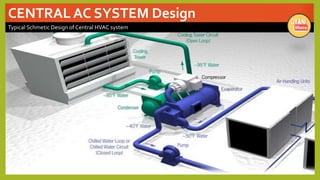
The Central HVAC system is a System Of high capacity used
for larger buildings, malls, Hospitals, complexes, etc.
Central air conditioners circulate cool air through the
AHU system of supply and return ducts. Supply ducts
carry cooled air from the air conditioner to the home.
Example:
AHU: AIR HANDLING UNIT
WATER COOLED CHILLER
AIR COOLED CHILLER
CHILLED WATER SYSTEM
COOLING TOWER
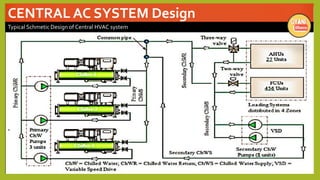
CENTRAL AC SYSTEM Design
Typical Schmetic Design of Central HVAC system
CENTRAL AC SYSTEM Design
Typical Schmetic Design of Central HVAC system
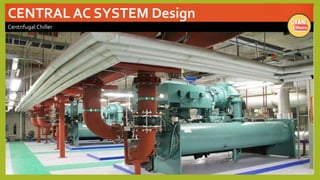
CENTRAL AC SYSTEM Design
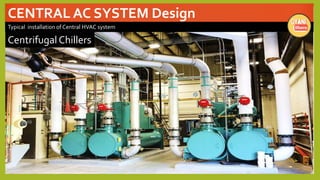
Typical installation of Central HVAC system
Centrifugal Chillers
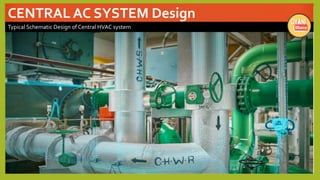
CENTRAL AC SYSTEM Design
Typical Schematic Design of Central HVAC system
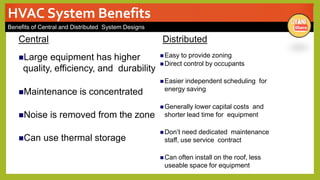
HVAC System Benefits
Benefits of Central and Distributed System Designs
Large equipment has higher
quality, efficiency, and durability
Maintenance is concentrated
Noise is removed from the zone
Can use thermal storage
 Easy to provide zoning
 Direct control by occupants
 Easier independent scheduling for
energy saving
 Generally lower capital costs and
shorter lead time for equipment
 Don’t need dedicated maintenance
staff, use service contract
 Can often install on the roof, less
useable space for equipment
Central Distributed
CENTRAL AC SYSTEM Design
Centrifugal Chiller
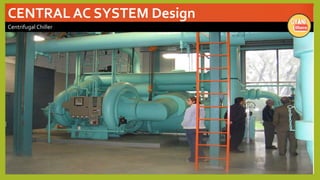
CENTRAL AC SYSTEM Design
Centrifugal Chiller
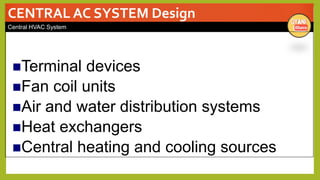
CENTRAL AC SYSTEM Design
Central HVAC System
Terminal devices
Fan coil units
Air and water distribution systems
Heat exchangers
Central heating and cooling sources
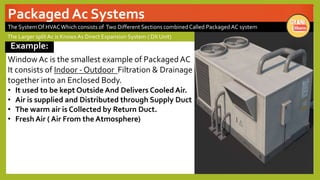
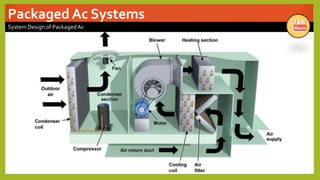
Packaged Ac Systems
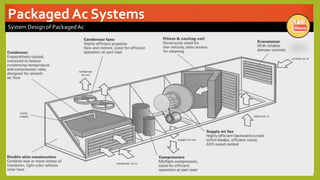
The System Of HVACWhich consists of Two Different Sections combined Called Packaged AC system
Window Ac is the smallest example of PackagedAC
It consists of Indoor - Outdoor Filtration & Drainage
together into an Enclosed Body.
• It used to be kept Outside And Delivers Cooled Air.
• Air is supplied and Distributed through Supply Duct
• The warm air is Collected by Return Duct.
• Fresh Air ( Air From the Atmosphere)
Example:
The Larger splitAc is Knows As Direct Expansion System ( DX Unit)
Packaged Ac Systems
System Design of Packaged Ac
Packaged Ac Systems
System Design of Packaged Ac
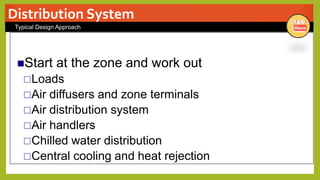
Start at the zone and work out
Loads
Air diffusers and zone terminals
Air distribution system
Air handlers
Chilled water distribution
Central cooling and heat rejection
Distribution System
Typical Design Approach
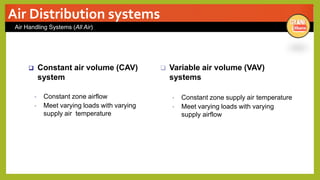
Air Distribution systems
Air Handling Systems (All Air)
 Constant air volume (CAV)
system
• Constant zone airflow
• Meet varying loads with varying
supply air temperature
 Variable air volume (VAV)
systems
• Constant zone supply air temperature
• Meet varying loads with varying
supply airflow
Air Distribution systems
Air Handling Systems (All Air)
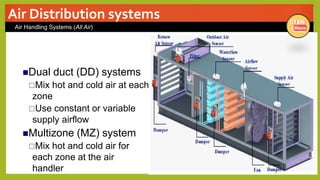
Dual duct (DD) systems
Mix hot and cold air at each
zone
Use constant or variable
supply airflow
Multizone (MZ) system
Mix hot and cold air for
each zone at the air
handler
Air Distribution systems
Air Handling Systems (All Air)
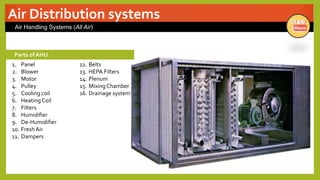
1. Panel
2. Blower
3. Motor
4. Pulley
5. Cooling coil
6. Heating Coil
7. Filters
8. Humidifier
9. De-Humidifier
10. Fresh Air
11. Dampers
12. Belts
13. HEPA Filters
14. Plenum
15. Mixing Chamber
16. Drainage system
Parts of AHU

BASIC OF HVAC.pptx

  • 1.
    BASIC OF HVAC BY: SHAHID IMAM
  • 2.
  • 3.
    H V AC - : H V A C S t a n d F o r : - H-HEAT V-VENTILATION A-AIR C-CONDITIONING HVAC is a combination of systems that improves Air Quality after maintaining Desired/ Comfortable AirTemperature. ( Heating 0r Cooling).
  • 4.
    COMPONENTS Of HVAC Thereare the Following Major components Of HVAC:- COMPRESSOR CONDENSERS EXPANSIONVALVE EVAPORATOR
  • 5.
    WORKING Of HVAC Majorcomponents Of HVACWorks onVapor Compression Refrigeration Cycle What is Refrigeration Cycle? The refrigeration cycle is a simple yet incredibly smart and useful process. In its simplest form, the refrigeration cycle consists of just 4 introductory factors to complete the circuit:- • Compressor • Condenser • Expansion/metering device • Evaporator / Cooling Coil
  • 6.
    WORKING Of REFCYCLE FOUR Major components Of HVACWorks InVapor Compression Refrigeration Cycle Refrigeration Cycle
  • 7.
    The refrigeration cycleconsists of just four components to complete the circuit. 1. Compressor 2. Condenser 3. Expansion device 4. Evaporator These all components perform their significant role during the process. Inside the circuit, there is a refrigerant filled. This refrigerant is compressed By Compressor & Discharges High pressure- High- Temperature Vapor to the condenser. A condenser is used to release Heat into the Atmosphere By using Its Fans or Cooling Tower. At this stage, the refrigerant changes its State from (Vapor to Liquid) High-Pressure Medium Temperature Liquid. Further, the refrigerant enters to Expansion Device (TXV-EEV) & Became Low Pressure – Low-Temperature Liquid. Then the refrigerant enters to Evaporator/ Cooling Coil, where the refrigerant Starts Boiling And Absorbs the High temperature from Air Or Water & Delivers Cooled Air/ Chiller Water For the cooling Application. Further, the Low Temperature and Low-Temperature Vapor Enter To Compressor and complete a cycle. This cycle continuously works until our Targeted Cooling Temperature is achieved. WORKING Of REF-CYCLE FOUR Major components Of HVACWorks InVapor Compression Refrigeration Cycle
  • 8.
    WHAT IS COMPRESSOR? Compressors&Their MajorTypes Compressor The Compressor is an Electro-Mechanical Device That is Used to compress The Low- Temperature Low-Pressure Vapor and Delivers High-pressure High-Temperature Vapor. Types :- • Scroll Compressor • Rotary Compressor • Reciprocating Compressor • Screw Compressor • Centrifugal Compressor
  • 9.
    WHAT IS CONDENSER? Condenser&Their MajorTypes Condenser The condenser is a type of Heat-Exchanger That rejects the heat of refrigerant into the atmosphere. After The Condensation process, the High Temp Vapor inside Condenser Becomes Low Temp liquid, While Pressure is Maintained. Types:- • Air Cooled ( Fan-Coil ) • Water Cooled ( Shell and Tube) • Platted Heat Exchanger (PHE) • Evaporative Condensers
  • 10.
    WHAT IS EXPANSIONVALVE? Compressors&Their MajorTypes Expansion & Metering Device The Expansion Device is a major part of the refrigeration system, it reduces the pressure & temperature of the refrigerant. There are several types of Valves used in the system for different applications. Types:- • TXV( Thermostatic EV) • EEV ( Electronic EV) • Capillary tube • Float valves • Automatic EV
  • 11.
    WHAT IS EVAPORATOR? Condenser&Their MajorTypes EVAPORATOR/COOLINGCOILS In refrigeration, an evaporator is the heat exchanger where the refrigerant circulating inside the refrigeration circuit absorbs the thermal energy from the environment, which is then cooled. This is how the state of the refrigerant changes from liquid to vapor. Types:- • Finned Tube Evaporators, • Platted Heat Exchanger (PHE) • Shell and Tube Evaporators.
  • 12.
    Important Air-conditioning Processes Thereare seven main processes required to achieve full air conditioning and These processes are: 1. Heating — the process of adding thermal energy to the space for the purposes of raising or maintaining the temperature of the space. 2. Cooling — the process of removing thermal energy from the space for the purposes of lowering or maintaining the temperature of the space. 3. Humidifying — the process of adding moisture to the air in the space for the purposes of raising or maintaining the moisture content of the air. 4. Dehumidifying — the process of removing moisture from the air in the space for the purposes of lowering or maintaining the moisture content of the air. 5. Cleaning — the process of removing particulates and biological contaminants from the air delivered to the space for the purposes of improving or maintaining the airquality. 6. Ventilation — the process of exchanging air between the outdoors and the conditioned space for the purposes of diluting the gaseous contaminants in the space. Ventilation can be achieved either through;  Natural ventilation: it is driven by natural drafts, like when you open a window.  Mechanical ventilation. Can be achieved by using fans to draw air in from outside or by fans that exhaust air from the space to outside. 7. Air Movement — the process of circulating and mixing air through conditioned spaces in the building for the purposes of achieving proper ventilation and facilitating thermal energy transfer.
  • 13.
    TYPES OF HVACSYSTEMS & EQUIPMENT FOLLOWINGTYPE OF HVAC EQUIPMENTAND ASSOSERIES Split A C System Central A C System Packaged A C System
  • 14.
    Split AC System TheSystem Of HVACWhich consists ofTwo Different Sections , Considered as SplitAc System. Example: The Smallest Split System You can find AC insideYour Home, Indoor Hanging Over the wall and blowing Cooled Air.Another Part of this system is kept outside which releases hot air from its fan called the Outdoor or Condenser Unit. The Larger splitAc is Knows As Direct Expansion System ( DX Unit) Example: AHU: AIR HANDLING UNIT DUCTED AC ACCU: AIR-COOLED CONDENSER UNIT VRV/VRF:VARIABLE REF.VOLUME/FLOW
  • 15.
    CENTRAL AC SYSTEM TheSystem Of HVACWhich consists ofTwo Different Sections, Considered as SplitAc System. The Central HVAC system is a System Of high capacity used for larger buildings, malls, Hospitals, complexes, etc. Central air conditioners circulate cool air through the AHU system of supply and return ducts. Supply ducts carry cooled air from the air conditioner to the home. Example: AHU: AIR HANDLING UNIT WATER COOLED CHILLER AIR COOLED CHILLER CHILLED WATER SYSTEM COOLING TOWER
  • 16.
    CENTRAL AC SYSTEMDesign Typical Schmetic Design of Central HVAC system
  • 17.
    CENTRAL AC SYSTEMDesign Typical Schmetic Design of Central HVAC system
  • 18.
    CENTRAL AC SYSTEMDesign Typical installation of Central HVAC system Centrifugal Chillers
  • 19.
    CENTRAL AC SYSTEMDesign Typical Schematic Design of Central HVAC system
  • 20.
    HVAC System Benefits Benefitsof Central and Distributed System Designs Large equipment has higher quality, efficiency, and durability Maintenance is concentrated Noise is removed from the zone Can use thermal storage  Easy to provide zoning  Direct control by occupants  Easier independent scheduling for energy saving  Generally lower capital costs and shorter lead time for equipment  Don’t need dedicated maintenance staff, use service contract  Can often install on the roof, less useable space for equipment Central Distributed
  • 21.
    CENTRAL AC SYSTEMDesign Centrifugal Chiller
  • 22.
    CENTRAL AC SYSTEMDesign Centrifugal Chiller
  • 23.
    CENTRAL AC SYSTEMDesign Central HVAC System Terminal devices Fan coil units Air and water distribution systems Heat exchangers Central heating and cooling sources
  • 24.
    Packaged Ac Systems TheSystem Of HVACWhich consists of Two Different Sections combined Called Packaged AC system Window Ac is the smallest example of PackagedAC It consists of Indoor - Outdoor Filtration & Drainage together into an Enclosed Body. • It used to be kept Outside And Delivers Cooled Air. • Air is supplied and Distributed through Supply Duct • The warm air is Collected by Return Duct. • Fresh Air ( Air From the Atmosphere) Example: The Larger splitAc is Knows As Direct Expansion System ( DX Unit)
  • 25.
    Packaged Ac Systems SystemDesign of Packaged Ac
  • 26.
    Packaged Ac Systems SystemDesign of Packaged Ac
  • 27.
    Start at thezone and work out Loads Air diffusers and zone terminals Air distribution system Air handlers Chilled water distribution Central cooling and heat rejection Distribution System Typical Design Approach
  • 28.
    Air Distribution systems AirHandling Systems (All Air)  Constant air volume (CAV) system • Constant zone airflow • Meet varying loads with varying supply air temperature  Variable air volume (VAV) systems • Constant zone supply air temperature • Meet varying loads with varying supply airflow
  • 29.
    Air Distribution systems AirHandling Systems (All Air) Dual duct (DD) systems Mix hot and cold air at each zone Use constant or variable supply airflow Multizone (MZ) system Mix hot and cold air for each zone at the air handler
  • 30.
    Air Distribution systems AirHandling Systems (All Air) 1. Panel 2. Blower 3. Motor 4. Pulley 5. Cooling coil 6. Heating Coil 7. Filters 8. Humidifier 9. De-Humidifier 10. Fresh Air 11. Dampers 12. Belts 13. HEPA Filters 14. Plenum 15. Mixing Chamber 16. Drainage system Parts of AHU