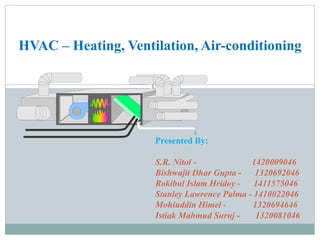

HVAC – Heating, Ventilation, Air-conditioning
Presented By:
S.R. Nitol - 1420009046
Bishwajit Dhar Gupta - 1320692046
Rokibul Islam Hridoy - 1411575046
Stanley Lawrence Palma - 1410022046
Mohiuddin Himel - 1320694646
Istiak Mahmud Suruj - 1320081046
HVAC
HVAC – Heating, Ventilation, Air-conditioning
Temperature
Humidity
Pressure
Ventilation
68°F (20°C) and 75°F (25°C)
30% relative humidity (RH) and 60% RH
A slightly positive pressure to reduce
outside air infiltration.
Rooms typically have several
complete air changes per hour
Where ?
 HVAC system is required in
Pharmaceutical companies
Certain Laboratories
Electronic Industries etc.
Hospitals
Universities
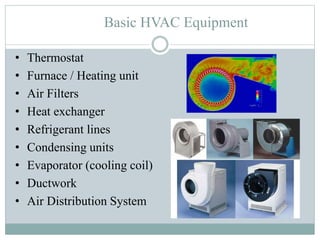
Basic HVAC Equipment
• Thermostat
• Furnace / Heating unit
• Air Filters
• Heat exchanger
• Refrigerant lines
• Condensing units
• Evaporator (cooling coil)
• Ductwork
• Air Distribution System
Thermostat
 The thermostat is usually the most visible part of HVAC
system.
 Set on a prominent, easily accessible wall, it may be either
programmed in advance or set manually to keep the home at a
desired temperature.
 When the ambient temperature becomes too cold or too hot,
the thermostat will trigger the heat exchanger.
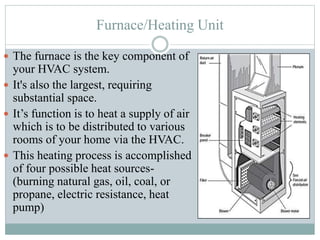
Furnace/Heating Unit
 The furnace is the key component of
your HVAC system.
 It's also the largest, requiring
substantial space.
 It’s function is to heat a supply of air
which is to be distributed to various
rooms of your home via the HVAC.
 This heating process is accomplished
of four possible heat sources-
(burning natural gas, oil, coal, or
propane, electric resistance, heat
pump)
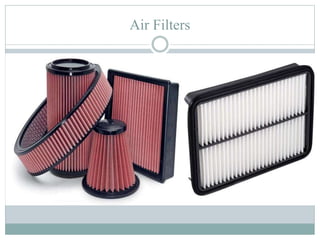
Air Filters
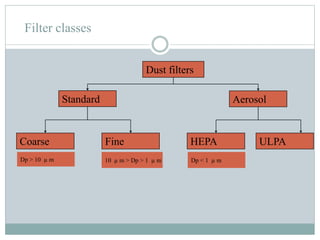
Filter classes
Dust filters
Standard Aerosol
FineCoarse ULPAHEPA
10 µ m > Dp > 1 µ mDp > 10 µ m Dp < 1 µ m
Heat Exchanger
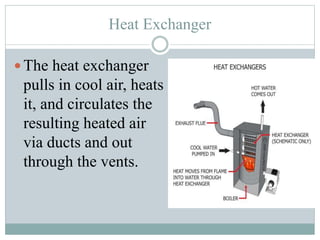
 The heat exchanger
pulls in cool air, heats
it, and circulates the
resulting heated air
via ducts and out
through the vents.
Evaporator coil
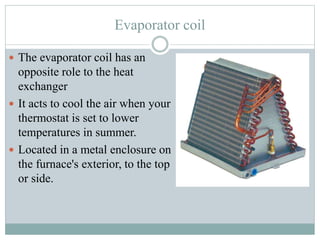
 The evaporator coil has an
opposite role to the heat
exchanger
 It acts to cool the air when your
thermostat is set to lower
temperatures in summer.
 Located in a metal enclosure on
the furnace's exterior, to the top
or side.
Condensing unit
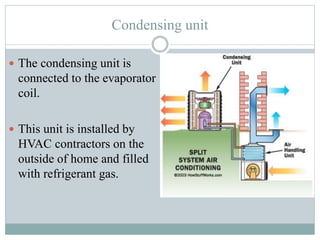
 The condensing unit is
connected to the evaporator
coil.
 This unit is installed by
HVAC contractors on the
outside of home and filled
with refrigerant gas.
Refrigerant lines
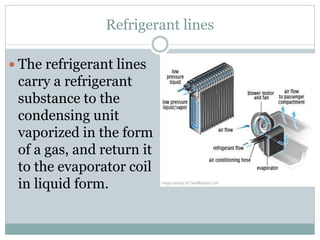
 The refrigerant lines
carry a refrigerant
substance to the
condensing unit
vaporized in the form
of a gas, and return it
to the evaporator coil
in liquid form.
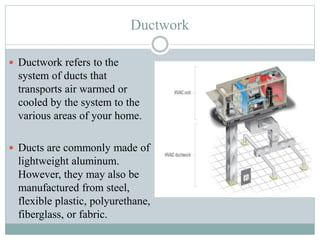
Ductwork
 Ductwork refers to the
system of ducts that
transports air warmed or
cooled by the system to the
various areas of your home.
 Ducts are commonly made of
lightweight aluminum.
However, they may also be
manufactured from steel,
flexible plastic, polyurethane,
fiberglass, or fabric.
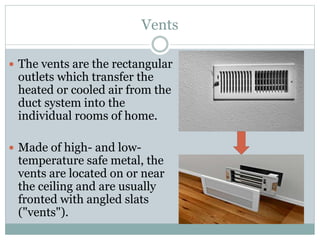
Vents
 The vents are the rectangular
outlets which transfer the
heated or cooled air from the
duct system into the
individual rooms of home.
 Made of high- and low-
temperature safe metal, the
vents are located on or near
the ceiling and are usually
fronted with angled slats
("vents").
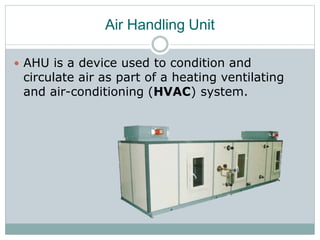
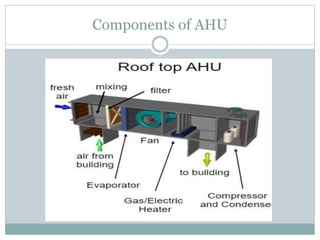
Air Handling Unit
 AHU is a device used to condition and
circulate air as part of a heating ventilating
and air-conditioning (HVAC) system.
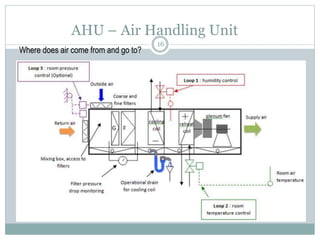
AHU – Air Handling Unit
16
Where does air come from and go to?
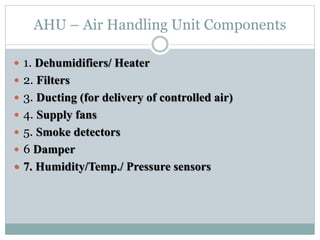
AHU – Air Handling Unit Components
 1. Dehumidifiers/ Heater
 2. Filters
 3. Ducting (for delivery of controlled air)
 4. Supply fans
 5. Smoke detectors
 6 Damper
 7. Humidity/Temp./ Pressure sensors
Components of AHU
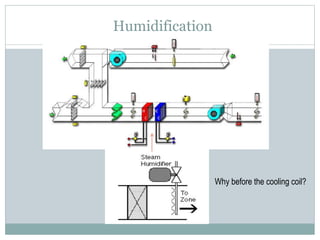
Humidification
19
Why before the cooling coil?
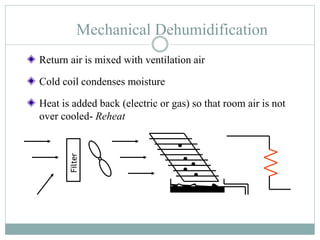
Mechanical Dehumidification
Return air is mixed with ventilation air
Cold coil condenses moisture
Heat is added back (electric or gas) so that room air is not
over cooled- Reheat
Filter
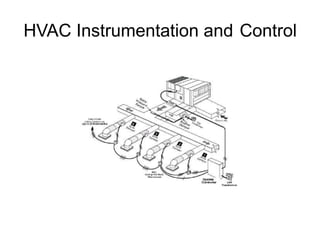
HVAC Instrumentation and Control
HVAC System Commissioning
The key elements of commissioning include:
Installation checks. Check installed equipment to ensure that all associated
components and accessories are in place.
Operational checks. Verify and document that systems are performing as
expected, and that all sensors and other system control devices are properly
calibrated.
Documentation. Confirm that all required documentation has been provided, such
as a statement of the design intent and operating protocols for all building systems.
O&M manuals and training. Prepare comprehensive operation and
maintenance (O&M) manuals, and provide training for rig operations staff.
Ongoing monitoring. Conduct periodic monitoring after the school is occupied to
ensure that equipment and systems continue to perform according to design intent.
improve the delivery process, increase systems reliability, improve energy
performance, ensure good indoor environmental quality, and improve operation
and maintenance of the facility.
Correctly implemented, commissioning is extremely cost-effective, and should
References
• https://sustainabilityworkshop.autodesk.com/buildings/hvac-
equipment
• https://www.networx.com/article/know-your-hvac-system-
components-and-how
• Samual C.Sugarman’s HVAC FUNDAMENTALS(SECOND EDITION)
Thank You

HVAC system

  • 1.
    HVAC – Heating,Ventilation, Air-conditioning Presented By: S.R. Nitol - 1420009046 Bishwajit Dhar Gupta - 1320692046 Rokibul Islam Hridoy - 1411575046 Stanley Lawrence Palma - 1410022046 Mohiuddin Himel - 1320694646 Istiak Mahmud Suruj - 1320081046
  • 2.
    HVAC HVAC – Heating,Ventilation, Air-conditioning Temperature Humidity Pressure Ventilation 68°F (20°C) and 75°F (25°C) 30% relative humidity (RH) and 60% RH A slightly positive pressure to reduce outside air infiltration. Rooms typically have several complete air changes per hour
  • 3.
    Where ?  HVACsystem is required in Pharmaceutical companies Certain Laboratories Electronic Industries etc. Hospitals Universities
  • 4.
    Basic HVAC Equipment •Thermostat • Furnace / Heating unit • Air Filters • Heat exchanger • Refrigerant lines • Condensing units • Evaporator (cooling coil) • Ductwork • Air Distribution System
  • 5.
    Thermostat  The thermostatis usually the most visible part of HVAC system.  Set on a prominent, easily accessible wall, it may be either programmed in advance or set manually to keep the home at a desired temperature.  When the ambient temperature becomes too cold or too hot, the thermostat will trigger the heat exchanger.
  • 6.
    Furnace/Heating Unit  Thefurnace is the key component of your HVAC system.  It's also the largest, requiring substantial space.  It’s function is to heat a supply of air which is to be distributed to various rooms of your home via the HVAC.  This heating process is accomplished of four possible heat sources- (burning natural gas, oil, coal, or propane, electric resistance, heat pump)
  • 7.
  • 8.
    Filter classes Dust filters StandardAerosol FineCoarse ULPAHEPA 10 µ m > Dp > 1 µ mDp > 10 µ m Dp < 1 µ m
  • 9.
    Heat Exchanger  Theheat exchanger pulls in cool air, heats it, and circulates the resulting heated air via ducts and out through the vents.
  • 10.
    Evaporator coil  Theevaporator coil has an opposite role to the heat exchanger  It acts to cool the air when your thermostat is set to lower temperatures in summer.  Located in a metal enclosure on the furnace's exterior, to the top or side.
  • 11.
    Condensing unit  Thecondensing unit is connected to the evaporator coil.  This unit is installed by HVAC contractors on the outside of home and filled with refrigerant gas.
  • 12.
    Refrigerant lines  Therefrigerant lines carry a refrigerant substance to the condensing unit vaporized in the form of a gas, and return it to the evaporator coil in liquid form.
  • 13.
    Ductwork  Ductwork refersto the system of ducts that transports air warmed or cooled by the system to the various areas of your home.  Ducts are commonly made of lightweight aluminum. However, they may also be manufactured from steel, flexible plastic, polyurethane, fiberglass, or fabric.
  • 14.
    Vents  The ventsare the rectangular outlets which transfer the heated or cooled air from the duct system into the individual rooms of home.  Made of high- and low- temperature safe metal, the vents are located on or near the ceiling and are usually fronted with angled slats ("vents").
  • 15.
    Air Handling Unit AHU is a device used to condition and circulate air as part of a heating ventilating and air-conditioning (HVAC) system.
  • 16.
    AHU – AirHandling Unit 16 Where does air come from and go to?
  • 17.
    AHU – AirHandling Unit Components  1. Dehumidifiers/ Heater  2. Filters  3. Ducting (for delivery of controlled air)  4. Supply fans  5. Smoke detectors  6 Damper  7. Humidity/Temp./ Pressure sensors
  • 18.
  • 19.
  • 20.
    Mechanical Dehumidification Return airis mixed with ventilation air Cold coil condenses moisture Heat is added back (electric or gas) so that room air is not over cooled- Reheat Filter
  • 21.
  • 22.
    HVAC System Commissioning Thekey elements of commissioning include: Installation checks. Check installed equipment to ensure that all associated components and accessories are in place. Operational checks. Verify and document that systems are performing as expected, and that all sensors and other system control devices are properly calibrated. Documentation. Confirm that all required documentation has been provided, such as a statement of the design intent and operating protocols for all building systems. O&M manuals and training. Prepare comprehensive operation and maintenance (O&M) manuals, and provide training for rig operations staff. Ongoing monitoring. Conduct periodic monitoring after the school is occupied to ensure that equipment and systems continue to perform according to design intent. improve the delivery process, increase systems reliability, improve energy performance, ensure good indoor environmental quality, and improve operation and maintenance of the facility. Correctly implemented, commissioning is extremely cost-effective, and should
  • 23.
  • 24.