COUNTRY
SELECTION AND
EVALUATION
.
INTERNATIONAL
BUSINESS
DIVERSIFICATION
CONTD..
ACQUISITION AMALGAMATION MERGER
COUNTRY SELECTION
AND EVALUATION
This process determines the geographical
opportunities firms choose to pursue and the
challenges of marketing and production site
location. It goes on to carefully examine the
process by describing the choice and
weighing of variables used for opportunity
and risk analysis as well as the inherent
problems associated with data collection and
analysis of a particular country.
OBJECTIVES
To grasp company strategies for sequencing
the penetration of countries.
To see how scanning techniques can help
managers both limit geographic alternatives
and consider otherwise overlooked areas.
To discern the major opportunity and risk
variables a company should consider when
deciding whether and where to expand
abroad.
CONTD..
To know the methods and problems when
collecting and comparing information
internationally.
To understand some simplifying tools for
helping to decide where to operate.
STEPS REQUIRED IN COUNTRY
SELECTION AND EVALUATION
SCANNING
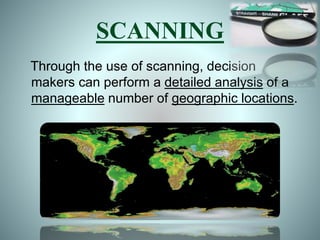
Through the use of scanning, decision
makers can perform a detailed analysis of a
manageable number of geographic locations.
IDENTIFICATION OF IMPORTANT
FACTORS AFFECTING COUNTRY
SELECTION AND EVALUATION
The Environmental climate of the host
country could significantly affect an
enterprise’s success or failure, therefore the
combination of the two factors that determine
what actions should be taken should be kept
in mind:
OPPORTUNITIES
Opportunities are determined by
competitiveness and profitability factors.
These includes:
MARKET SIZE
Market size is determined by sales potential.
Data such as GNP, per capita income,
population, income distribution, economic
growth rates, and levels of economic
development will also be useful.
EASE AND
COMPATIBILITY OF
OPERATIONSCompanies are naturally attracted to
countries that are located nearby, share the
same language and offer market conditions
similar to those in their home countries.
Beyond that, proposals may then be limited
to those countries that offer, among other
factors, the appropriate plant size, the local
availability of resources and the sufficient
repatriation of profits.
COSTS AND RESOURCE
AVAILABILITY
Costs are a critical factor in production
location decisions. Productivity related factors
include:
COST OF LABOR COST OF INPUTS TAX RATES
AVAILABLE CAPITAL,
REAL ESTATE AND
TRANSPORTATION
CONTD..
The quality of a country’s infrastructure can
be very important in location decisions.
Firms often need to locate in an area that will
allow them to move supplies and finished
products very efficiently.
RED TAPE AND
CORRUPTION
Red Tape includes:
 unnecessary paperwork
 having multiple people or committees to
approve a decision, and,
 various low-level rules that make conducting
one's affairs slower, more difficult, or both.
CONTD..
It usually involves the difficulty of:
 getting permission to operate,
 obtaining licenses to produce and market
goods and
 satisfying government agencies on matters
such as taxes, labor conditions and
environmental compliance.
CONTD..
Government corruption may include
requirements of payments to win a contract
or receive government services, such as visa
issuance.
Although not always a directly measurable
cost, red tape and corruption increase the
cost of doing business.
RISK
Firms usually experience higher risk and
uncertainty when they operate abroad. Given
the same expected return, most decision
makers prefer a more certain outcome to a
less certain one. As part of a feasibility study,
the degree of acceptable risk should be
determined so a firm does not incur
unacceptable costs.
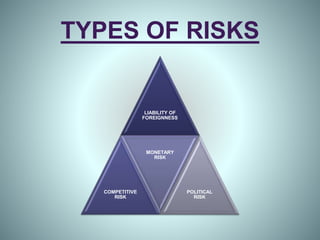
TYPES OF RISKS
LIABILITY OF
FOREIGNNESS
COMPETITIVE
RISK
MONETARY
RISK
POLITICAL
RISK
COLLECTION AND
ANALYSIS OF DATA
Firms perform research to reduce
uncertainties in their decision processes, to
expand or narrow the alternatives they
consider and to assess the merits of their
existing programs.
COUNTRY
COMPARISON TOOLS
GRIDS MATRICES
GRIDS
Here country comparison is done on the
basis of potential returns and perceived risks
present in the country. Countries are ranked
in order of these factors.
The present situation and objectives of
different firms can be determined through this
ranking.
MATRICES
Here the countries are arranged by managers
in the:
Order of perceived value of opportunity
offered by the country, and
Order of expected level of risk associated
with operating in that country.
Weights and scores are given and on those
basis country is selected.
ALLOCATING AMONG
LOCATIONS
Over time, most of the value of a firm’s FDI
comes from reinvestment. Thus, in deciding
where to invest, firms must consider whether
to reinvest or harvest, to what degree there is
interdependence among their locations and
whether they should diversify or concentrate
their activities.
NON COMPARATIVE
DECISION MAKING
Companies often examine one opportunity at
a time rather than ranking a set of foreign
operating proposals using predetermined
criteria. Companies need to respond to
opportunities as they arise. Decision makers
often need to react quickly for both offensive
and defensive motives.
MAKING FINAL
COUNTRY SELECTIONS
For new investments companies develop
detailed estimates of all costs and expenses
and consider whether to enter a particular
venture alone or with a partner. For
acquisitions, firms will need to examine
financial statements in great detail. To
maximize expected gains, decisions must be
made in a timely fashion.
SELECTION AND
EVALUATION PROCESS
FOR OUTSOURCING IN I.T.
BUSINESS
CONTD..
SELECTION
When considering offshore operations firms
have to look at, what is called, in the context
of offshore outsourcing, low cost countries.
These types of countries are usually
developing countries, countries in transition,
third world countries or emerging economies.
CONTD..
Low cost countries have:
CONTD..
CONTD..
MATURITY
CRITICAL
MASS
EXPORT
REVENUE
CONTD..
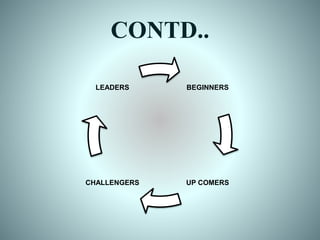
BEGINNERS
UP COMERSCHALLENGERS
LEADERS
CONTD..
EVALUATION
After reviewing country resources and pre-
selecting a number of prospective
outsourcing destinations it is time to evaluate
those countries more in detail. Before
constructing the country evaluation grid a
good inventory of resources is created.
CONTD..
The resource inventory include:
General country information, references and
research,
Third party sector research,
Web resources,
Trade and industry association, and
Government resources.
ADVANTAGES
Country Selection and Evaluation helps in
determining:
the geographical opportunities,
challenges of marketing and production site
location,
the order of country entry,
the rates of resource allocation across
countries,
CONTD..
Where to market and where to produce.
CASE STUDY
CONTD..
CONTD..
Ford Motor Company is an American
multinational corporation and the world's
fourth largest automaker based on worldwide
vehicle sales.
It emphasised on 100% control over foreign
expansion.
CONTD..
 While Ford attained international status
in1904 with the founding of Ford of
Canada, it was in 1911 the company
began to rapidly expand overseas.
 By the end of 1919, Ford was producing
50% of all cars in the United States, and
40% of all British ones
By 1920, half of all cars in the U.S. were
Model Ts.
CONTD..
CONTD..
Soon there was opening of assembly
plants in England and France, followed by
Denmark (1923), Germany (1925), Austria
(1925) and Argentina (1925)and also in
South Africa (1924) and Australia (1925)
as subsidiaries of Ford of Canada due to
preferential tariff rules for Commonwealth
countries.
CONTD..
 By 1930 Ford was manufacturing
or assembling automobiles in 20 foreign
countries.
By 1998, Ford sold in over 200 countries and
territories and had production in 30 different
countries.
CONTD..
CONCLUSION
It helps in determining the geographical
opportunities firms choose to pursue.
It helps in determining challenges of
marketing and production.
It helps in determining site location.
Both the order of country entry as well as the
rates of resource allocation across countries
can be determined through this process.
CONTD..
It is due to this process that careful
examination is done by describing the choice
and weighing of variables used for
opportunity and risk analysis.
Decisions regarding whether to continue
investing in a particular operation or to
harvest the earnings (and possibly divest the
assets) and use them elsewhere are taken
with the help of country evaluation.
CONTD..
It promotes cross border transactions of
goods, services, resources between two or
more nations.
It helps in the transaction of economic
resources including capital, skills, people etc.
for international production of physical goods
and services.
THANK
YOU

Country selection and evaluation

  • 1.
  • 2.
  • 3.
  • 4.
  • 5.
    COUNTRY SELECTION AND EVALUATION Thisprocess determines the geographical opportunities firms choose to pursue and the challenges of marketing and production site location. It goes on to carefully examine the process by describing the choice and weighing of variables used for opportunity and risk analysis as well as the inherent problems associated with data collection and analysis of a particular country.
  • 6.
    OBJECTIVES To grasp companystrategies for sequencing the penetration of countries. To see how scanning techniques can help managers both limit geographic alternatives and consider otherwise overlooked areas. To discern the major opportunity and risk variables a company should consider when deciding whether and where to expand abroad.
  • 7.
    CONTD.. To know themethods and problems when collecting and comparing information internationally. To understand some simplifying tools for helping to decide where to operate.
  • 8.
    STEPS REQUIRED INCOUNTRY SELECTION AND EVALUATION
  • 9.
    SCANNING Through the useof scanning, decision makers can perform a detailed analysis of a manageable number of geographic locations.
  • 10.
    IDENTIFICATION OF IMPORTANT FACTORSAFFECTING COUNTRY SELECTION AND EVALUATION The Environmental climate of the host country could significantly affect an enterprise’s success or failure, therefore the combination of the two factors that determine what actions should be taken should be kept in mind:
  • 11.
    OPPORTUNITIES Opportunities are determinedby competitiveness and profitability factors. These includes:
  • 12.
    MARKET SIZE Market sizeis determined by sales potential. Data such as GNP, per capita income, population, income distribution, economic growth rates, and levels of economic development will also be useful.
  • 13.
    EASE AND COMPATIBILITY OF OPERATIONSCompaniesare naturally attracted to countries that are located nearby, share the same language and offer market conditions similar to those in their home countries. Beyond that, proposals may then be limited to those countries that offer, among other factors, the appropriate plant size, the local availability of resources and the sufficient repatriation of profits.
  • 14.
    COSTS AND RESOURCE AVAILABILITY Costsare a critical factor in production location decisions. Productivity related factors include: COST OF LABOR COST OF INPUTS TAX RATES AVAILABLE CAPITAL, REAL ESTATE AND TRANSPORTATION
  • 15.
    CONTD.. The quality ofa country’s infrastructure can be very important in location decisions. Firms often need to locate in an area that will allow them to move supplies and finished products very efficiently.
  • 16.
    RED TAPE AND CORRUPTION RedTape includes:  unnecessary paperwork  having multiple people or committees to approve a decision, and,  various low-level rules that make conducting one's affairs slower, more difficult, or both.
  • 17.
    CONTD.. It usually involvesthe difficulty of:  getting permission to operate,  obtaining licenses to produce and market goods and  satisfying government agencies on matters such as taxes, labor conditions and environmental compliance.
  • 18.
    CONTD.. Government corruption mayinclude requirements of payments to win a contract or receive government services, such as visa issuance. Although not always a directly measurable cost, red tape and corruption increase the cost of doing business.
  • 19.
    RISK Firms usually experiencehigher risk and uncertainty when they operate abroad. Given the same expected return, most decision makers prefer a more certain outcome to a less certain one. As part of a feasibility study, the degree of acceptable risk should be determined so a firm does not incur unacceptable costs.
  • 20.
    TYPES OF RISKS LIABILITYOF FOREIGNNESS COMPETITIVE RISK MONETARY RISK POLITICAL RISK
  • 21.
    COLLECTION AND ANALYSIS OFDATA Firms perform research to reduce uncertainties in their decision processes, to expand or narrow the alternatives they consider and to assess the merits of their existing programs.
  • 22.
  • 23.
    GRIDS Here country comparisonis done on the basis of potential returns and perceived risks present in the country. Countries are ranked in order of these factors. The present situation and objectives of different firms can be determined through this ranking.
  • 24.
    MATRICES Here the countriesare arranged by managers in the: Order of perceived value of opportunity offered by the country, and Order of expected level of risk associated with operating in that country. Weights and scores are given and on those basis country is selected.
  • 25.
    ALLOCATING AMONG LOCATIONS Over time,most of the value of a firm’s FDI comes from reinvestment. Thus, in deciding where to invest, firms must consider whether to reinvest or harvest, to what degree there is interdependence among their locations and whether they should diversify or concentrate their activities.
  • 26.
    NON COMPARATIVE DECISION MAKING Companiesoften examine one opportunity at a time rather than ranking a set of foreign operating proposals using predetermined criteria. Companies need to respond to opportunities as they arise. Decision makers often need to react quickly for both offensive and defensive motives.
  • 27.
    MAKING FINAL COUNTRY SELECTIONS Fornew investments companies develop detailed estimates of all costs and expenses and consider whether to enter a particular venture alone or with a partner. For acquisitions, firms will need to examine financial statements in great detail. To maximize expected gains, decisions must be made in a timely fashion.
  • 28.
    SELECTION AND EVALUATION PROCESS FOROUTSOURCING IN I.T. BUSINESS
  • 29.
    CONTD.. SELECTION When considering offshoreoperations firms have to look at, what is called, in the context of offshore outsourcing, low cost countries. These types of countries are usually developing countries, countries in transition, third world countries or emerging economies.
  • 30.
  • 31.
  • 32.
  • 33.
  • 34.
    CONTD.. EVALUATION After reviewing countryresources and pre- selecting a number of prospective outsourcing destinations it is time to evaluate those countries more in detail. Before constructing the country evaluation grid a good inventory of resources is created.
  • 35.
    CONTD.. The resource inventoryinclude: General country information, references and research, Third party sector research, Web resources, Trade and industry association, and Government resources.
  • 36.
    ADVANTAGES Country Selection andEvaluation helps in determining: the geographical opportunities, challenges of marketing and production site location, the order of country entry, the rates of resource allocation across countries,
  • 37.
    CONTD.. Where to marketand where to produce.
  • 38.
  • 39.
  • 40.
    CONTD.. Ford Motor Companyis an American multinational corporation and the world's fourth largest automaker based on worldwide vehicle sales. It emphasised on 100% control over foreign expansion.
  • 41.
    CONTD..  While Fordattained international status in1904 with the founding of Ford of Canada, it was in 1911 the company began to rapidly expand overseas.  By the end of 1919, Ford was producing 50% of all cars in the United States, and 40% of all British ones By 1920, half of all cars in the U.S. were Model Ts.
  • 42.
  • 43.
    CONTD.. Soon there wasopening of assembly plants in England and France, followed by Denmark (1923), Germany (1925), Austria (1925) and Argentina (1925)and also in South Africa (1924) and Australia (1925) as subsidiaries of Ford of Canada due to preferential tariff rules for Commonwealth countries.
  • 44.
    CONTD..  By 1930Ford was manufacturing or assembling automobiles in 20 foreign countries. By 1998, Ford sold in over 200 countries and territories and had production in 30 different countries.
  • 45.
  • 46.
    CONCLUSION It helps indetermining the geographical opportunities firms choose to pursue. It helps in determining challenges of marketing and production. It helps in determining site location. Both the order of country entry as well as the rates of resource allocation across countries can be determined through this process.
  • 47.
    CONTD.. It is dueto this process that careful examination is done by describing the choice and weighing of variables used for opportunity and risk analysis. Decisions regarding whether to continue investing in a particular operation or to harvest the earnings (and possibly divest the assets) and use them elsewhere are taken with the help of country evaluation.
  • 48.
    CONTD.. It promotes crossborder transactions of goods, services, resources between two or more nations. It helps in the transaction of economic resources including capital, skills, people etc. for international production of physical goods and services.
  • 49.