Competitive Advantage of Nations Author: Michael Porter Presenter: Wesley Shu Prepared for EMBA, Feng-Chia University
Eroded Early Mover Advantages Customer relationship Scale economies Loyalty of distribution channels All can be overtaken by competitors if not improved.
Global Competitiveness Report Composition of GCI GCI Ranking
Su stainability The only way to sustain a competitive advantage is to upgrade it.
Why companies capable of innovation in some nations? Why do they pursue improvements,? Why are they able to overcome the substantial barriers?
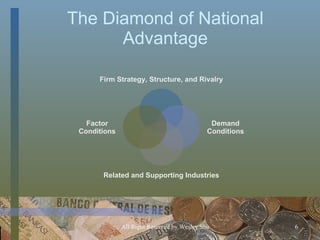
The Diamond of National Advantage Firm Strategy, Structure, and Rivalry Demand Conditions Related and Supporting Industries Factor Conditions
F a ctor Condition Availability of resources and skills necessary for competitive advantage in an industry e.g., Skilled Labor or Infrastructure
Demand Condition Home market – the information that shapes the opportunities that companies perceive and the directions in which they deploy their resources and skills.
Related & Supporting Industries The international competitiveness of supplier industries & other related industries
Firm Strategy, Structure, & Rivalry The conditions governing how companies are created, organized, and managed, and the nature of domestic rivalry
Factor Conditions A nation does not inherit but instead creates the most important factors of production to form the backbone of any advanced economy.
Factor Conditions The rate and efficiency with which a nation creates, upgrades, and deploys the factors is more important than the volume.
Factor Conditions A factor must be highly specialized to an industry’s particular needs to support competitive advantage.
Factor Conditions Highly specialized factors come from world-class institutes that create and then upgrade them.
Factor Conditions Selective disadvantages can prod a company to innovate and upgrade –  e.g., high land costs, labor shortage, or the lack of local raw materials lead companies to innovating and upgrading to compete.
Factor Conditions - Disadvantage The following conditions have to be met for disadvantage-advantage transformation to work:
Factor Conditions - Disadvantage Signal companies and companies innovate in advance of rivals Favorable conditions in other aspects of the diamond Company commitment
Demand Conditions Home demand gives companies clear and early picture of emerging buyer needs Demanding buyers
Demand Conditions The character of home demand is more significant than the size.
Characters of Demand Conditions Market segment is larger or more visible than in foreign countries. Buyers are more sophisticated. Buyers’ needs anticipate or even shape those of other nations
Characters of Demand Conditions Exporting values and tastes as well as products
Related & Supporting Industries Those who are internationally competitive can provide competitive production methods and trigger innovation and upgrading.
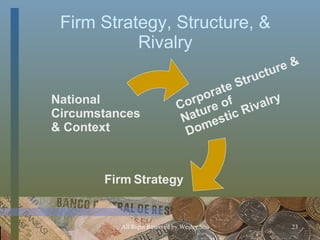
Firm Strategy, Structure, & Rivalry Corporate Structure & Nature of Domestic Rivalry National Circumstances & Context Firm   Strategy
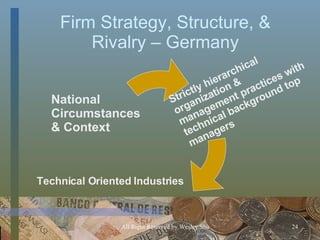
Firm Strategy, Structure, & Rivalry – Germany Strictly hierarchical organization & management practices with technical background top managers National Circumstances & Context Technical Oriented Industries
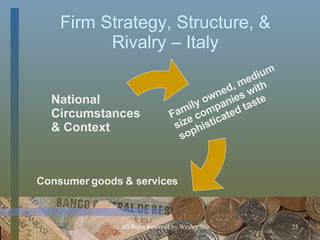
Firm Strategy, Structure, & Rivalry – Italy Family owned, medium size companies with sophisticated taste National Circumstances & Context Consumer goods & services
Firm Strategy, Structure, & Rivalry Domestic rivalry to stimulate competition, creating pressure on companies to innovate and improve
The Diamond as a System The effect of one point often depends on the state of others. E.g., sophisticated buyers & human resources Each point can reinforce others.  E.g., domestic rivalry promotes improvement in all the other determinants.
The Diamond as a System Nations are rarely home to just one competitive industry – clusters of industries.
The Role of Government Catalyst and Challenger
The Role of Government But in politics, a decade is an eternity.  Consequently, most governments favor policies that offer easily perceived short-term benefits, such as subsidies, protection, and arranged mergers  –  the very policies that retard innovation.
The Role of Government Focus on specialized factor creation. A void intervening in factor and currency markets. E nforce strict product, safety, and environmental standards
The Role of Government S harply limit direct cooperation among industry rivals. P romote goals that lead to sustained investment   D eregulate competition E nforce strong domestic antitrust policies
Focus on Specialized Factor Creation G eneral factors rarely produce competitive advantage, e.g., secondary education system, broad national concern such as health care. S pecialized apprenticeship programs, university research efforts linked with industries, private company investment ultimately create the factors that will yield advantage.
Avoid intervening in factor & currency markets E .g., lower factor cost E .g., currency devaluation
Sharply limit direct cooperation among industry rivals C ompanies rarely contribute their best scientists and engineers to cooperative projects. Divert company attention and resources from  proprietary research Value of cooperative research:  S ignal the importance of emerging technical areas
Company Agenda Create pressures for innovation Seek out the most capable competitors as motivators Establish early-warning systems  –  translate into early-mover advantages Improve the national diamond
Company Agenda W elcome domestic rivalry G lobalize to tap selective advantages in other nations Use alliances only selectively Locate the home base to support competitive advantage
Improve the National Diamond F orm clusters  –  work with its home-nation buyers, suppliers, and channels T ake explicit steps to create specialized factors

Competitive Advantage of Nations

  • 1.
    Competitive Advantage ofNations Author: Michael Porter Presenter: Wesley Shu Prepared for EMBA, Feng-Chia University
  • 2.
    Eroded Early MoverAdvantages Customer relationship Scale economies Loyalty of distribution channels All can be overtaken by competitors if not improved.
  • 3.
    Global Competitiveness ReportComposition of GCI GCI Ranking
  • 4.
    Su stainability Theonly way to sustain a competitive advantage is to upgrade it.
  • 5.
    Why companies capableof innovation in some nations? Why do they pursue improvements,? Why are they able to overcome the substantial barriers?
  • 6.
    The Diamond ofNational Advantage Firm Strategy, Structure, and Rivalry Demand Conditions Related and Supporting Industries Factor Conditions
  • 7.
    F a ctorCondition Availability of resources and skills necessary for competitive advantage in an industry e.g., Skilled Labor or Infrastructure
  • 8.
    Demand Condition Homemarket – the information that shapes the opportunities that companies perceive and the directions in which they deploy their resources and skills.
  • 9.
    Related & SupportingIndustries The international competitiveness of supplier industries & other related industries
  • 10.
    Firm Strategy, Structure,& Rivalry The conditions governing how companies are created, organized, and managed, and the nature of domestic rivalry
  • 11.
    Factor Conditions Anation does not inherit but instead creates the most important factors of production to form the backbone of any advanced economy.
  • 12.
    Factor Conditions Therate and efficiency with which a nation creates, upgrades, and deploys the factors is more important than the volume.
  • 13.
    Factor Conditions Afactor must be highly specialized to an industry’s particular needs to support competitive advantage.
  • 14.
    Factor Conditions Highlyspecialized factors come from world-class institutes that create and then upgrade them.
  • 15.
    Factor Conditions Selectivedisadvantages can prod a company to innovate and upgrade – e.g., high land costs, labor shortage, or the lack of local raw materials lead companies to innovating and upgrading to compete.
  • 16.
    Factor Conditions -Disadvantage The following conditions have to be met for disadvantage-advantage transformation to work:
  • 17.
    Factor Conditions -Disadvantage Signal companies and companies innovate in advance of rivals Favorable conditions in other aspects of the diamond Company commitment
  • 18.
    Demand Conditions Homedemand gives companies clear and early picture of emerging buyer needs Demanding buyers
  • 19.
    Demand Conditions Thecharacter of home demand is more significant than the size.
  • 20.
    Characters of DemandConditions Market segment is larger or more visible than in foreign countries. Buyers are more sophisticated. Buyers’ needs anticipate or even shape those of other nations
  • 21.
    Characters of DemandConditions Exporting values and tastes as well as products
  • 22.
    Related & SupportingIndustries Those who are internationally competitive can provide competitive production methods and trigger innovation and upgrading.
  • 23.
    Firm Strategy, Structure,& Rivalry Corporate Structure & Nature of Domestic Rivalry National Circumstances & Context Firm Strategy
  • 24.
    Firm Strategy, Structure,& Rivalry – Germany Strictly hierarchical organization & management practices with technical background top managers National Circumstances & Context Technical Oriented Industries
  • 25.
    Firm Strategy, Structure,& Rivalry – Italy Family owned, medium size companies with sophisticated taste National Circumstances & Context Consumer goods & services
  • 26.
    Firm Strategy, Structure,& Rivalry Domestic rivalry to stimulate competition, creating pressure on companies to innovate and improve
  • 27.
    The Diamond asa System The effect of one point often depends on the state of others. E.g., sophisticated buyers & human resources Each point can reinforce others. E.g., domestic rivalry promotes improvement in all the other determinants.
  • 28.
    The Diamond asa System Nations are rarely home to just one competitive industry – clusters of industries.
  • 29.
    The Role ofGovernment Catalyst and Challenger
  • 30.
    The Role ofGovernment But in politics, a decade is an eternity. Consequently, most governments favor policies that offer easily perceived short-term benefits, such as subsidies, protection, and arranged mergers – the very policies that retard innovation.
  • 31.
    The Role ofGovernment Focus on specialized factor creation. A void intervening in factor and currency markets. E nforce strict product, safety, and environmental standards
  • 32.
    The Role ofGovernment S harply limit direct cooperation among industry rivals. P romote goals that lead to sustained investment D eregulate competition E nforce strong domestic antitrust policies
  • 33.
    Focus on SpecializedFactor Creation G eneral factors rarely produce competitive advantage, e.g., secondary education system, broad national concern such as health care. S pecialized apprenticeship programs, university research efforts linked with industries, private company investment ultimately create the factors that will yield advantage.
  • 34.
    Avoid intervening infactor & currency markets E .g., lower factor cost E .g., currency devaluation
  • 35.
    Avoid intervening infactor & currency markets E .g., lower factor cost E .g., currency devaluation
  • 36.
    Sharply limit directcooperation among industry rivals C ompanies rarely contribute their best scientists and engineers to cooperative projects. Divert company attention and resources from proprietary research Value of cooperative research: S ignal the importance of emerging technical areas
  • 37.
    Company Agenda Createpressures for innovation Seek out the most capable competitors as motivators Establish early-warning systems – translate into early-mover advantages Improve the national diamond
  • 38.
    Company Agenda Welcome domestic rivalry G lobalize to tap selective advantages in other nations Use alliances only selectively Locate the home base to support competitive advantage
  • 39.
    Improve the NationalDiamond F orm clusters – work with its home-nation buyers, suppliers, and channels T ake explicit steps to create specialized factors