COMPETENCY- BASED
LANGUAGE TEACHING
(CBLT)
by
SURYANI
DEFINITION
Focus on what learners are expected to do with
the language. This approach emerged in the
United States in the 1970s and can be described
as “defining educational goals in terms of precise
measurable descriptions of the knowledge, skills,
and behaviors students should possess at the end
of a course of study
Why we choose CBLT
Teaching Method
 CBLT as the Theory of Language and Learning.
 Competency-Based Language Teaching (CBLT)
Syllabus Design.
 Learning Activities suggested by CBLT.
 Eight Key Features of CBLT.
 Role of Teacher In CBLT.
 Role of Learner In CBLT.
 Materials suggested by CBLT.
 Teaching Procedures in CBLT.
 Reasons of using Competency-Based Language
Teaching (CBLT
Theory of Language and
Learning
O Functional and interactional perspective on the
nature of language
O Language is seen as “a medium of interaction
and communication between people”
O Applies to situations in which the learner has
to fulfill a particular role with language skills
which can be predicted or determined for the
relevant context
O Shares the behaviorist view of learning that
“certain life encounters call for certain kinds
of language”
Syllabus Design
O The focus of CBLT syllabus is on how the students
can use the language instead of their knowledge
about the language.
O The teacher provides a list of competencies which
the course is going to deal with, and these are
“typically required of students in life role
situations
O CBLT is an outcome-based approach also
influences the syllabus, especially the kind of
assessment which is used
O The competencies tested “consist of a description
of the essential skills, knowledge, attitudes, and
behaviors required for effective performance of a
real-world task or activity”
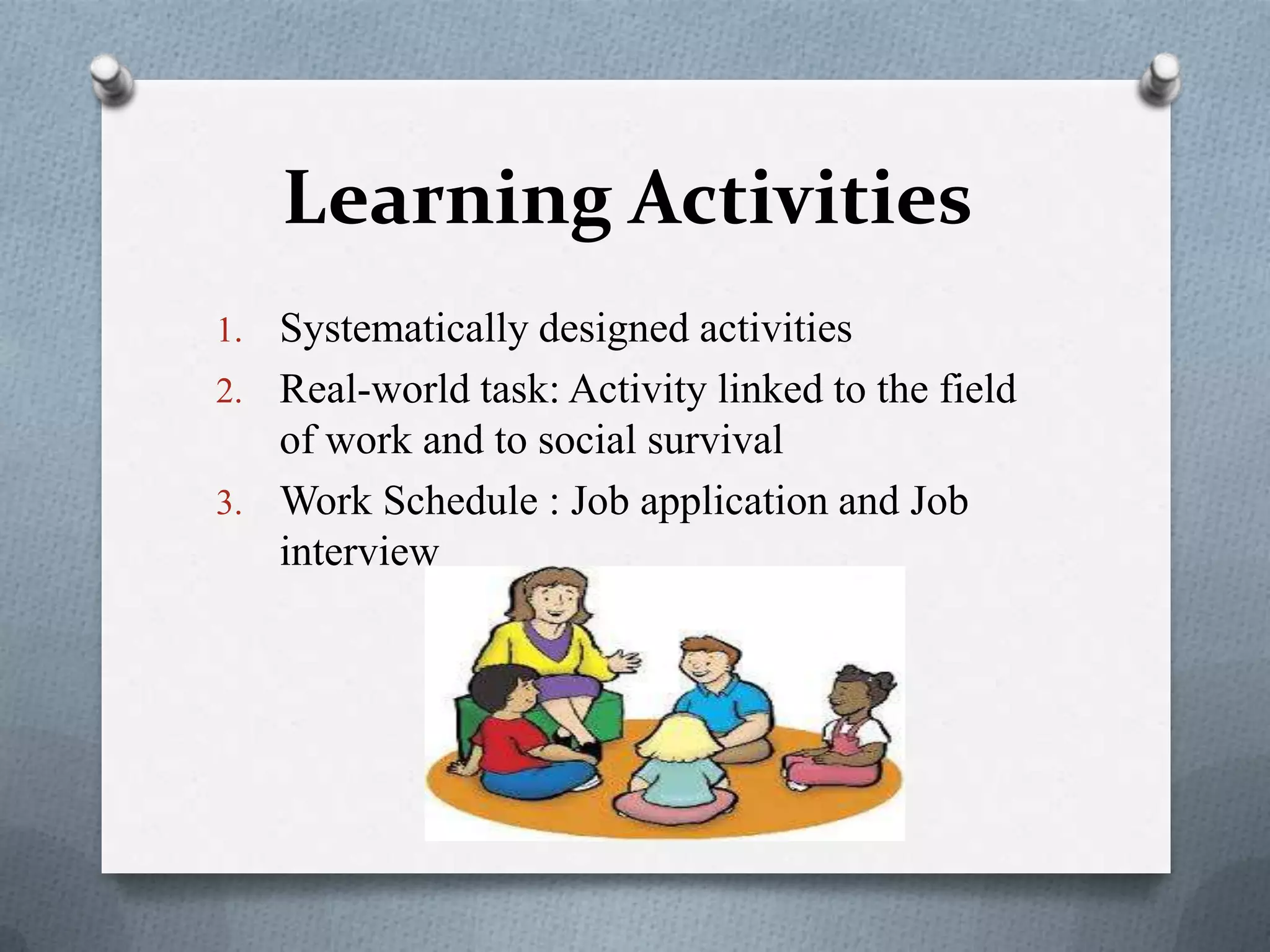
Learning Activities
1. Systematically designed activities
2. Real-world task: Activity linked to the field
of work and to social survival
3. Work Schedule : Job application and Job
interview
Key Features
 Language functioning in societyb.
 Concrete tasks of Life skills (language forms/skills)
 Performance-centered orientation
 Modularized instruction
 Outcomes; “Outcomes are public knowledge, known and
agreed upon by both learner and teacher”
 Continuous and ongoing assessment.
 Demonstrated mastery of performance
 Individualized, student-centered instruction.
Role of
Teacher
To provide positive and constructive feedback
To be aware of the learners’ needs
To make everybody feels welcome in class
To give clear orders and explanations
To make sure that every student understands the
task
Not to push the students because the instructions
are not time-based
To select learning activities
To design a syllabus according to the competency
the students are going to acquire.
Role of
Learner
To be active in the classroom
To perform the skills taught
To know the use of the competencies Appropriately &
Purposely
To stay in the actual program until they improve
To be moved into a more proficient group of students.
To be able to adapt and transfer knowledge from one
setting to another.
MATERIALS
TEACHING PROCEDURE
At the beginning of a course in a competency-based framework the
students have to go through an initial assessment, in which the teacher
determines the current proficiency level of the individual student.
After this the students are grouped on the basis of “their current English
proficiency level, their learning pace, their needs, and their social goals
for learning English”
Furthermore, a course based on CBLT is divided into three stages, which
the students have to go through in order to successfully finish the course
At Stages 1 and 2 the learners deal with twelve competencies which are
related to general language. At Stage 3 the students are grouped on the
basis of their learning goals and “competencies are defined according to
the three syllabus strands of Further Study, Vocational English, and
Community Access”.
REASONS OF USING CBLT
Because CBLT provides lists of
competencies for every specific
situation
Because CBLT covers many areas
or certain competencies needed
Because CBLT describe an activity in
terms of a set of different competencies
Because CBLT focuses on the outcomes
Because CBLT can give the continuous
feedback.
Because CBLT guides the teacher and
student to the quality of assessment.
.
Because CBLT can point out that “the business of
improving learning competencies and skills will remain one
of the world’s fastest growing industries and priorities” in
the future
Because In CBLT language learning always connected
to the social context
Because in CBLT Language is seen as a medium of
interaction and communication between people.
Because CBLT can fulfill particular roles with language
skills
Because Competency-Based Language Teaching (CBLT)
shares the behaviorist view of learning that “certain life
encounters call for certain kinds of language
Because CBLT is gaining popularity in the whole world
Competency based-kk yani

Competency based-kk yani

  • 1.
  • 2.
    DEFINITION Focus on whatlearners are expected to do with the language. This approach emerged in the United States in the 1970s and can be described as “defining educational goals in terms of precise measurable descriptions of the knowledge, skills, and behaviors students should possess at the end of a course of study
  • 3.
    Why we chooseCBLT Teaching Method  CBLT as the Theory of Language and Learning.  Competency-Based Language Teaching (CBLT) Syllabus Design.  Learning Activities suggested by CBLT.  Eight Key Features of CBLT.  Role of Teacher In CBLT.  Role of Learner In CBLT.  Materials suggested by CBLT.  Teaching Procedures in CBLT.  Reasons of using Competency-Based Language Teaching (CBLT
  • 4.
    Theory of Languageand Learning O Functional and interactional perspective on the nature of language O Language is seen as “a medium of interaction and communication between people” O Applies to situations in which the learner has to fulfill a particular role with language skills which can be predicted or determined for the relevant context O Shares the behaviorist view of learning that “certain life encounters call for certain kinds of language”
  • 5.
    Syllabus Design O Thefocus of CBLT syllabus is on how the students can use the language instead of their knowledge about the language. O The teacher provides a list of competencies which the course is going to deal with, and these are “typically required of students in life role situations O CBLT is an outcome-based approach also influences the syllabus, especially the kind of assessment which is used O The competencies tested “consist of a description of the essential skills, knowledge, attitudes, and behaviors required for effective performance of a real-world task or activity”
  • 6.
    Learning Activities 1. Systematicallydesigned activities 2. Real-world task: Activity linked to the field of work and to social survival 3. Work Schedule : Job application and Job interview
  • 7.
    Key Features  Languagefunctioning in societyb.  Concrete tasks of Life skills (language forms/skills)  Performance-centered orientation  Modularized instruction  Outcomes; “Outcomes are public knowledge, known and agreed upon by both learner and teacher”  Continuous and ongoing assessment.  Demonstrated mastery of performance  Individualized, student-centered instruction.
  • 8.
    Role of Teacher To providepositive and constructive feedback To be aware of the learners’ needs To make everybody feels welcome in class To give clear orders and explanations To make sure that every student understands the task Not to push the students because the instructions are not time-based To select learning activities To design a syllabus according to the competency the students are going to acquire.
  • 9.
    Role of Learner To beactive in the classroom To perform the skills taught To know the use of the competencies Appropriately & Purposely To stay in the actual program until they improve To be moved into a more proficient group of students. To be able to adapt and transfer knowledge from one setting to another.
  • 10.
  • 11.
    TEACHING PROCEDURE At thebeginning of a course in a competency-based framework the students have to go through an initial assessment, in which the teacher determines the current proficiency level of the individual student. After this the students are grouped on the basis of “their current English proficiency level, their learning pace, their needs, and their social goals for learning English” Furthermore, a course based on CBLT is divided into three stages, which the students have to go through in order to successfully finish the course At Stages 1 and 2 the learners deal with twelve competencies which are related to general language. At Stage 3 the students are grouped on the basis of their learning goals and “competencies are defined according to the three syllabus strands of Further Study, Vocational English, and Community Access”.
  • 12.
    REASONS OF USINGCBLT Because CBLT provides lists of competencies for every specific situation Because CBLT covers many areas or certain competencies needed Because CBLT describe an activity in terms of a set of different competencies Because CBLT focuses on the outcomes Because CBLT can give the continuous feedback. Because CBLT guides the teacher and student to the quality of assessment.
  • 13.
    . Because CBLT canpoint out that “the business of improving learning competencies and skills will remain one of the world’s fastest growing industries and priorities” in the future Because In CBLT language learning always connected to the social context Because in CBLT Language is seen as a medium of interaction and communication between people. Because CBLT can fulfill particular roles with language skills Because Competency-Based Language Teaching (CBLT) shares the behaviorist view of learning that “certain life encounters call for certain kinds of language Because CBLT is gaining popularity in the whole world