Competency-Based
Language Teaching
Eiram Amjed Khudhr
Content:
• What is CBLT?
• History of CBLT
• Characteristics of CBLT
• Theory of Language
• Course Design
• The Syllabus design
• Types of Learning and Teaching Activities
• Learner Roles
• Teacher Roles
• Advantages and Disadvantages of CBLT
What is
COMPETENCE
?
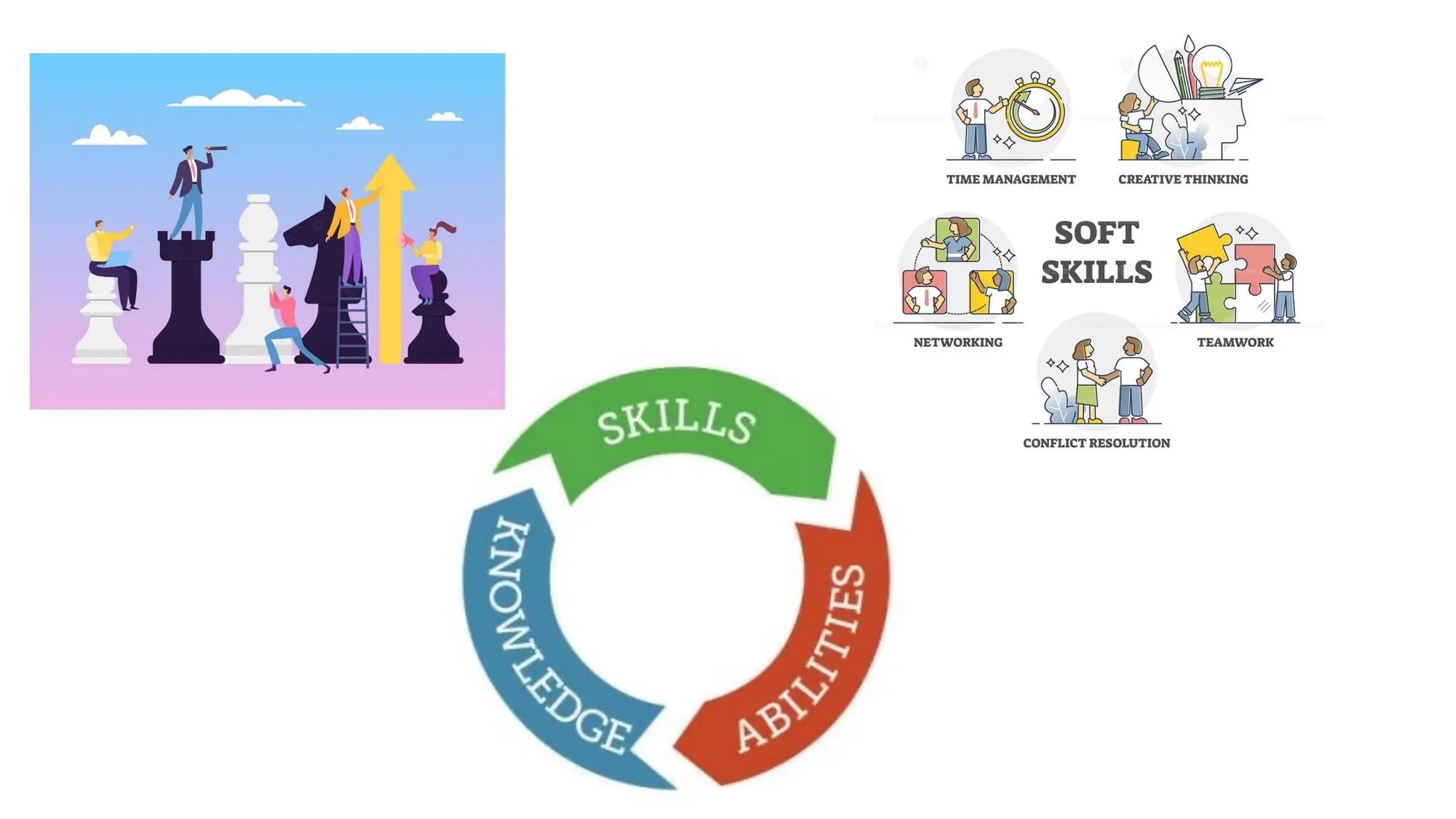
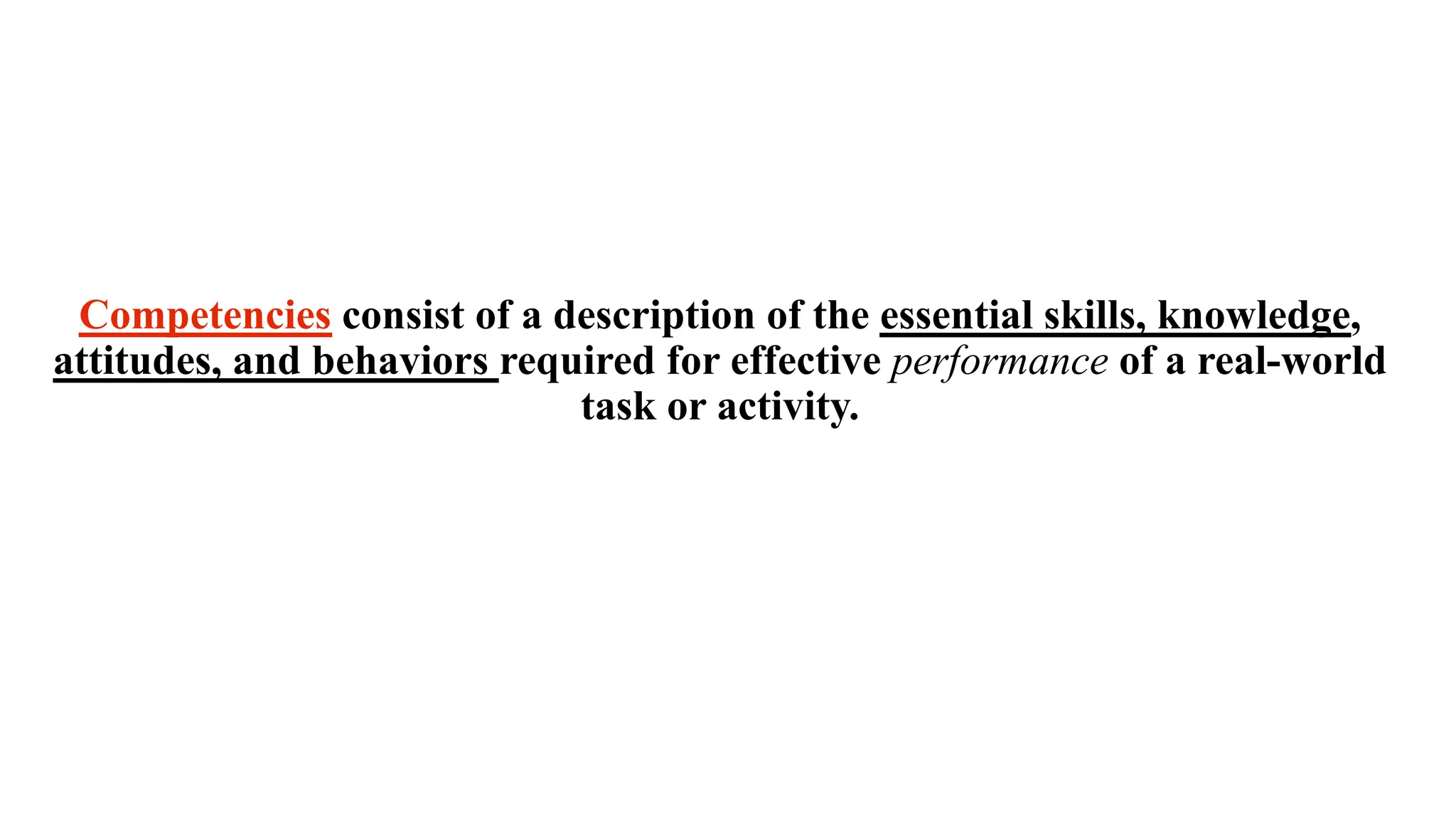
Competencies consist of a description of the essential skills, knowledge,
attitudes, and behaviors required for effective performance of a real-world
task or activity.
History of CBLT
• An educational movement that focuses on the outcomes or outputs of learning in the development of
language programs. CBE addresses what the learners are expected to do with the language, however they
learned to do it. The focus on outputs rather than on inputs to learning is central to the competencies
perspective.
• CBE emerged in the United States in the 1970s and advocated defining educational goals in terms of
precise measurable descriptions of the knowledge, skills, and behaviours students should possess at the
end of a course of study.
• Adopted by the end of the 1970s, particularly as the basis for the design of work-related and survival-
oriented language teaching programs for adults.
History of CBLT
• In work-related programs it is no longer the assumption that employees will develop competence through work
experience: educational institutions are expected to deliver professionals with the competencies expected
(Hoogveld 2003; Baines and Stanley 2006).
• The Center for Applied Linguistics called competency- based ESL curricula “the most important breakthrough
in adult ESL” (1983). By the 1990s, CBLT had come to be accepted as “the state of the art approach to adult
ESL by national policymakers and leaders in curriculum development as well” (Auerbach 1986: 411), and any
refugee in the United States who wished to receive federal assistance had to be enrolled in a competency-based
program (Auerbach 1986: 412).
Characteristics of CBLT
1. A focus on successful functioning in society. The goal is to enable students to become autonomous
individuals capable of coping with the demands of the world.
2. A focus on life skills. Rather than teaching language in isolation, CBLT teaches language as a function of
communication about concrete tasks. Students are taught just those language forms/skills required by the
situations in which they will function.
3. Task or performance-centered orientation. What counts is what students can do as a result of instruction.
The emphasis is on overt behaviours rather than on knowledge or the ability to talk about language and
skills.
4. Modularized instruction. “Language learning is broken down into manageable and immediately
meaningful chunks” (Center for Applied Linguistics 1983: 2). Objectives are broken into narrowly focused
sub-objectives so that both teachers and students can get a clear sense of progress.
5. Outcomes that are made explicit a priori. Outcomes are public knowledge, known and agreed
upon by both learner and teacher, they are specified in terms of behavioural objectives so that
students know exactly what behaviors are expected of them.
6. Continuous and ongoing assessment. Students are pretested to determine what skills they lack and
post-tested after instruction in that skill. If they do not achieve the desired level of mastery, they
continue to work on the objective and are retested.
7. Demonstrated mastery of performance objectives. Rather than the traditional paper and pencil
tests, assessment is based on the ability to demonstrate pre specified behaviours.
8. Individualized, student-centered instruction. In content, level, and pace, objectives are defined in
terms of individual needs; prior learning and achievement are taken into account in developing
curricula.
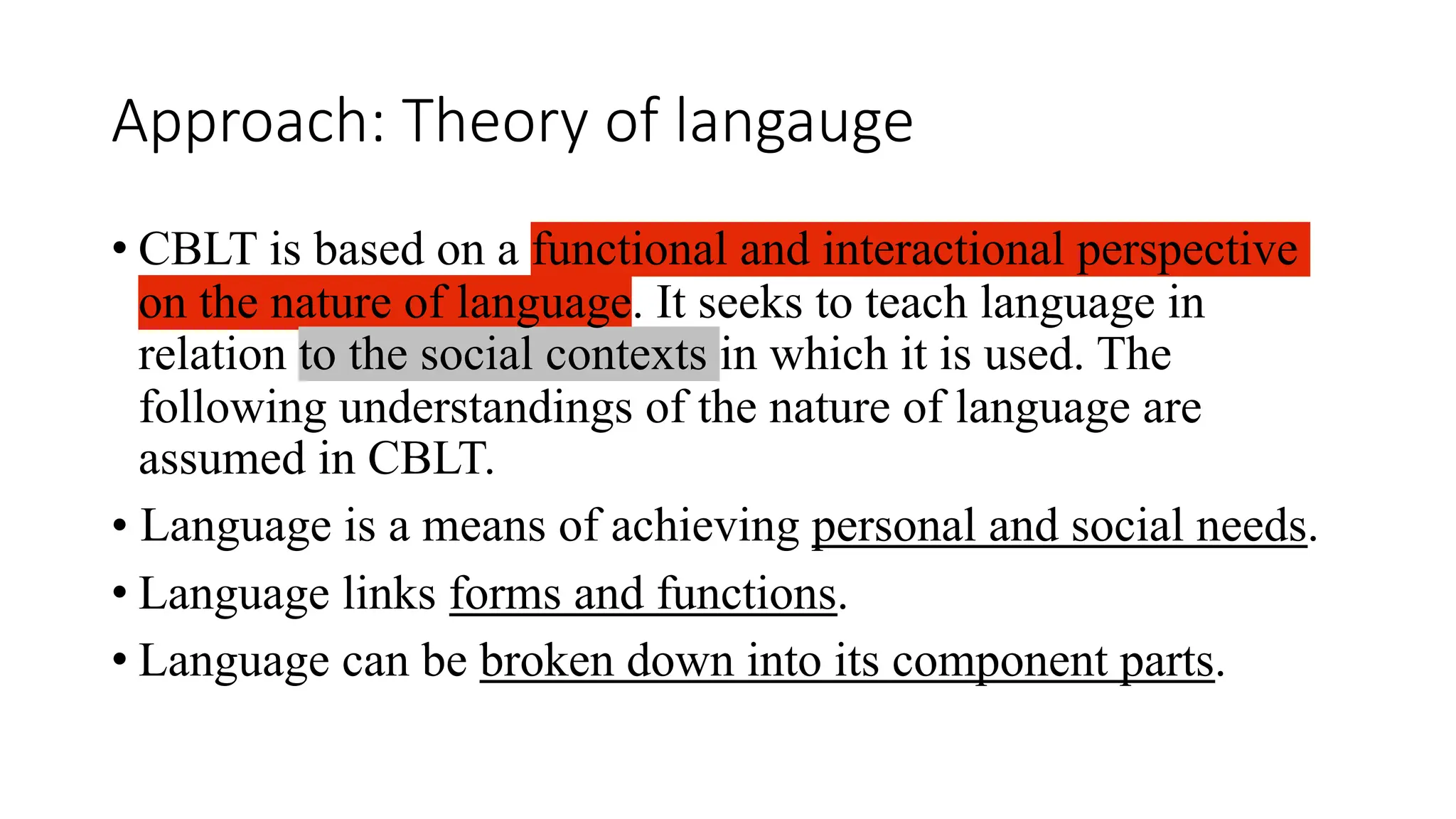
Approach: Theory of langauge
• CBLT is based on a functional and interactional perspective
on the nature of language. It seeks to teach language in
relation to the social contexts in which it is used. The
following understandings of the nature of language are
assumed in CBLT.
• Language is a means of achieving personal and social needs.
• Language links forms and functions.
• Language can be broken down into its component parts.
Course Design
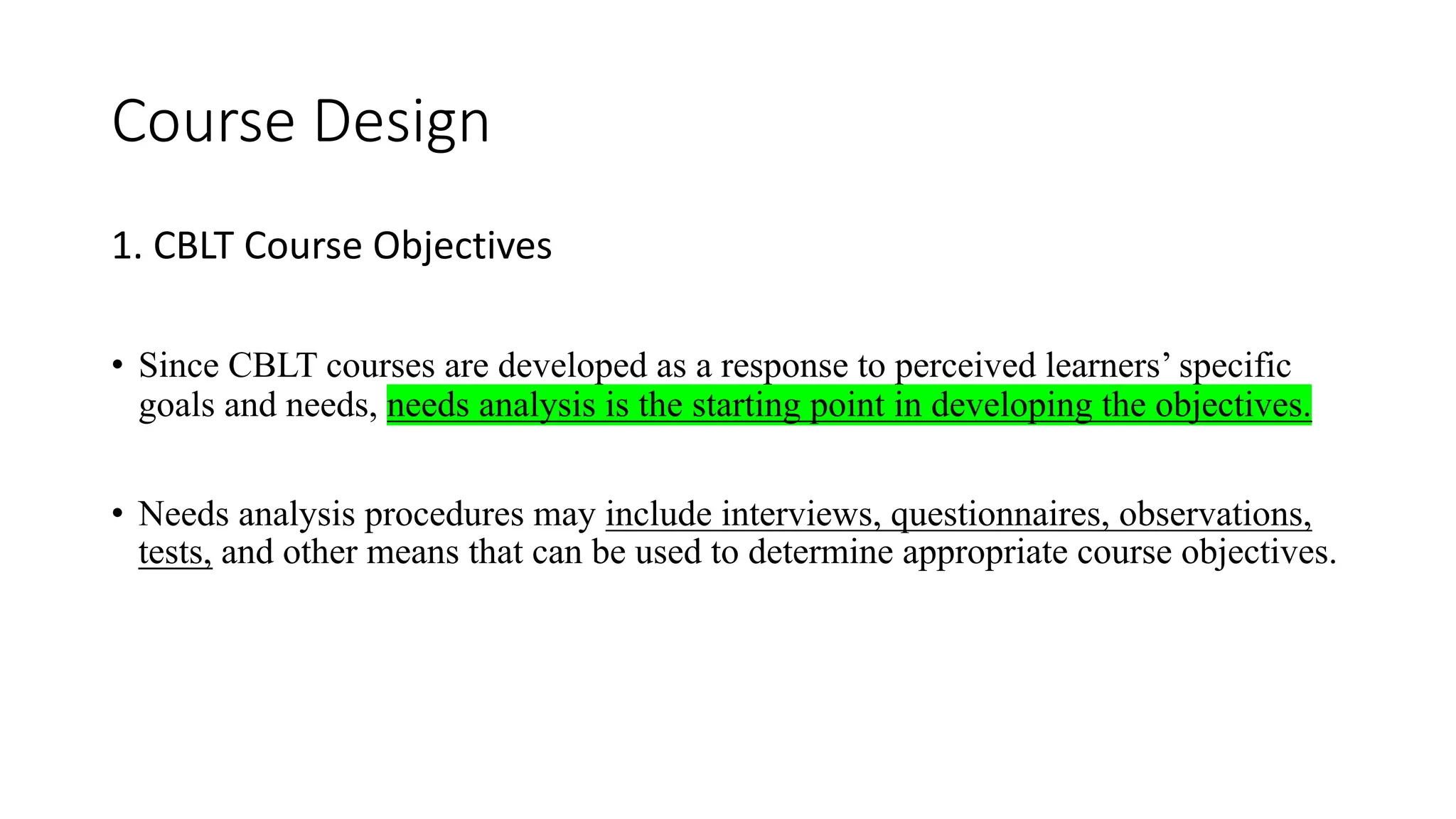
1. CBLT Course Objectives
• Since CBLT courses are developed as a response to perceived learners’ specific
goals and needs, needs analysis is the starting point in developing the objectives.
• Needs analysis procedures may include interviews, questionnaires, observations,
tests, and other means that can be used to determine appropriate course objectives.
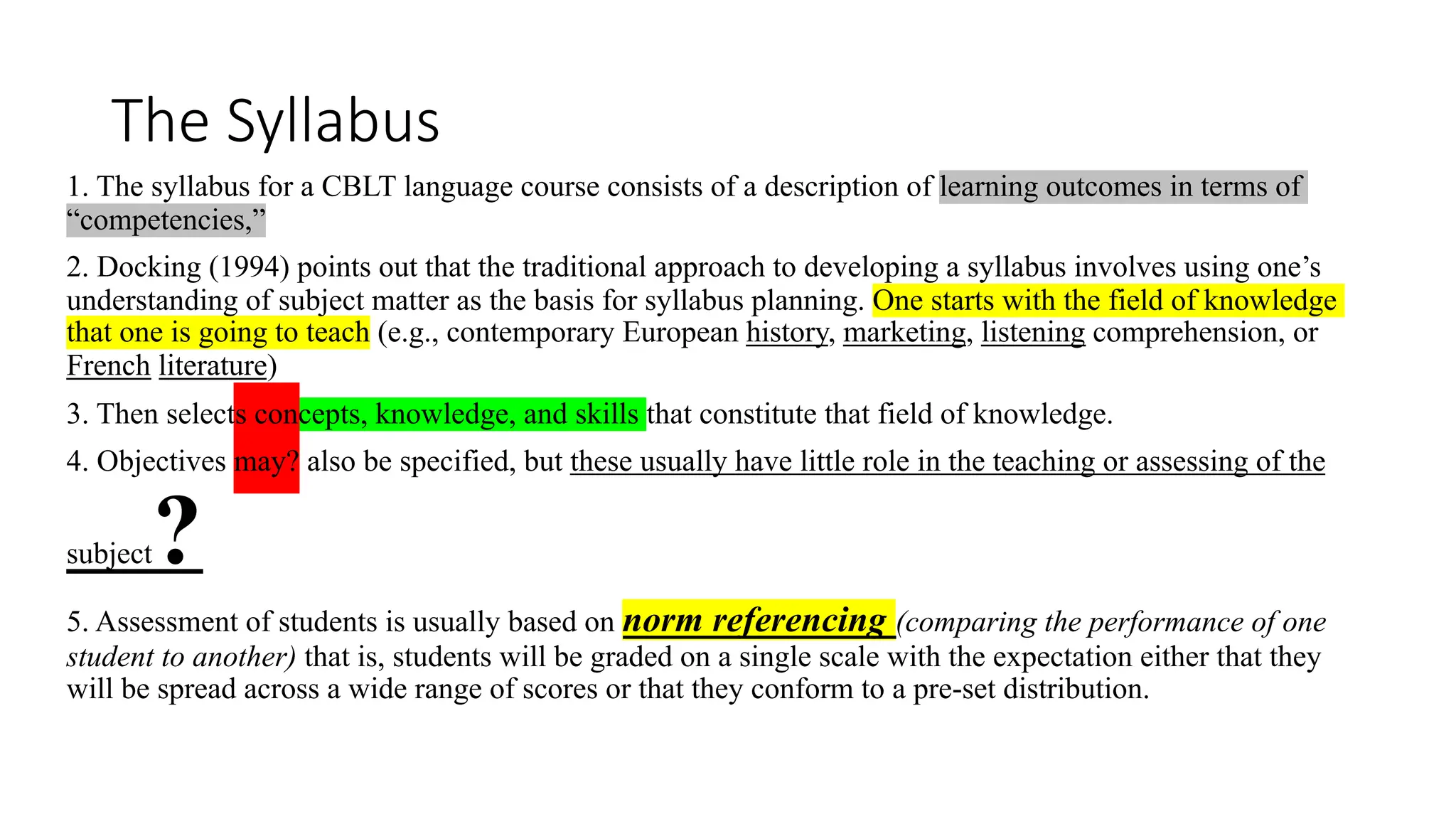
The Syllabus
1. The syllabus for a CBLT language course consists of a description of learning outcomes in terms of
“competencies,”
2. Docking (1994) points out that the traditional approach to developing a syllabus involves using one’s
understanding of subject matter as the basis for syllabus planning. One starts with the field of knowledge
that one is going to teach (e.g., contemporary European history, marketing, listening comprehension, or
French literature)
3. Then selects concepts, knowledge, and skills that constitute that field of knowledge.
4. Objectives may? also be specified, but these usually have little role in the teaching or assessing of the
subject?
5. Assessment of students is usually based on norm referencing (comparing the performance of one
student to another) that is, students will be graded on a single scale with the expectation either that they
will be spread across a wide range of scores or that they conform to a pre-set distribution.
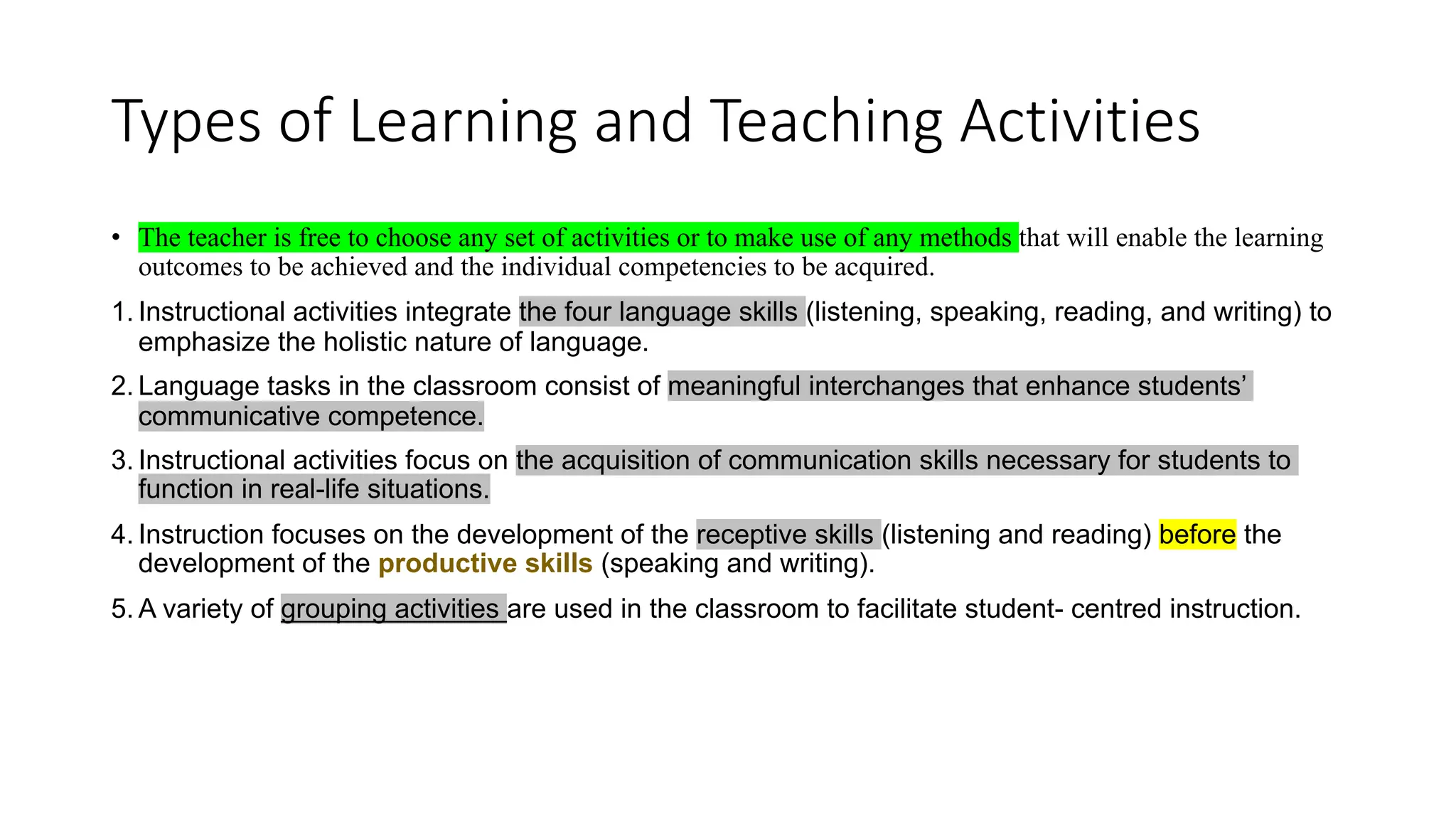
Types of Learning and Teaching Activities
• The teacher is free to choose any set of activities or to make use of any methods that will enable the learning
outcomes to be achieved and the individual competencies to be acquired.
1. Instructional activities integrate the four language skills (listening, speaking, reading, and writing) to
emphasize the holistic nature of language.
2. Language tasks in the classroom consist of meaningful interchanges that enhance students’
communicative competence.
3. Instructional activities focus on the acquisition of communication skills necessary for students to
function in real-life situations.
4. Instruction focuses on the development of the receptive skills (listening and reading) before the
development of the productive skills (speaking and writing).
5. A variety of grouping activities are used in the classroom to facilitate student- centred instruction.
6. Instructional activities are varied to address different learning styles (aural, oral, visual,
kinesthetic) of the students.
7. Instructional activities integrate language and culture so that students learn about the
culture in terms of significant and subtle characteristics that compare and contrast with
those of their own cultures.
8. Learning activities develop the language necessary for students to access higher level
thought processes (analysis, synthesis, and evaluation).
9. Instructional activities require students to take active roles in the learning process,
transferring critical thinking to real problem-solving situations in their everyday lives.
Learner Roles
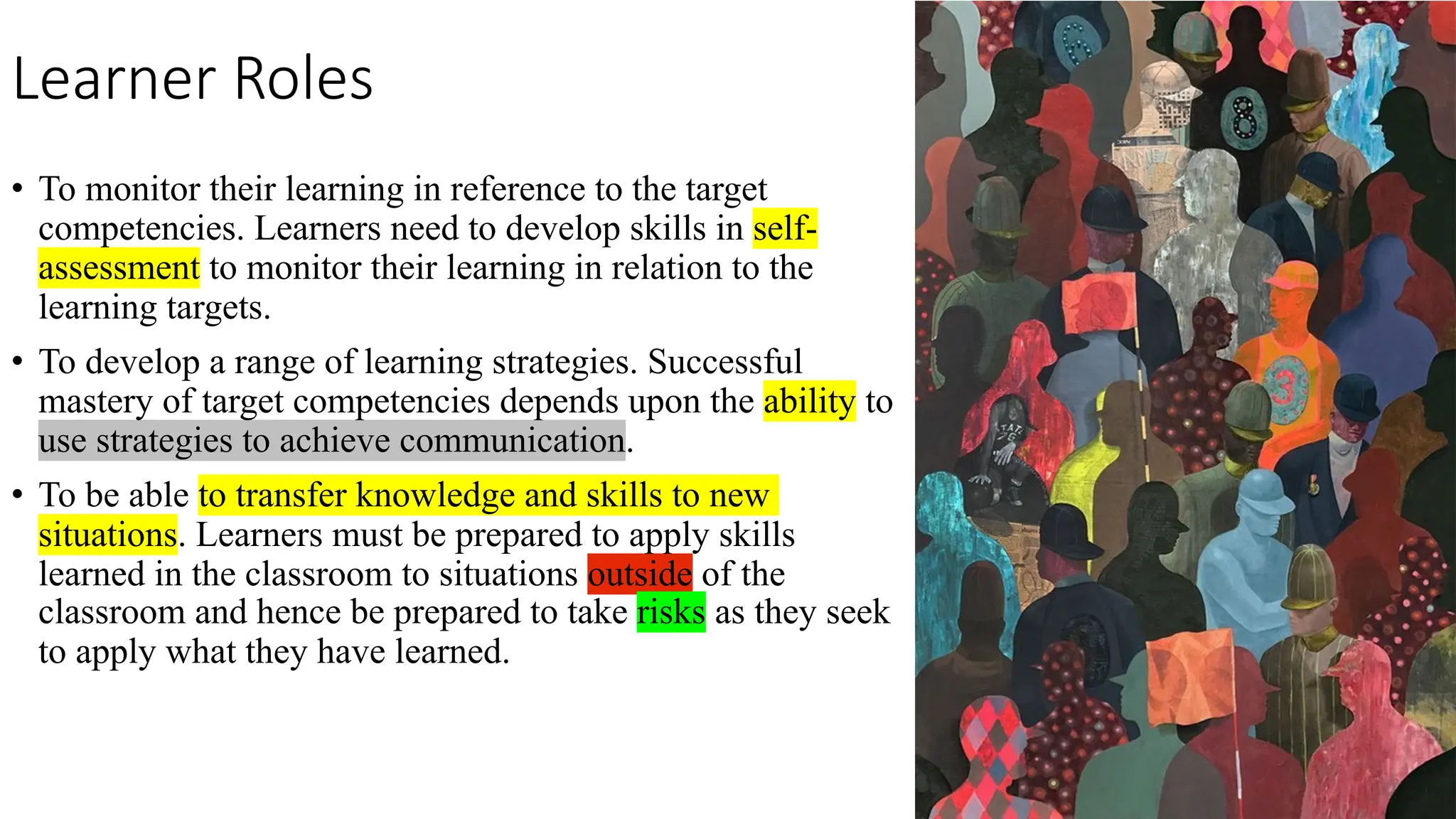
• To monitor their learning in reference to the target
competencies. Learners need to develop skills in self-
assessment to monitor their learning in relation to the
learning targets.
• To develop a range of learning strategies. Successful
mastery of target competencies depends upon the ability to
use strategies to achieve communication.
• To be able to transfer knowledge and skills to new
situations. Learners must be prepared to apply skills
learned in the classroom to situations outside of the
classroom and hence be prepared to take risks as they seek
to apply what they have learned.
Teacher roles
1.Needs analyst. The teacher may be required to conduct a needs analysis of his or
her students and is able to select suitable competencies based on the learners’
needs.
2.Materials developer and materials resource assembler. The teacher may he
required to assemble suitable materials - including technology-supported materials
- as well as to develop materials to address specific target competencies.
3.Assessor. The teacher is engaged in ongoing assessment of students’ learning and
may need to re- teach skills that have not been adequately mastered.
4.Coach. The teacher is also expected to guide students toward use of appropriate
learning strategies and to provide the necessary guidance and support for this
purpose.
Advantages of CBLT
1. Learning outcomes are holistic (integrated) rather than fragmented (isolated).
2. Learning outcomes are more long term, flexible for future skills needs/ labour
market needs.
3.Individual learners benefit. Because learning outcomes are more application
based, learners are more motivated, understanding the purpose.
4. Benefits all and particularly for disadvantaged students.
5. Benefits for teacher in new ways of working (including team working).
6. Benefits for the system by involvement of practitioners from the labour market.
7. The focus is on the success of each learner, and participants build confidence as
they succeed in mastering specific competencies.
8. More group work than individual work.
9. More efficient and effective as the teacher is a facilitator of learning
as opposed to a provider of information.
10.Specific and practical.
11. Student learning is enhanced because of the specification of
expected outcomes and continuous feedback.
12. Quality of assessment and teaching improves.
Disadvantages of CBLT
1. A risk of neglecting inputs and processes (a need for balance).
2. Teacher have to deal with it, and be properly trained (team effort).
3. Risk of atomized approach of formulating outcomes, can’t cope with
complex situations.
4. May detract from general academic excellence.
5. Tendency to generate inequity.
6. A risk that it is not flexible enough for further education or to switch
to other professions.
7. There is a tendency to “teach as we were taught” and competency-
based teachers quickly slip back into the role of the traditional teacher.
References
• Richards, J., and Rodgers, Th. (2014) Approaches and Methods in Language
Teaching. Cambridge University. 3rd ed.
• Kumadavadivelu, B. (2008)Understanding Language Teaching from Method to
Post-Method. Taylor & Francis.
• https://moroccoenglish.com/me-md/2017/12/Advantages-and-Limitations-of-
the-Competency-Based-Curriculum-2012-2013.pdf
• https://www.researchgate.net/publication/330088979_Competency-
Based_Language_Teaching#fullTextFileContent
Thank you!

Competency-based Language Teaching/Eiram Amjed

  • 1.
  • 2.
    Content: • What isCBLT? • History of CBLT • Characteristics of CBLT • Theory of Language • Course Design • The Syllabus design • Types of Learning and Teaching Activities • Learner Roles • Teacher Roles • Advantages and Disadvantages of CBLT
  • 3.
  • 5.
    Competencies consist ofa description of the essential skills, knowledge, attitudes, and behaviors required for effective performance of a real-world task or activity.
  • 6.
    History of CBLT •An educational movement that focuses on the outcomes or outputs of learning in the development of language programs. CBE addresses what the learners are expected to do with the language, however they learned to do it. The focus on outputs rather than on inputs to learning is central to the competencies perspective. • CBE emerged in the United States in the 1970s and advocated defining educational goals in terms of precise measurable descriptions of the knowledge, skills, and behaviours students should possess at the end of a course of study. • Adopted by the end of the 1970s, particularly as the basis for the design of work-related and survival- oriented language teaching programs for adults.
  • 7.
    History of CBLT •In work-related programs it is no longer the assumption that employees will develop competence through work experience: educational institutions are expected to deliver professionals with the competencies expected (Hoogveld 2003; Baines and Stanley 2006). • The Center for Applied Linguistics called competency- based ESL curricula “the most important breakthrough in adult ESL” (1983). By the 1990s, CBLT had come to be accepted as “the state of the art approach to adult ESL by national policymakers and leaders in curriculum development as well” (Auerbach 1986: 411), and any refugee in the United States who wished to receive federal assistance had to be enrolled in a competency-based program (Auerbach 1986: 412).
  • 8.
    Characteristics of CBLT 1.A focus on successful functioning in society. The goal is to enable students to become autonomous individuals capable of coping with the demands of the world. 2. A focus on life skills. Rather than teaching language in isolation, CBLT teaches language as a function of communication about concrete tasks. Students are taught just those language forms/skills required by the situations in which they will function. 3. Task or performance-centered orientation. What counts is what students can do as a result of instruction. The emphasis is on overt behaviours rather than on knowledge or the ability to talk about language and skills. 4. Modularized instruction. “Language learning is broken down into manageable and immediately meaningful chunks” (Center for Applied Linguistics 1983: 2). Objectives are broken into narrowly focused sub-objectives so that both teachers and students can get a clear sense of progress.
  • 9.
    5. Outcomes thatare made explicit a priori. Outcomes are public knowledge, known and agreed upon by both learner and teacher, they are specified in terms of behavioural objectives so that students know exactly what behaviors are expected of them. 6. Continuous and ongoing assessment. Students are pretested to determine what skills they lack and post-tested after instruction in that skill. If they do not achieve the desired level of mastery, they continue to work on the objective and are retested. 7. Demonstrated mastery of performance objectives. Rather than the traditional paper and pencil tests, assessment is based on the ability to demonstrate pre specified behaviours. 8. Individualized, student-centered instruction. In content, level, and pace, objectives are defined in terms of individual needs; prior learning and achievement are taken into account in developing curricula.
  • 10.
    Approach: Theory oflangauge • CBLT is based on a functional and interactional perspective on the nature of language. It seeks to teach language in relation to the social contexts in which it is used. The following understandings of the nature of language are assumed in CBLT. • Language is a means of achieving personal and social needs. • Language links forms and functions. • Language can be broken down into its component parts.
  • 11.
    Course Design 1. CBLTCourse Objectives • Since CBLT courses are developed as a response to perceived learners’ specific goals and needs, needs analysis is the starting point in developing the objectives. • Needs analysis procedures may include interviews, questionnaires, observations, tests, and other means that can be used to determine appropriate course objectives.
  • 12.
    The Syllabus 1. Thesyllabus for a CBLT language course consists of a description of learning outcomes in terms of “competencies,” 2. Docking (1994) points out that the traditional approach to developing a syllabus involves using one’s understanding of subject matter as the basis for syllabus planning. One starts with the field of knowledge that one is going to teach (e.g., contemporary European history, marketing, listening comprehension, or French literature) 3. Then selects concepts, knowledge, and skills that constitute that field of knowledge. 4. Objectives may? also be specified, but these usually have little role in the teaching or assessing of the subject? 5. Assessment of students is usually based on norm referencing (comparing the performance of one student to another) that is, students will be graded on a single scale with the expectation either that they will be spread across a wide range of scores or that they conform to a pre-set distribution.
  • 13.
    Types of Learningand Teaching Activities • The teacher is free to choose any set of activities or to make use of any methods that will enable the learning outcomes to be achieved and the individual competencies to be acquired. 1. Instructional activities integrate the four language skills (listening, speaking, reading, and writing) to emphasize the holistic nature of language. 2. Language tasks in the classroom consist of meaningful interchanges that enhance students’ communicative competence. 3. Instructional activities focus on the acquisition of communication skills necessary for students to function in real-life situations. 4. Instruction focuses on the development of the receptive skills (listening and reading) before the development of the productive skills (speaking and writing). 5. A variety of grouping activities are used in the classroom to facilitate student- centred instruction.
  • 14.
    6. Instructional activitiesare varied to address different learning styles (aural, oral, visual, kinesthetic) of the students. 7. Instructional activities integrate language and culture so that students learn about the culture in terms of significant and subtle characteristics that compare and contrast with those of their own cultures. 8. Learning activities develop the language necessary for students to access higher level thought processes (analysis, synthesis, and evaluation). 9. Instructional activities require students to take active roles in the learning process, transferring critical thinking to real problem-solving situations in their everyday lives.
  • 15.
    Learner Roles • Tomonitor their learning in reference to the target competencies. Learners need to develop skills in self- assessment to monitor their learning in relation to the learning targets. • To develop a range of learning strategies. Successful mastery of target competencies depends upon the ability to use strategies to achieve communication. • To be able to transfer knowledge and skills to new situations. Learners must be prepared to apply skills learned in the classroom to situations outside of the classroom and hence be prepared to take risks as they seek to apply what they have learned.
  • 16.
    Teacher roles 1.Needs analyst.The teacher may be required to conduct a needs analysis of his or her students and is able to select suitable competencies based on the learners’ needs. 2.Materials developer and materials resource assembler. The teacher may he required to assemble suitable materials - including technology-supported materials - as well as to develop materials to address specific target competencies. 3.Assessor. The teacher is engaged in ongoing assessment of students’ learning and may need to re- teach skills that have not been adequately mastered. 4.Coach. The teacher is also expected to guide students toward use of appropriate learning strategies and to provide the necessary guidance and support for this purpose.
  • 17.
    Advantages of CBLT 1.Learning outcomes are holistic (integrated) rather than fragmented (isolated). 2. Learning outcomes are more long term, flexible for future skills needs/ labour market needs. 3.Individual learners benefit. Because learning outcomes are more application based, learners are more motivated, understanding the purpose. 4. Benefits all and particularly for disadvantaged students. 5. Benefits for teacher in new ways of working (including team working). 6. Benefits for the system by involvement of practitioners from the labour market. 7. The focus is on the success of each learner, and participants build confidence as they succeed in mastering specific competencies.
  • 18.
    8. More groupwork than individual work. 9. More efficient and effective as the teacher is a facilitator of learning as opposed to a provider of information. 10.Specific and practical. 11. Student learning is enhanced because of the specification of expected outcomes and continuous feedback. 12. Quality of assessment and teaching improves.
  • 19.
    Disadvantages of CBLT 1.A risk of neglecting inputs and processes (a need for balance). 2. Teacher have to deal with it, and be properly trained (team effort). 3. Risk of atomized approach of formulating outcomes, can’t cope with complex situations. 4. May detract from general academic excellence. 5. Tendency to generate inequity. 6. A risk that it is not flexible enough for further education or to switch to other professions. 7. There is a tendency to “teach as we were taught” and competency- based teachers quickly slip back into the role of the traditional teacher.
  • 20.
    References • Richards, J.,and Rodgers, Th. (2014) Approaches and Methods in Language Teaching. Cambridge University. 3rd ed. • Kumadavadivelu, B. (2008)Understanding Language Teaching from Method to Post-Method. Taylor & Francis. • https://moroccoenglish.com/me-md/2017/12/Advantages-and-Limitations-of- the-Competency-Based-Curriculum-2012-2013.pdf • https://www.researchgate.net/publication/330088979_Competency- Based_Language_Teaching#fullTextFileContent
  • 21.