INTRODUCTION
 Competency Based Education has many
elements that fit with the goals of nursing
education programs.
 Nursing leaders have promoted this approach
since the early 1900s.
 Competency Based Education focuses on
outcomes of learning.
 CBE addresses what the learners are
expected to do rather than on what they are
expected to learn about.
COMPETENCY-BASED EDUCATION
(CBE): HISTORY AND OVERVIEW
 CBE is an institutional process that moves
education from focusing on what academics
believe graduates need to know (teacher-
focused) to what students need to know and be
able to do in varying and complex situations.
 Large skill sets are broken down into
competencies, which may have sequential
levels of mastery. Competencies reinforce one
another from basic to advanced as learning
progresses; the impact of increasing
competencies is synergistic, and the whole is
greater than the sum of the parts.
CONTD..
 CBE is focused on outcomes (competencies)
that are linked to workforce needs, as
defined by employers and the profession.
CBE’s outcomes are increasingly complex in
nature, rather than deriving from the
addition of multiple low-level objectives.
CBE often necessitates more complex
assessment, involving portfolios, experiential
learning assessment in field experience,
demonstration in varying contexts, role play,
use of standardized patients or clients, etc.
MEANING OF COMPETENCIES:
 Competencies refers to the nursing
student’s ability to apply basic and
advanced nursing skills, knowledge and attitude
which is required for everyday life of a
professional nurse
 Competencies consist of a description of
essential skills , knowledge and attitudes and
behaviour that required for professional nurse
for effective performance of real-world task
involved in the care of patients in clinical or
community areas.
DEFINITION
 CBE emerged in the United States in the 1970s
and refers to an educational movement that
advocates defining educational goals in terms of
precise measurable descriptions of knowledge,
skills, and behaviours students should possess at
the end of a course of study. „ Richards and
Rodgers
 The National Council of State Boards of Nursing
(2005) describes competency as the ability to apply
knowledge and interpersonal, decision-making, and
psychomotor skills to nursing practice roles.
NEED OF CBE:
 It involves shift of focus of nursing education
from what nursing faculties believe under-or-
postgraduate nursing students need
- to know
- to able to do in varying and complex clinical
and teaching and administration situations.
 CBE emphasizes on what the students are
expected to do rather than what they are
expected to learn.
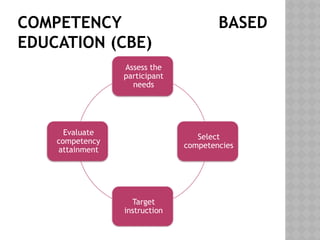
COMPETENCY BASED
EDUCATION (CBE)
Assess the
participant
needs
Select
competencies
Target
instruction
Evaluate
competency
attainment
DEVELOPMENT OF COMPETENCY-
BASED EDUCATION PROGRAMMES:
 Development of competency based
education requires specific, measurable
competency statements that are considered
compulsory for an ideal professional nurse.
 These statements reflect the task of a nurse
or the expectations of the employers from
the nurses.
CONTD..
 Content of education programme is selected
on the basis of learner competencies.
 Students continue the programme until they
demonstrate mastery of desired skills.
COMPETENCY BASED EDUCATION PROGRAMS
 1. Specific, measurable competency
statements
 2. Content based on learner goals
(outcomes/competencies)
 3. Learner continues in program until
demonstrating mastery
 4. Use a variety of instructional techniques
and group activities
 5. Use texts, media, and real life materials
geared to targeted competencies
CONTD..
 6. Focus on what the learner needs to learn,
which is the application of basic skills in a
life skills context
 7. Provide learners with immediate feedback
on assessment performance
 8. Pace instruction to learner needs
 9. Have learner demonstrate mastery of
specified competency statements
COMPETENCIES SUPPORT
LEARNING BY:
 Focusing learning on the critical
competencies needed for success in the job
and organization
 Providing standards for measuring employee
performance and capabilities
 Providing the framework for identifying
learning options/curriculum/programs to
meet employee and organizational needs
CONTD..
 Supporting effective forecasting of
organizational, as well as project-related
learning requirements.
 Providing standards for determining how
well learning has occurred, both at the
individual and organizational level
CHARACTERISTICS OF CBE:
 Acquisition of essential cognitive,
psychomotor, and affective skills;
 Continued development of skills;
 Broadly based competency development
derived from the best professional evidence,
current standards, and regulations;
 Authentic assessments which are valid and
reliable;
 The use of adult learning principles;
 Individual learning styles and abilities are
recognized and appreciated.
ADVANTAGES OF CBE:
 Makes the curriculum to take on a more
holistic appearance and coherence – be more
than a ‘string of beads.’
 Gets whole faculty to address and assume
ownership for the basic competencies.
 Makes clear to students what the
expectations are.
 Improves the system of feedback to students.
DISADVANTAGES OF CBE:
 Sliding back into traditional teaching
methods if there is not enough follow-up and
training for the facilitators.
 If the competencies and accompanying
rubrics are not carefully chosen and planned
to ensure successful implementation, the
curriculum will not be strong enough to
support a true competency-based learning
experience.
BENEFITS OF CBE
 Having clear guidelines for everyone
involved in the process
 Encouraging teamwork
 Enhancing skills and knowledge
 Increasing staff retention
 Reducing staff anxiety
 Improving nursing performance
 Ensuring compliance with The Joint
Commission standard that all members of the
staff are competent to fulfil their assigned
responsibilities
CHALLENGES OF CBE:
 The challenge is to determine which
competencies can be bundled together to
provide the optimal grouping for performing
tasks.
 Another challenge is designing learning
experiences that support students as they
practice using and applying these competencies
in different contexts.
 Continual refinement of defined competencies
is necessary so that enhanced performance in a
variety of contexts can be assessed.
 In essence, CBE is a process, not a product.
SEVERAL REASONS OF INTEREST
OF CBE:
 Educational institutions and providers need
evidence that anyone who completes a degree
or course has achieved a required level of
competency.
 Accrediting, regulatory, and professional
groups want assurance that completion of an
educational endeavour indicates competency.
 There is greater accountability for cost and
time it takes to complete educational
endeavours and determine if they achieve the
expected outcomes.
CONTD..
 Employers hires new workers who don’t have
basic competencies required for entry-level
positions.
 Regulatory, legal, external standards, and
quality measures require demonstration of
competence.
 Workers need to continue their own personal
and professional development to advance
their careers and make positive contributions
to organizations.
APPROACHES TO CBE:
 Although there are different perspectives on
the definition of CBE, diverse groups see the
need to incorporate common elements:
 1. Consumers, regulatory, educational, and
practice groups establish partnerships.
 2. Collaboration and innovation in education
and practice settings support the
development and maintenance of competent
workforce ( Coonan, 2008)
 3. Educational systems respond to changes in
complex work environments (Coonan, 2008)
CONTD..
 4. Learner have active role in determining their
educational needs.
 5. The primary focus is on identifying &
measuring specific learning outcomes for initial
and continued competence.
 6. Required competencies include all the
domains required for practice in a discipline.
 7. Assessments are given at each level with the
learners demonstration competence at each
level.
 8. Assessments are done at different points in
time, using a variety of approaches.
IMPORTANT CONSIDERATIONS
 One key element is that each set of
competencies should be made available to
school or program constituents, especially
students.
 Competencies should be reviewed regularly
and redefined to reflect the changing needs
of public health practice. Expected
documentation “a description of the manner
in which the SPH/PHP periodically assesses
the changing needs of public health practice
and uses this information to establish the
competencies for its educational programs.”
CONTD..
 While course learning objectives are most
appropriately developed by the course
instructor (as part of a collaborative
curriculum development process),
instructional objectives and competencies
should be developed through a process of
consensus-building. Ideally, all affected
parties should be involved in their
development. Faculty, in particular, but also
students and representatives from the public
health practice community and workforce
support quality assurance processes.
SUMMARIZATION:
 Introduction
 History and overview
 Meaning, Definition
 Need of CBE
 Development of Competency-based education programmes
 Characteristics of Competency Based Education Programs
 Competencies support learning
 Characteristics of CBE
 Advantages of CBE
 Disadvantages of CBE
 Benefits of CBE
 Challenges of CBE
 Several reasons of interest of CBE
 Approaches to CBE
 Important Considerations
any
query ? ? ?
? ? ? ? ?
RECAPTULIZATION:
i. Expand CBE .
ii. Fill in the blanks:
1. Competency Based Education focuses
_________________.
2. CBE is a process, not a _________.
iii. True/ false
3. CBE emphasizes on what the students are
expected to do rather than what they are
expected to learn.
4. The disadvantage of CBE is to improves the
system of feedback to students.
FURTHER READING:
 www.googlebooks.com/competencybasededucat
ion
.
 Anurag Bhai Patidhar, ‘Communication and
Nursing Education’ published by Pearson edition
Ist, pg.no. 99.
 Argüelles, A, Gonczi, A, eds. Competency based
education and training: A world perspective.
Mexico City: Gruop Noriega Edition; 2000.
 Bloom, BS,Hastings, JT, Madaus, GG. Handbook
on formative and summative evaluation of
student learning. New York: McGraw-Hill; 1971.
thank you
   


powerpoint presentation on competency based education .pptx

  • 1.
    INTRODUCTION  Competency BasedEducation has many elements that fit with the goals of nursing education programs.  Nursing leaders have promoted this approach since the early 1900s.  Competency Based Education focuses on outcomes of learning.  CBE addresses what the learners are expected to do rather than on what they are expected to learn about.
  • 2.
    COMPETENCY-BASED EDUCATION (CBE): HISTORYAND OVERVIEW  CBE is an institutional process that moves education from focusing on what academics believe graduates need to know (teacher- focused) to what students need to know and be able to do in varying and complex situations.  Large skill sets are broken down into competencies, which may have sequential levels of mastery. Competencies reinforce one another from basic to advanced as learning progresses; the impact of increasing competencies is synergistic, and the whole is greater than the sum of the parts.
  • 3.
    CONTD..  CBE isfocused on outcomes (competencies) that are linked to workforce needs, as defined by employers and the profession. CBE’s outcomes are increasingly complex in nature, rather than deriving from the addition of multiple low-level objectives. CBE often necessitates more complex assessment, involving portfolios, experiential learning assessment in field experience, demonstration in varying contexts, role play, use of standardized patients or clients, etc.
  • 4.
    MEANING OF COMPETENCIES: Competencies refers to the nursing student’s ability to apply basic and advanced nursing skills, knowledge and attitude which is required for everyday life of a professional nurse  Competencies consist of a description of essential skills , knowledge and attitudes and behaviour that required for professional nurse for effective performance of real-world task involved in the care of patients in clinical or community areas.
  • 5.
    DEFINITION  CBE emergedin the United States in the 1970s and refers to an educational movement that advocates defining educational goals in terms of precise measurable descriptions of knowledge, skills, and behaviours students should possess at the end of a course of study. „ Richards and Rodgers  The National Council of State Boards of Nursing (2005) describes competency as the ability to apply knowledge and interpersonal, decision-making, and psychomotor skills to nursing practice roles.
  • 6.
    NEED OF CBE: It involves shift of focus of nursing education from what nursing faculties believe under-or- postgraduate nursing students need - to know - to able to do in varying and complex clinical and teaching and administration situations.  CBE emphasizes on what the students are expected to do rather than what they are expected to learn.
  • 7.
    COMPETENCY BASED EDUCATION (CBE) Assessthe participant needs Select competencies Target instruction Evaluate competency attainment
  • 8.
    DEVELOPMENT OF COMPETENCY- BASEDEDUCATION PROGRAMMES:  Development of competency based education requires specific, measurable competency statements that are considered compulsory for an ideal professional nurse.  These statements reflect the task of a nurse or the expectations of the employers from the nurses.
  • 9.
    CONTD..  Content ofeducation programme is selected on the basis of learner competencies.  Students continue the programme until they demonstrate mastery of desired skills.
  • 10.
    COMPETENCY BASED EDUCATIONPROGRAMS  1. Specific, measurable competency statements  2. Content based on learner goals (outcomes/competencies)  3. Learner continues in program until demonstrating mastery  4. Use a variety of instructional techniques and group activities  5. Use texts, media, and real life materials geared to targeted competencies
  • 11.
    CONTD..  6. Focuson what the learner needs to learn, which is the application of basic skills in a life skills context  7. Provide learners with immediate feedback on assessment performance  8. Pace instruction to learner needs  9. Have learner demonstrate mastery of specified competency statements
  • 12.
    COMPETENCIES SUPPORT LEARNING BY: Focusing learning on the critical competencies needed for success in the job and organization  Providing standards for measuring employee performance and capabilities  Providing the framework for identifying learning options/curriculum/programs to meet employee and organizational needs
  • 13.
    CONTD..  Supporting effectiveforecasting of organizational, as well as project-related learning requirements.  Providing standards for determining how well learning has occurred, both at the individual and organizational level
  • 14.
    CHARACTERISTICS OF CBE: Acquisition of essential cognitive, psychomotor, and affective skills;  Continued development of skills;  Broadly based competency development derived from the best professional evidence, current standards, and regulations;  Authentic assessments which are valid and reliable;  The use of adult learning principles;  Individual learning styles and abilities are recognized and appreciated.
  • 15.
    ADVANTAGES OF CBE: Makes the curriculum to take on a more holistic appearance and coherence – be more than a ‘string of beads.’  Gets whole faculty to address and assume ownership for the basic competencies.  Makes clear to students what the expectations are.  Improves the system of feedback to students.
  • 16.
    DISADVANTAGES OF CBE: Sliding back into traditional teaching methods if there is not enough follow-up and training for the facilitators.  If the competencies and accompanying rubrics are not carefully chosen and planned to ensure successful implementation, the curriculum will not be strong enough to support a true competency-based learning experience.
  • 17.
    BENEFITS OF CBE Having clear guidelines for everyone involved in the process  Encouraging teamwork  Enhancing skills and knowledge  Increasing staff retention  Reducing staff anxiety  Improving nursing performance  Ensuring compliance with The Joint Commission standard that all members of the staff are competent to fulfil their assigned responsibilities
  • 18.
    CHALLENGES OF CBE: The challenge is to determine which competencies can be bundled together to provide the optimal grouping for performing tasks.  Another challenge is designing learning experiences that support students as they practice using and applying these competencies in different contexts.  Continual refinement of defined competencies is necessary so that enhanced performance in a variety of contexts can be assessed.  In essence, CBE is a process, not a product.
  • 19.
    SEVERAL REASONS OFINTEREST OF CBE:  Educational institutions and providers need evidence that anyone who completes a degree or course has achieved a required level of competency.  Accrediting, regulatory, and professional groups want assurance that completion of an educational endeavour indicates competency.  There is greater accountability for cost and time it takes to complete educational endeavours and determine if they achieve the expected outcomes.
  • 20.
    CONTD..  Employers hiresnew workers who don’t have basic competencies required for entry-level positions.  Regulatory, legal, external standards, and quality measures require demonstration of competence.  Workers need to continue their own personal and professional development to advance their careers and make positive contributions to organizations.
  • 21.
    APPROACHES TO CBE: Although there are different perspectives on the definition of CBE, diverse groups see the need to incorporate common elements:  1. Consumers, regulatory, educational, and practice groups establish partnerships.  2. Collaboration and innovation in education and practice settings support the development and maintenance of competent workforce ( Coonan, 2008)  3. Educational systems respond to changes in complex work environments (Coonan, 2008)
  • 22.
    CONTD..  4. Learnerhave active role in determining their educational needs.  5. The primary focus is on identifying & measuring specific learning outcomes for initial and continued competence.  6. Required competencies include all the domains required for practice in a discipline.  7. Assessments are given at each level with the learners demonstration competence at each level.  8. Assessments are done at different points in time, using a variety of approaches.
  • 23.
    IMPORTANT CONSIDERATIONS  Onekey element is that each set of competencies should be made available to school or program constituents, especially students.  Competencies should be reviewed regularly and redefined to reflect the changing needs of public health practice. Expected documentation “a description of the manner in which the SPH/PHP periodically assesses the changing needs of public health practice and uses this information to establish the competencies for its educational programs.”
  • 24.
    CONTD..  While courselearning objectives are most appropriately developed by the course instructor (as part of a collaborative curriculum development process), instructional objectives and competencies should be developed through a process of consensus-building. Ideally, all affected parties should be involved in their development. Faculty, in particular, but also students and representatives from the public health practice community and workforce support quality assurance processes.
  • 25.
    SUMMARIZATION:  Introduction  Historyand overview  Meaning, Definition  Need of CBE  Development of Competency-based education programmes  Characteristics of Competency Based Education Programs  Competencies support learning  Characteristics of CBE  Advantages of CBE  Disadvantages of CBE  Benefits of CBE  Challenges of CBE  Several reasons of interest of CBE  Approaches to CBE  Important Considerations
  • 26.
    any query ? ?? ? ? ? ? ?
  • 27.
    RECAPTULIZATION: i. Expand CBE. ii. Fill in the blanks: 1. Competency Based Education focuses _________________. 2. CBE is a process, not a _________. iii. True/ false 3. CBE emphasizes on what the students are expected to do rather than what they are expected to learn. 4. The disadvantage of CBE is to improves the system of feedback to students.
  • 28.
    FURTHER READING:  www.googlebooks.com/competencybasededucat ion . Anurag Bhai Patidhar, ‘Communication and Nursing Education’ published by Pearson edition Ist, pg.no. 99.  Argüelles, A, Gonczi, A, eds. Competency based education and training: A world perspective. Mexico City: Gruop Noriega Edition; 2000.  Bloom, BS,Hastings, JT, Madaus, GG. Handbook on formative and summative evaluation of student learning. New York: McGraw-Hill; 1971.
  • 29.
    thank you    