Continuous Assessment
DEVELOP, NOT JUDGE: CONTINUOUS ASSESSMENT IN THE ESL CLASSROOM
A CASE STUDY BY CAROL PUHL
This presentation will reflect the findings presented by Carol Puhl about continuous Assessment (CA)
CA was applied to primary education students enrolled in a semester-long
second-year ESL writing course at the university level.
The course focused on personal development in English.
Specific semester objectives centered on narrative and descriptive skills.
Most learners were 19 years old, some not very mature about their goals.
Most had English as their second language.
Considerations In Puhl’s words
Most of these learners wanted to know, “What do I have to do to pass?” But in
contrast, we wanted them to understand that they were here to learn. We also
wanted to reach more than the good learners, for whom method is less
important. Therefore, we aimed for the middle group, the ones we felt needed us
in order to learn.
CA Devices
The devices used for the study were:
Self-assessment
Peer-assessment
Assessment by lecturer
Portfolio
Executing Continuous Assessment
Students’ assignment was to produce four short stories on topics of their own
choice, they were encouraged to tell their own true stories. Each class was
planed for the semester, specifying due dates, and using weekly class period to
assist students in their work, helping them choose their topics, critiquing stories
as examples, and teaching them aspects of narration, description, and, of
course, English.
Step1: Self-assessment
When the students brought in their first story
(Draft 1), they filled out a self-assessment sheet
(Fig.1).
Then they rewrote their story in light of this
assessment.
Fig.1 Self-assessment questionnaire sample.
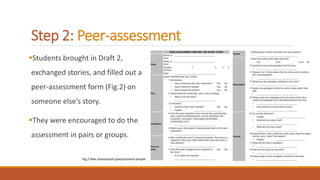
Step 2: Peer-assessment
Students brought in Draft 2,
exchanged stories, and filled out a
peer-assessment form (Fig.2) on
someone else’s story.
They were encouraged to do the
assessment in pairs or groups.
Fig.2 Peer-assessment questionnaire sample.
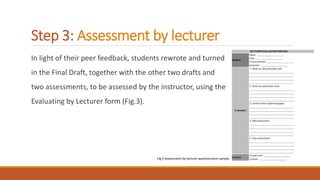
Step 3: Assessment by lecturer
In light of their peer feedback, students rewrote and turned
in the Final Draft, together with the other two drafts and
two assessments, to be assessed by the instructor, using the
Evaluating by Lecturer form (Fig.3).
Fig.3 Assessment by lecturer questionnaire sample.
Step 4: Portfolio
Students kept each story packet to include in their portfolio. At the end they
chose one story to be “published” in a class book (photocopied and plastic
bound), and they submitted their portfolio, which included the typed story of
their choice and a one-page written reflection explaining why they selected that
story.
Results
While we felt we had incorporated many aspects of good teaching (a genre
approach, a process approach, a well organized course, appropriate exams,
publication of the story), what made the course a resounding success was, in our
opinion, the continuous assessment devices that we used.
Results: Self-assessment
Self-assessment forced students to reread their stories and make some
improvements.
By the time the instructors received the stories, students had been re-worked
with most of the ordinary problems already solved.
As a result, instructors were free to concentrate on higher-level matters.
Results: Peer-assessment
Peer-assessment seemed to be the most successful of the CA devices.
Most students gave it the top rating. For example, when they saw what their
peers did not understand from their story, they worked hard to make their own
feelings clear to the readers (peers rather than teachers).
Results: Assessment by lecturer In Puhl’s words
Grading, the bane of teaching, actually became a joy; it was pleasurable to sit
down to read decently written stories, to know the students better through their
writing, and to see their progress through their drafts. We felt relieved of much
of the “drudgery” of teaching. We created and displayed the specific marking
criteria we used. Without making it a conscious objective, we had taught
students how writing develops through drafts. It seemed to be a new learning
experience, and a valuable, realistic one for them.
Results: Portfolio
As the semester went on, instructors could see how the students took
increasing ownership of their work.
They wrote less for “homework” and more for their readers and themselves.
They did soul-searching; they worked to find the best words. Contrary to
previous genres, this program succeeded in engaging the students in the
process.
Results: Benefits In Puhl’s words
Students began to work to communicate something of importance to
themselves, rather than mainly to an authority figure. They began to do their
work, not ours. The focus of evaluation shifted more to learners—and this,
without our even discussing it.
A community of learners developed, through peer-assessment in giving and
receiving extended written feedback. Class attendance improved, and sometimes
the students sent the work to class even if the writer could not make it!
Students began to experience the drafts not as required rewrites (which they
were), but as yet another chance to produce their best.
Continuous Assessment
TRADITIONAL vs. CONTINUOUS ASSESSMENT
A CONTRAST
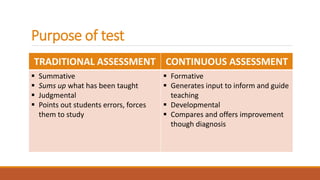
Purpose of test
TRADITIONAL ASSESSMENT CONTINUOUS ASSESSMENT
 Summative
 Sums up what has been taught
 Judgmental
 Points out students errors, forces
them to study
 Formative
 Generates input to inform and guide
teaching
 Developmental
 Compares and offers improvement
though diagnosis
Focus
TRADITIONAL ASSESSMENT CONTINUOUS ASSESSMENT
 Product of instruction
 Teacher-created activity
 Memorization and recall
 Process of instruction
 Learner-created activity
 Thinking, analyzing
Feedback
TRADITIONAL ASSESSMENT CONTINUOUS ASSESSMENT
 De-contextualized
 Scores
 Grades are final
 All-inclusive
 Peer/teacher comments
 Process, open to change
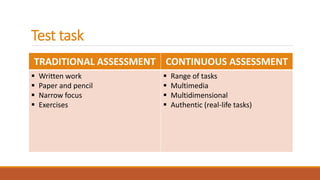
Test task
TRADITIONAL ASSESSMENT CONTINUOUS ASSESSMENT
 Written work
 Paper and pencil
 Narrow focus
 Exercises
 Range of tasks
 Multimedia
 Multidimensional
 Authentic (real-life tasks)
Classroom management
TRADITIONAL ASSESSMENT CONTINUOUS ASSESSMENT
 Formal
 Intrusive (class process is
interrupted)
 One opportunity to show
competence
 Results need time to be determined
 Informal
 Integrated (part o the class)
 Chance to revise, improve, add
 Feedback is immediate
Frame of reference
TRADITIONAL ASSESSMENT CONTINUOUS ASSESSMENT
 Books closed
 Norm-reference
 Learners are compared against
norms based on the test-takers
 Reference available
 Criterion-reference
 Learners are compared against
specified criteria of achievement
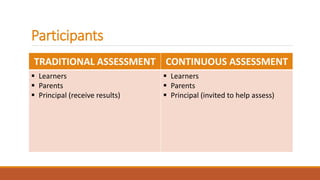
Participants
TRADITIONAL ASSESSMENT CONTINUOUS ASSESSMENT
 Learners
 Parents
 Principal (receive results)
 Learners
 Parents
 Principal (invited to help assess)
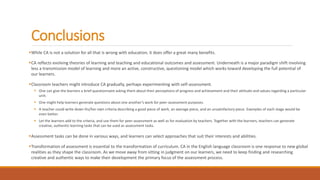
Conclusions
While CA is not a solution for all that is wrong with education, it does offer a great many benefits.
CA reflects evolving theories of learning and teaching and educational outcomes and assessment. Underneath is a major paradigm shift involving
less a transmission model of learning and more an active, constructive, questioning model which works toward developing the full potential of
our learners.
Classroom teachers might introduce CA gradually, perhaps experimenting with self-assessment.
 One can give the learners a brief questionnaire asking them about their perceptions of progress and achievement and their attitude and values regarding a particular
unit.
 One might help learners generate questions about one another’s work for peer-assessment purposes.
 A teacher could write down his/her own criteria describing a good piece of work, an average piece, and an unsatisfactory piece. Examples of each stage would be
even better.
 Let the learners add to the criteria, and use them for peer-assessment as well as for evaluation by teachers. Together with the learners, teachers can generate
creative, authentic learning tasks that can be used as assessment tasks.
Assessment tasks can be done in various ways, and learners can select approaches that suit their interests and abilities.
Transformation of assessment is essential to the transformation of curriculum. CA in the English language classroom is one response to new global
realities as they shape the classroom. As we move away from sitting in judgment on our learners, we need to keep finding and researching
creative and authentic ways to make their development the primary focus of the assessment process.
References
Puhl, C. (1997). Develop, Not Judge. Continuous Assessment in the ESL Classroom. English
Teaching Forum, 2-9, 15. Retrieved from http://dosfan.lib.uic.edu/usia/E-
USIA/forum/vols/vol35/no2/p2.htm

Continuous Assessment

  • 1.
    Continuous Assessment DEVELOP, NOTJUDGE: CONTINUOUS ASSESSMENT IN THE ESL CLASSROOM A CASE STUDY BY CAROL PUHL
  • 2.
    This presentation willreflect the findings presented by Carol Puhl about continuous Assessment (CA) CA was applied to primary education students enrolled in a semester-long second-year ESL writing course at the university level. The course focused on personal development in English. Specific semester objectives centered on narrative and descriptive skills. Most learners were 19 years old, some not very mature about their goals. Most had English as their second language.
  • 3.
    Considerations In Puhl’swords Most of these learners wanted to know, “What do I have to do to pass?” But in contrast, we wanted them to understand that they were here to learn. We also wanted to reach more than the good learners, for whom method is less important. Therefore, we aimed for the middle group, the ones we felt needed us in order to learn.
  • 4.
    CA Devices The devicesused for the study were: Self-assessment Peer-assessment Assessment by lecturer Portfolio
  • 5.
    Executing Continuous Assessment Students’assignment was to produce four short stories on topics of their own choice, they were encouraged to tell their own true stories. Each class was planed for the semester, specifying due dates, and using weekly class period to assist students in their work, helping them choose their topics, critiquing stories as examples, and teaching them aspects of narration, description, and, of course, English.
  • 6.
    Step1: Self-assessment When thestudents brought in their first story (Draft 1), they filled out a self-assessment sheet (Fig.1). Then they rewrote their story in light of this assessment. Fig.1 Self-assessment questionnaire sample.
  • 7.
    Step 2: Peer-assessment Studentsbrought in Draft 2, exchanged stories, and filled out a peer-assessment form (Fig.2) on someone else’s story. They were encouraged to do the assessment in pairs or groups. Fig.2 Peer-assessment questionnaire sample.
  • 8.
    Step 3: Assessmentby lecturer In light of their peer feedback, students rewrote and turned in the Final Draft, together with the other two drafts and two assessments, to be assessed by the instructor, using the Evaluating by Lecturer form (Fig.3). Fig.3 Assessment by lecturer questionnaire sample.
  • 9.
    Step 4: Portfolio Studentskept each story packet to include in their portfolio. At the end they chose one story to be “published” in a class book (photocopied and plastic bound), and they submitted their portfolio, which included the typed story of their choice and a one-page written reflection explaining why they selected that story.
  • 10.
    Results While we feltwe had incorporated many aspects of good teaching (a genre approach, a process approach, a well organized course, appropriate exams, publication of the story), what made the course a resounding success was, in our opinion, the continuous assessment devices that we used.
  • 11.
    Results: Self-assessment Self-assessment forcedstudents to reread their stories and make some improvements. By the time the instructors received the stories, students had been re-worked with most of the ordinary problems already solved. As a result, instructors were free to concentrate on higher-level matters.
  • 12.
    Results: Peer-assessment Peer-assessment seemedto be the most successful of the CA devices. Most students gave it the top rating. For example, when they saw what their peers did not understand from their story, they worked hard to make their own feelings clear to the readers (peers rather than teachers).
  • 13.
    Results: Assessment bylecturer In Puhl’s words Grading, the bane of teaching, actually became a joy; it was pleasurable to sit down to read decently written stories, to know the students better through their writing, and to see their progress through their drafts. We felt relieved of much of the “drudgery” of teaching. We created and displayed the specific marking criteria we used. Without making it a conscious objective, we had taught students how writing develops through drafts. It seemed to be a new learning experience, and a valuable, realistic one for them.
  • 14.
    Results: Portfolio As thesemester went on, instructors could see how the students took increasing ownership of their work. They wrote less for “homework” and more for their readers and themselves. They did soul-searching; they worked to find the best words. Contrary to previous genres, this program succeeded in engaging the students in the process.
  • 15.
    Results: Benefits InPuhl’s words Students began to work to communicate something of importance to themselves, rather than mainly to an authority figure. They began to do their work, not ours. The focus of evaluation shifted more to learners—and this, without our even discussing it. A community of learners developed, through peer-assessment in giving and receiving extended written feedback. Class attendance improved, and sometimes the students sent the work to class even if the writer could not make it! Students began to experience the drafts not as required rewrites (which they were), but as yet another chance to produce their best.
  • 16.
    Continuous Assessment TRADITIONAL vs.CONTINUOUS ASSESSMENT A CONTRAST
  • 17.
    Purpose of test TRADITIONALASSESSMENT CONTINUOUS ASSESSMENT  Summative  Sums up what has been taught  Judgmental  Points out students errors, forces them to study  Formative  Generates input to inform and guide teaching  Developmental  Compares and offers improvement though diagnosis
  • 18.
    Focus TRADITIONAL ASSESSMENT CONTINUOUSASSESSMENT  Product of instruction  Teacher-created activity  Memorization and recall  Process of instruction  Learner-created activity  Thinking, analyzing
  • 19.
    Feedback TRADITIONAL ASSESSMENT CONTINUOUSASSESSMENT  De-contextualized  Scores  Grades are final  All-inclusive  Peer/teacher comments  Process, open to change
  • 20.
    Test task TRADITIONAL ASSESSMENTCONTINUOUS ASSESSMENT  Written work  Paper and pencil  Narrow focus  Exercises  Range of tasks  Multimedia  Multidimensional  Authentic (real-life tasks)
  • 21.
    Classroom management TRADITIONAL ASSESSMENTCONTINUOUS ASSESSMENT  Formal  Intrusive (class process is interrupted)  One opportunity to show competence  Results need time to be determined  Informal  Integrated (part o the class)  Chance to revise, improve, add  Feedback is immediate
  • 22.
    Frame of reference TRADITIONALASSESSMENT CONTINUOUS ASSESSMENT  Books closed  Norm-reference  Learners are compared against norms based on the test-takers  Reference available  Criterion-reference  Learners are compared against specified criteria of achievement
  • 23.
    Participants TRADITIONAL ASSESSMENT CONTINUOUSASSESSMENT  Learners  Parents  Principal (receive results)  Learners  Parents  Principal (invited to help assess)
  • 24.
    Conclusions While CA isnot a solution for all that is wrong with education, it does offer a great many benefits. CA reflects evolving theories of learning and teaching and educational outcomes and assessment. Underneath is a major paradigm shift involving less a transmission model of learning and more an active, constructive, questioning model which works toward developing the full potential of our learners. Classroom teachers might introduce CA gradually, perhaps experimenting with self-assessment.  One can give the learners a brief questionnaire asking them about their perceptions of progress and achievement and their attitude and values regarding a particular unit.  One might help learners generate questions about one another’s work for peer-assessment purposes.  A teacher could write down his/her own criteria describing a good piece of work, an average piece, and an unsatisfactory piece. Examples of each stage would be even better.  Let the learners add to the criteria, and use them for peer-assessment as well as for evaluation by teachers. Together with the learners, teachers can generate creative, authentic learning tasks that can be used as assessment tasks. Assessment tasks can be done in various ways, and learners can select approaches that suit their interests and abilities. Transformation of assessment is essential to the transformation of curriculum. CA in the English language classroom is one response to new global realities as they shape the classroom. As we move away from sitting in judgment on our learners, we need to keep finding and researching creative and authentic ways to make their development the primary focus of the assessment process.
  • 25.
    References Puhl, C. (1997).Develop, Not Judge. Continuous Assessment in the ESL Classroom. English Teaching Forum, 2-9, 15. Retrieved from http://dosfan.lib.uic.edu/usia/E- USIA/forum/vols/vol35/no2/p2.htm