Competency-based
Education
Definition & History
Gerome Bryan S. Laureta
Definition of CBE1
Compete
 is the ability to outperform others
 to try to be noticed, accepted, or
chosen over something else
 establishing superiority over others
who are trying to do the same.
Competency
is having the ability to do somethings
successful which requires knowledge
and skill to have mastery and
effectiveness to a certain task.
What is CBE or
Competency-
based Education?
So now with that said
Is an dynamic educational
program developed in USA
that was idelized by John
Dewey in the early1900s then
began to modernized with
online technology in the near
20th century.
Competency
Based
Education
It is a carrier focused educational
program where you study only the
knowledge, skills, and ability you need
to know on your chosen college
degree. It only need specific subject for
you to get a job and/or compete for a
job.
History of CBE
in Chronological Order
2
“
From the traditional general
education to the classified specific
type of educational curriculum.
Here we will see the improvement
of the so called personalized
educational program or CBE.
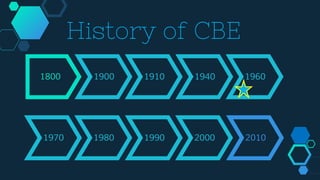
1800 1900 1910 1940 1960
History of CBE
1970 1980 1990 2000 2010
Late 1800s
 Secondary education became the
standard learning system.
 Students were graded based on the time
spent in class (seat time) and the
performance and knowledge he/she has
acquire on that time span
Back
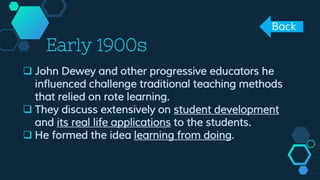
Early 1900s
 John Dewey and other progressive educators he
influenced challenge traditional teaching methods
that relied on rote learning.
 They discuss extensively on student development
and its real life applications to the students.
 He formed the idea learning from doing.
Back
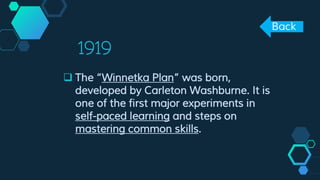
1919
 The “Winnetka Plan” was born,
developed by Carleton Washburne. It is
one of the first major experiments in
self-paced learning and steps on
mastering common skills.
Back
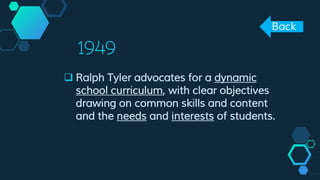
1949
 Ralph Tyler advocates for a dynamic
school curriculum, with clear objectives
drawing on common skills and content
and the needs and interests of students.
Back
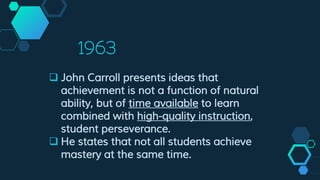
1963
 John Carroll presents ideas that
achievement is not a function of natural
ability, but of time available to learn
combined with high-quality instruction,
student perseverance.
 He states that not all students achieve
mastery at the same time.
Late 1960s
 “Open classroom” models focus on
“learning by doing,” exploring
“interest centers” at a student’s own
pace, with teacher guidance.
1968
 Benjamin Bloom publishes “Learning for
Mastery,” which lays a foundation for
organizing schools to allow individual
students the time needed to meet
objective learning goals.
Back
1970s
 Fred S. Keller proposes far more individually
paced mastery-based approach.
 The Personalized System of Instruction divides
material into self-contained modules, with
specific learning objectives.
 Students advance only after mastery of
previous module.
1970s-1980s
 Period of mastery in learning.
 Extensive research finds impressive learning
gains.
 Early criticisms included a lack of commonly
recognized, highly specific educational goals,
and of diagnostic, assessment, and progress
tracking tools.
Back
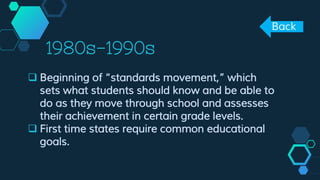
1980s-1990s
 Beginning of “standards movement,” which
sets what students should know and be able to
do as they move through school and assesses
their achievement in certain grade levels.
 First time states require common educational
goals.
Back
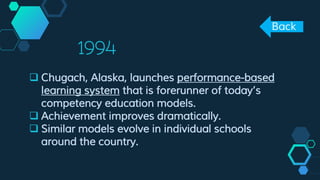
1994
 Chugach, Alaska, launches performance-based
learning system that is forerunner of today’s
competency education models.
 Achievement improves dramatically.
 Similar models evolve in individual schools
around the country.
Back
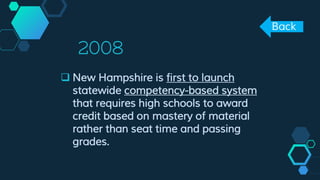
2008
 New Hampshire is first to launch
statewide competency-based system
that requires high schools to award
credit based on mastery of material
rather than seat time and passing
grades.
Back
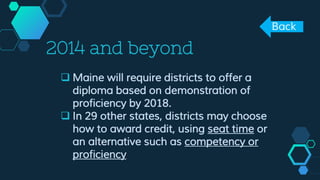
2014 and beyond
 Maine will require districts to offer a
diploma based on demonstration of
proficiency by 2018.
 In 29 other states, districts may choose
how to award credit, using seat time or
an alternative such as competency or
proficiency
Back
Place your screenshot here
Thanks for
Watching!

Competency Based Education

  • 1.
  • 2.
  • 3.
    Compete  is theability to outperform others  to try to be noticed, accepted, or chosen over something else  establishing superiority over others who are trying to do the same.
  • 4.
    Competency is having theability to do somethings successful which requires knowledge and skill to have mastery and effectiveness to a certain task.
  • 5.
    What is CBEor Competency- based Education? So now with that said
  • 6.
    Is an dynamiceducational program developed in USA that was idelized by John Dewey in the early1900s then began to modernized with online technology in the near 20th century. Competency Based Education
  • 7.
    It is acarrier focused educational program where you study only the knowledge, skills, and ability you need to know on your chosen college degree. It only need specific subject for you to get a job and/or compete for a job.
  • 8.
    History of CBE inChronological Order 2
  • 9.
    “ From the traditionalgeneral education to the classified specific type of educational curriculum. Here we will see the improvement of the so called personalized educational program or CBE.
  • 10.
    1800 1900 19101940 1960 History of CBE 1970 1980 1990 2000 2010
  • 11.
    Late 1800s  Secondaryeducation became the standard learning system.  Students were graded based on the time spent in class (seat time) and the performance and knowledge he/she has acquire on that time span Back
  • 12.
    Early 1900s  JohnDewey and other progressive educators he influenced challenge traditional teaching methods that relied on rote learning.  They discuss extensively on student development and its real life applications to the students.  He formed the idea learning from doing. Back
  • 13.
    1919  The “WinnetkaPlan” was born, developed by Carleton Washburne. It is one of the first major experiments in self-paced learning and steps on mastering common skills. Back
  • 14.
    1949  Ralph Tyleradvocates for a dynamic school curriculum, with clear objectives drawing on common skills and content and the needs and interests of students. Back
  • 15.
    1963  John Carrollpresents ideas that achievement is not a function of natural ability, but of time available to learn combined with high-quality instruction, student perseverance.  He states that not all students achieve mastery at the same time.
  • 16.
    Late 1960s  “Openclassroom” models focus on “learning by doing,” exploring “interest centers” at a student’s own pace, with teacher guidance.
  • 17.
    1968  Benjamin Bloompublishes “Learning for Mastery,” which lays a foundation for organizing schools to allow individual students the time needed to meet objective learning goals. Back
  • 18.
    1970s  Fred S.Keller proposes far more individually paced mastery-based approach.  The Personalized System of Instruction divides material into self-contained modules, with specific learning objectives.  Students advance only after mastery of previous module.
  • 19.
    1970s-1980s  Period ofmastery in learning.  Extensive research finds impressive learning gains.  Early criticisms included a lack of commonly recognized, highly specific educational goals, and of diagnostic, assessment, and progress tracking tools. Back
  • 20.
    1980s-1990s  Beginning of“standards movement,” which sets what students should know and be able to do as they move through school and assesses their achievement in certain grade levels.  First time states require common educational goals. Back
  • 21.
    1994  Chugach, Alaska,launches performance-based learning system that is forerunner of today’s competency education models.  Achievement improves dramatically.  Similar models evolve in individual schools around the country. Back
  • 22.
    2008  New Hampshireis first to launch statewide competency-based system that requires high schools to award credit based on mastery of material rather than seat time and passing grades. Back
  • 23.
    2014 and beyond Maine will require districts to offer a diploma based on demonstration of proficiency by 2018.  In 29 other states, districts may choose how to award credit, using seat time or an alternative such as competency or proficiency Back
  • 24.
  • 25.
  • 26.