The document provides a comprehensive overview of competency-based education (CBE), particularly in the context of nursing. It outlines its purpose, components, characteristics, advantages, and disadvantages, as well as a comparison to traditional education methods, emphasizing the importance of measuring student learning rather than time. Additionally, it discusses different approaches to CBE and presents research findings that highlight its effectiveness and implementation in medical education.
Competency based education
SUBMITTEDTO: SUBMITTED BY:
DR. RAKESH SHARMA MS. KOMAL
ASSISTANT PROFESSOR ROLL NO. 8
AIIMS, RISHIKESH MSC. NURSING 1ST YEAR
3.
INDEX
Introduction (definition,purposes, components, procedure)
Comparison of traditional and CBE
Characteristics of CBE
Teaching and enhancement of CBE
CBE in Nursing Education
1.Introduction
We arein period of learning revolution.
Current learning pathways have been fashioned by intense
competition from organizations whose soul is to impart learning
and by rapid advances in information technology.
The learning revolution can be established in competency based
approach.
6.
We cannotpresume that traditional approaches in nursing education
are automatically the most productive ways to meet the learning
needs of today's students.
We must explorer innovative ways to help professional perpetuate
necessary competencies and obtain new competencies throughout
their career
7.
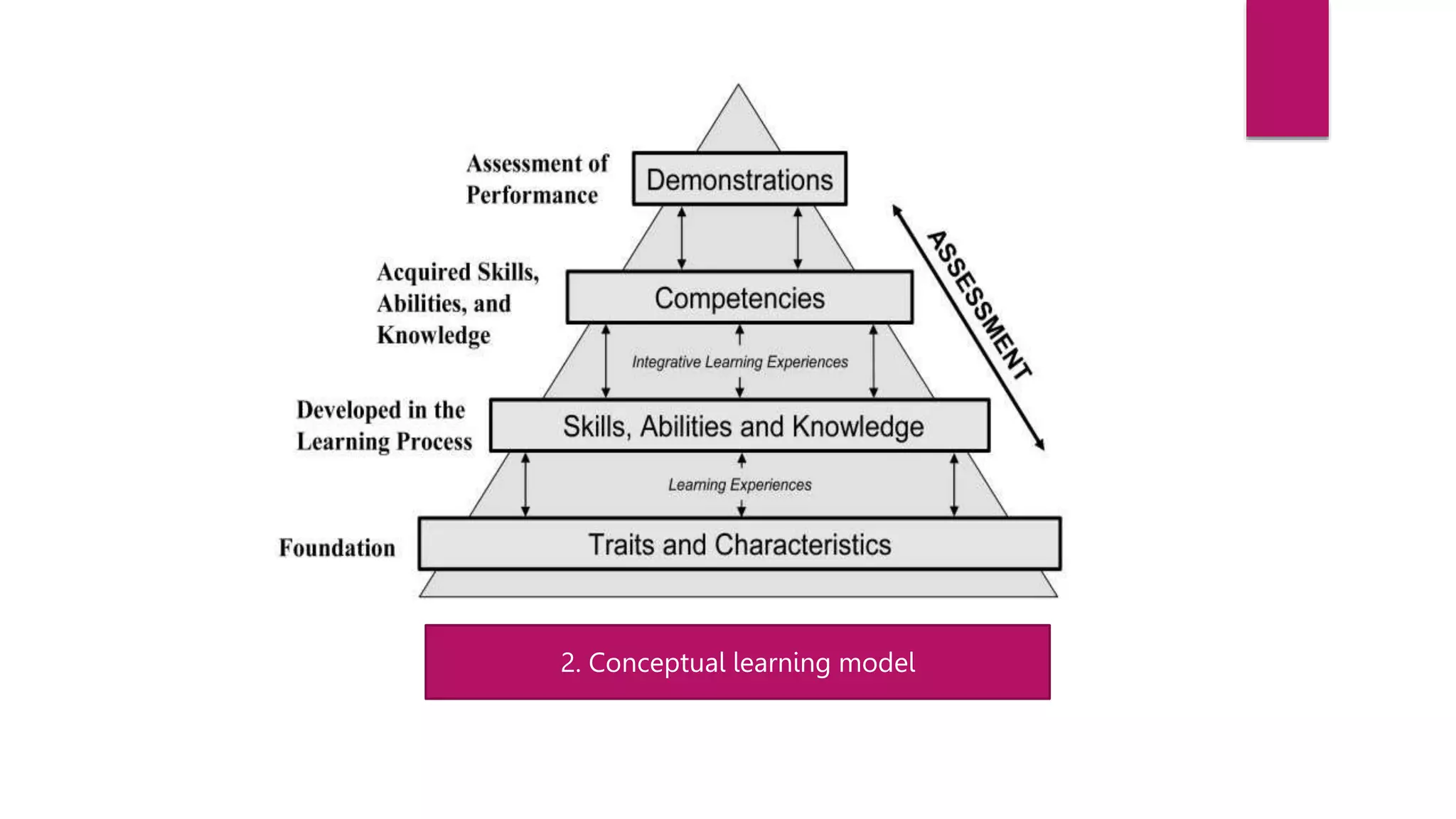
What is competency?
Competency focuses on individuals ability to perform activities
related to work life skills or learning
Competence describe action or skills the person should be able to
demonstrate.
A competency is task performed to meet an established standard.
In nursing education it is a nursing activity or task performed to
meet an established criteria or standard of performance.
Competency should be taught, not the tasks.
8.
Definition by Organizationfor economic
cooperation and development (OECD)
A competency is more than just knowledge and skills. It involves
the ability to meet complex demands, by drawing upon and
mobilizing psychosocial resources in a particular context.
9.
Indian institute ofmedicine (IOM)
Definition of Professional Competency
An individual who demonstrates competence is performing at an
expected level.
Habitual and judicious use of communication, knowledge,
technical skills, clinical reasoning, emotions, values, and reflection
in daily practice for the benefit of the individual and community
being served (IOM, 2003).
10.
Baccalaureate Nursing Competencies
Start with evidence-based and consensus determined competencies.
These are derived thoughtfully by a group of experts in nursing
education and service with input from relevant stakeholders
including leaders in higher education, and professional and inter
professional organizations, health policy and workforce experts and
recipients of care.
11.
Purposes of CBE
Measure student learning rather than time.
Harness the power of technology for teaching and learning,
example: computer mediated instructions gives ability to individual
learning.
Change the faculty role (guide on the side)
Define what students should know and be able to do and they
graduated when they demonstrate their competency.
12.
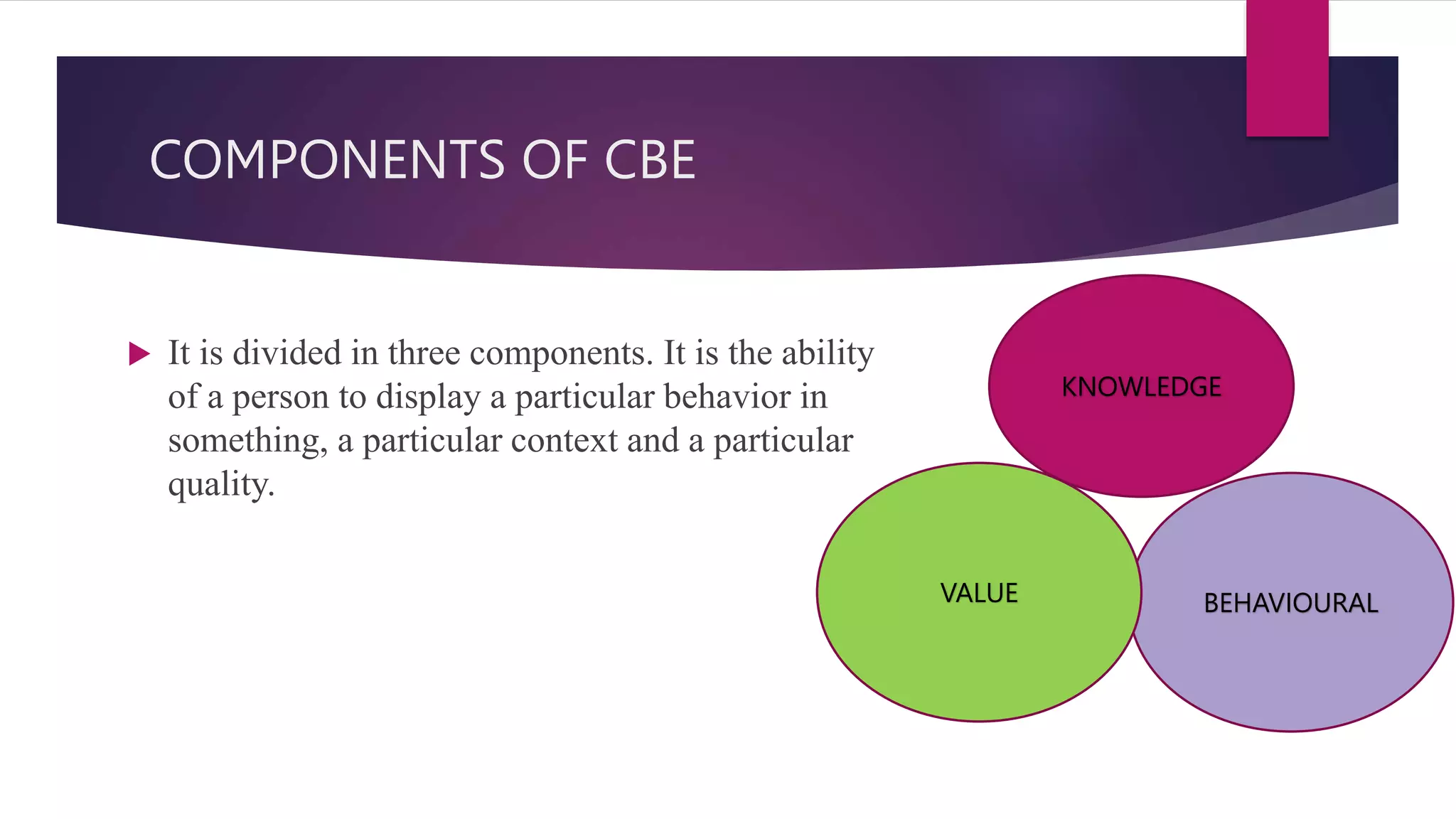
COMPONENTS OF CBE
It is divided in three components. It is the ability
of a person to display a particular behavior in
something, a particular context and a particular
quality.
KNOWLEDGE
BEHAVIOURAL
VALUE
13.
Competency development
Contextis key factor
Policy and position statements for health care professionals and
requisites for quality health care.
National and international recommendations.
14.
Based onevidence.
Based on the expected professional nursing roles:
1. Provider of care
2. Coordinator of care
3. Member of the profession
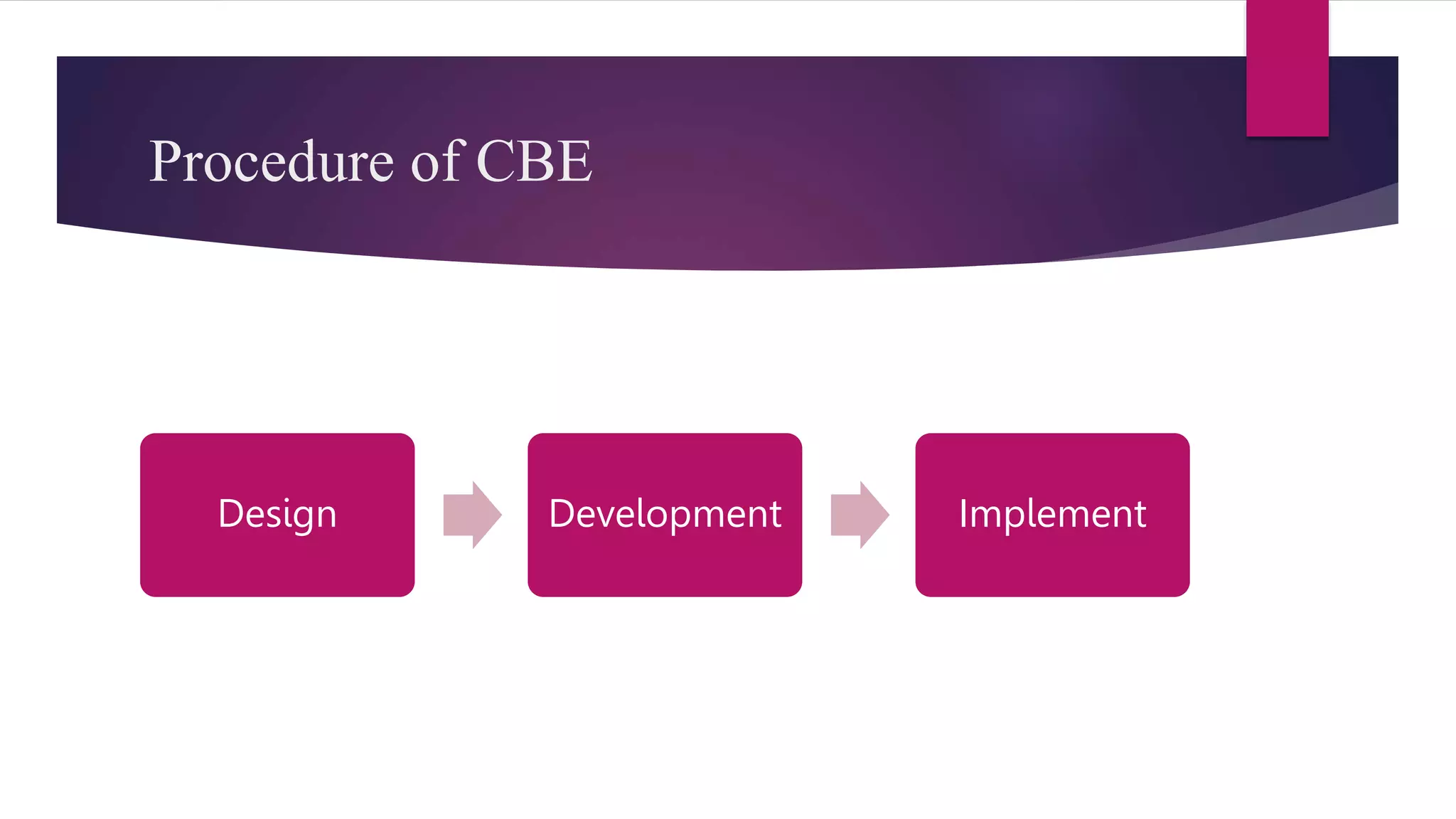
1.Design
To settraining approach.
To develop learning purposes.
To determine operational scales.
To design education.
17.
2.Development
To preparelearning guide.
To verify task.
To prepare course plans.
To prepare auxiliary medium.
To review materials and procedures.
CBE in teachingand learning
Competency based teaching :
The most important characteristic of CBE is that it measures
learning rather than time. While most Universities hold time
requirements constant and let learning vary, competency based
learning allows us to hold learning constant and let time vary.
21.
Characteristics of competencybased
teaching
Understand how students learn.
Correlate principles of learning and teaching. Teachers are
expected to blend the principles of teaching and learning while
imparting CBE. •
Act as catalyst rather control teaching. Varying instruction means
using different methods to deliver lessons to students.
22.
Characteristics cont.
CBEdemands student accountability as it is a significant trait to be developed
among students.
It helps them to take responsibility for their actions, learning, and helps improve
academic performance and achievements.
Offer timely, specific feedback on learner progress beginning with learner self
assessment. This helps students to grow in the direction of the objectives to be
accomplished.
23.
Display humility,critical thinking, respect, competency and caring
at all times. This reflects the value component that a student learns
from teachers particularly through observation.
Feedback when provided timely and making it specific helps
students to focus on their weakness and aids them in self
evaluation. Individual traits and characteristics determine that all
individuals are not same.
24.
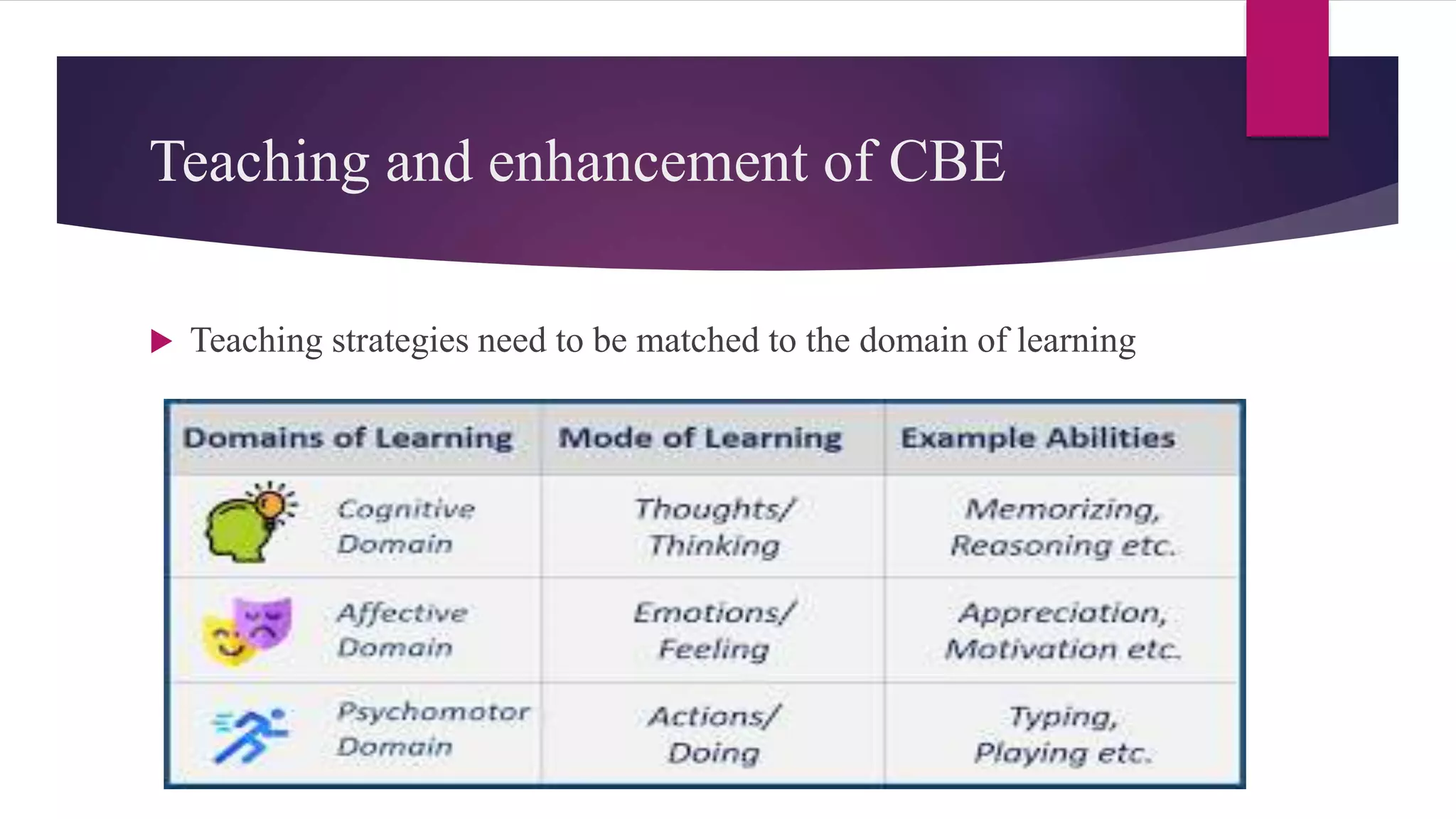
Teaching and enhancementof CBE
Teaching strategies need to be matched to the domain of learning
25.
Theories related toCBE
Pertaining to CBE in learning, a couple of theories are dealt those
envelopes CBE.
1. Constructivism:
It is basically a theory which is based on observation and scientific
study, and about how people learn.
It says that people construct their own knowledge of the world,
through experiencing things and reflecting on those experiences.
Competency based approachin nurse
education:
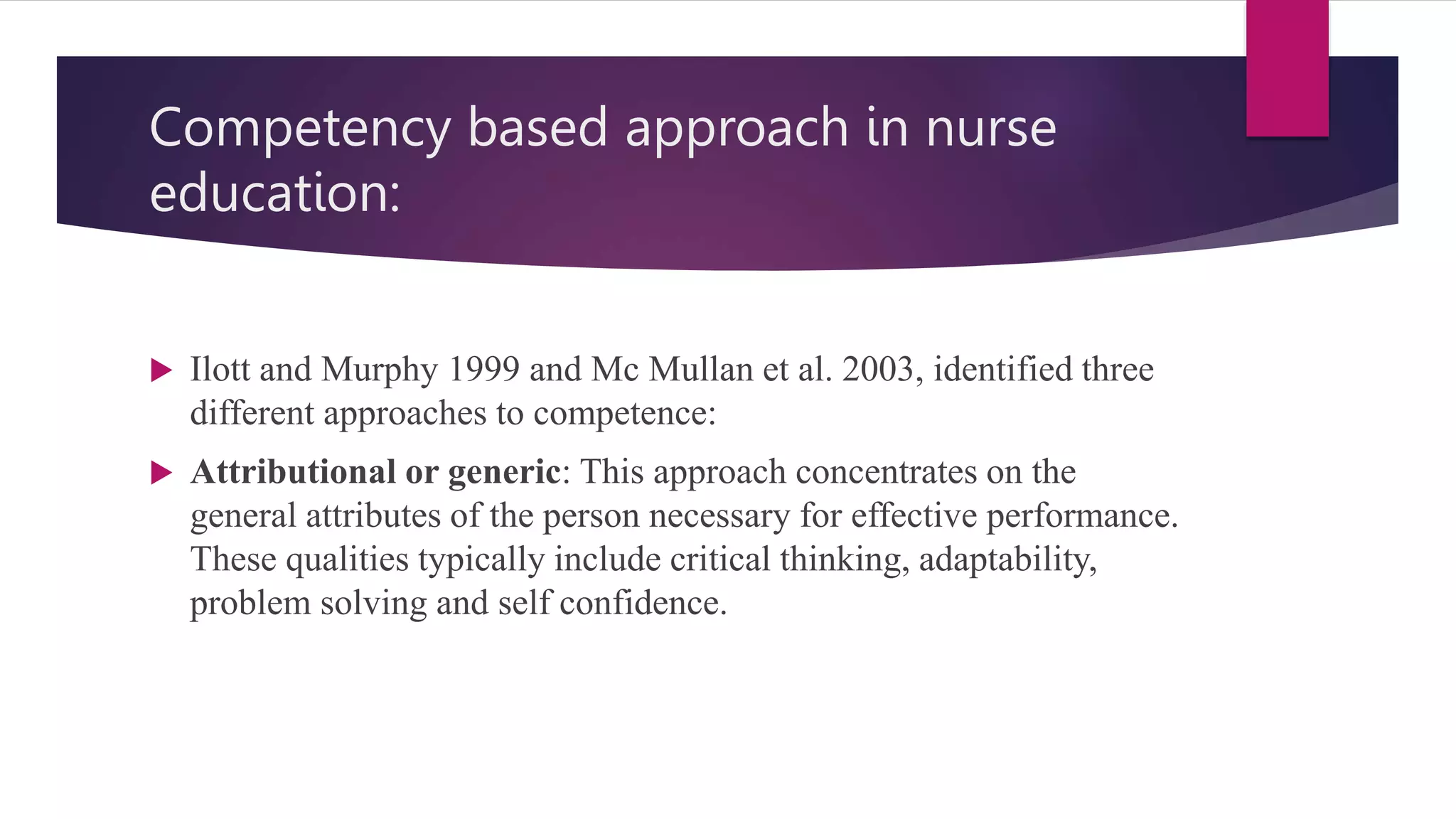
Ilott and Murphy 1999 and Mc Mullan et al. 2003, identified three
different approaches to competence:
Attributional or generic: This approach concentrates on the
general attributes of the person necessary for effective performance.
These qualities typically include critical thinking, adaptability,
problem solving and self confidence.
28.
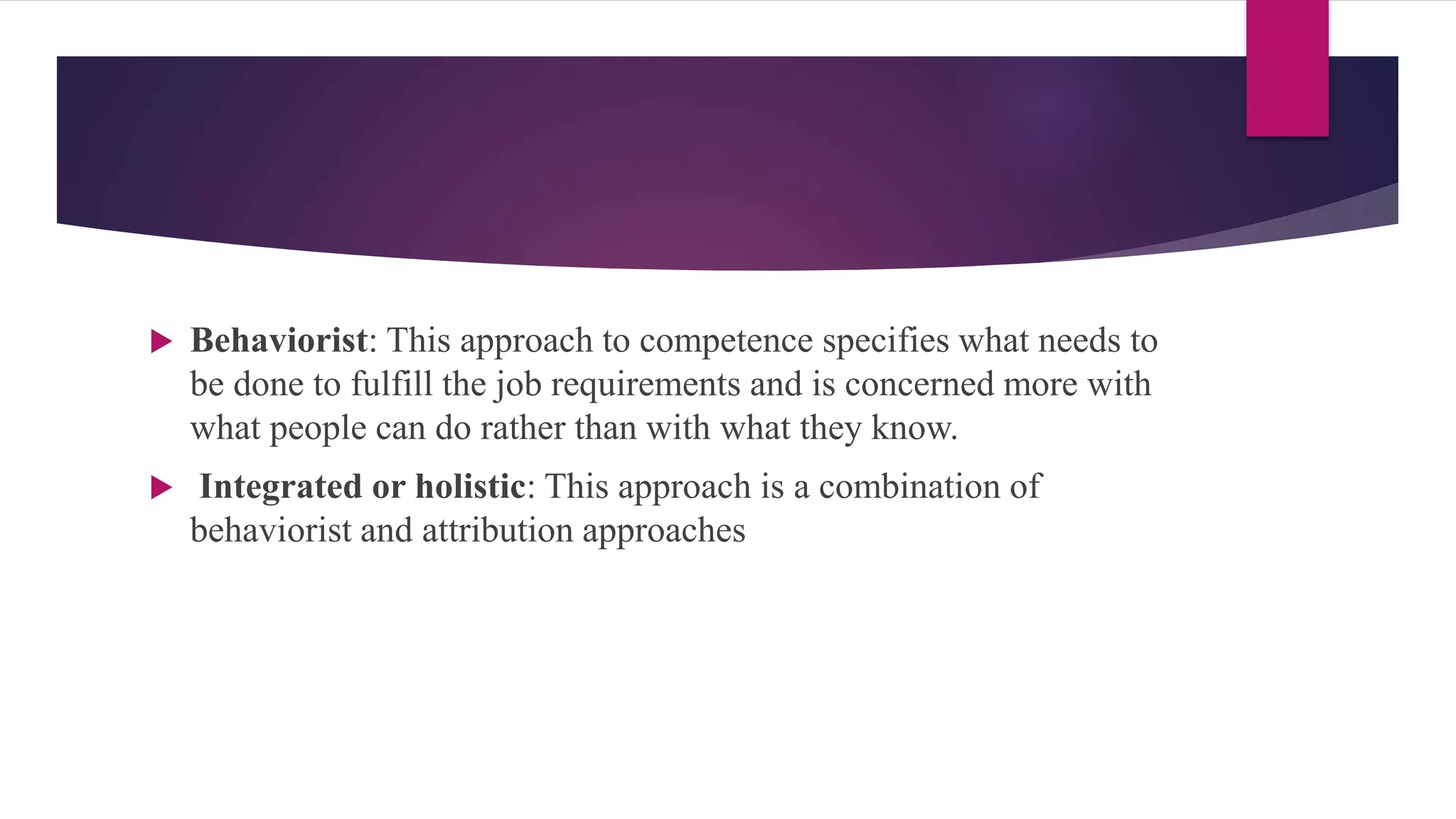
Behaviorist: Thisapproach to competence specifies what needs to
be done to fulfill the job requirements and is concerned more with
what people can do rather than with what they know.
Integrated or holistic: This approach is a combination of
behaviorist and attribution approaches
29.
Advantages of CBE
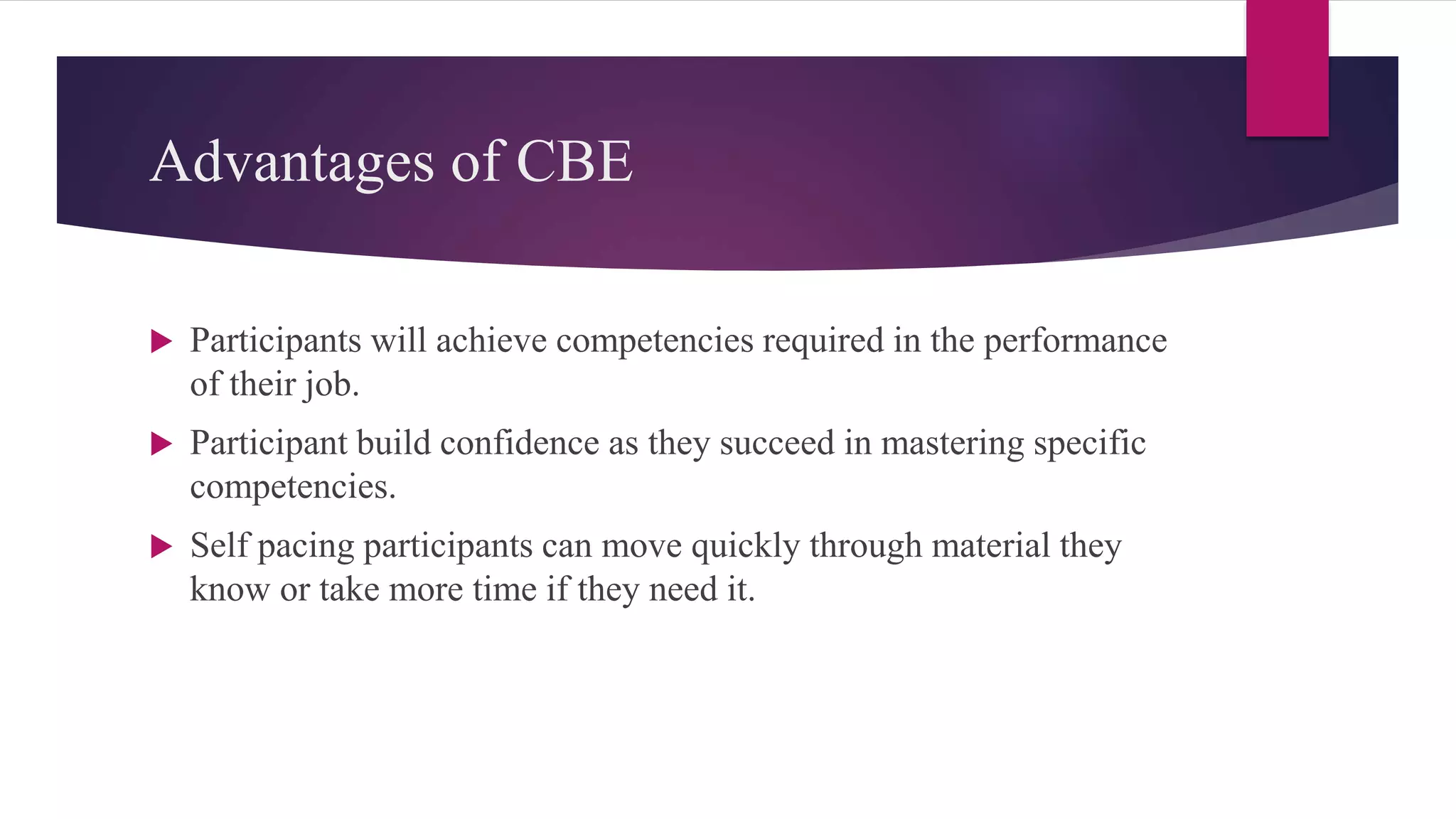
Participants will achieve competencies required in the performance
of their job.
Participant build confidence as they succeed in mastering specific
competencies.
Self pacing participants can move quickly through material they
know or take more time if they need it.
30.
Participants receivea list of competencies they achieved.
Provide standards for determining how well learning has occurred
both at the individual or organization level
31.
Disadvantages of CBE
CBE course is only effective as process used to identify the
competencies.
When no or little orientation is given to identification of essential
job skills, then the resulting training courses is likely to be
ineffective.
Unless initial training and follow up assistant is provided for the
trainers, there is tendency to teach as we were taught and trainers
quickly slip back into the role of the traditional teacher.
32.
DIFFERING VIEWS OFCBE
According to Voorhees 2001, Institutions of higher education are
recognizing that institutional accountability, articulation and student
transfer concerns are reason for considering movement to CBE.
Opponents of CBE higher education raise following issues for not
implementing change:
General resistance to change in college and universities
33.
DIFFERING VIEWS CONT.
CBE is currently viewed as being useful primarily in vocational or
technical education setting.
The faculty currently determine assessments based on professional
judgement, and CBE shifts this process to include others.
Lack of emphasis on CBE in programs that prepare educators.
Need to train educators to recognize curriculum.
34.
RESEARCH CORNER
1. Towarda definition of competency based education in
medicine: a systematic review of published definitions.
Jason R frank at L dot Med tech dot 2010 aim to In to systematically
review CBE related literature in order to identify key terms and
constructs to inform the development of a useful working definition of
CBE for medical education.
35.
Result: Theyidentified 15,956 records a total of 173 record were
analysed be identified 4 major themes, organising framework,
rationale, contrast with time and implementing a CBE and 6 sub
themes, outcomes, defined curriculum of competencies,
demonstrable, assessment, learner centred and societal needs.
36.
2. Thepromise of competency based education in the health
professions for improving global health
Larry D Gruppen, Rajesh S Mangrulkar and Joseph C kolars
Article no. 43 (2012).
Abstract: CBE provides a useful alternative to time based models
for preparing health professional and constructing educational
programs we describe the concepts of competence and
competencies as well as the critical curricular implication that
arrived to focus on competence rather than time.
37.
The implicationsinclude defining education outcomes, developing
individualized learning pathways, setting standards and centrality
of valid assessment so as to reflect stakeholder priorities,
They also highlight four challenges to CBE ,certifying health needs
of community, defining competencies, developing self regulated
and flexible learning options and assessing learners for competence
38.
3. Exploringthe learner’s perspectives on competency based
medical education
Rashmi Ramanathan and ATL 2021
Background: A novel innovation medical education was initiated by
the Medical Council of India after 21 years CBME is an effective
strategy which requires integration of knowledge attitude skills
values and responsiveness the aim was to assess students
perspective on CBME.
39.
Material andmethods:
Cross-sectional descriptive study was conducted among first year
MBAs students validated questionnaire was administered through
Google link.
Result: Total of 987 students from 74 medical colleges responded
nearly ¾ find that foundation course attitude ethics communication
module and early clinical exposure were necessary
Conclusion: CBME when meticulously adopted will inspire
student enthusiasm for learning.
40.
BIBLIOGRAPHY
Bhaskara RajDE,Bhaskar N. Textbook of nursing education. 2nd edition.
Emmess Medical Publishers; 2015. p.108-109.
Anema GM, McCoy J. Competency based nursing education: Guide to achieving
outstanding learner outcomes. 1st edition. New York; Springer publications; 2010.
p. 5-12.
Frank JR, Mungroo R, Ahmad Y, Wang M, De Rossi S, Horsley T. Toward a
definition of competency-based education in medicine: a systematic review of
published definitions. Med Teach. 2010;32(8):631-7. doi:
10.3109/0142159X.2010.500898. PMID: 20662573.
Gruppen, L.D., Mangrulkar, R.S. & Kolars, J.C. The promise of competency-
based education in the health professions for improving global health. Hum
Resour Health 10, 43 (2012). https://doi.org/10.1186/1478-4491-10-43
41.
Ramanathan R,Shanmugam J, Gopalkrishna SM, Palanisami K, Narayanam S.
Exploring learners perspective on competency based medical education ,J edu
health promot 2021:10:109.
Pramila R, “Competency based education: Towards Self – Direction”,
International Journal of Science and Research (USR), Volume 8 issue 5, May
2019, 46-50.
The Essentials of Baccalaureate Education for Professional Nursing Practice
(2008) – http://www.aacn.nche.edu/educationresources/baccessentials08.pdf –
http://www.aacn.nche.edu/faculty/facultydevelopment/facultytoolkits/BacEssToo
lkit.pdf









![competency based education [Autosaved]1.ppt](https://cdn.slidesharecdn.com/ss_thumbnails/competencybasededucationautosaved1-230723164405-7499f07f-thumbnail.jpg?width=640&height=640&fit=bounds)


