Bresenham’s Line Algorithm
.
2
of
13
The Problem (cont…)
What happens when we try to draw this on a
pixel based display?
How do we choose which pixels to turn on?
3
of
13
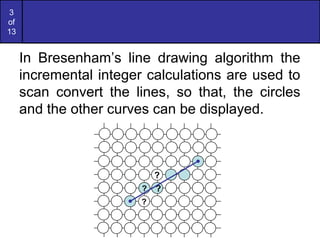
In Bresenham’s line drawing algorithm the
incremental integer calculations are used to
scan convert the lines, so that, the circles
and the other curves can be displayed.
?
? ?
?
4
of
13
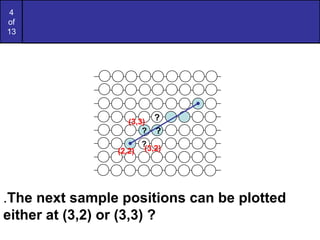
.The next sample positions can be plotted
either at (3,2) or (3,3) ?
?
? ?
?
(2,2) (3,2)
(3,3)
5
of
13
6
of
13
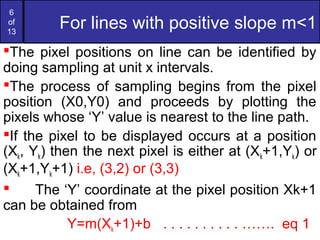
For lines with positive slope m<1
The pixel positions on line can be identified by
doing sampling at unit x intervals.
The process of sampling begins from the pixel
position (X0,Y0) and proceeds by plotting the
pixels whose ‘Y’ value is nearest to the line path.
If the pixel to be displayed occurs at a position
(Xk, Yk) then the next pixel is either at (Xk+1,Yk) or
(Xk+1,Yk+1) i.e, (3,2) or (3,3)
 The ‘Y’ coordinate at the pixel position Xk+1
can be obtained from
Y=m(Xk+1)+b . . . . . . . . . . ……. eq 1
7
of
13
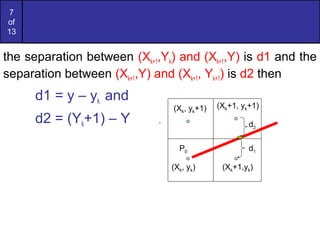
the separation between (Xk+1,Yk) and (Xk+1,Y) is d1 and the
separation between (Xk+1,Y) and (Xk+1, Yk+1) is d2 then
d1 = y – yk and
d2 = (Yk+1) – Y .
(Xk, yk)
(Xk, yk+1) (Xk+1, yk+1)
(Xk+1,yk)
P0 d1
d2
8
of
13
Y=m(Xk+1)+b . . . . . . . ……. eq 1
d1=y – yk
d1=m(xk+1)+b – Yk ( from eqn (1) …..( 2)
And d2= (Yk+1) – Y
=(YK+1) – [m(Xk+1)+b]
=(YK+1) – m(Xk+1) – b …….(3)
The difference is given as
d1-d2 =
= m(Xk+1)+b-Yk-[(Yk+1)-m(Xk+1)-b]
=m(Xk+1)+b-Yk-(Yk+1)+m(Xk+1)+b
d1-d2 = 2m(X +1)-2Y +2b – 1 ………(4)
9
of
13
Contd..
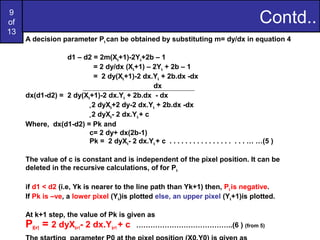
A decision parameter Pk can be obtained by substituting m= dy/dx in equation 4
d1 – d2 = 2m(Xk+1)-2Yk+2b – 1
= 2 dy/dx (Xk+1) – 2Yk + 2b – 1
= 2 dy(Xk+1)-2 dx.Yk + 2b.dx -dx
dx
dx(d1-d2) = 2 dy(Xk+1)-2 dx.Yk + 2b.dx - dx
= 2 dyXk+2 dy-2 dx.Yk + 2b.dx -dx
= 2 dyXk- 2 dx.Yk + c
Where, dx(d1-d2) = Pk and
c= 2 dy+ dx(2b-1)
Pk = 2 dyXk- 2 dx.Yk + c . . . . . . . . . . . . . . . . . . . … …(5 )
The value of c is constant and is independent of the pixel position. It can be
deleted in the recursive calculations, of for Pk
if d1 < d2 (i.e, Yk is nearer to the line path than Yk+1) then, Pk is negative.
If Pk is –ve, a lower pixel (Yk)is plotted else, an upper pixel (Yk+1)is plotted.
At k+1 step, the value of Pk is given as
PK+1 = 2 dyXk+1- 2 dx.Yk+1 + c …………………………………..(6 ) (from 5)
10
of
13
(X0, y0)
(X0, y0+1) (X0+1, y0+1)
(X0+1,y0)
P0 d1
d2
y=mx+c is the eq of line
In col 2 the line is passing through x0+1 so the y
value is given by
y=m(x0+1)+c (green dot)
Now we need to find out the values of d1 and d2
d1= y-y0
d2=(y0+1)-y
d1=m(x0+1) – y0 and d2= (y0+1) - m(x0+1)
d1-d2=[mx0+m – y0] - [(y0+1) - mx0-m]
=mx0+m – y0 - y0-1 + mx0+m
= 2mx0+2m –2y0-1
= 2mx0+2m –2mx0-1 (y=mx+c passes thr
(x0, y0) so we can say y0=mx0+c)
d1-d2 = 2mx0+2m –2mx0-1
d1-d2=2m-1 ( m= ∆y / ∆x)
d1-d2 = 2∆y/ ∆x - 1
Col 1 Col 2
∆x(d1-d2) = 2∆y - ∆x∆x(d1-d2) = 2∆y - ∆x
11
of
13
Bresenham’s algorithm
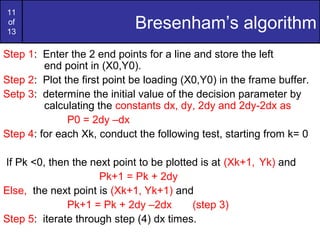
Step 1: Enter the 2 end points for a line and store the left
end point in (X0,Y0).
Step 2: Plot the first point be loading (X0,Y0) in the frame buffer.
Setp 3: determine the initial value of the decision parameter by
calculating the constants dx, dy, 2dy and 2dy-2dx as
P0 = 2dy –dx
Step 4: for each Xk, conduct the following test, starting from k= 0
If Pk <0, then the next point to be plotted is at (Xk+1, Yk) and
Pk+1 = Pk + 2dy
Else, the next point is (Xk+1, Yk+1) and
Pk+1 = Pk + 2dy –2dx (step 3)
Step 5: iterate through step (4) dx times.
12
of
13
Task
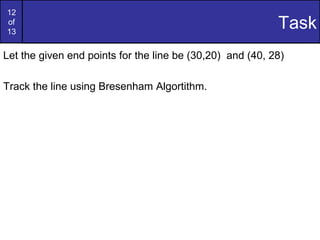
Let the given end points for the line be (30,20) and (40, 28)
Track the line using Bresenham Algortithm.
13
of
13
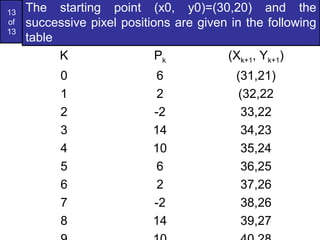
The starting point (x0, y0)=(30,20) and the
successive pixel positions are given in the following
table
K Pk (Xk+1, Yk+1)
0 6 (31,21)
1 2 (32,22
2 -2 33,22
3 14 34,23
4 10 35,24
5 6 36,25
6 2 37,26
7 -2 38,26
8 14 39,27
14
of
13
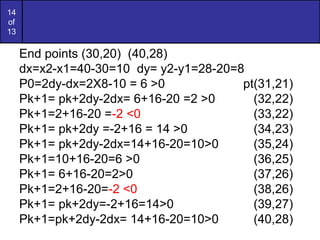
End points (30,20) (40,28)
dx=x2-x1=40-30=10 dy= y2-y1=28-20=8
P0=2dy-dx=2X8-10 = 6 >0 pt(31,21)
Pk+1= pk+2dy-2dx= 6+16-20 =2 >0 (32,22)
Pk+1=2+16-20 =-2 <0 (33,22)
Pk+1= pk+2dy =-2+16 = 14 >0 (34,23)
Pk+1= pk+2dy-2dx=14+16-20=10>0 (35,24)
Pk+1=10+16-20=6 >0 (36,25)
Pk+1= 6+16-20=2>0 (37,26)
Pk+1=2+16-20=-2 <0 (38,26)
Pk+1= pk+2dy=-2+16=14>0 (39,27)
Pk+1=pk+2dy-2dx= 14+16-20=10>0 (40,28)
15
of
13
Advantages of Bresenham’s Alg.
It uses only integer calculations
So, it is faster than DDA

Lab lecture 2 bresenham

  • 1.
  • 2.
    2 of 13 The Problem (cont…) Whathappens when we try to draw this on a pixel based display? How do we choose which pixels to turn on?
  • 3.
    3 of 13 In Bresenham’s linedrawing algorithm the incremental integer calculations are used to scan convert the lines, so that, the circles and the other curves can be displayed. ? ? ? ?
  • 4.
    4 of 13 .The next samplepositions can be plotted either at (3,2) or (3,3) ? ? ? ? ? (2,2) (3,2) (3,3)
  • 5.
  • 6.
    6 of 13 For lines withpositive slope m<1 The pixel positions on line can be identified by doing sampling at unit x intervals. The process of sampling begins from the pixel position (X0,Y0) and proceeds by plotting the pixels whose ‘Y’ value is nearest to the line path. If the pixel to be displayed occurs at a position (Xk, Yk) then the next pixel is either at (Xk+1,Yk) or (Xk+1,Yk+1) i.e, (3,2) or (3,3)  The ‘Y’ coordinate at the pixel position Xk+1 can be obtained from Y=m(Xk+1)+b . . . . . . . . . . ……. eq 1
  • 7.
    7 of 13 the separation between(Xk+1,Yk) and (Xk+1,Y) is d1 and the separation between (Xk+1,Y) and (Xk+1, Yk+1) is d2 then d1 = y – yk and d2 = (Yk+1) – Y . (Xk, yk) (Xk, yk+1) (Xk+1, yk+1) (Xk+1,yk) P0 d1 d2
  • 8.
    8 of 13 Y=m(Xk+1)+b . .. . . . . ……. eq 1 d1=y – yk d1=m(xk+1)+b – Yk ( from eqn (1) …..( 2) And d2= (Yk+1) – Y =(YK+1) – [m(Xk+1)+b] =(YK+1) – m(Xk+1) – b …….(3) The difference is given as d1-d2 = = m(Xk+1)+b-Yk-[(Yk+1)-m(Xk+1)-b] =m(Xk+1)+b-Yk-(Yk+1)+m(Xk+1)+b d1-d2 = 2m(X +1)-2Y +2b – 1 ………(4)
  • 9.
    9 of 13 Contd.. A decision parameterPk can be obtained by substituting m= dy/dx in equation 4 d1 – d2 = 2m(Xk+1)-2Yk+2b – 1 = 2 dy/dx (Xk+1) – 2Yk + 2b – 1 = 2 dy(Xk+1)-2 dx.Yk + 2b.dx -dx dx dx(d1-d2) = 2 dy(Xk+1)-2 dx.Yk + 2b.dx - dx = 2 dyXk+2 dy-2 dx.Yk + 2b.dx -dx = 2 dyXk- 2 dx.Yk + c Where, dx(d1-d2) = Pk and c= 2 dy+ dx(2b-1) Pk = 2 dyXk- 2 dx.Yk + c . . . . . . . . . . . . . . . . . . . … …(5 ) The value of c is constant and is independent of the pixel position. It can be deleted in the recursive calculations, of for Pk if d1 < d2 (i.e, Yk is nearer to the line path than Yk+1) then, Pk is negative. If Pk is –ve, a lower pixel (Yk)is plotted else, an upper pixel (Yk+1)is plotted. At k+1 step, the value of Pk is given as PK+1 = 2 dyXk+1- 2 dx.Yk+1 + c …………………………………..(6 ) (from 5)
  • 10.
    10 of 13 (X0, y0) (X0, y0+1)(X0+1, y0+1) (X0+1,y0) P0 d1 d2 y=mx+c is the eq of line In col 2 the line is passing through x0+1 so the y value is given by y=m(x0+1)+c (green dot) Now we need to find out the values of d1 and d2 d1= y-y0 d2=(y0+1)-y d1=m(x0+1) – y0 and d2= (y0+1) - m(x0+1) d1-d2=[mx0+m – y0] - [(y0+1) - mx0-m] =mx0+m – y0 - y0-1 + mx0+m = 2mx0+2m –2y0-1 = 2mx0+2m –2mx0-1 (y=mx+c passes thr (x0, y0) so we can say y0=mx0+c) d1-d2 = 2mx0+2m –2mx0-1 d1-d2=2m-1 ( m= ∆y / ∆x) d1-d2 = 2∆y/ ∆x - 1 Col 1 Col 2 ∆x(d1-d2) = 2∆y - ∆x∆x(d1-d2) = 2∆y - ∆x
  • 11.
    11 of 13 Bresenham’s algorithm Step 1:Enter the 2 end points for a line and store the left end point in (X0,Y0). Step 2: Plot the first point be loading (X0,Y0) in the frame buffer. Setp 3: determine the initial value of the decision parameter by calculating the constants dx, dy, 2dy and 2dy-2dx as P0 = 2dy –dx Step 4: for each Xk, conduct the following test, starting from k= 0 If Pk <0, then the next point to be plotted is at (Xk+1, Yk) and Pk+1 = Pk + 2dy Else, the next point is (Xk+1, Yk+1) and Pk+1 = Pk + 2dy –2dx (step 3) Step 5: iterate through step (4) dx times.
  • 12.
    12 of 13 Task Let the givenend points for the line be (30,20) and (40, 28) Track the line using Bresenham Algortithm.
  • 13.
    13 of 13 The starting point(x0, y0)=(30,20) and the successive pixel positions are given in the following table K Pk (Xk+1, Yk+1) 0 6 (31,21) 1 2 (32,22 2 -2 33,22 3 14 34,23 4 10 35,24 5 6 36,25 6 2 37,26 7 -2 38,26 8 14 39,27
  • 14.
    14 of 13 End points (30,20)(40,28) dx=x2-x1=40-30=10 dy= y2-y1=28-20=8 P0=2dy-dx=2X8-10 = 6 >0 pt(31,21) Pk+1= pk+2dy-2dx= 6+16-20 =2 >0 (32,22) Pk+1=2+16-20 =-2 <0 (33,22) Pk+1= pk+2dy =-2+16 = 14 >0 (34,23) Pk+1= pk+2dy-2dx=14+16-20=10>0 (35,24) Pk+1=10+16-20=6 >0 (36,25) Pk+1= 6+16-20=2>0 (37,26) Pk+1=2+16-20=-2 <0 (38,26) Pk+1= pk+2dy=-2+16=14>0 (39,27) Pk+1=pk+2dy-2dx= 14+16-20=10>0 (40,28)
  • 15.
    15 of 13 Advantages of Bresenham’sAlg. It uses only integer calculations So, it is faster than DDA