International Journal of Engineering Research and Development
ISSN: 2278-067X, Volume 1, Issue 12 (July 2012), PP.27-32
www.ijerd.com

   Design Analysis of Slotted Diagonal Shape Patch Antenna with
                           Hybrid Coupler
                                   A.Sahaya Anselin Nisha 1, T.Jayanthy2
                         1
                             Research Scholar, Sathyabama University, Chennai - 600119, India
                        2
                            Principal, Panimalar Institute of Technology, Chennai-602103, India.


Abstract—In this paper hybrid coupler connected diagonal shaped patch antenna with slot is examined. Theoretical
performance is carried out using advanced system design (ADS) software. Measurement of antenna parameters like
return loss, standing wave ratio also have been presented in this article. The measured values for the antenna are taken
by agilent E5062A network analyzer. Simulated and measured results are having good agreement. The effect of excited
two orthogonal modes with equal amplitude and 90 degree phase shift coupler connected with patch will produce circular
polarization. The antenna is having gain of 3.319dB and the directivity of 6.98dB. The proposed antenna can be useful in
wireless applications.

Keywords— Advanced Design System, Circular Polarization, C band, Network Analyser, Patch antenna

                                               I.        INTRODUCTION
          Microstrip patch antennas are placing vital role in personal communication systems because of its tremendous
advantages of light weight, thin profile and low cost [1]. The other side micro strip patch antenna having great disadvantage
is narrow bandwidth. Many techniques are introduced to improve the bandwidth for example multilayer, thick substrate [2].
Patch can be in any shape like rectangular, Circular, Square, Elliptical, Triangular etc [3]. Hybrid coupler
implementation with Varactor diode and Pin diode is proposed by S. Cheng, K-O. Sun, [ 4 , 5 ] . Commercial
wireless systems require low cost antenna with large bandwidth, slot antennas satisfying these requirements [6, 7]. By
introducing Log periodic microstrip antennas [8,9], different types of feeding techniques [10-14] bandwidth is enhanced in
wireless applications. Circular polarization antenna have been proposed and studied over the past few years [15-19]. In this
design a new shaped microstrip antenna is introduced and the hybrid coupler is connected to get circular polarization. The
design concept comes from circularly polarized antenna with conical beam [20].

                                         II.         MICROSTRIP ANTENNA
          Microstrip or patch antennas are becoming increasingly useful because they can be printed directly onto a circuit
board. They are becoming very widespread within the mobile phone market. They are low cost, have a low profile and are
easily fabricated. Discontinuities are present in microstrip antenna to produce electric and magnetic field distributions [21].
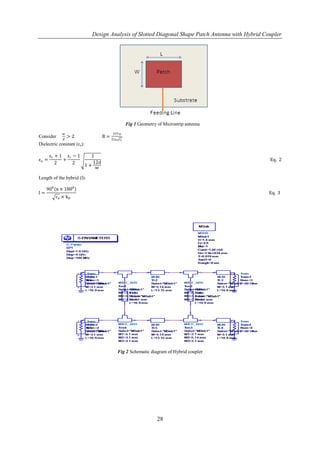
The fig 1 shows the geometry of the microstrip patch antenna. This patch antenna is having the ground plane and dielectric
which would be underneath. The length L causes resonance at its half-wavelength frequency. The radiating edges are at the
ends of the L-dimension of the rectangle, which sets up the single polarization. Radiation that occurs at the ends of the W-
dimension is far less and is referred to as the cross polarization. The thickness of the ground plane is not critically impor tant.
Typically the height h is much smaller than the wavelength of operation. In GPS receivers the size of portable
communication device is very important [22]. The square ring microstrip antenna design is having very small size of
antenna proposed by J.S.Row [23]. To reduce the size of square patch antenna slits are introduced at the corner of antenna.
Phase detection and the circularly polarized antenna is produced by a square patch antenna with feed point on the diagonal.
Slot antennas will be having wider circular polarization bandwidth than single feed circularly polarized antenna. In this
paper a novel design of microstrip octagonal shaped patch antenna is proposed for wireless applications.

                                       III.         HYBRID COUPLER DESIGN
          Hybrid couplers normally split an input signal into two unequal amplitude outputs. It is a four port device with one
input, two outputs and one isolated port. At ideal condition input port power is equal to sum of two output port power ie 90
degree phase shift between these ports. Termination impedance is connected with the isolated port. According to the
impedance choice of the series and stub microstrip transmission lines we can calculate the w/d ratios of those lines in
microstrip form by using the following formulas: Width of Hybrid (w) is as follows
          8eA                                                           w
 w       2A − 2
                                                                          <2
   = e                                                                  d                                               Eq. 1
 d      2                         ɛr − 1                       0.61     w
           B − 1 − ln 2B − 1 +            ln B − 1 + 0.39 −               >2
        π                           2ɛr                         ɛr      d


                                                               27
Design Analysis of Slotted Diagonal Shape Patch Antenna with Hybrid Coupler


                                              Fig 1 Geometry of Microstrip antenna
            w                       377 π
Consider         >2            B=
             d                      2z 0 ɛr
Dielectric constant (εe):

       ε r + 1 εr − 1   1
εe =          +                                                                                   Eq. 2
           2      2      12d
                      1+
                          w

Length of the hybrid (l):

     900 π × 1800
l=                                                                                                Eq. 3
         ɛe × k 0


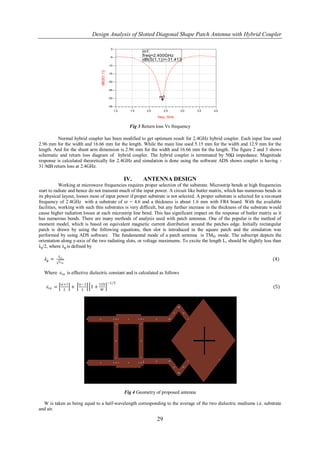
                                        Fig 2 Schematic diagram of Hybrid coupler


                                                             28
Design Analysis of Slotted Diagonal Shape Patch Antenna with Hybrid Coupler

                                                     0
                                                                        m1
                                                     -5
                                                                        freq=2.400GHz
                                                                        dB(S(1,1))=-31.413
                                                    -10


                                       dB(S(1,1))
                                                    -15


                                                    -20


                                                    -25


                                                    -30                         m1

                                                    -35
                                                          1.0     1.5     2.0        2.5    3.0      3.5   4.0

                                                                                freq, GHz

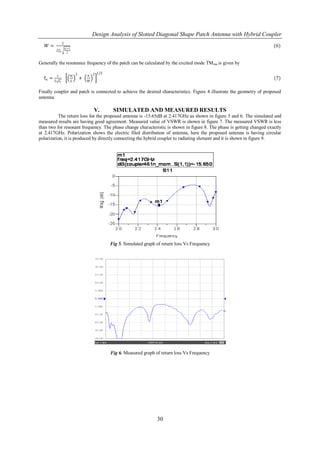
                                                                  Fig 3 Return loss Vs frequency

          Normal hybrid coupler has been modified to get optimum result for 2.4GHz hybrid coupler. Each input line used
2.96 mm for the width and 16.66 mm for the length. While the main line used 5.15 mm for the width and 12.9 mm for the
length. And for the shunt arm dimension is 2.96 mm for the width and 16.66 mm for the length. The figure 2 and 3 shows
schematic and return loss diagram of hybrid coupler. The hybrid coupler is terminated by 50Ω impedance. Magnitude
response is calculated theoretically for 2.4GHz and simulation is done using the software ADS shows coupler is having -
31.9dB return loss at 2.4GHz.

                                                                IV.      ANTENNA DESIGN
            Working at microwave frequencies requires proper selection of the substrate. Microstrip bends at high frequencies
start to radiate and hence do not transmit much of the input power. A circuit like butler matrix, which has numerous bends in
its physical layout, looses most of input power if proper substrate is not selected. A proper substrate is selected for a resonant
frequency of 2.4GHz with a substrate of εr = 4.6 and a thickness is about 1.6 mm with FR4 board. With the available
facilities, working with such thin substrates is very difficult, but any further increase in the thickness of the substrate would
cause higher radiation losses at each microstrip line bend. This has significant impact on the response of butler matrix as it
has numerous bends. There are many methods of analysis used with patch antennas. One of the popular is the method of
moment model, which is based on equivalent magnetic current distribution around the patches edge. Initially rectangular
patch is drawn by using the following equations, then slot is introduced in the square patch and the simulation was
performed by using ADS software. The fundamental mode of a patch antenna is TM01 mode. The subscript depicts the
orientation along y-axis of the two radiating slots, or voltage maximums. To excite the length L, should be slightly less than
λg/2, where λg is defined by

             𝜆𝑜
   𝜆𝑔 =      𝜀 𝑟𝑒
                                                                                                                             (4)

  Where 𝜀 𝑟𝑒 is effective dielectric constant and is calculated as follows

              εr+1        εr−1        12h −1∕2
    𝜀 𝑟𝑒 =        2
                      +    2
                                 1+   W
                                                                                                                             (5)


                                                                Fig 4 Geometry of proposed antenna

  W is taken as being equal to a half-wavelength corresponding to the average of the two dielectric mediums i.e. substrate
and air.

                                                                                29
Design Analysis of Slotted Diagonal Shape Patch Antenna with Hybrid Coupler
                 𝐶
   𝑊=                εr +1
                                                                                                                       (6)
          2𝑓 𝑜
                       2


Generally the resonance frequency of the patch can be calculated by the excited mode TM mn is given by

                                           1/2
          c                  𝑚 2       𝑛 2
  fo =                             +                                                                                   (7)
         2 εr                𝐿         𝑊


Finally coupler and patch is connected to achieve the desired characteristics. Figure 4 illustrate the geometry of proposed
antenna.

                                           V.      SIMULATED AND MEASURED RESULTS
          The return loss for the proposed antenna is -15.65dB at 2.417GHz as shown in figure 5 and 6. The simulated and
measured results are having good agreement. Measured value of VSWR is shown in figure 7. The measured VSWR is less
than two for resonant frequency. The phase change characteristic is shown in figure 8. The phase is getting changed exactly
at 2.417GHz. Polarization shows the electric filed distribution of antenna, here the proposed antenna is having circular
polarization, it is produced by directly connecting the hybrid coupler to radiating element and it is shown in figure 9.


                                                  Fig 5. Simulated graph of return loss Vs Frequency


                                                  Fig 6. Measured graph of return loss Vs Frequency


                                                                         30
Design Analysis of Slotted Diagonal Shape Patch Antenna with Hybrid Coupler


                                                      Fig 7 Measured Characteristic of VSWR


                                                                            S11
                                               200


                                               100
                                 Phase [deg]


                                                 0


                                               -100


                                               -200
                                                      2.0     2.2     2.4         2.6   2.8      3.0
                                                                       Frequency


                                                Fig 8 Phase Characteristic of proposed antenna


                                                  Fig 9 Radiation pattern of proposed antenna

                                                            VI.     CONCLUSION
          A new feeding technique is introduced in this paper. Circular polarization is achieved by connecting directly
hybrid coupler to radiating element. The return loss value is greater than -10dB so the proposed antenna can be useful in the
field of wireless application. Proposed antenna also having high directivity.

                                                                       31
Design Analysis of Slotted Diagonal Shape Patch Antenna with Hybrid Coupler

                                                       REFERENCES
[1].    Bahl, J. and P. Bhartia, Microstrip Antennas, Artech House, Inc., London, 1980.
[2].    James, J. R. and P. S. Hall, Handbook of Microstrip Antennas,Peter Peregronic Ltd., London, 1989.
[3].    N.T. Tokan and F. Gune¸, “support vector characterization of the microstrip antennas based on
                                       ¨ s
        measurements”, Progress In Electromagnetics Research B, Vol. 5, 49–61, 2008.
[4].    S. Cheng, E. Ojefors, P. Hallbjorner, A. Rydberg, “Compact reflective microstrip phase shifter for traveling wave antenna
        applications ,” IEEE Microwave & Wireless Components Letters, vol. 16, pp. 431-433, July 2006.
[5].    K-O. Sun, C-C. Yen, D. Van der Weide, “A size reduced reflection-mode phase shifter,” Mic. & Opt. Tech. Letters, Vol.
        47, pp. 457-459, Dec. 2005.
[6].    Eldek, A. A., A. Z. Elsherbeni, C. E. Smith, and K.-F. Lee,“Wideband slot antennas for radar applications,” Proc. IEEE Radar
        Conf., 79–84, Huntsville, AL, May 2003.
[7].    Neto, N. Llombart, G. Gerini, and P. de Maagt, “On the optimal radiation bandwidth of printed slot antennas surrounded by
        EBGs,” IEEE Trans. Antennas Propag., vol. 54, no. 4, pp. 1074–1082, Apr. 2006.
[8].    P. S. Hall, “New wideband microstrip antenna using log-periodic technique,” Electron. Lett., vol. 16, no. 4, pp. 127–128, 1980.
[9].    P. S. Hall, “Multi-octave bandwidth log-periodic microstrip antenna array,” Proc. Inst. Elect. Eng. Microw., Antennas Propag.,
        vol. 133, no. 2, pt. H, pp. 127–136, 1986.
[10].   H. Pues, J. Bogaers, R. Pieck, and A. van de Capelle, “Wideband quasi log-periodic microstrip antennas,” Proc. Inst. Elect. Eng.
        Microw., Antennas Propag., vol. 128, no. 3, pt. H, pp. 159–163, 1981.
[11].   R. Kakkar and G. Kumar, “Stagger tuned microstrip log-periodic antenna,” in IEEE AP-S Int. Symp. Digest, Jun. 1996, pp.
        1262–1265.
[12].   H. Ozeke, S. Hayashi, N. Kikuma, and N. Inagaki, “Quasi-log-periodic microstrip antenna with closely coupled elements,” Elect.
        Eng., vol. 132, no. 2, pp. 58–64, 2000, in Japan.
[13].   H. K. Smith and P. E. Mayes, “Log-periodic array of dual-feed microstrip patch antennas,” IEEE Trans. Antennas Propag., vol.
        39, no. 12, pp. 1659–1664, 1991.
[14].   M. K. A. Rahim, M. N. A. Karim, T. Masri, and A. Asrokin, “Comparison between straight and U shape of ultra wide band
        microstrip antenna using log periodic technique,” in Proc. IEEE Int. Conf. on UWB, Sep. 2007, pp. 696–699.
[15].   H. Kawakami, G. Sato, and R. Wakabayashi, “Research on circularly polarized conical-beam antennas,” IEEE Antennas Mag.,
        vol. 39, pp. 27–39, Jun. 1997.
[16].   D. Zhou, R. A. Abd-Alhameed, C. H. See, N. J. McEwan, and P. S. Excell, “New circularly-polarized conical-beam microstrip
        patch antenna array for short-range communication systems,” Microw. Opt. Technol. Lett., vol. 51, pp. 78–81, Jan. 2009.
[17].   D. I. Wu, “Omnidirectional circularly-polarized conformal microstrip array for telemetry applications,” in IEEE Antennas
        Propag. Soc. Int.Symp. Dig., 1995, vol. 2, pp. 998–1001.
[18].   Nesic, V. Brankovic, and I. Radnovic, “Circularly polarised printed antenna with conical beam,” Electron. Lett., vol. 34, pp.
        1165–1167, Jun. 11, 1998.
[19].   K. L. Lau and K. M. Luk, “A wideband circularly polarized conicalbeam patch antenna,” IEEE Trans. Antennas Propag., vol.
        AP-54, pp. 1591–1594, May 2006.
[20].   Jeen-Sheen Row and Ming-Che Chan, “Reconfigurable Circularly-Polarized Patch Antenna With Conical Beam”, IEEE
        transactions on antennas and propagation, vol. 58, no. 8, august 2010.
[21].   Slobodzian.P and R.Borowiec, “ Microstrip antenna for cellular and Wireless communication system”, Microwave
        Opt.Tech.Lett., Vol.34, No.5, 380-384,Sppt 5, 2002.
[22].   G.S.Shiroma, R.Y.Miyamoto and W.A.Shiroma. “A full duplex dual frequency self steering array using phase detection and
        phase shifting”, IEEE Trans. on Microwave Theory Tech., Vol.54,PP.128-134,Jan 2006.
[23].   J.S Row, “ Design of square ring microstrip antenna for circular Polarization”, Electronics letter , Vol.40.No.2, 22 ndJan 2004.


                                                                32

IJERD(www.ijerd.com)International Journal of Engineering Research and Development

  • 1.
    International Journal ofEngineering Research and Development ISSN: 2278-067X, Volume 1, Issue 12 (July 2012), PP.27-32 www.ijerd.com Design Analysis of Slotted Diagonal Shape Patch Antenna with Hybrid Coupler A.Sahaya Anselin Nisha 1, T.Jayanthy2 1 Research Scholar, Sathyabama University, Chennai - 600119, India 2 Principal, Panimalar Institute of Technology, Chennai-602103, India. Abstract—In this paper hybrid coupler connected diagonal shaped patch antenna with slot is examined. Theoretical performance is carried out using advanced system design (ADS) software. Measurement of antenna parameters like return loss, standing wave ratio also have been presented in this article. The measured values for the antenna are taken by agilent E5062A network analyzer. Simulated and measured results are having good agreement. The effect of excited two orthogonal modes with equal amplitude and 90 degree phase shift coupler connected with patch will produce circular polarization. The antenna is having gain of 3.319dB and the directivity of 6.98dB. The proposed antenna can be useful in wireless applications. Keywords— Advanced Design System, Circular Polarization, C band, Network Analyser, Patch antenna I. INTRODUCTION Microstrip patch antennas are placing vital role in personal communication systems because of its tremendous advantages of light weight, thin profile and low cost [1]. The other side micro strip patch antenna having great disadvantage is narrow bandwidth. Many techniques are introduced to improve the bandwidth for example multilayer, thick substrate [2]. Patch can be in any shape like rectangular, Circular, Square, Elliptical, Triangular etc [3]. Hybrid coupler implementation with Varactor diode and Pin diode is proposed by S. Cheng, K-O. Sun, [ 4 , 5 ] . Commercial wireless systems require low cost antenna with large bandwidth, slot antennas satisfying these requirements [6, 7]. By introducing Log periodic microstrip antennas [8,9], different types of feeding techniques [10-14] bandwidth is enhanced in wireless applications. Circular polarization antenna have been proposed and studied over the past few years [15-19]. In this design a new shaped microstrip antenna is introduced and the hybrid coupler is connected to get circular polarization. The design concept comes from circularly polarized antenna with conical beam [20]. II. MICROSTRIP ANTENNA Microstrip or patch antennas are becoming increasingly useful because they can be printed directly onto a circuit board. They are becoming very widespread within the mobile phone market. They are low cost, have a low profile and are easily fabricated. Discontinuities are present in microstrip antenna to produce electric and magnetic field distributions [21]. The fig 1 shows the geometry of the microstrip patch antenna. This patch antenna is having the ground plane and dielectric which would be underneath. The length L causes resonance at its half-wavelength frequency. The radiating edges are at the ends of the L-dimension of the rectangle, which sets up the single polarization. Radiation that occurs at the ends of the W- dimension is far less and is referred to as the cross polarization. The thickness of the ground plane is not critically impor tant. Typically the height h is much smaller than the wavelength of operation. In GPS receivers the size of portable communication device is very important [22]. The square ring microstrip antenna design is having very small size of antenna proposed by J.S.Row [23]. To reduce the size of square patch antenna slits are introduced at the corner of antenna. Phase detection and the circularly polarized antenna is produced by a square patch antenna with feed point on the diagonal. Slot antennas will be having wider circular polarization bandwidth than single feed circularly polarized antenna. In this paper a novel design of microstrip octagonal shaped patch antenna is proposed for wireless applications. III. HYBRID COUPLER DESIGN Hybrid couplers normally split an input signal into two unequal amplitude outputs. It is a four port device with one input, two outputs and one isolated port. At ideal condition input port power is equal to sum of two output port power ie 90 degree phase shift between these ports. Termination impedance is connected with the isolated port. According to the impedance choice of the series and stub microstrip transmission lines we can calculate the w/d ratios of those lines in microstrip form by using the following formulas: Width of Hybrid (w) is as follows 8eA w w 2A − 2 <2 = e d Eq. 1 d 2 ɛr − 1 0.61 w B − 1 − ln 2B − 1 + ln B − 1 + 0.39 − >2 π 2ɛr ɛr d 27
  • 2.
    Design Analysis ofSlotted Diagonal Shape Patch Antenna with Hybrid Coupler Fig 1 Geometry of Microstrip antenna w 377 π Consider >2 B= d 2z 0 ɛr Dielectric constant (εe): ε r + 1 εr − 1 1 εe = + Eq. 2 2 2 12d 1+ w Length of the hybrid (l): 900 π × 1800 l= Eq. 3 ɛe × k 0 Fig 2 Schematic diagram of Hybrid coupler 28
  • 3.
    Design Analysis ofSlotted Diagonal Shape Patch Antenna with Hybrid Coupler 0 m1 -5 freq=2.400GHz dB(S(1,1))=-31.413 -10 dB(S(1,1)) -15 -20 -25 -30 m1 -35 1.0 1.5 2.0 2.5 3.0 3.5 4.0 freq, GHz Fig 3 Return loss Vs frequency Normal hybrid coupler has been modified to get optimum result for 2.4GHz hybrid coupler. Each input line used 2.96 mm for the width and 16.66 mm for the length. While the main line used 5.15 mm for the width and 12.9 mm for the length. And for the shunt arm dimension is 2.96 mm for the width and 16.66 mm for the length. The figure 2 and 3 shows schematic and return loss diagram of hybrid coupler. The hybrid coupler is terminated by 50Ω impedance. Magnitude response is calculated theoretically for 2.4GHz and simulation is done using the software ADS shows coupler is having - 31.9dB return loss at 2.4GHz. IV. ANTENNA DESIGN Working at microwave frequencies requires proper selection of the substrate. Microstrip bends at high frequencies start to radiate and hence do not transmit much of the input power. A circuit like butler matrix, which has numerous bends in its physical layout, looses most of input power if proper substrate is not selected. A proper substrate is selected for a resonant frequency of 2.4GHz with a substrate of εr = 4.6 and a thickness is about 1.6 mm with FR4 board. With the available facilities, working with such thin substrates is very difficult, but any further increase in the thickness of the substrate would cause higher radiation losses at each microstrip line bend. This has significant impact on the response of butler matrix as it has numerous bends. There are many methods of analysis used with patch antennas. One of the popular is the method of moment model, which is based on equivalent magnetic current distribution around the patches edge. Initially rectangular patch is drawn by using the following equations, then slot is introduced in the square patch and the simulation was performed by using ADS software. The fundamental mode of a patch antenna is TM01 mode. The subscript depicts the orientation along y-axis of the two radiating slots, or voltage maximums. To excite the length L, should be slightly less than λg/2, where λg is defined by 𝜆𝑜 𝜆𝑔 = 𝜀 𝑟𝑒 (4) Where 𝜀 𝑟𝑒 is effective dielectric constant and is calculated as follows εr+1 εr−1 12h −1∕2 𝜀 𝑟𝑒 = 2 + 2 1+ W (5) Fig 4 Geometry of proposed antenna W is taken as being equal to a half-wavelength corresponding to the average of the two dielectric mediums i.e. substrate and air. 29
  • 4.
    Design Analysis ofSlotted Diagonal Shape Patch Antenna with Hybrid Coupler 𝐶 𝑊= εr +1 (6) 2𝑓 𝑜 2 Generally the resonance frequency of the patch can be calculated by the excited mode TM mn is given by 1/2 c 𝑚 2 𝑛 2 fo = + (7) 2 εr 𝐿 𝑊 Finally coupler and patch is connected to achieve the desired characteristics. Figure 4 illustrate the geometry of proposed antenna. V. SIMULATED AND MEASURED RESULTS The return loss for the proposed antenna is -15.65dB at 2.417GHz as shown in figure 5 and 6. The simulated and measured results are having good agreement. Measured value of VSWR is shown in figure 7. The measured VSWR is less than two for resonant frequency. The phase change characteristic is shown in figure 8. The phase is getting changed exactly at 2.417GHz. Polarization shows the electric filed distribution of antenna, here the proposed antenna is having circular polarization, it is produced by directly connecting the hybrid coupler to radiating element and it is shown in figure 9. Fig 5. Simulated graph of return loss Vs Frequency Fig 6. Measured graph of return loss Vs Frequency 30
  • 5.
    Design Analysis ofSlotted Diagonal Shape Patch Antenna with Hybrid Coupler Fig 7 Measured Characteristic of VSWR S11 200 100 Phase [deg] 0 -100 -200 2.0 2.2 2.4 2.6 2.8 3.0 Frequency Fig 8 Phase Characteristic of proposed antenna Fig 9 Radiation pattern of proposed antenna VI. CONCLUSION A new feeding technique is introduced in this paper. Circular polarization is achieved by connecting directly hybrid coupler to radiating element. The return loss value is greater than -10dB so the proposed antenna can be useful in the field of wireless application. Proposed antenna also having high directivity. 31
  • 6.
    Design Analysis ofSlotted Diagonal Shape Patch Antenna with Hybrid Coupler REFERENCES [1]. Bahl, J. and P. Bhartia, Microstrip Antennas, Artech House, Inc., London, 1980. [2]. James, J. R. and P. S. Hall, Handbook of Microstrip Antennas,Peter Peregronic Ltd., London, 1989. [3]. N.T. Tokan and F. Gune¸, “support vector characterization of the microstrip antennas based on ¨ s measurements”, Progress In Electromagnetics Research B, Vol. 5, 49–61, 2008. [4]. S. Cheng, E. Ojefors, P. Hallbjorner, A. Rydberg, “Compact reflective microstrip phase shifter for traveling wave antenna applications ,” IEEE Microwave & Wireless Components Letters, vol. 16, pp. 431-433, July 2006. [5]. K-O. Sun, C-C. Yen, D. Van der Weide, “A size reduced reflection-mode phase shifter,” Mic. & Opt. Tech. Letters, Vol. 47, pp. 457-459, Dec. 2005. [6]. Eldek, A. A., A. Z. Elsherbeni, C. E. Smith, and K.-F. Lee,“Wideband slot antennas for radar applications,” Proc. IEEE Radar Conf., 79–84, Huntsville, AL, May 2003. [7]. Neto, N. Llombart, G. Gerini, and P. de Maagt, “On the optimal radiation bandwidth of printed slot antennas surrounded by EBGs,” IEEE Trans. Antennas Propag., vol. 54, no. 4, pp. 1074–1082, Apr. 2006. [8]. P. S. Hall, “New wideband microstrip antenna using log-periodic technique,” Electron. Lett., vol. 16, no. 4, pp. 127–128, 1980. [9]. P. S. Hall, “Multi-octave bandwidth log-periodic microstrip antenna array,” Proc. Inst. Elect. Eng. Microw., Antennas Propag., vol. 133, no. 2, pt. H, pp. 127–136, 1986. [10]. H. Pues, J. Bogaers, R. Pieck, and A. van de Capelle, “Wideband quasi log-periodic microstrip antennas,” Proc. Inst. Elect. Eng. Microw., Antennas Propag., vol. 128, no. 3, pt. H, pp. 159–163, 1981. [11]. R. Kakkar and G. Kumar, “Stagger tuned microstrip log-periodic antenna,” in IEEE AP-S Int. Symp. Digest, Jun. 1996, pp. 1262–1265. [12]. H. Ozeke, S. Hayashi, N. Kikuma, and N. Inagaki, “Quasi-log-periodic microstrip antenna with closely coupled elements,” Elect. Eng., vol. 132, no. 2, pp. 58–64, 2000, in Japan. [13]. H. K. Smith and P. E. Mayes, “Log-periodic array of dual-feed microstrip patch antennas,” IEEE Trans. Antennas Propag., vol. 39, no. 12, pp. 1659–1664, 1991. [14]. M. K. A. Rahim, M. N. A. Karim, T. Masri, and A. Asrokin, “Comparison between straight and U shape of ultra wide band microstrip antenna using log periodic technique,” in Proc. IEEE Int. Conf. on UWB, Sep. 2007, pp. 696–699. [15]. H. Kawakami, G. Sato, and R. Wakabayashi, “Research on circularly polarized conical-beam antennas,” IEEE Antennas Mag., vol. 39, pp. 27–39, Jun. 1997. [16]. D. Zhou, R. A. Abd-Alhameed, C. H. See, N. J. McEwan, and P. S. Excell, “New circularly-polarized conical-beam microstrip patch antenna array for short-range communication systems,” Microw. Opt. Technol. Lett., vol. 51, pp. 78–81, Jan. 2009. [17]. D. I. Wu, “Omnidirectional circularly-polarized conformal microstrip array for telemetry applications,” in IEEE Antennas Propag. Soc. Int.Symp. Dig., 1995, vol. 2, pp. 998–1001. [18]. Nesic, V. Brankovic, and I. Radnovic, “Circularly polarised printed antenna with conical beam,” Electron. Lett., vol. 34, pp. 1165–1167, Jun. 11, 1998. [19]. K. L. Lau and K. M. Luk, “A wideband circularly polarized conicalbeam patch antenna,” IEEE Trans. Antennas Propag., vol. AP-54, pp. 1591–1594, May 2006. [20]. Jeen-Sheen Row and Ming-Che Chan, “Reconfigurable Circularly-Polarized Patch Antenna With Conical Beam”, IEEE transactions on antennas and propagation, vol. 58, no. 8, august 2010. [21]. Slobodzian.P and R.Borowiec, “ Microstrip antenna for cellular and Wireless communication system”, Microwave Opt.Tech.Lett., Vol.34, No.5, 380-384,Sppt 5, 2002. [22]. G.S.Shiroma, R.Y.Miyamoto and W.A.Shiroma. “A full duplex dual frequency self steering array using phase detection and phase shifting”, IEEE Trans. on Microwave Theory Tech., Vol.54,PP.128-134,Jan 2006. [23]. J.S Row, “ Design of square ring microstrip antenna for circular Polarization”, Electronics letter , Vol.40.No.2, 22 ndJan 2004. 32