Case 2:
Barnes & Noble
1
Content
I. Barnes & Noble History
II. Technologies
III. Financial Information
IV. Summary and Analysis
Group Members
• Aki Inoue
• Anuar Beibytov
• Yihua (Elaine) Pan
• Kheamasuda Reongvan
I. Barnes & Noble History
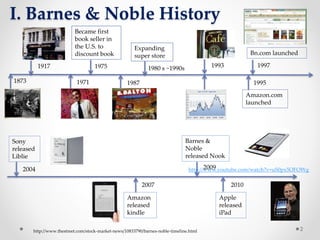
http://www.thestreet.com/stock-market-news/10833790/barnes-noble-timeline.html
1873
1917
1971
1975
Became first
book seller in
the U.S. to
discount book
2
1987
Expanding
super store
1980 s ~1990s 1993
Amazon.com
launched
1995
Bn.com launched
1997
Amazon
released
kindle
Sony
released
Liblie
Barnes &
Noble
released Nook
Apple
released
iPad
http://www.youtube.com/watch?v=uS0px5OFOWg2004
2007
2009
2010
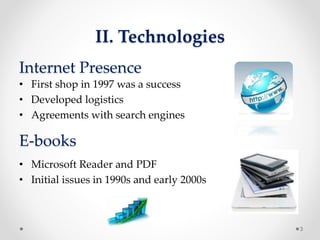
Internet Presence
• First shop in 1997 was a success
• Developed logistics
• Agreements with search engines
II. Technologies
E-books
• Microsoft Reader and PDF
• Initial issues in 1990s and early 2000s
3
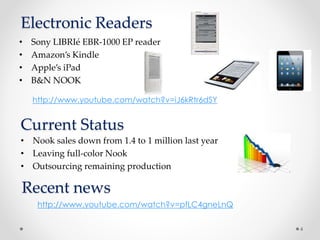
Electronic Readers
• Sony LIBRIé EBR-1000 EP reader
• Amazon’s Kindle
• Apple’s iPad
• B&N NOOK
4
http://www.youtube.com/watch?v=iJ6kRtr6dSY
Current Status
• Nook sales down from 1.4 to 1 million last year
• Leaving full-color Nook
• Outsourcing remaining production
http://www.youtube.com/watch?v=pfLC4gneLnQ
Recent news
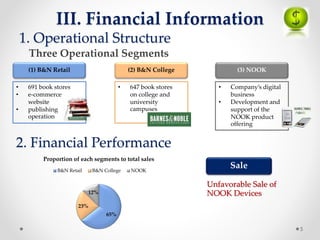
1. Operational Structure
Three Operational Segments
(1) B&N Retail (2) B&N College (3) NOOK
• 691 book stores
• e-commerce
website
• publishing
operation
• 647 book stores
on college and
university
campuses
• Company’s digital
business
• Development and
support of the
NOOK product
offering
5
III. Financial Information
2. Financial Performance
65%
23%
12%
Proportion of each segments to total sales
B&N Retail B&N College NOOK
Unfavorable Sale of
NOOK Devices
Sale
Earning
-2000
0
2000
4000
6000
8000 2003
2004
2005
2006
2007
2008
2009
2010
2011
2012
2013
InUSDMillions
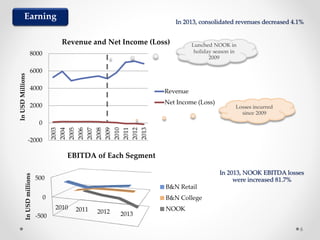
Revenue and Net Income (Loss)
Revenue
Net Income (Loss)
Lunched NOOK in
holiday season in
2009
Losses incurred
since 2009
6
In 2013, consolidated revenues decreased 4.1%
-500
0
500
2010 2011 2012 2013
InUSDmillions
EBITDA of Each Segment
B&N Retail
B&N College
NOOK
In 2013, NOOK EBITDA losses
were increased 81.7%
Cost
0
20
40
60
80
2003 2005 2007 2009 2011 2013
PercentageofTotal
Sales
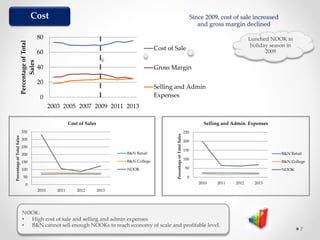
Cost of Sale
Gross Margin
Selling and Admin
Expenses
Lunched NOOK in
holiday season in
2009
7
Since 2009, cost of sale increased
and gross margin declined
0
50
100
150
200
250
300
350
2010 2011 2012 2013
PercentageofTotalSales
Cost of Sales
B&N Retail
B&N College
NOOK
0
50
100
150
200
250
2010 2011 2012 2013
PercentageofTotalSales
Selling and Admin. Expenses
B&N Retail
B&N College
NOOK
NOOK:
• High cost of sale and selling and admin expenses
• B&N cannot sell enough NOOKs to reach economy of scale and profitable level.
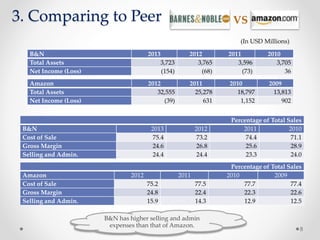
3. Comparing to Peer
8
VS
B&N 2013 2012 2011 2010
Total Assets 3,723 3,765 3,596 3,705
Net Income (Loss) (154) (68) (73) 36
Amazon 2012 2011 2010 2009
Total Assets 32,555 25,278 18,797 13,813
Net Income (Loss) (39) 631 1,152 902
Percentage of Total Sales
B&N 2013 2012 2011 2010
Cost of Sale 75.4 73.2 74.4 71.1
Gross Margin 24.6 26.8 25.6 28.9
Selling and Admin. 24.4 24.4 23.3 24.0
Percentage of Total Sales
Amazon 2012 2011 2010 2009
Cost of Sale 75.2 77.5 77.7 77.4
Gross Margin 24.8 22.4 22.3 22.6
Selling and Admin. 15.9 14.3 12.9 12.5
(In USD Millions)
B&N has higher selling and admin
expenses than that of Amazon.
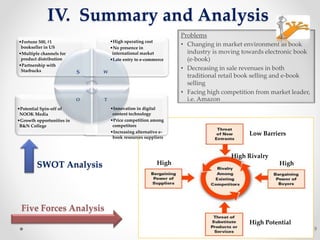
SWOT Analysis
•Innovation in digital
content technology
•Price competition among
competitors
•Increasing alternative e-
book resources suppliers
•Potential Spin-off of
NOOK Media
•Growth opportunities in
B&N College
•High operating cost
•No presence in
international market
•Late entry to e-commerce
•Fortune 500, #1
bookseller in US
•Multiple channels for
product distribution
•Partnership with
Starbucks S W
TO
9
HighHigh
Low Barriers
High Rivalry
High Potential
Five Forces Analysis
IV. Summary and Analysis
Problems
• Changing in market environment as book
industry is moving towards electronic book
(e-book)
• Decreasing in sale revenues in both
traditional retail book selling and e-book
selling
• Facing high competition from market leader,
i.e. Amazon
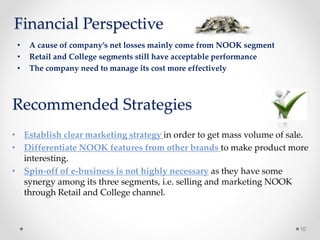
Recommended Strategies
• Establish clear marketing strategy in order to get mass volume of sale.
• Differentiate NOOK features from other brands to make product more
interesting.
• Spin-off of e-business is not highly necessary as they have some
synergy among its three segments, i.e. selling and marketing NOOK
through Retail and College channel.
10
Financial Perspective
• A cause of company’s net losses mainly come from NOOK segment
• Retail and College segments still have acceptable performance
• The company need to manage its cost more effectively

Barnes and noble a case presentation for harvard by Aki Inoue Anuar Beibytov Yihua Pan Kheamasuda Reongvan

  • 1.
    Case 2: Barnes &Noble 1 Content I. Barnes & Noble History II. Technologies III. Financial Information IV. Summary and Analysis Group Members • Aki Inoue • Anuar Beibytov • Yihua (Elaine) Pan • Kheamasuda Reongvan
  • 2.
    I. Barnes &Noble History http://www.thestreet.com/stock-market-news/10833790/barnes-noble-timeline.html 1873 1917 1971 1975 Became first book seller in the U.S. to discount book 2 1987 Expanding super store 1980 s ~1990s 1993 Amazon.com launched 1995 Bn.com launched 1997 Amazon released kindle Sony released Liblie Barnes & Noble released Nook Apple released iPad http://www.youtube.com/watch?v=uS0px5OFOWg2004 2007 2009 2010
  • 3.
    Internet Presence • Firstshop in 1997 was a success • Developed logistics • Agreements with search engines II. Technologies E-books • Microsoft Reader and PDF • Initial issues in 1990s and early 2000s 3
  • 4.
    Electronic Readers • SonyLIBRIé EBR-1000 EP reader • Amazon’s Kindle • Apple’s iPad • B&N NOOK 4 http://www.youtube.com/watch?v=iJ6kRtr6dSY Current Status • Nook sales down from 1.4 to 1 million last year • Leaving full-color Nook • Outsourcing remaining production http://www.youtube.com/watch?v=pfLC4gneLnQ Recent news
  • 5.
    1. Operational Structure ThreeOperational Segments (1) B&N Retail (2) B&N College (3) NOOK • 691 book stores • e-commerce website • publishing operation • 647 book stores on college and university campuses • Company’s digital business • Development and support of the NOOK product offering 5 III. Financial Information 2. Financial Performance 65% 23% 12% Proportion of each segments to total sales B&N Retail B&N College NOOK Unfavorable Sale of NOOK Devices Sale
  • 6.
    Earning -2000 0 2000 4000 6000 8000 2003 2004 2005 2006 2007 2008 2009 2010 2011 2012 2013 InUSDMillions Revenue andNet Income (Loss) Revenue Net Income (Loss) Lunched NOOK in holiday season in 2009 Losses incurred since 2009 6 In 2013, consolidated revenues decreased 4.1% -500 0 500 2010 2011 2012 2013 InUSDmillions EBITDA of Each Segment B&N Retail B&N College NOOK In 2013, NOOK EBITDA losses were increased 81.7%
  • 7.
    Cost 0 20 40 60 80 2003 2005 20072009 2011 2013 PercentageofTotal Sales Cost of Sale Gross Margin Selling and Admin Expenses Lunched NOOK in holiday season in 2009 7 Since 2009, cost of sale increased and gross margin declined 0 50 100 150 200 250 300 350 2010 2011 2012 2013 PercentageofTotalSales Cost of Sales B&N Retail B&N College NOOK 0 50 100 150 200 250 2010 2011 2012 2013 PercentageofTotalSales Selling and Admin. Expenses B&N Retail B&N College NOOK NOOK: • High cost of sale and selling and admin expenses • B&N cannot sell enough NOOKs to reach economy of scale and profitable level.
  • 8.
    3. Comparing toPeer 8 VS B&N 2013 2012 2011 2010 Total Assets 3,723 3,765 3,596 3,705 Net Income (Loss) (154) (68) (73) 36 Amazon 2012 2011 2010 2009 Total Assets 32,555 25,278 18,797 13,813 Net Income (Loss) (39) 631 1,152 902 Percentage of Total Sales B&N 2013 2012 2011 2010 Cost of Sale 75.4 73.2 74.4 71.1 Gross Margin 24.6 26.8 25.6 28.9 Selling and Admin. 24.4 24.4 23.3 24.0 Percentage of Total Sales Amazon 2012 2011 2010 2009 Cost of Sale 75.2 77.5 77.7 77.4 Gross Margin 24.8 22.4 22.3 22.6 Selling and Admin. 15.9 14.3 12.9 12.5 (In USD Millions) B&N has higher selling and admin expenses than that of Amazon.
  • 9.
    SWOT Analysis •Innovation indigital content technology •Price competition among competitors •Increasing alternative e- book resources suppliers •Potential Spin-off of NOOK Media •Growth opportunities in B&N College •High operating cost •No presence in international market •Late entry to e-commerce •Fortune 500, #1 bookseller in US •Multiple channels for product distribution •Partnership with Starbucks S W TO 9 HighHigh Low Barriers High Rivalry High Potential Five Forces Analysis IV. Summary and Analysis Problems • Changing in market environment as book industry is moving towards electronic book (e-book) • Decreasing in sale revenues in both traditional retail book selling and e-book selling • Facing high competition from market leader, i.e. Amazon
  • 10.
    Recommended Strategies • Establishclear marketing strategy in order to get mass volume of sale. • Differentiate NOOK features from other brands to make product more interesting. • Spin-off of e-business is not highly necessary as they have some synergy among its three segments, i.e. selling and marketing NOOK through Retail and College channel. 10 Financial Perspective • A cause of company’s net losses mainly come from NOOK segment • Retail and College segments still have acceptable performance • The company need to manage its cost more effectively