DR. GAURAV SANGAM
DEFINATION:
• An abscess is a collection of pus that has built
up within the tissue of the body.
• An abscess is a circumscribed area of
inflammation or an abnormal cavity that
contains pus if matured.
TYPES:
•There are 3 types of abscess:
•1. Pyogenic abscess
•2. Pyaemic abscess
•3. Cold abscess
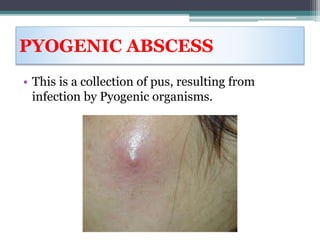
PYOGENIC ABSCESS
• This is a collection of pus, resulting from
infection by Pyogenic organisms.
ENTRY OF ORGANISMS:
1. Direct infection from outside due
to penetrating wound
2. Local exension from adjacent focus
of infection
3. Lymphatics
4. Blood stream or haematogenous
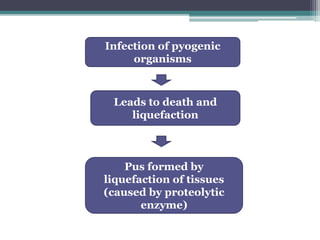
Infection of pyogenic
organisms
Pus formed by
liquefaction of tissues
(caused by proteolytic
enzyme)
Leads to death and
liquefaction
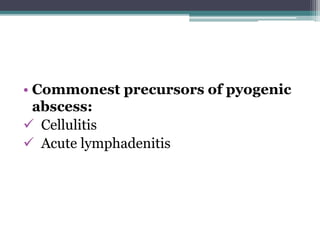
• Commonest precursors of pyogenic
abscess:
 Cellulitis
 Acute lymphadenitis
FATE
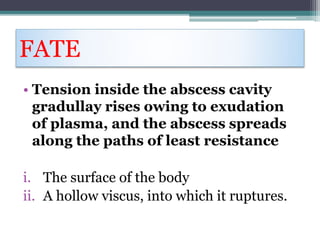
• Tension inside the abscess cavity
gradullay rises owing to exudation
of plasma, and the abscess spreads
along the paths of least resistance
i. The surface of the body
ii. A hollow viscus, into which it ruptures.
FATE
2.
Body resistance, aided by antibiotics
Kills bacteria before the abscess finds its
way to the surface
Fibrosis
occur
Fluids is then gradually reabsorbed
Cavity persists
and contains
thick,sterile
pus
(antibioma)
CLINICAL FREATURES:
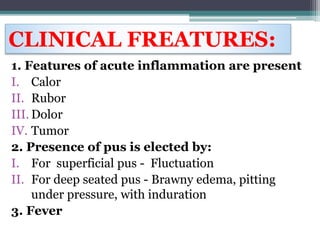
1. Features of acute inflammation are present
I. Calor
II. Rubor
III. Dolor
IV. Tumor
2. Presence of pus is elected by:
I. For superficial pus - Fluctuation
II. For deep seated pus - Brawny edema, pitting
under pressure, with induration
3. Fever
FEW OF THE PYOGENIC ABSCESS
1. Axillary abscess
2. Inguinal abscess
3. Popliteal abscess
4. Gluteal abscess
5. Thigh abscess
6. Deltoid abscess
7. Sole abscess / Heel abscess
Treatment in pyogenic abscess
• In early cases – where pus is still to form
I. Conservative management
II. Rest and elevation of the part
III. Antibiotic cover
• As presence of pus is diagnosed
I. Incision and drainage
PYAEMIC ABSCESS:
• Pyaemic absceses, caused by
infective emboli in cases of pyaemia.
• Pyaemia is a condition in which infective emboli,
consisting of clumps of organisms, infected
clots, or vegetation, circulate in the blood
stream.
( In conditions like acute osteomyelitis, infected compound fracture,
acute inflammation of an intracranial sinus.)
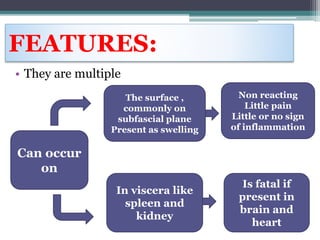
FEATURES:
• They are multiple
Can occur
on
Is fatal if
present in
brain and
heart
The surface ,
commonly on
subfascial plane
Present as swelling
In viscera like
spleen and
kidney
Non reacting
Little pain
Little or no sign
of inflammation
TREATMENT OF PYAEMIC ABSCESS:
I. Identify the source, if
detectable
II. Antibiotics preferably
choosen by culture
sensitivity test
III.Incision and drainage
COLD ABSCESS
• These denote tuberculous abscess
• Most commonly arising in lymph
nodes, bones or joints
• Non reacting, with no cardinal
features of acute inflammation
(sometimes present)
HOW TO DIAGNOSE?
• Are diagnosed by their characteristic
positions where important sets of nodes are
present
Eg- neck, axilla, groin
• On palpation – characteristic features of
tuberculous lymphadenitis, i.e soft and
matted nodes
• Cold abscess have tendency to travel to long
distances along definite anatomical planes
(Tracing nerve, sometimes vessels)
SPECIAL INVESTIGATIONS
1. Blood examination
2. X-ray chest
3. Mantoux text
4. ELISA test
5. Aspiraion – culture sensitivity
TREATMENT OF COLD ABSCESS
1. Full Anti-tuberculosis treatment
2. Treatment for primary focus
3. For abscess itself –
i. Repeated aspiration with local
instillation of INH (Isoniazid) solution
ii. Complete excision of the abscess with its
wall, together with focus origin
Eg- group of nodes3
Incision and Drainage
A. Anesthesia
B. Incison
i. Free or Liberal Incision
ii. Hilton’s Method
C. Exploration
D. Counter-incision
E. Drainage
F. Post Opeartive Care
A. Anesthesia
• Superficial abscesses may be drained
with surface anesthesia
• Deep abscesses require General
Anesthesia
(LA might spread infection to
neighbouring tissues)
B. Incision:
Free/Liberal Incision:
• Made on mostly prominent part
• It causes minimum damage to the
surrounding healthy tissue
 Principle of incision –
• Should ensure adequate drainage
• Parallel to important vessels, nerves, tendons
• Muscle should be incisied along the line of
fibers
Incision
Hiltons method:
• Chosen when there are plenty of
important structures like nerves and
vessels
• Employed in places like neck, axilla, groin
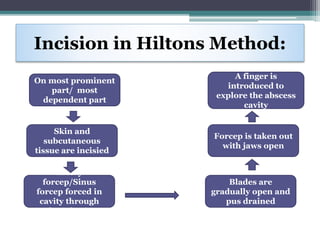
Incision in Hiltons Method:
Skin and
subcutaneous
tissue are incisied
On most prominent
part/ most
dependent part
Forcep is taken out
with jaws open
A finger is
introduced to
explore the abscess
cavity
Artery
forcep/Sinus
forcep forced in
cavity through
deep fascia
Blades are
gradually open and
pus drained
C. Exploration
• A fnger is introduced into the
abscess cavity
I. To define its limit
II. To break any septum inside, thus
making all loculi into one cavity,
for complete drainage
4. Counter incision
1. Abscess will drain better if there is counter
incision
2. Where original incision is not the most
dependent part, here counter incision helps in
draining cavity
3. A sinus forcep passed in cavity till most
dependent part, a small nick is made on the
skin over the forceps to make the counter
opening
E. Drainage:
• A corrugated rain or wick of gauze
• Where walls of abscess is very
vascular, a tight packing of the cavity
is required to achieve hemostasis
F. Post opeartive care
1. Rest to the part
2. Antibiotics preferably chosen by
culture sensitivity test
3. Regular dressing – if the cavity has
been packed, the packing should
4. Drains are removed after 48hrs
Cruciate Incision:
Blades and handle
• Handles :
• 3 & 4 : shorter and wider
• 5 & 7 : longer but breadth is less
• Blades :
• 11 – stab incisions (drainage of abscess)
• 15 – plastic surgery, pediatric surgery
• 23 – skin and deeper incision
Handle Blade
3 11 & 15
4 22
•THANK YOU…..

Abscess

  • 1.
  • 2.
    DEFINATION: • An abscessis a collection of pus that has built up within the tissue of the body. • An abscess is a circumscribed area of inflammation or an abnormal cavity that contains pus if matured.
  • 3.
    TYPES: •There are 3types of abscess: •1. Pyogenic abscess •2. Pyaemic abscess •3. Cold abscess
  • 4.
    PYOGENIC ABSCESS • Thisis a collection of pus, resulting from infection by Pyogenic organisms.
  • 5.
    ENTRY OF ORGANISMS: 1.Direct infection from outside due to penetrating wound 2. Local exension from adjacent focus of infection 3. Lymphatics 4. Blood stream or haematogenous
  • 6.
    Infection of pyogenic organisms Pusformed by liquefaction of tissues (caused by proteolytic enzyme) Leads to death and liquefaction
  • 7.
    • Commonest precursorsof pyogenic abscess:  Cellulitis  Acute lymphadenitis
  • 8.
    FATE • Tension insidethe abscess cavity gradullay rises owing to exudation of plasma, and the abscess spreads along the paths of least resistance i. The surface of the body ii. A hollow viscus, into which it ruptures.
  • 9.
    FATE 2. Body resistance, aidedby antibiotics Kills bacteria before the abscess finds its way to the surface Fibrosis occur Fluids is then gradually reabsorbed Cavity persists and contains thick,sterile pus (antibioma)
  • 10.
    CLINICAL FREATURES: 1. Featuresof acute inflammation are present I. Calor II. Rubor III. Dolor IV. Tumor 2. Presence of pus is elected by: I. For superficial pus - Fluctuation II. For deep seated pus - Brawny edema, pitting under pressure, with induration 3. Fever
  • 11.
    FEW OF THEPYOGENIC ABSCESS 1. Axillary abscess 2. Inguinal abscess 3. Popliteal abscess 4. Gluteal abscess 5. Thigh abscess 6. Deltoid abscess 7. Sole abscess / Heel abscess
  • 12.
    Treatment in pyogenicabscess • In early cases – where pus is still to form I. Conservative management II. Rest and elevation of the part III. Antibiotic cover • As presence of pus is diagnosed I. Incision and drainage
  • 13.
    PYAEMIC ABSCESS: • Pyaemicabsceses, caused by infective emboli in cases of pyaemia. • Pyaemia is a condition in which infective emboli, consisting of clumps of organisms, infected clots, or vegetation, circulate in the blood stream. ( In conditions like acute osteomyelitis, infected compound fracture, acute inflammation of an intracranial sinus.)
  • 14.
    FEATURES: • They aremultiple Can occur on Is fatal if present in brain and heart The surface , commonly on subfascial plane Present as swelling In viscera like spleen and kidney Non reacting Little pain Little or no sign of inflammation
  • 15.
    TREATMENT OF PYAEMICABSCESS: I. Identify the source, if detectable II. Antibiotics preferably choosen by culture sensitivity test III.Incision and drainage
  • 16.
    COLD ABSCESS • Thesedenote tuberculous abscess • Most commonly arising in lymph nodes, bones or joints • Non reacting, with no cardinal features of acute inflammation (sometimes present)
  • 18.
    HOW TO DIAGNOSE? •Are diagnosed by their characteristic positions where important sets of nodes are present Eg- neck, axilla, groin • On palpation – characteristic features of tuberculous lymphadenitis, i.e soft and matted nodes • Cold abscess have tendency to travel to long distances along definite anatomical planes (Tracing nerve, sometimes vessels)
  • 19.
    SPECIAL INVESTIGATIONS 1. Bloodexamination 2. X-ray chest 3. Mantoux text 4. ELISA test 5. Aspiraion – culture sensitivity
  • 20.
    TREATMENT OF COLDABSCESS 1. Full Anti-tuberculosis treatment 2. Treatment for primary focus 3. For abscess itself – i. Repeated aspiration with local instillation of INH (Isoniazid) solution ii. Complete excision of the abscess with its wall, together with focus origin Eg- group of nodes3
  • 21.
    Incision and Drainage A.Anesthesia B. Incison i. Free or Liberal Incision ii. Hilton’s Method C. Exploration D. Counter-incision E. Drainage F. Post Opeartive Care
  • 22.
    A. Anesthesia • Superficialabscesses may be drained with surface anesthesia • Deep abscesses require General Anesthesia (LA might spread infection to neighbouring tissues)
  • 23.
    B. Incision: Free/Liberal Incision: •Made on mostly prominent part • It causes minimum damage to the surrounding healthy tissue  Principle of incision – • Should ensure adequate drainage • Parallel to important vessels, nerves, tendons • Muscle should be incisied along the line of fibers
  • 24.
    Incision Hiltons method: • Chosenwhen there are plenty of important structures like nerves and vessels • Employed in places like neck, axilla, groin
  • 25.
    Incision in HiltonsMethod: Skin and subcutaneous tissue are incisied On most prominent part/ most dependent part Forcep is taken out with jaws open A finger is introduced to explore the abscess cavity Artery forcep/Sinus forcep forced in cavity through deep fascia Blades are gradually open and pus drained
  • 26.
    C. Exploration • Afnger is introduced into the abscess cavity I. To define its limit II. To break any septum inside, thus making all loculi into one cavity, for complete drainage
  • 28.
    4. Counter incision 1.Abscess will drain better if there is counter incision 2. Where original incision is not the most dependent part, here counter incision helps in draining cavity 3. A sinus forcep passed in cavity till most dependent part, a small nick is made on the skin over the forceps to make the counter opening
  • 30.
    E. Drainage: • Acorrugated rain or wick of gauze • Where walls of abscess is very vascular, a tight packing of the cavity is required to achieve hemostasis
  • 32.
    F. Post opeartivecare 1. Rest to the part 2. Antibiotics preferably chosen by culture sensitivity test 3. Regular dressing – if the cavity has been packed, the packing should 4. Drains are removed after 48hrs
  • 33.
  • 34.
    Blades and handle •Handles : • 3 & 4 : shorter and wider • 5 & 7 : longer but breadth is less • Blades : • 11 – stab incisions (drainage of abscess) • 15 – plastic surgery, pediatric surgery • 23 – skin and deeper incision Handle Blade 3 11 & 15 4 22
  • 37.