PRESENTED BY NUSRAT BASHIR
15031761-004
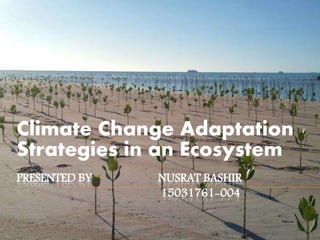
Climate Change Adaptation
Strategies in an Ecosystem
CLIMATE CHANGE
Climate change, also called global warming,
refers to the rise in average surface
temperatures on Earth. An overwhelming
scientific consensus maintains that climate
change is primarily due to the human use of
fossil fuels, which releases carbon dioxide
and other greenhouse gases into the air.
CLIMATE CHANGE ADAPTATION
 Adaptation means anticipating the
adverse effects of climate change and
taking appropriate action to prevent or
minimize the damage they can cause, or
taking advantage of opportunities that
may arise. It has been shown that well
planned, early adaptation action saves
money and lives later.
 Comer, P. (2007, January). Climate change vulnerability and adpatation strategies for natural
communities: pioloting methods in the Mojave and Sonoran deserts. In 8th International Wildlife
Ranching Symposium. Colorado State University. Libraries.
EXAMPLES OF ADAPTATION MEASURES
 Using scarce water resources more
efficiently;
 Adapting building codes to future climate
conditions and extreme weather events
 Building flood defenses and raising the
levels of dykes
 Developing drought-tolerant crops; choosing
tree species and forestry practices less
vulnerable to storms and fires
CLIMATE CHANGE ADAPTATION STRATEGIES
 The UNFCCC(United Nations Framework Convention on Climate
Change) defines it as actions taken to help
communities and ecosystems cope
with changing climate condition. The IPCC
describes it as adjustment in natural or
human systems in response to actual or
expected climatic stimuli or their effects,
which moderates harm or exploits beneficial
opportunities.
ECOLOGICAL IMPACTS OF CLIMATE CHANGE
Some of the most common
ecological changes
currently being observed
include:
 Transforming habitats
 Shifts in timing
(change in phenology)
 Rising temperatures
 Range shifting
 Spreading pests and
disease
KEY CONCEPTS
 Adaptive Capacity
The ability of a system to adjust to climate change
(including climate variability and extremes) to moderate
potential damages, to take advantage of opportunities, or
to cope with the consequences
 Sensitivity
Is the degree to which a system is affected, either
adversely or beneficially, by climate-related stimuli.
 Vulnerability
The degree to which a system is susceptible to, or unable
to cope with, adverse effects of climate change, including
climate variability and extremes. Vulnerability is a function
of the character, magnitude, and rate of climate variation
to which a system is exposed, its sensitivity, and its
adaptive capacity
WHY IS ADAPTATION IMPORTANT?
 Regardless of mitigation, we are faced with a
finite, and significant degree of
anthropogenic climate change
 Managing climate risk is likely to be
important for sustainable development
 For both these reasons, adaptation should
be an important part of policy response to
climate change
MEASURING ADAPTATION
 What should be measured?
 Hazard
 Risk
 Exposure
 Vulnerability
 Impacts
 Adaptation intervention
 Effectiveness of adaptation intervention
May 2006Anand Patwardhan - BASIC project
India workshop
9
ADAPTATION MEASURES
 Adaptation Measures
 Policy Measures
 Technological Measures
 Climate responsive change in location,
 Monitoring and Forecasting
 Risk sharing
RANGE OF ADAPTATION RESPONSES
CLASSIFYING ADAPTATION MEASURES
Source IPCC 2001.
<http://www.grida.no/publications/other/ipcc_tar/?src=/climate/ipcc_tar/wg2/645.htm#1825>
STEPS FOR CLIMATE CHANGE ADAPTATION
STRATEGIES FOR LOCAL IMPACT
 1. Prioritize adaptation efforts in communities
where vulnerabilities are highest and where the
need for safety and resilience is greatest.
 2. Build projected climate change related trends
in today’s risk and vulnerability assessment
based on current climate variability.
 3. Fully integrate adaptation into longer-term
national and local sustainable development and
poverty reduction strategies.
CONTINUE…..
 4. Prioritize the strengthening of existing capacities –
among local authorities
 5. Develop robust resource mobilization mechanisms
for adaptation that ensure the flow of both financial
and technical support to local actors.
 6. Leverage the opportunities in disaster prevention
and response, through improved early warning
systems, contingency planning and integrated
response,
 Mekong River Commission. (2010). Review of climate change adaptation methods and tools. MRC
Technical Paper, (34).
RESILIENCE
 The capacity to recover from difficulties
 Reducing other threats
 Maximise heterogeneity in microclimate /
soils
 Specific adaptations e.g. planting drought
tolerant species.
Morecroft et al. (2012) Resilience to climate change: translating principles
into practice. Journal of Applied Ecology, 49: 547-551.
ACCOMMODATING CHANGE
 Flexibility in designations
 Review approach to non-native species and
genotypes
 Increased landscape permeability
 Transplantation?
enable persistence ---> accept change
resilience accommodation
Changing approach as the climate changes
1°C > 2°C > 3°C > 4°C
Resilience or accommodation?
---> promote
transformation
?
→
Ecosystem based
adaptation
Conservation can help human society
to adapt to climate change
ECOSYSTEM-BASED ADAPTATION: AN EMERGING
CONCEPT
 Offers opportunities for both ecosystems and
ecosystem-dependent communities to
overcome the challenges (IUCN, 2009).
 Conservation or restoration of specific
ecosystem services that are crucial for
societal adaptation in a particular region.
 Management plans and priorities may need
to be modified in the future under climate
change.
EXAMPLES OF ECOSYSTEM-BASED
APPROACHES FOR ADAPTATION
 Coastal defense through the maintenance
and/or restoration of mangroves and other
coastal wetlands to reduce coastal flooding and
coastal erosion.
 Adapting the design and management of marine
protected areas to protect coral reefs and
shellfish reefs
 Sustainable management of upland wetlands
and floodplains for maintenance of water flow
and quality.
CONTINUE……
 Removing or controlling invasive species
 Managing wildfire risk with controlled burns
and thinning
REFERENCES
 Vignola, R., Locatelli, B., Martinez, C., & Imbach, P. (2009). Ecosystem-based adaptation to
climate change: what role for policy-makers, society and scientists?. Mitigation and Adaptation
Strategies for Global Change, 14(8), 691-696.
 Berkes, F., Colding, J., & Folke, C. (Eds.). (2008). Navigating social-ecological systems: building
resilience for complexity and change. Cambridge University Press.
 Comer, P. (2007, January). Climate change vulnerability and adpatation strategies for natural
communities: pioloting methods in the Mojave and Sonoran deserts. In 8th International Wildlife
Ranching Symposium. Colorado State University. Libraries.
 Change, I. P. O. C. (2001). Climate change 2007: impacts, adaptation and
vulnerability. Genebra, Suíça.
 Ford, J. D., & Smit, B. (2004). A framework for assessing the vulnerability of communities in the
Canadian Arctic to risks associated with climate change.Arctic, 389-400.
 Mawdsley, J. R., O’MALLEY, R. O. B. I. N., & Ojima, D. S. (2009). A review of climate‐change
adaptation strategies for wildlife management and biodiversity conservation. Conservation
Biology, 23(5), 1080-1089.
 Thomas, C. D. (2011). Translocation of species, climate change, and the end of trying to
recreate past ecological communities. Trends in Ecology & Evolution, 26(5), 216-221.
 Klein, R. J., & Nicholls, R. J. (1999). Assessment of coastal vulnerability to climate
change. Ambio, 182-187.

Climate change

  • 1.
    PRESENTED BY NUSRATBASHIR 15031761-004 Climate Change Adaptation Strategies in an Ecosystem
  • 2.
    CLIMATE CHANGE Climate change,also called global warming, refers to the rise in average surface temperatures on Earth. An overwhelming scientific consensus maintains that climate change is primarily due to the human use of fossil fuels, which releases carbon dioxide and other greenhouse gases into the air.
  • 3.
    CLIMATE CHANGE ADAPTATION Adaptation means anticipating the adverse effects of climate change and taking appropriate action to prevent or minimize the damage they can cause, or taking advantage of opportunities that may arise. It has been shown that well planned, early adaptation action saves money and lives later.  Comer, P. (2007, January). Climate change vulnerability and adpatation strategies for natural communities: pioloting methods in the Mojave and Sonoran deserts. In 8th International Wildlife Ranching Symposium. Colorado State University. Libraries.
  • 4.
    EXAMPLES OF ADAPTATIONMEASURES  Using scarce water resources more efficiently;  Adapting building codes to future climate conditions and extreme weather events  Building flood defenses and raising the levels of dykes  Developing drought-tolerant crops; choosing tree species and forestry practices less vulnerable to storms and fires
  • 5.
    CLIMATE CHANGE ADAPTATIONSTRATEGIES  The UNFCCC(United Nations Framework Convention on Climate Change) defines it as actions taken to help communities and ecosystems cope with changing climate condition. The IPCC describes it as adjustment in natural or human systems in response to actual or expected climatic stimuli or their effects, which moderates harm or exploits beneficial opportunities.
  • 6.
    ECOLOGICAL IMPACTS OFCLIMATE CHANGE Some of the most common ecological changes currently being observed include:  Transforming habitats  Shifts in timing (change in phenology)  Rising temperatures  Range shifting  Spreading pests and disease
  • 7.
    KEY CONCEPTS  AdaptiveCapacity The ability of a system to adjust to climate change (including climate variability and extremes) to moderate potential damages, to take advantage of opportunities, or to cope with the consequences  Sensitivity Is the degree to which a system is affected, either adversely or beneficially, by climate-related stimuli.  Vulnerability The degree to which a system is susceptible to, or unable to cope with, adverse effects of climate change, including climate variability and extremes. Vulnerability is a function of the character, magnitude, and rate of climate variation to which a system is exposed, its sensitivity, and its adaptive capacity
  • 8.
    WHY IS ADAPTATIONIMPORTANT?  Regardless of mitigation, we are faced with a finite, and significant degree of anthropogenic climate change  Managing climate risk is likely to be important for sustainable development  For both these reasons, adaptation should be an important part of policy response to climate change
  • 9.
    MEASURING ADAPTATION  Whatshould be measured?  Hazard  Risk  Exposure  Vulnerability  Impacts  Adaptation intervention  Effectiveness of adaptation intervention May 2006Anand Patwardhan - BASIC project India workshop 9
  • 10.
    ADAPTATION MEASURES  AdaptationMeasures  Policy Measures  Technological Measures  Climate responsive change in location,  Monitoring and Forecasting  Risk sharing
  • 11.
  • 12.
    CLASSIFYING ADAPTATION MEASURES SourceIPCC 2001. <http://www.grida.no/publications/other/ipcc_tar/?src=/climate/ipcc_tar/wg2/645.htm#1825>
  • 13.
    STEPS FOR CLIMATECHANGE ADAPTATION STRATEGIES FOR LOCAL IMPACT  1. Prioritize adaptation efforts in communities where vulnerabilities are highest and where the need for safety and resilience is greatest.  2. Build projected climate change related trends in today’s risk and vulnerability assessment based on current climate variability.  3. Fully integrate adaptation into longer-term national and local sustainable development and poverty reduction strategies.
  • 14.
    CONTINUE…..  4. Prioritizethe strengthening of existing capacities – among local authorities  5. Develop robust resource mobilization mechanisms for adaptation that ensure the flow of both financial and technical support to local actors.  6. Leverage the opportunities in disaster prevention and response, through improved early warning systems, contingency planning and integrated response,  Mekong River Commission. (2010). Review of climate change adaptation methods and tools. MRC Technical Paper, (34).
  • 15.
    RESILIENCE  The capacityto recover from difficulties  Reducing other threats  Maximise heterogeneity in microclimate / soils  Specific adaptations e.g. planting drought tolerant species. Morecroft et al. (2012) Resilience to climate change: translating principles into practice. Journal of Applied Ecology, 49: 547-551.
  • 16.
    ACCOMMODATING CHANGE  Flexibilityin designations  Review approach to non-native species and genotypes  Increased landscape permeability  Transplantation?
  • 17.
    enable persistence --->accept change resilience accommodation Changing approach as the climate changes 1°C > 2°C > 3°C > 4°C Resilience or accommodation? ---> promote transformation ?
  • 18.
    → Ecosystem based adaptation Conservation canhelp human society to adapt to climate change
  • 19.
    ECOSYSTEM-BASED ADAPTATION: ANEMERGING CONCEPT  Offers opportunities for both ecosystems and ecosystem-dependent communities to overcome the challenges (IUCN, 2009).  Conservation or restoration of specific ecosystem services that are crucial for societal adaptation in a particular region.  Management plans and priorities may need to be modified in the future under climate change.
  • 20.
    EXAMPLES OF ECOSYSTEM-BASED APPROACHESFOR ADAPTATION  Coastal defense through the maintenance and/or restoration of mangroves and other coastal wetlands to reduce coastal flooding and coastal erosion.  Adapting the design and management of marine protected areas to protect coral reefs and shellfish reefs  Sustainable management of upland wetlands and floodplains for maintenance of water flow and quality.
  • 21.
    CONTINUE……  Removing orcontrolling invasive species  Managing wildfire risk with controlled burns and thinning
  • 22.
    REFERENCES  Vignola, R.,Locatelli, B., Martinez, C., & Imbach, P. (2009). Ecosystem-based adaptation to climate change: what role for policy-makers, society and scientists?. Mitigation and Adaptation Strategies for Global Change, 14(8), 691-696.  Berkes, F., Colding, J., & Folke, C. (Eds.). (2008). Navigating social-ecological systems: building resilience for complexity and change. Cambridge University Press.  Comer, P. (2007, January). Climate change vulnerability and adpatation strategies for natural communities: pioloting methods in the Mojave and Sonoran deserts. In 8th International Wildlife Ranching Symposium. Colorado State University. Libraries.  Change, I. P. O. C. (2001). Climate change 2007: impacts, adaptation and vulnerability. Genebra, Suíça.  Ford, J. D., & Smit, B. (2004). A framework for assessing the vulnerability of communities in the Canadian Arctic to risks associated with climate change.Arctic, 389-400.  Mawdsley, J. R., O’MALLEY, R. O. B. I. N., & Ojima, D. S. (2009). A review of climate‐change adaptation strategies for wildlife management and biodiversity conservation. Conservation Biology, 23(5), 1080-1089.  Thomas, C. D. (2011). Translocation of species, climate change, and the end of trying to recreate past ecological communities. Trends in Ecology & Evolution, 26(5), 216-221.  Klein, R. J., & Nicholls, R. J. (1999). Assessment of coastal vulnerability to climate change. Ambio, 182-187.