Climate-­‐smart	
  village	
  :	
  	
  
the	
  CCAFS	
  model	
  to	
  improve	
  the	
  adap2ve	
  
capacity	
  of	
  communi2es	
  	
  
Robert Zougmoré
Regional Program Leader, West Africa,
CCAFS
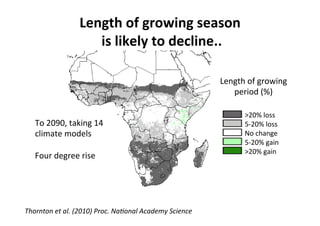
To	
  2090,	
  taking	
  14	
  
climate	
  models	


Four	
  degree	
  rise	
  
Thornton	
  et	
  al.	
  (2010)	
  Proc.	
  Na4onal	
  Academy	
  Science	
  
>20%	
  loss	
  
5-­‐20%	
  loss	
  
No	
  change	
  
5-­‐20%	
  gain	
  
>20%	
  gain	


Length	
  of	
  growing	
  
period	
  (%)	
  	
  
Length	
  of	
  growing	
  season	
  
	
  is	
  likely	
  to	
  decline..	


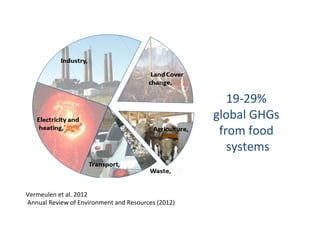
Vermeulen	
  et	
  al.	
  2012	
  
	
  Annual	
  Review	
  of	
  Environment	
  and	
  Resources	
  (2012)	


19-­‐29%	
  
global	
  GHGs	
  
from	
  food	
  
systems	
  
How	
  can	
  smallholder	
  farmers	
  
achieve	
  food	
  security	
  under	
  a	
  
changing	
  climate?	
  
Agriculture	
  must	
  become	
  	
  
“climate-­‐smart”	
  
•  contributes to climate change adaptation by
sustainably increasing productivity & resilience
•  mitigates climate change by reducing
greenhouse gases where possible
•  and enhances the achievement of national food
security and development goals
•  Approach where CCAFS in partnership with rural
communities and other stakeholders (NARES, NGOs,
local authorities…), tests & validates in an integrated
manner, several agricultural interventions
•  Aims to boost farmers’ ability to adapt to climate
change, manage risks and build resilience.
•  At the same time, the hope is to improve livelihoods
and incomes and, where possible, reduce greenhouse
gas emissions to ensure solutions are sustainable
Concept	
  of	
  “climate-­‐smart	
  
villages”	
  
7
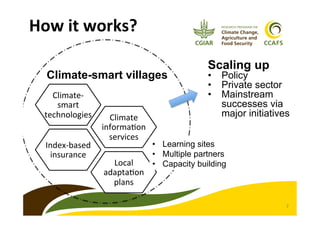
Climate-smart villages
Index-­‐based	
  
insurance	
  
Climate	
  
informa2on	
  
services	
  
Climate-­‐
smart	
  
technologies	
  
Local	
  
adapta2on	
  
plans	
  
•  Learning sites
•  Multiple partners
•  Capacity building
Scaling up
•  Policy
•  Private sector
•  Mainstream
successes via
major initiatives
How	
  it	
  works?	
  
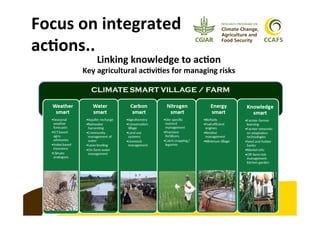
Focus	
  on	
  integrated	
  
acCons..	
  
Linking	
  knowledge	
  to	
  acCon	
  
Key	
  agricultural	
  acCviCes	
  for	
  managing	
  risks	
  
9
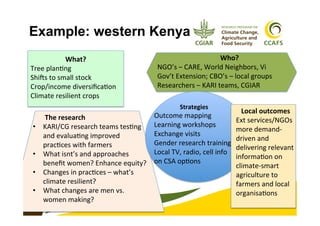
What?	
  
Tree	
  plan2ng	
  	
  
ShiTs	
  to	
  small	
  stock	
  
Crop/income	
  diversifica2on	
  
Climate	
  resilient	
  crops	
  
Who?	
  
NGO’s	
  –	
  CARE,	
  World	
  Neighbors,	
  Vi	
  	
  
Gov’t	
  Extension;	
  CBO’s	
  –	
  local	
  groups	
  
Researchers	
  –	
  KARI	
  teams,	
  CGIAR	
  
Strategies	
  
Outcome	
  mapping	
  
Learning	
  workshops	
  
Exchange	
  visits	
  
Gender	
  research	
  training	
  
Local	
  TV,	
  radio,	
  cell	
  info	
  
on	
  CSA	
  op2ons	


  The	
  research	
  
•  KARI/CG	
  research	
  teams	
  tes2ng	
  
and	
  evalua2ng	
  improved	
  
prac2ces	
  with	
  farmers	
  
•  What	
  isnt’s	
  and	
  approaches	
  
benefit	
  women?	
  Enhance	
  equity?	
  
•  Changes	
  in	
  prac2ces	
  –	
  what’s	
  
climate	
  resilient?	
  
•  What	
  changes	
  are	
  men	
  vs.	
  
women	
  making?	
  
Local	
  outcomes	
  
Ext	
  services/NGOs	
  
more	
  demand-­‐
driven	
  and	
  
delivering	
  relevant	
  
informa2on	
  on	
  
climate-­‐smart	
  	
  
agriculture	
  to	
  
farmers	
  and	
  local	
  
organisa2ons	
  
Example: western Kenya
10
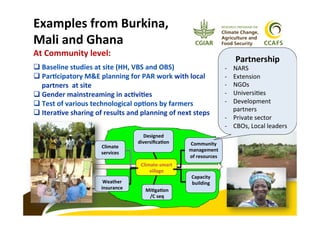
q Baseline	
  studies	
  at	
  site	
  (HH,	
  VBS	
  and	
  OBS)	
  
q ParCcipatory	
  M&E	
  planning	
  for	
  PAR	
  work	
  with	
  local	
  
partners	
  	
  at	
  site	
  
q Gender	
  mainstreaming	
  in	
  acCviCes	
  
q Test	
  of	
  various	
  technological	
  opCons	
  by	
  farmers	
  	
  
q IteraCve	
  sharing	
  of	
  results	
  and	
  planning	
  of	
  next	
  steps	
  
Climate-­‐smart	
  
village	
  
Climate	
  
services	
  
Weather	
  
insurance	
  
Designed	
  
diversificaCon	
  
MiCgaCon
/C	
  seq	
  
Community	
  
management	
  
of	
  resources	
  
Capacity	
  
building	
  
Partnership	
  
-­‐  NARS	
  
-­‐  Extension	
  
-­‐  NGOs	
  
-­‐  Universi2es	
  
-­‐  Development	
  
partners	
  
-­‐  Private	
  sector	
  
-­‐  CBOs,	
  Local	
  leaders	
  
Examples	
  from	
  Burkina,	
  	
  
Mali	
  and	
  Ghana	
  
At	
  Community	
  level:	
  
11
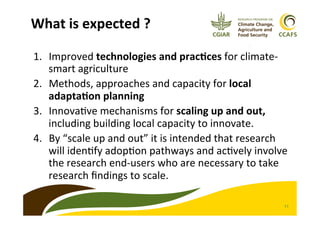
1.  Improved	
  technologies	
  and	
  pracCces	
  for	
  climate-­‐
smart	
  agriculture	
  	
  
2.  Methods,	
  approaches	
  and	
  capacity	
  for	
  local	
  
adaptaCon	
  planning	
  
3.  Innova2ve	
  mechanisms	
  for	
  scaling	
  up	
  and	
  out,	
  
including	
  building	
  local	
  capacity	
  to	
  innovate.	
  	
  
4.  By	
  “scale	
  up	
  and	
  out”	
  it	
  is	
  intended	
  that	
  research	
  
will	
  iden2fy	
  adop2on	
  pathways	
  and	
  ac2vely	
  involve	
  
the	
  research	
  end-­‐users	
  who	
  are	
  necessary	
  to	
  take	
  
research	
  findings	
  to	
  scale.	
  	
  
What	
  is	
  expected	
  ?	
  
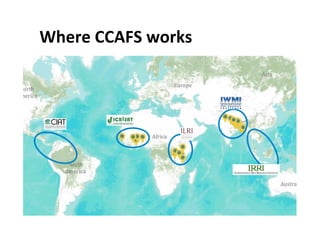
Where	
  CCAFS	
  works	
  
13
1.  To identify and test pro-poor adaptation and
mitigation technologies, practices, and policies for
food systems, adaptive capacity and rural
livelihoods
2.  To provide diagnosis and analysis that will ensure
cost effective investments, the inclusion of
agriculture in climate change policies, and the
inclusion of climate issues in agricultural policies,
from the sub-national to the global level
Over-­‐arching	
  objecCves	
  	
  
14
www.ccafs.cgiar.org;
r.zougmore@cgiar.org

The climate-smart village

  • 1.
    Climate-­‐smart  village  :     the  CCAFS  model  to  improve  the  adap2ve   capacity  of  communi2es     Robert Zougmoré Regional Program Leader, West Africa, CCAFS
  • 2.
    To  2090,  taking  14   climate  models     Four  degree  rise   Thornton  et  al.  (2010)  Proc.  Na4onal  Academy  Science   >20%  loss   5-­‐20%  loss   No  change   5-­‐20%  gain   >20%  gain                     Length  of  growing   period  (%)     Length  of  growing  season    is  likely  to  decline..                      
  • 3.
    Vermeulen  et  al.  2012    Annual  Review  of  Environment  and  Resources  (2012)       19-­‐29%   global  GHGs   from  food   systems  
  • 4.
    How  can  smallholder  farmers   achieve  food  security  under  a   changing  climate?  
  • 5.
    Agriculture  must  become     “climate-­‐smart”   •  contributes to climate change adaptation by sustainably increasing productivity & resilience •  mitigates climate change by reducing greenhouse gases where possible •  and enhances the achievement of national food security and development goals
  • 6.
    •  Approach whereCCAFS in partnership with rural communities and other stakeholders (NARES, NGOs, local authorities…), tests & validates in an integrated manner, several agricultural interventions •  Aims to boost farmers’ ability to adapt to climate change, manage risks and build resilience. •  At the same time, the hope is to improve livelihoods and incomes and, where possible, reduce greenhouse gas emissions to ensure solutions are sustainable Concept  of  “climate-­‐smart   villages”  
  • 7.
    7 Climate-smart villages Index-­‐based   insurance   Climate   informa2on   services   Climate-­‐ smart   technologies   Local   adapta2on   plans   •  Learning sites •  Multiple partners •  Capacity building Scaling up •  Policy •  Private sector •  Mainstream successes via major initiatives How  it  works?  
  • 8.
    Focus  on  integrated   acCons..   Linking  knowledge  to  acCon   Key  agricultural  acCviCes  for  managing  risks  
  • 9.
    9 What?   Tree  plan2ng     ShiTs  to  small  stock   Crop/income  diversifica2on   Climate  resilient  crops   Who?   NGO’s  –  CARE,  World  Neighbors,  Vi     Gov’t  Extension;  CBO’s  –  local  groups   Researchers  –  KARI  teams,  CGIAR   Strategies   Outcome  mapping   Learning  workshops   Exchange  visits   Gender  research  training   Local  TV,  radio,  cell  info   on  CSA  op2ons                  The  research   •  KARI/CG  research  teams  tes2ng   and  evalua2ng  improved   prac2ces  with  farmers   •  What  isnt’s  and  approaches   benefit  women?  Enhance  equity?   •  Changes  in  prac2ces  –  what’s   climate  resilient?   •  What  changes  are  men  vs.   women  making?   Local  outcomes   Ext  services/NGOs   more  demand-­‐ driven  and   delivering  relevant   informa2on  on   climate-­‐smart     agriculture  to   farmers  and  local   organisa2ons   Example: western Kenya
  • 10.
    10 q Baseline  studies  at  site  (HH,  VBS  and  OBS)   q ParCcipatory  M&E  planning  for  PAR  work  with  local   partners    at  site   q Gender  mainstreaming  in  acCviCes   q Test  of  various  technological  opCons  by  farmers     q IteraCve  sharing  of  results  and  planning  of  next  steps   Climate-­‐smart   village   Climate   services   Weather   insurance   Designed   diversificaCon   MiCgaCon /C  seq   Community   management   of  resources   Capacity   building   Partnership   -­‐  NARS   -­‐  Extension   -­‐  NGOs   -­‐  Universi2es   -­‐  Development   partners   -­‐  Private  sector   -­‐  CBOs,  Local  leaders   Examples  from  Burkina,     Mali  and  Ghana   At  Community  level:  
  • 11.
    11 1.  Improved  technologies  and  pracCces  for  climate-­‐ smart  agriculture     2.  Methods,  approaches  and  capacity  for  local   adaptaCon  planning   3.  Innova2ve  mechanisms  for  scaling  up  and  out,   including  building  local  capacity  to  innovate.     4.  By  “scale  up  and  out”  it  is  intended  that  research   will  iden2fy  adop2on  pathways  and  ac2vely  involve   the  research  end-­‐users  who  are  necessary  to  take   research  findings  to  scale.     What  is  expected  ?  
  • 12.
  • 13.
    13 1.  To identifyand test pro-poor adaptation and mitigation technologies, practices, and policies for food systems, adaptive capacity and rural livelihoods 2.  To provide diagnosis and analysis that will ensure cost effective investments, the inclusion of agriculture in climate change policies, and the inclusion of climate issues in agricultural policies, from the sub-national to the global level Over-­‐arching  objecCves    
  • 14.