IPCC AR6 Synthesis Report
June 26,2023
Climate Change 2023
Synthesis Report
SixthAssessmentReport
JoséRomero,Head SYRTSU
IntergovernmentalPanelon ClimateChange(IPCC) 1/2
• Established in 1988,195member governments.
• Objective: to provide scientific information for policy-
making on climate change: drivers of climate change, its
impacts and future risks, and adaptation and mitigation.
• Thousands of people from allover the world
contribute to the work of the IPCC. For the
assessment reports, experts volunteer their time as
IPCC authors to assess the thousands of scientific
papers published each year to provide a
comprehensive summary of what is known about the
drivers of climate change, its impacts and future risks,
and how adaptationandmitigation can reduce those
risks.
Sixth Assessment Report | Synthesis Report
The IntergovernmentalPanelon Climate Change
(IPCC)is the United Nationsbodyfor assessing
the science relatedto climate change.
IntergovernmentalPanelon ClimateChange(IPCC) 2/2
• Through its assessments, the IPCC identifies the
strength of scientific agreement in different areas and
indicateswhere further research is needed. The IPCC
does not conduct its own research.
• An open and transparent review by experts and
governments around the world is an essential part of the
IPCC process, to ensure an objective andcomplete
assessment and to reflect adiverse range of views
and expertise.
Sixth Assessment Report | Synthesis Report
The IntergovernmentalPanelon Climate Change
(IPCC)is the United Nationsbodyfor assessing
the science relatedto climate change.
SynthesisReport(SYR) of SixthAssessmentReport 1/2
• Sixth Assessment Report (AR6) started in 2015.
• Professor Hoesung Lee, Chairman.
• The Synthesis Report (SYR) is the final report of the
AR6.
• SYR integrates the content of the three reports
produced by the Working Groups of the IPCC on the
science; impacts and adaptation;andmitigation; and
the three Special Reports (Global Warming of 1.5°C;
Land; and Ocean and Cryosphere) during the AR6.
• The AR6 is the most comprehensive assessment of
climate change undertaken thus far by the IPCC.
Sixth Assessment Report | Synthesis Report
WGIII
Special Report
WGII
WGI
Climate Change 2022:
Mitigation of Climate Change
Global Warming of 1.5 ºC
Climate Change and Land
Ocean and Cryosphere in a Changing
Climate
Climate Change 2022:
Impacts, Adaptation and Vulnerability
AR6 Climate Change 2021:
The Physical Science Basis
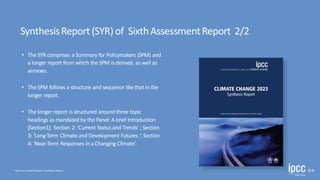
SynthesisReport(SYR) of SixthAssessmentReport 2/2
• The SYR comprises a Summary for Policymakers (SPM) and
a longer report from which the SPM is derived, as well as
annexes.
• The SPM follows a structure and sequence like that in the
longer report.
• The longer report is structured around three topic
headings as mandated by the Panel: A brief Introduction
(Section1); Section 2: ‘Current Status and Trends’ ;Section
3: ‘Long-Term Climate and Development Futures ’; Section
4: ‘Near-Term Responses in aChanging Climate’.
Sixth Assessment Report | Synthesis Report
j of Kore
Technical Support Unit of
the SYR (SYR TSU)
• The Technical Support Unit (TSU) of the SYR of
the AR6 plans and manages the writing process
of the SYR, including arranging author meetings,
assisting the author team while drafting the
SYR, ensuring quality control of the SYR and
ensuring compliance with the IPCC Processes
and Procedures and Panel decisions.
• The SYR TSU is established under the
responsibility of the Chair of the IPCC.
• The SYR TSU is located in Seoul, Republic of
Korea and financially supported by the
Government of the Republic of Korea.
Government of the
Republic of Korea
Sixth Assessment Report | Synthesis Report
A. Current Status and Trends
Observed Warming and
its Causes
Global surface temperaturewas 1.1°C above
1850–1900in 2011–2020.
This warming is unequivocally caused by GHG emissions
due to human activities.
Historicalandongoingemissionsdifferacrossregions,
between andwithin countries,andamongindividuals.
In2019about80%ofemissionscamefromenergy,industry,
transportandbuildings.Therestcamefromagriculture,
forestryandotherlanduse. Source: IPCC AR6 Figure 2.1 (c), 2023
Sixth Assessment Report | Synthesis Report
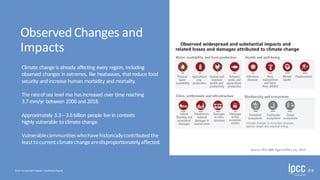
ObservedChanges and
Impacts
Climate change is already affecting every region, including
observed changes in extremes, like heatwaves, thatreduce food
security and increase human morbidity and mortality.
The rateof sea level rise hasincreased over time reaching
3.7mm/yr between 2006and 2018.
Approximately 3.3 – 3.6billion people live in contexts
highly vulnerable to climate change.
Vulnerablecommunitieswhohavehistoricallycontributedthe
leasttocurrentclimatechangearedisproportionatelyaffected.
Source: IPCC AR6 Figure SPM.1 (a), 2023
Sixth Assessment Report | Synthesis Report
Adaptation Progress, Gaps and Challenges
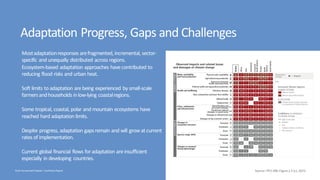
Mostadaptationresponses arefragmented,incremental, sector-
specific and unequally distributed across regions.
Ecosystem-based adaptation approaches have contributed to
reducing flood risks and urban heat.
Soft limits to adaptation are being experienced by small-scale
farmersandhouseholds inlow-lying coastalregions.
Some tropical, coastal, polar and mountain ecosystems have
reached hard adaptation limits.
Despite progress, adaptation gapsremain and will grow atcurrent
rates of implementation.
Current global financial flows foradaptation are insufficient
especially in developing countries.
Sixth Assessment Report | Synthesis Report Source: IPCC AR6 Figure 2.3 (c), 2023
MitigationProgress,Gaps
and Challenges
More countries have implemented mitigation policies avoiding
emissions of atleast 1.8GtCO2e/yr but global emissions continue
to rise.
At least 18countries have sustained adecade of declining
absolute emissions.
October 2021NDCs not sufficient toachieve Paris Agreement
temperature goal.
2020policies not sufficient toachieve the NDCs.
Finance flows fall short of the levels needed and the
USD100billion/yr goal.
Source: IPCC AR6 Figure 2.5 (a),2023
Sixth Assessment Report | Synthesis Report
B. Future Climate Change, Risks, and
Long-Term Responses
Future Climate
Change
Nearly all scenarios and modelled pathways project continued
growth in annual GHG emissions in the near term – 2021-2040–
leading toincreasing global warming.
Warming is more likely than not toreach 1.5°C in the near term
even under the very low GHG emissions scenario (SSP1-1.9).
Every increment of global warming will affect all major climate
system components and intensify multiple and concurrent
hazards.
Deep, rapid, and sustained reductions in GHG emissions would
lead to adiscernible difference in global warming trends within
two decades. Source: IPCC AR6 Cross-Section Box.2 Figure 1 (a), 2023
Sixth Assessment Report | Synthesis Report
Climate Change Impacts and
Related Risks
Sixth Assessment Report | Synthesis Report
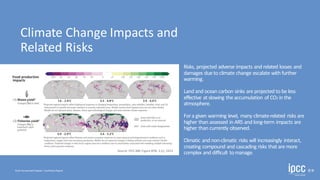
Risks, projected adverse impacts and related losses and
damages due to climate change escalate with further
warming.
Land and ocean carbon sinks are projected to be less
effective atslowing the accumulation of CO2 in the
atmosphere.
Fora given warming level, many climate-related risks are
higher than assessed in AR5 and long-term impacts are
higher than currently observed.
Climatic and non-climatic risks will increasingly interact,
creating compound and cascading risks thatare more
complex and difficult tomanage.
Source: IPCC AR6 Figure SPM. 3 (c), 2023
Likelihood and Risks of Unavoidable, Irreversible
or Abrupt Changes
Some future changes are unavoidable
and/or irreversible but can be limited by deep,
rapid and sustained global emissions reduction.
The likelihood of abrupt and/or irreversible
changes suchas species loss in forests, coral
reefs and Arctic regions increases with
additional warming.
Similarly, the probability of low-likelihood
outcomes associated with potentially very large
adverse impacts increases with additional
warming. Source: IPCC AR6 Figure SPM. 4 (a), 2023
Sixth Assessment Report | Synthesis Report
Adaptation Options and their Limits in a
Warmer World
Adaptation options, including most water
related options, will become constrained and
less effective with further warming.
With more warming, losses and damages,
concentrated among vulnerable populations,
will increase and additional human and natural
systems will reach adaptation limits.
Maladaptation canbe avoided by careful long-
term planning and implementation.
Source: IPCC AR6 Figure SPM. 4 (c), 2023
Sixth Assessment Report | Synthesis Report
Carbon Budgets and
Net Zero Emissions
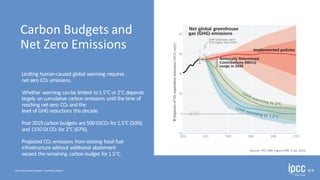
Limiting human-caused global warming requires
net zero CO2 emissions.
Whether warming canbe limited to1.5°C or 2°C depends
largely on cumulative carbon emissions until the time of
reaching net-zero CO2 and the
level of GHG reductions this decade.
Post2019carbon budgets are 500GtCO2 for1.5°C (50%)
and 1150GtCO2 for 2°C (67%).
Projected CO2 emissions from existing fossil fuel
infrastructure without additional abatement
exceed the remaining carbon budget for1.5°C.
Source: IPCC AR6 Figure SPM. 5 (a), 2023
Sixth Assessment Report | Synthesis Report
Mitigation Pathways
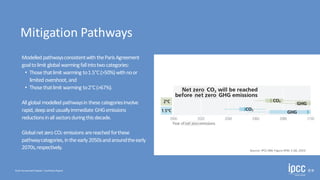
Modelled pathwaysconsistentwith theParisAgreement
goaltolimit global warmingfallintotwocategories:
• Those thatlimit warming to1.5°C(>50%)withnoor
limited overshoot,and
• Those thatlimit warming to2°C(>67%).
All global modelled pathwaysin these categoriesinvolve
rapid,deepand usuallyimmediate GHGemissions
reductionsinall sectorsduringthisdecade.
Globalnetzero CO2 emissions arereached forthese
pathwaycategories,inthe early 2050sandaroundtheearly
2070s,respectively. Source: IPCC AR6 Figure SPM. 5 (d), 2023
Sixth Assessment Report | Synthesis Report
Overshoot:
Exceeding a Warming Level
and Returning
If warming exceeds a specified level, such as 1.5°C,it could gradually
be reduced again by achieving and sustaining net negative global CO2
emissions.
Net negative CO2 emissions would require more carbon dioxide
removal (CDR) deployment compared topathways without
overshoot.
Greater deployment of CDR raises feasibility and sustainability
concerns.
Overshoot entails risks and adverse impacts, some irreversible, for
human and natural systems, that grow with the magnitude and
duration of overshoot.
Source: IPCC AR6 Figure 3.6 (a),2023
Sixth Assessment Report | Synthesis Report
C. Responses in the Near Term
Sixth Assessment Report | Synthesis Report
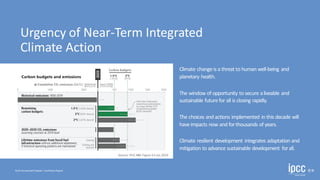
Climate change is a threat to human well-being and
planetary health.
The window of opportunity to secure aliveable and
sustainable future for all is closing rapidly.
The choices and actions implemented in this decade will
have impacts now and forthousands of years.
Climate resilient development integrates adaptation and
mitigation to advance sustainable development forall.
Source: IPCC AR6 Figure 3.5 (a),2023
Urgency of Near-Term Integrated
Climate Action
Benefits of
Near-Term Action
Ambitious action in this decade would yield numerous
benefits.
Ambitious near-term action would reduce projected
losses and damages for humans and natural ecosystems
and deliver many co-benefits.
Delayed action would reduce feasible adaptation
options, increase losses and damages, and raise risks of
stranded assets.
Near-term actions involve higher investments initially but
yield savings in the longer term.
Sixth Assessment Report | Synthesis Report
Source: IPCC AR6 Figure SPM. 7 (a), 2023
Mitigation and Adaptation Options
across Systems
Rapid, ambitious and extensive transitions are needed in
all sectorsandsystemstoachievenetzeroemissions.
Feasible, effective, and low-cost options for mitigation and
adaptation are already available, with differences across
systems and regions.
Optionscosting<USD100/tCO2ecouldreduce2019
globalemissionsby at leasthalf by 2030.
The pace of the transitions will differ across sectors and
regions.
Sixth Assessment Report | Synthesis Report
Source:IPCCAR6 Figure 4.1 (a),2023
Synergies and Trade-
Offs with Sustainable
Development
Accelerated and equitable action in mitigating and
adapting toclimate change impacts is critical to
sustainable development.
Mitigation andadaptation actions have more synergies
than trade-offs with Sustainable Development Goals.
Synergies and trade-offs depend on context and scale of
implementation.
Sixth Assessment Report | Synthesis Report
Source: IPCC AR6 Figure 4.5, 2023
EquityandInclusion
Prioritising equity, climate justice, social justice, inclusion
and justtransition processes canenable adaptation and
ambitious mitigation actions.
Adaptation outcomes are enhanced by increased
support toregions and people with the highest
vulnerability toclimatic hazards.
Integrating climate adaptation into social protection
programs improves resilience.
Options that reduce emission-intensive consumption can
enhance societal well-being.
Extreme poverty can be eradicated without significant
emissions growth.
Sixth Assessment Report | Synthesis Report
Source: IPCC AR6 Figure SPM. 6, 2023
Sixth Assessment Report | Synthesis Report
Effective national, sub-national and municipal
government institutions are crucial foreffective
climate action.
Clear goals and inclusive governance processes
facilitate effective climate action.
Vulnerabilities and climate risks can be reduced
through carefully designed laws, policies and
participatory processes.
Regulatory and economic instruments could
achieve deep emissions reductions if applied
widely and made more stringent.
Source: IPCC AR6 Table2.2, 2023
Governance and
Policies
Sixth Assessment Report | Synthesis Report
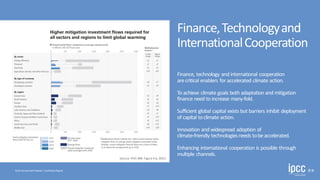
Source: IPCC AR6 Figure 4.6, 2023
Finance,Technologyand
InternationalCooperation
Finance, technology and international cooperation
are critical enablers for accelerated climate action.
To achieve climate goals both adaptation and mitigation
finance need to increase many-fold.
Sufficient global capital exists but barriers inhibit deployment
of capital toclimate action.
Innovation and widespread adoption of
climate-friendly technologiesneeds tobe accelerated.
Enhancing international cooperation is possible through
multiple channels.
Sixth Assessment Report | Synthesis Report
https://www.ipcc.ch/report/ar6/syr/

IPCC AR6 Synthesis Report

  • 1.
    IPCC AR6 SynthesisReport June 26,2023 Climate Change 2023 Synthesis Report SixthAssessmentReport JoséRomero,Head SYRTSU
  • 3.
    IntergovernmentalPanelon ClimateChange(IPCC) 1/2 •Established in 1988,195member governments. • Objective: to provide scientific information for policy- making on climate change: drivers of climate change, its impacts and future risks, and adaptation and mitigation. • Thousands of people from allover the world contribute to the work of the IPCC. For the assessment reports, experts volunteer their time as IPCC authors to assess the thousands of scientific papers published each year to provide a comprehensive summary of what is known about the drivers of climate change, its impacts and future risks, and how adaptationandmitigation can reduce those risks. Sixth Assessment Report | Synthesis Report The IntergovernmentalPanelon Climate Change (IPCC)is the United Nationsbodyfor assessing the science relatedto climate change.
  • 4.
    IntergovernmentalPanelon ClimateChange(IPCC) 2/2 •Through its assessments, the IPCC identifies the strength of scientific agreement in different areas and indicateswhere further research is needed. The IPCC does not conduct its own research. • An open and transparent review by experts and governments around the world is an essential part of the IPCC process, to ensure an objective andcomplete assessment and to reflect adiverse range of views and expertise. Sixth Assessment Report | Synthesis Report The IntergovernmentalPanelon Climate Change (IPCC)is the United Nationsbodyfor assessing the science relatedto climate change.
  • 5.
    SynthesisReport(SYR) of SixthAssessmentReport1/2 • Sixth Assessment Report (AR6) started in 2015. • Professor Hoesung Lee, Chairman. • The Synthesis Report (SYR) is the final report of the AR6. • SYR integrates the content of the three reports produced by the Working Groups of the IPCC on the science; impacts and adaptation;andmitigation; and the three Special Reports (Global Warming of 1.5°C; Land; and Ocean and Cryosphere) during the AR6. • The AR6 is the most comprehensive assessment of climate change undertaken thus far by the IPCC. Sixth Assessment Report | Synthesis Report WGIII Special Report WGII WGI Climate Change 2022: Mitigation of Climate Change Global Warming of 1.5 ºC Climate Change and Land Ocean and Cryosphere in a Changing Climate Climate Change 2022: Impacts, Adaptation and Vulnerability AR6 Climate Change 2021: The Physical Science Basis
  • 6.
    SynthesisReport(SYR) of SixthAssessmentReport2/2 • The SYR comprises a Summary for Policymakers (SPM) and a longer report from which the SPM is derived, as well as annexes. • The SPM follows a structure and sequence like that in the longer report. • The longer report is structured around three topic headings as mandated by the Panel: A brief Introduction (Section1); Section 2: ‘Current Status and Trends’ ;Section 3: ‘Long-Term Climate and Development Futures ’; Section 4: ‘Near-Term Responses in aChanging Climate’. Sixth Assessment Report | Synthesis Report
  • 8.
    j of Kore TechnicalSupport Unit of the SYR (SYR TSU) • The Technical Support Unit (TSU) of the SYR of the AR6 plans and manages the writing process of the SYR, including arranging author meetings, assisting the author team while drafting the SYR, ensuring quality control of the SYR and ensuring compliance with the IPCC Processes and Procedures and Panel decisions. • The SYR TSU is established under the responsibility of the Chair of the IPCC. • The SYR TSU is located in Seoul, Republic of Korea and financially supported by the Government of the Republic of Korea. Government of the Republic of Korea
  • 10.
    Sixth Assessment Report| Synthesis Report A. Current Status and Trends
  • 11.
    Observed Warming and itsCauses Global surface temperaturewas 1.1°C above 1850–1900in 2011–2020. This warming is unequivocally caused by GHG emissions due to human activities. Historicalandongoingemissionsdifferacrossregions, between andwithin countries,andamongindividuals. In2019about80%ofemissionscamefromenergy,industry, transportandbuildings.Therestcamefromagriculture, forestryandotherlanduse. Source: IPCC AR6 Figure 2.1 (c), 2023 Sixth Assessment Report | Synthesis Report
  • 12.
    ObservedChanges and Impacts Climate changeis already affecting every region, including observed changes in extremes, like heatwaves, thatreduce food security and increase human morbidity and mortality. The rateof sea level rise hasincreased over time reaching 3.7mm/yr between 2006and 2018. Approximately 3.3 – 3.6billion people live in contexts highly vulnerable to climate change. Vulnerablecommunitieswhohavehistoricallycontributedthe leasttocurrentclimatechangearedisproportionatelyaffected. Source: IPCC AR6 Figure SPM.1 (a), 2023 Sixth Assessment Report | Synthesis Report
  • 13.
    Adaptation Progress, Gapsand Challenges Mostadaptationresponses arefragmented,incremental, sector- specific and unequally distributed across regions. Ecosystem-based adaptation approaches have contributed to reducing flood risks and urban heat. Soft limits to adaptation are being experienced by small-scale farmersandhouseholds inlow-lying coastalregions. Some tropical, coastal, polar and mountain ecosystems have reached hard adaptation limits. Despite progress, adaptation gapsremain and will grow atcurrent rates of implementation. Current global financial flows foradaptation are insufficient especially in developing countries. Sixth Assessment Report | Synthesis Report Source: IPCC AR6 Figure 2.3 (c), 2023
  • 14.
    MitigationProgress,Gaps and Challenges More countrieshave implemented mitigation policies avoiding emissions of atleast 1.8GtCO2e/yr but global emissions continue to rise. At least 18countries have sustained adecade of declining absolute emissions. October 2021NDCs not sufficient toachieve Paris Agreement temperature goal. 2020policies not sufficient toachieve the NDCs. Finance flows fall short of the levels needed and the USD100billion/yr goal. Source: IPCC AR6 Figure 2.5 (a),2023 Sixth Assessment Report | Synthesis Report
  • 15.
    Sixth Assessment Report| Synthesis Report B. Future Climate Change, Risks, and Long-Term Responses
  • 16.
    Future Climate Change Nearly allscenarios and modelled pathways project continued growth in annual GHG emissions in the near term – 2021-2040– leading toincreasing global warming. Warming is more likely than not toreach 1.5°C in the near term even under the very low GHG emissions scenario (SSP1-1.9). Every increment of global warming will affect all major climate system components and intensify multiple and concurrent hazards. Deep, rapid, and sustained reductions in GHG emissions would lead to adiscernible difference in global warming trends within two decades. Source: IPCC AR6 Cross-Section Box.2 Figure 1 (a), 2023 Sixth Assessment Report | Synthesis Report
  • 17.
    Climate Change Impactsand Related Risks Sixth Assessment Report | Synthesis Report Risks, projected adverse impacts and related losses and damages due to climate change escalate with further warming. Land and ocean carbon sinks are projected to be less effective atslowing the accumulation of CO2 in the atmosphere. Fora given warming level, many climate-related risks are higher than assessed in AR5 and long-term impacts are higher than currently observed. Climatic and non-climatic risks will increasingly interact, creating compound and cascading risks thatare more complex and difficult tomanage. Source: IPCC AR6 Figure SPM. 3 (c), 2023
  • 18.
    Likelihood and Risksof Unavoidable, Irreversible or Abrupt Changes Some future changes are unavoidable and/or irreversible but can be limited by deep, rapid and sustained global emissions reduction. The likelihood of abrupt and/or irreversible changes suchas species loss in forests, coral reefs and Arctic regions increases with additional warming. Similarly, the probability of low-likelihood outcomes associated with potentially very large adverse impacts increases with additional warming. Source: IPCC AR6 Figure SPM. 4 (a), 2023 Sixth Assessment Report | Synthesis Report
  • 19.
    Adaptation Options andtheir Limits in a Warmer World Adaptation options, including most water related options, will become constrained and less effective with further warming. With more warming, losses and damages, concentrated among vulnerable populations, will increase and additional human and natural systems will reach adaptation limits. Maladaptation canbe avoided by careful long- term planning and implementation. Source: IPCC AR6 Figure SPM. 4 (c), 2023 Sixth Assessment Report | Synthesis Report
  • 20.
    Carbon Budgets and NetZero Emissions Limiting human-caused global warming requires net zero CO2 emissions. Whether warming canbe limited to1.5°C or 2°C depends largely on cumulative carbon emissions until the time of reaching net-zero CO2 and the level of GHG reductions this decade. Post2019carbon budgets are 500GtCO2 for1.5°C (50%) and 1150GtCO2 for 2°C (67%). Projected CO2 emissions from existing fossil fuel infrastructure without additional abatement exceed the remaining carbon budget for1.5°C. Source: IPCC AR6 Figure SPM. 5 (a), 2023 Sixth Assessment Report | Synthesis Report
  • 21.
    Mitigation Pathways Modelled pathwaysconsistentwiththeParisAgreement goaltolimit global warmingfallintotwocategories: • Those thatlimit warming to1.5°C(>50%)withnoor limited overshoot,and • Those thatlimit warming to2°C(>67%). All global modelled pathwaysin these categoriesinvolve rapid,deepand usuallyimmediate GHGemissions reductionsinall sectorsduringthisdecade. Globalnetzero CO2 emissions arereached forthese pathwaycategories,inthe early 2050sandaroundtheearly 2070s,respectively. Source: IPCC AR6 Figure SPM. 5 (d), 2023 Sixth Assessment Report | Synthesis Report
  • 22.
    Overshoot: Exceeding a WarmingLevel and Returning If warming exceeds a specified level, such as 1.5°C,it could gradually be reduced again by achieving and sustaining net negative global CO2 emissions. Net negative CO2 emissions would require more carbon dioxide removal (CDR) deployment compared topathways without overshoot. Greater deployment of CDR raises feasibility and sustainability concerns. Overshoot entails risks and adverse impacts, some irreversible, for human and natural systems, that grow with the magnitude and duration of overshoot. Source: IPCC AR6 Figure 3.6 (a),2023 Sixth Assessment Report | Synthesis Report
  • 23.
    Sixth Assessment Report| Synthesis Report C. Responses in the Near Term
  • 24.
    Sixth Assessment Report| Synthesis Report Climate change is a threat to human well-being and planetary health. The window of opportunity to secure aliveable and sustainable future for all is closing rapidly. The choices and actions implemented in this decade will have impacts now and forthousands of years. Climate resilient development integrates adaptation and mitigation to advance sustainable development forall. Source: IPCC AR6 Figure 3.5 (a),2023 Urgency of Near-Term Integrated Climate Action
  • 25.
    Benefits of Near-Term Action Ambitiousaction in this decade would yield numerous benefits. Ambitious near-term action would reduce projected losses and damages for humans and natural ecosystems and deliver many co-benefits. Delayed action would reduce feasible adaptation options, increase losses and damages, and raise risks of stranded assets. Near-term actions involve higher investments initially but yield savings in the longer term. Sixth Assessment Report | Synthesis Report Source: IPCC AR6 Figure SPM. 7 (a), 2023
  • 26.
    Mitigation and AdaptationOptions across Systems Rapid, ambitious and extensive transitions are needed in all sectorsandsystemstoachievenetzeroemissions. Feasible, effective, and low-cost options for mitigation and adaptation are already available, with differences across systems and regions. Optionscosting<USD100/tCO2ecouldreduce2019 globalemissionsby at leasthalf by 2030. The pace of the transitions will differ across sectors and regions. Sixth Assessment Report | Synthesis Report Source:IPCCAR6 Figure 4.1 (a),2023
  • 27.
    Synergies and Trade- Offswith Sustainable Development Accelerated and equitable action in mitigating and adapting toclimate change impacts is critical to sustainable development. Mitigation andadaptation actions have more synergies than trade-offs with Sustainable Development Goals. Synergies and trade-offs depend on context and scale of implementation. Sixth Assessment Report | Synthesis Report Source: IPCC AR6 Figure 4.5, 2023
  • 28.
    EquityandInclusion Prioritising equity, climatejustice, social justice, inclusion and justtransition processes canenable adaptation and ambitious mitigation actions. Adaptation outcomes are enhanced by increased support toregions and people with the highest vulnerability toclimatic hazards. Integrating climate adaptation into social protection programs improves resilience. Options that reduce emission-intensive consumption can enhance societal well-being. Extreme poverty can be eradicated without significant emissions growth. Sixth Assessment Report | Synthesis Report Source: IPCC AR6 Figure SPM. 6, 2023
  • 29.
    Sixth Assessment Report| Synthesis Report Effective national, sub-national and municipal government institutions are crucial foreffective climate action. Clear goals and inclusive governance processes facilitate effective climate action. Vulnerabilities and climate risks can be reduced through carefully designed laws, policies and participatory processes. Regulatory and economic instruments could achieve deep emissions reductions if applied widely and made more stringent. Source: IPCC AR6 Table2.2, 2023 Governance and Policies
  • 30.
    Sixth Assessment Report| Synthesis Report Source: IPCC AR6 Figure 4.6, 2023 Finance,Technologyand InternationalCooperation Finance, technology and international cooperation are critical enablers for accelerated climate action. To achieve climate goals both adaptation and mitigation finance need to increase many-fold. Sufficient global capital exists but barriers inhibit deployment of capital toclimate action. Innovation and widespread adoption of climate-friendly technologiesneeds tobe accelerated. Enhancing international cooperation is possible through multiple channels.
  • 31.
    Sixth Assessment Report| Synthesis Report https://www.ipcc.ch/report/ar6/syr/