
COMMUNICATIVE
APPROACH
Communicative Language Teaching
COMMUNICATIVE
APPROACH
Bruno Caballero and Camila Muñoz
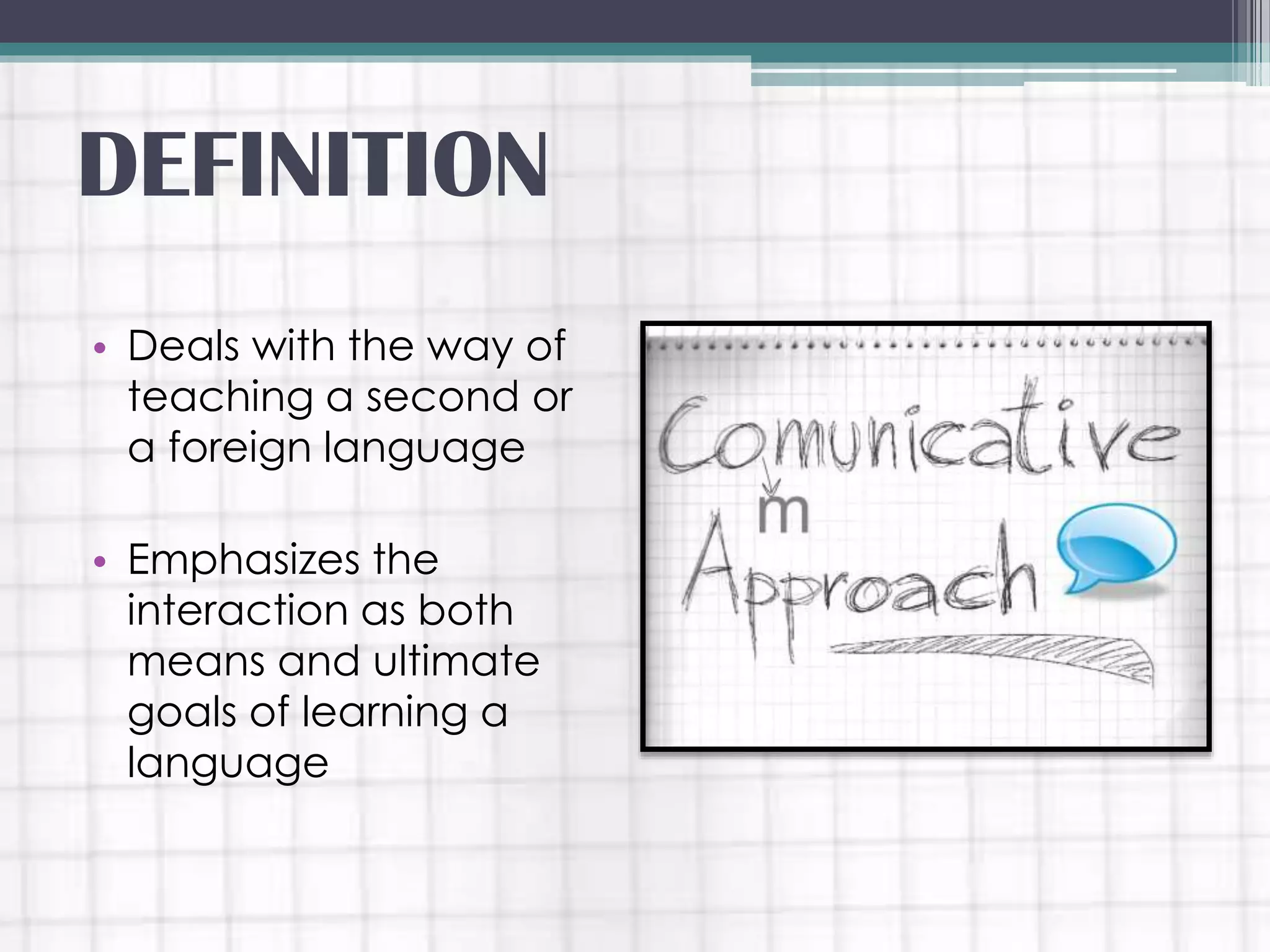
• Deals with the way of
teaching a second or
a foreign language
• Emphasizes the
interaction as both
means and ultimate
goals of learning a
language
DEFINITION
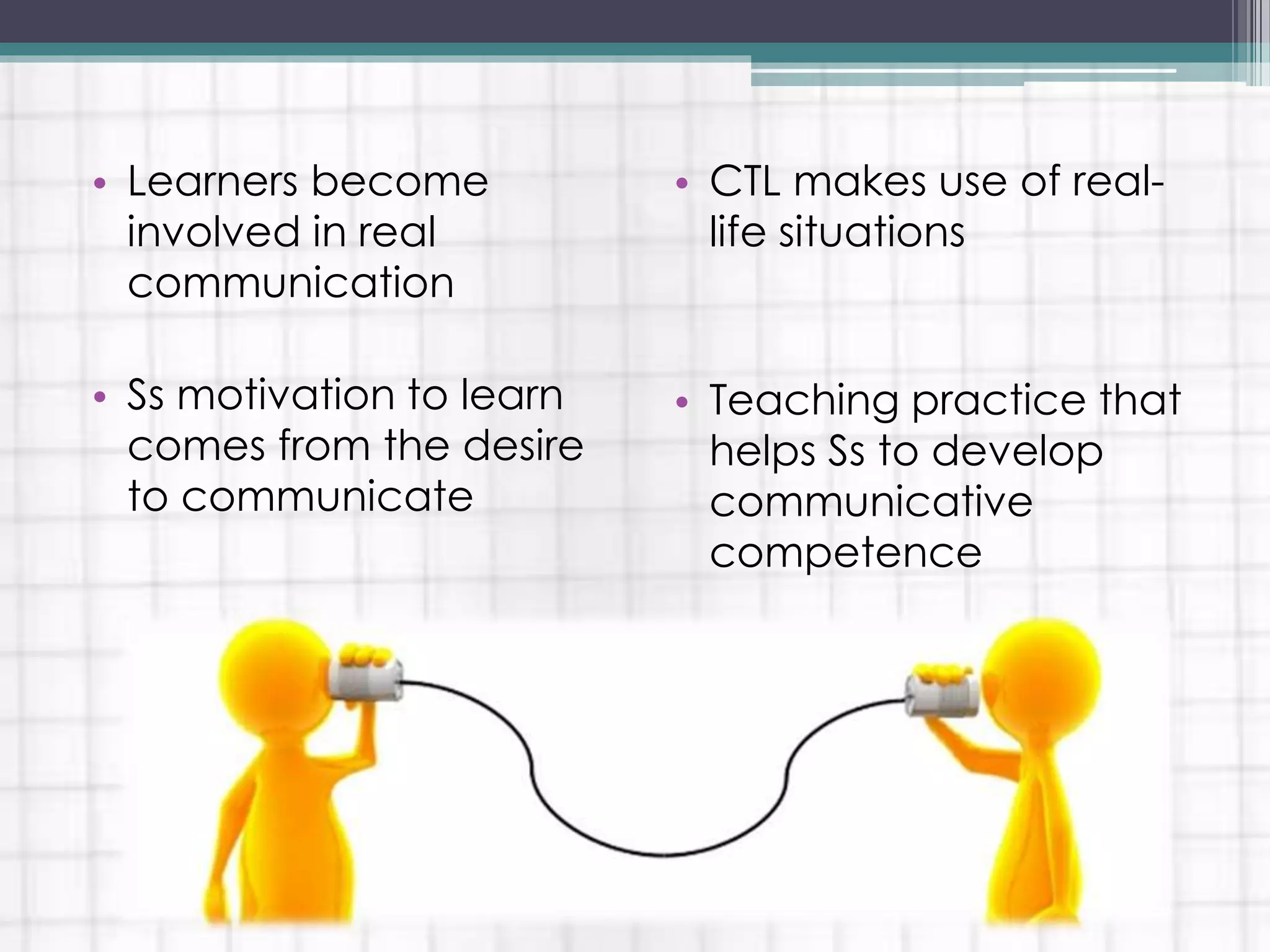
• Learners become
involved in real
communication
• Ss motivation to learn
comes from the desire
to communicate
• CTL makes use of real-
life situations
• Teaching practice that
helps Ss to develop
communicative
competence
1970s and early1980s
• Rose to prominence as
a result of many
disparate developments
in Europe
• Increasing demand for
language learning
• Its origins are many,
insofar as one teaching
methodology tends to
influence the next
• influenced by works by
the Council of Europe
• Based on the theories of
British functional linguists
such as: Firth, Halliday
and the American
sociolinguistics Hymes,
Gumperz and Lavob
HISTORICAL CONTEXT
Notional: time, location,
frequency, and quantity.
Functional: offers, complaints,
denials, and requests
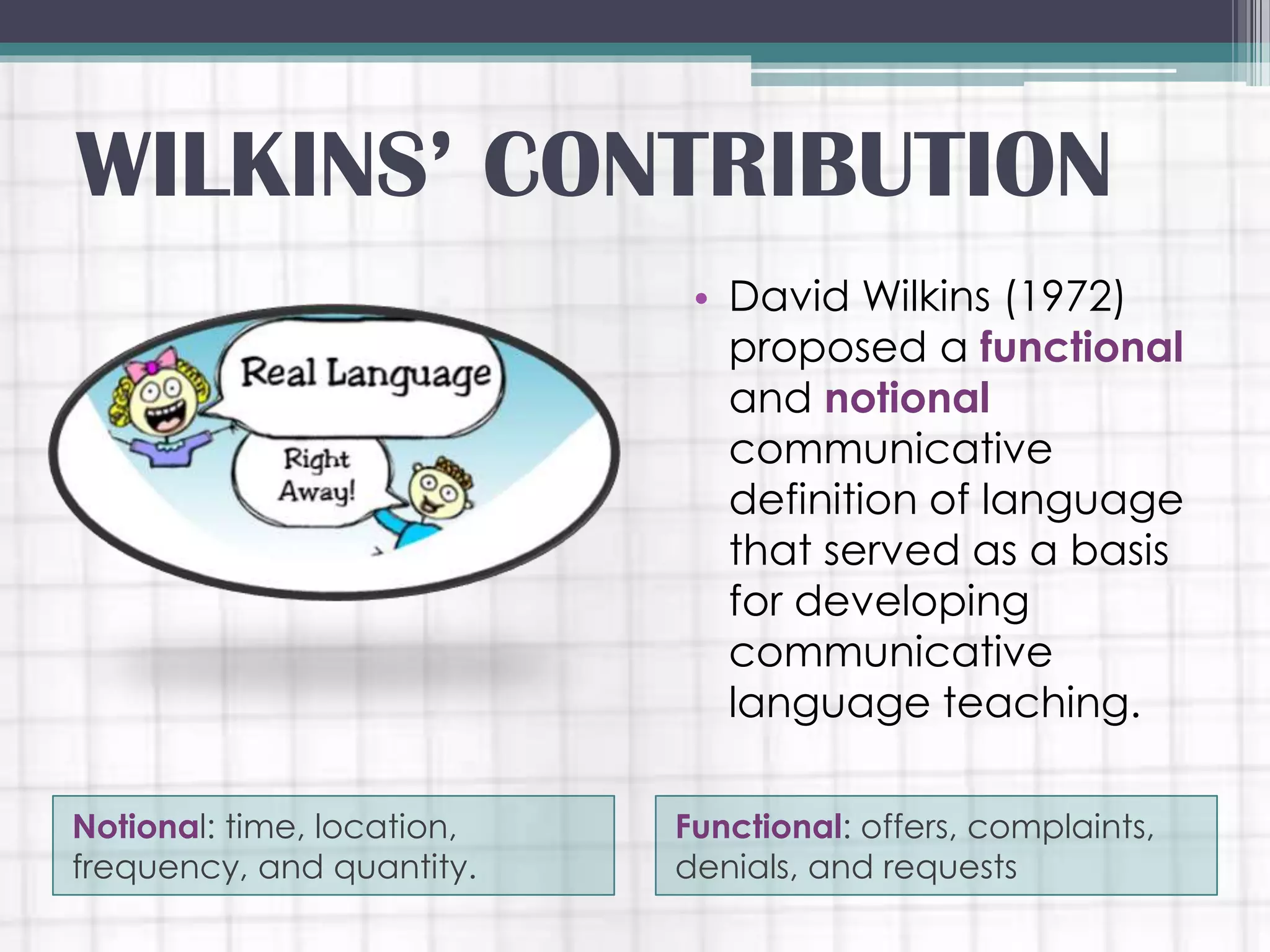
• David Wilkins (1972)
proposed a functional
and notional
communicative
definition of language
that served as a basis
for developing
communicative
language teaching.
WILKINS’ CONTRIBUTION
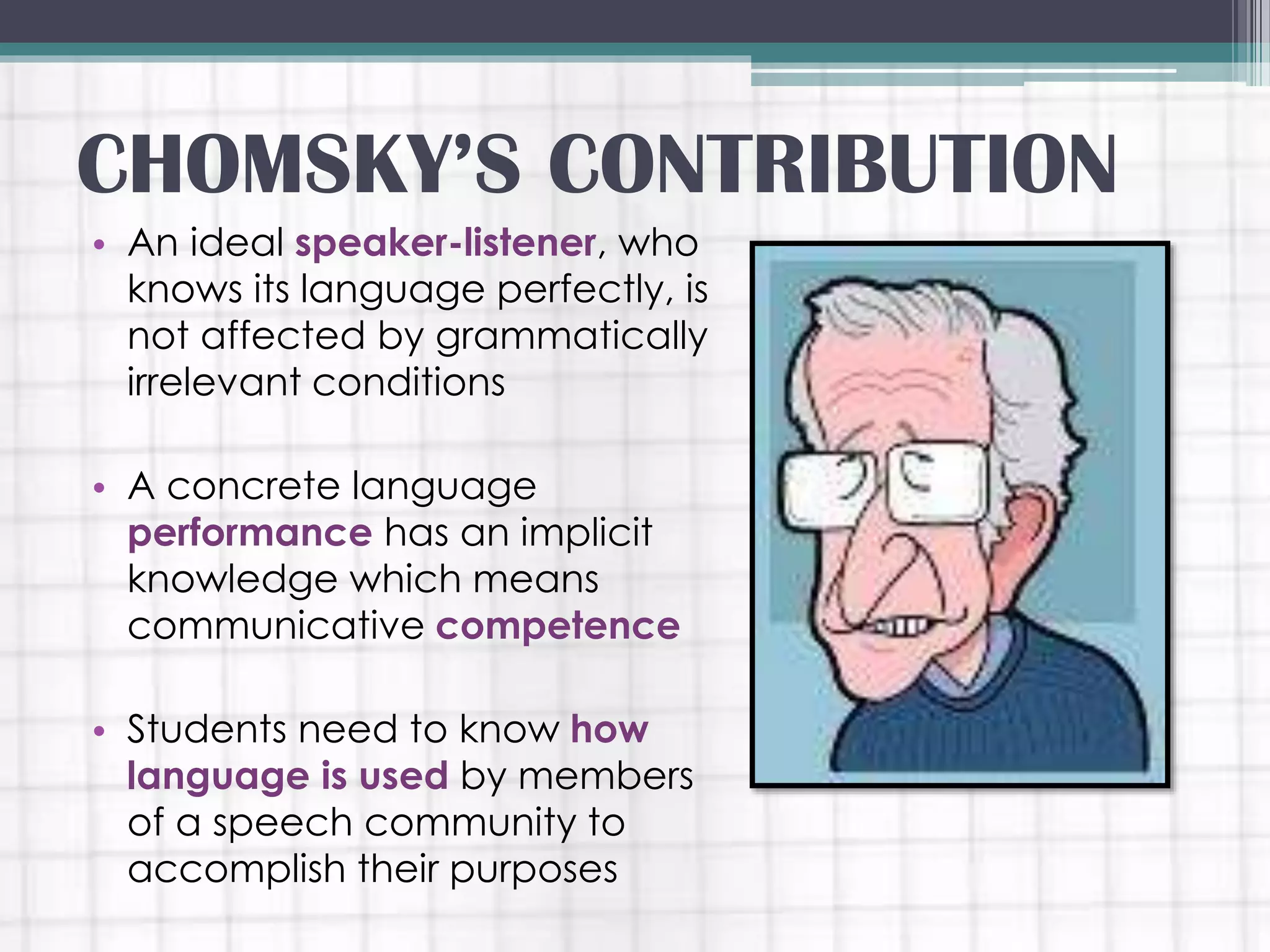
• An ideal speaker-listener, who
knows its language perfectly, is
not affected by grammatically
irrelevant conditions
• A concrete language
performance has an implicit
knowledge which means
communicative competence
• Students need to know how
language is used by members
of a speech community to
accomplish their purposes
CHOMSKY’S CONTRIBUTION
• Facilitates the
communication in the
classroom
• Acts as adviser – guide
or monitor
• Sets up exercises and
activities
• Evaluations
TEACHER’S ROLE
• Students are
communicators
• they are actively
engaged in trying to
make themselves
understood and in
understanding others
• Errors are seen as a
natural outcome of the
development of
communicative skills
STUDENTS’ ROLE
• CLT is not only focused on the traditional structural
syllabus, but also it takes into consideration
communicative context
• CLT provides vitality and motivation within the
classroom
• CLT is a learner-centered approach. It is based on
learners’ needs and interests
MERITS OF CLT
CLASSROOM ACTIVITIES
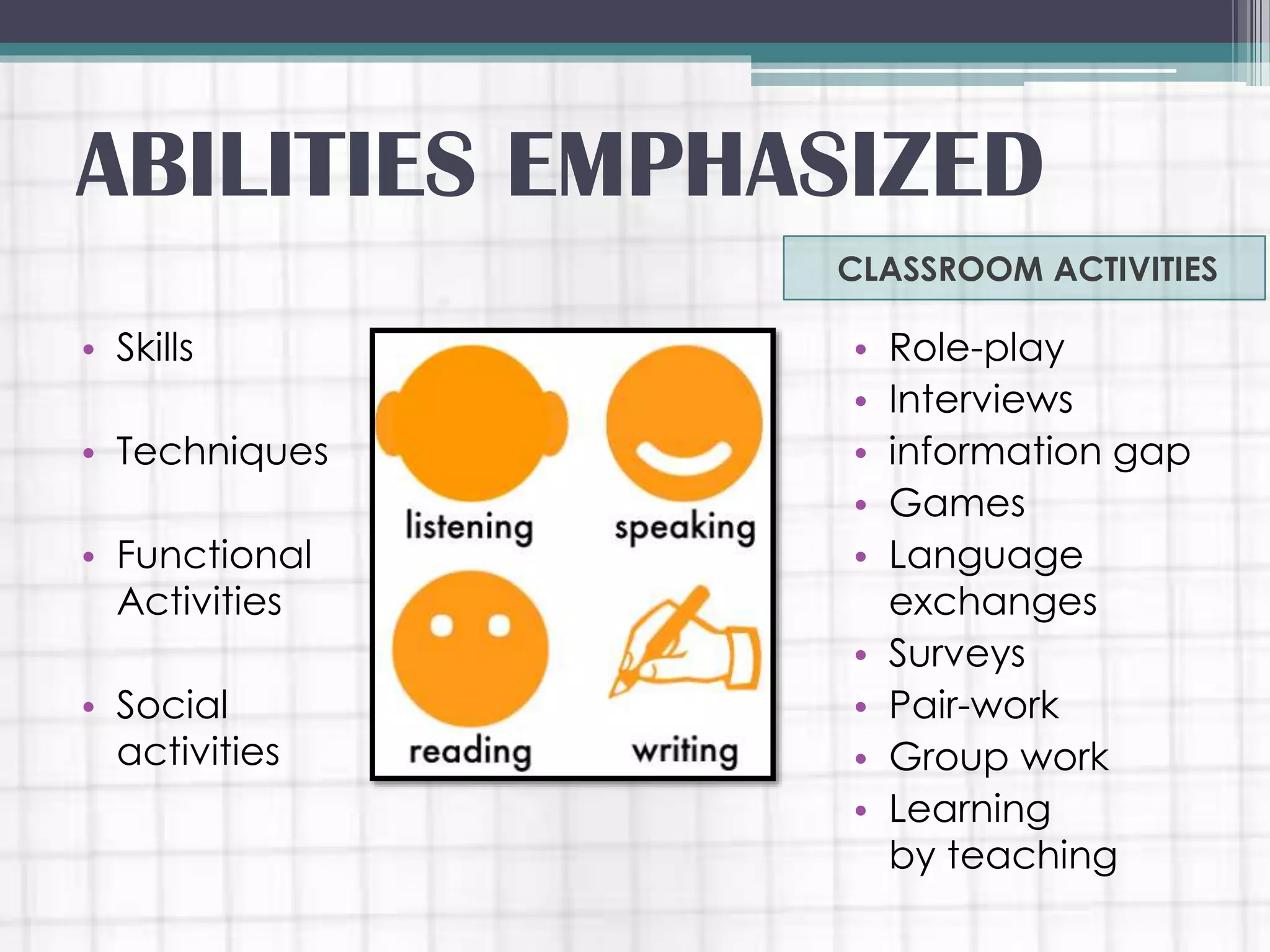
• Skills
• Techniques
• Functional
Activities
• Social
activities
• Role-play
• Interviews
• information gap
• Games
• Language
exchanges
• Surveys
• Pair-work
• Group work
• Learning
by teaching
ABILITIES EMPHASIZED
• CA Increases the teacher-student relationship. It is
an interactive relationship
• CA Provides the opportunity for students to be
aware of their abilities and exhibit them
• Ss in this approach can learn the target language
in an enjoyable way
• Students will be more motivated by learning to
communicate
• Students will learn to communicate effectively
CONTRIBUTIONS OF CLT
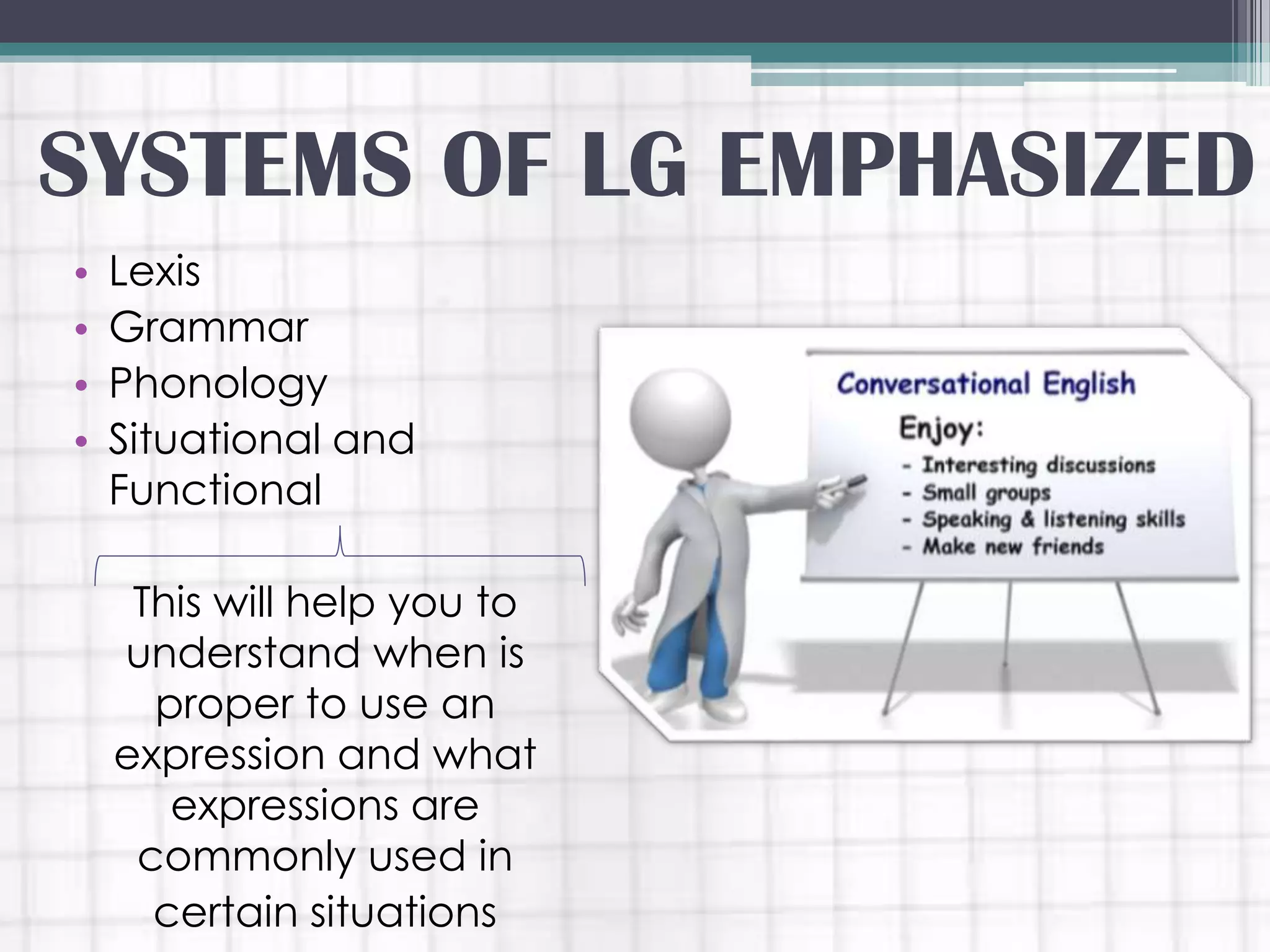
SYSTEMS OF LG EMPHASIZED
• Lexis
• Grammar
• Phonology
• Situational and
Functional
This will help you to
understand when is
proper to use an
expression and what
expressions are
commonly used in
certain situations
COMMUNICATIVE APPROACH

Communicative approach

  • 1.
  • 2.
  • 3.
    • Deals withthe way of teaching a second or a foreign language • Emphasizes the interaction as both means and ultimate goals of learning a language DEFINITION
  • 4.
    • Learners become involvedin real communication • Ss motivation to learn comes from the desire to communicate • CTL makes use of real- life situations • Teaching practice that helps Ss to develop communicative competence
  • 5.
  • 6.
    • Rose toprominence as a result of many disparate developments in Europe • Increasing demand for language learning • Its origins are many, insofar as one teaching methodology tends to influence the next • influenced by works by the Council of Europe • Based on the theories of British functional linguists such as: Firth, Halliday and the American sociolinguistics Hymes, Gumperz and Lavob HISTORICAL CONTEXT
  • 7.
    Notional: time, location, frequency,and quantity. Functional: offers, complaints, denials, and requests • David Wilkins (1972) proposed a functional and notional communicative definition of language that served as a basis for developing communicative language teaching. WILKINS’ CONTRIBUTION
  • 8.
    • An idealspeaker-listener, who knows its language perfectly, is not affected by grammatically irrelevant conditions • A concrete language performance has an implicit knowledge which means communicative competence • Students need to know how language is used by members of a speech community to accomplish their purposes CHOMSKY’S CONTRIBUTION
  • 10.
    • Facilitates the communicationin the classroom • Acts as adviser – guide or monitor • Sets up exercises and activities • Evaluations TEACHER’S ROLE
  • 11.
    • Students are communicators •they are actively engaged in trying to make themselves understood and in understanding others • Errors are seen as a natural outcome of the development of communicative skills STUDENTS’ ROLE
  • 12.
    • CLT isnot only focused on the traditional structural syllabus, but also it takes into consideration communicative context • CLT provides vitality and motivation within the classroom • CLT is a learner-centered approach. It is based on learners’ needs and interests MERITS OF CLT
  • 13.
    CLASSROOM ACTIVITIES • Skills •Techniques • Functional Activities • Social activities • Role-play • Interviews • information gap • Games • Language exchanges • Surveys • Pair-work • Group work • Learning by teaching ABILITIES EMPHASIZED
  • 14.
    • CA Increasesthe teacher-student relationship. It is an interactive relationship • CA Provides the opportunity for students to be aware of their abilities and exhibit them • Ss in this approach can learn the target language in an enjoyable way • Students will be more motivated by learning to communicate • Students will learn to communicate effectively CONTRIBUTIONS OF CLT
  • 15.
    SYSTEMS OF LGEMPHASIZED • Lexis • Grammar • Phonology • Situational and Functional This will help you to understand when is proper to use an expression and what expressions are commonly used in certain situations
  • 16.