Inventor/Proponent Prahbu.  Country of origin India.  TASK  Activity that needs to have a specific outcome or a result.
Theory of Language -“Language is primarily a means of making meaning”.  Theory of Learning  -> Communicative Approach. “ Tasks provide both input and output processing necessary for language acquisition”.
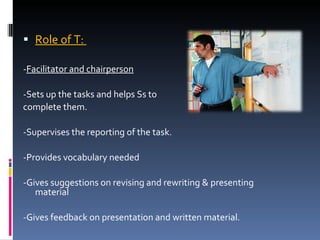
Role of T:  - Facilitator and chairperson -Sets up the tasks and helps Ss to  complete them.  -Supervises the reporting of the task.  -Provides vocabulary needed  -Gives suggestions on revising and rewriting & presenting material  -Gives feedback on presentation and written material.
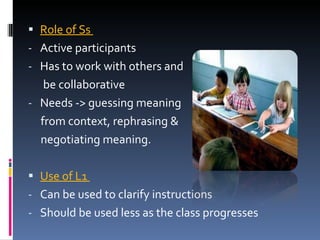
Role of Ss  Active participants  Has to work with others and be collaborative  Needs -> guessing meaning  from context, rephrasing &  negotiating meaning.  Use of L1  Can be used to clarify instructions Should be used less as the class progresses
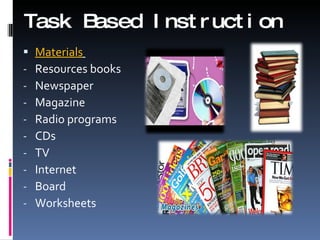
Materials   Resources books  Newspaper  Magazine  Radio programs  CDs TV  Internet Board Worksheets Task Based Instruction
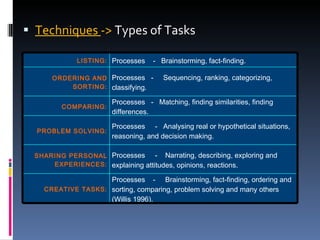
Techniques  ->  Types of Tasks  LISTING: Processes    -   Brainstorming, fact-finding. ORDERING AND SORTING: Processes   -     Sequencing, ranking, categorizing, classifying. COMPARING: Processes   -   Matching, finding similarities, finding differences. PROBLEM SOLVING: Processes     -   Analysing real or hypothetical situations, reasoning, and decision making. SHARING PERSONAL EXPERIENCES: Processes     -    Narrating, describing, exploring and explaining attitudes, opinions, reactions. CREATIVE TASKS: Processes    -     Brainstorming, fact-finding, ordering and sorting, comparing, problem solving and many others (Willis 1996).
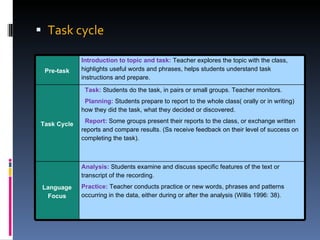
Task cycle Pre-task Introduction to topic and task:  Teacher explores the topic with the class, highlights useful words and phrases, helps students understand task instructions and prepare. Task Cycle    Task:   Students do the task, in pairs or small groups. Teacher monitors.     Planning:   Students prepare to report to the whole class( orally or in writing) how they did the task, what they decided or discovered.     Report:  Some groups present their reports to the class, or exchange written reports and compare results. (Ss receive feedback on their level of success on completing the task).  Language Focus Analysis:  Students examine and discuss specific features of the text or transcript of the recording. Practice:  Teacher conducts practice or new words, phrases and patterns occurring in the data, either during or after the analysis (Willis 1996: 38).
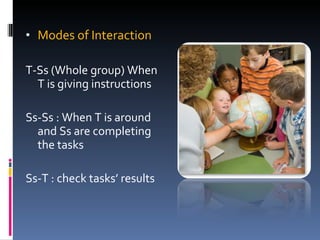
Modes of Interaction  T-Ss (Whole group) When T is giving instructions  Ss-Ss : When T is around and Ss are completing the tasks Ss-T : check tasks’ results
Areas of Language Communication, meaning & fluency.  Evaluation   Ss can be evaluated in written form or presentations.
How Ss’ errors are corrected  Ss are corrected discreetly.  T want Ss to use the TL.  Ss’s feelings  Ss should  feel comfortable  during class.
Advantages TBL is applicable and suitable for Ss of all ages and backgrounds. Ss will have a much more varied exposure to language with TBL.  Ss are free to use whatever vocabulary and grammar they know, rather than just the TL of the lesson.  Allows meaningful communication.  Ss will be exposed to a whole range of lexical phrases, collocations and patterns as well as L forms. Encourages Ss to be more ambitious in the L they use.
Disadvantages TBL requires a high level of creativity and initiative on the part of the T. TBL requires resources  beyond  the textbooks and related materials usually found in language classrooms. T-B instruction is not teacher-centered and it requires individual and group responsibility and commitment on the part of Ss. There is a risk for learners to achieve fluency at the expense of accuracy.
Reference Larsen-Freeman, D. (2000).  Techniques and Principles in Language Teaching.  (Second Edition). Oxford University Press .

Task based instruction method

  • 1.
  • 2.
    Inventor/Proponent Prahbu. Country of origin India. TASK Activity that needs to have a specific outcome or a result.
  • 3.
    Theory of Language-“Language is primarily a means of making meaning”. Theory of Learning -> Communicative Approach. “ Tasks provide both input and output processing necessary for language acquisition”.
  • 4.
    Role of T: - Facilitator and chairperson -Sets up the tasks and helps Ss to complete them. -Supervises the reporting of the task. -Provides vocabulary needed -Gives suggestions on revising and rewriting & presenting material -Gives feedback on presentation and written material.
  • 5.
    Role of Ss Active participants Has to work with others and be collaborative Needs -> guessing meaning from context, rephrasing & negotiating meaning. Use of L1 Can be used to clarify instructions Should be used less as the class progresses
  • 6.
    Materials Resources books Newspaper Magazine Radio programs CDs TV Internet Board Worksheets Task Based Instruction
  • 7.
    Techniques -> Types of Tasks LISTING: Processes    -   Brainstorming, fact-finding. ORDERING AND SORTING: Processes   -     Sequencing, ranking, categorizing, classifying. COMPARING: Processes   -   Matching, finding similarities, finding differences. PROBLEM SOLVING: Processes     -   Analysing real or hypothetical situations, reasoning, and decision making. SHARING PERSONAL EXPERIENCES: Processes     -    Narrating, describing, exploring and explaining attitudes, opinions, reactions. CREATIVE TASKS: Processes    -     Brainstorming, fact-finding, ordering and sorting, comparing, problem solving and many others (Willis 1996).
  • 8.
    Task cycle Pre-taskIntroduction to topic and task: Teacher explores the topic with the class, highlights useful words and phrases, helps students understand task instructions and prepare. Task Cycle   Task: Students do the task, in pairs or small groups. Teacher monitors.   Planning: Students prepare to report to the whole class( orally or in writing) how they did the task, what they decided or discovered.   Report: Some groups present their reports to the class, or exchange written reports and compare results. (Ss receive feedback on their level of success on completing the task). Language Focus Analysis: Students examine and discuss specific features of the text or transcript of the recording. Practice: Teacher conducts practice or new words, phrases and patterns occurring in the data, either during or after the analysis (Willis 1996: 38).
  • 9.
    Modes of Interaction T-Ss (Whole group) When T is giving instructions Ss-Ss : When T is around and Ss are completing the tasks Ss-T : check tasks’ results
  • 10.
    Areas of LanguageCommunication, meaning & fluency. Evaluation Ss can be evaluated in written form or presentations.
  • 11.
    How Ss’ errorsare corrected Ss are corrected discreetly. T want Ss to use the TL. Ss’s feelings Ss should feel comfortable during class.
  • 12.
    Advantages TBL isapplicable and suitable for Ss of all ages and backgrounds. Ss will have a much more varied exposure to language with TBL. Ss are free to use whatever vocabulary and grammar they know, rather than just the TL of the lesson. Allows meaningful communication. Ss will be exposed to a whole range of lexical phrases, collocations and patterns as well as L forms. Encourages Ss to be more ambitious in the L they use.
  • 13.
    Disadvantages TBL requiresa high level of creativity and initiative on the part of the T. TBL requires resources beyond the textbooks and related materials usually found in language classrooms. T-B instruction is not teacher-centered and it requires individual and group responsibility and commitment on the part of Ss. There is a risk for learners to achieve fluency at the expense of accuracy.
  • 14.
    Reference Larsen-Freeman, D.(2000). Techniques and Principles in Language Teaching. (Second Edition). Oxford University Press .