Making Pair Work and Group Work
Effective
Strategies to overcome the challenges
Why is Group Work Important?
Most descriptions of Communicative Language Teaching
encourage teachers to use pair work and group work during their
lessons. Why do you that that is?
Communicative Approach
• Interaction is the means and the goal
• Learning is task-based
• Meaning/understanding the message is more important than
exact grammar
• Authentic materials are used
• Many answers are possible
• Mistakes are a part of learning
Types of Communicative Activities
• Role plays
• Interviews
• Information gap
• Games
• Surveys
• Debates
• Pair work
• Drama
• Learn by teaching
Teacher-Centered vs. Learner-Centered
Classrooms
Teacher-centered: the teacher is the focus and takes responsibility
for everything - analyzing ideas, organizing information,
explaining rules, correcting mistakes
Learner-centered: students work independently; more responsible
for activities; focus on communicating with each other and the
teacher
Learner-Centered classrooms are better
-Just listening to the teacher doesn’t prepare students
enough to use English
-Students practicing English in pairs and groups will help
them understand and remember new information better
-Just listening to the teacher all the time is boring!
Students lose motivation
Boring
Video Clip : SEE or DON’T SEE
1. Students always sitting in rows, facing teacher.
2. Students in groups.
3. Students in teams.
4. Students learning through games.
5. Students being tested through games.
6. All student groups writing the same thing.
7. The teacher giving feedback to the students.
8. Students giving feedback to each other.
The Challenges
#1: Students only speak in Portuguese
Strategies:
-Teacher very strict about English-only in the classroom.
-Close monitoring of pair work & group work.
-Providing incentives for students/groups who only use English in
class - candy, extra homework points.
The Challenges
#2: Students make too much noise, are out of
control
Strategies:
-Use a “quiet signal” to maintain control. It can be raised hand, a
clap, light turn off/on
-Set strong and clear guidelines about classroom behavior from the
beginning
-Assign a student monitor(s) to keep control
The Challenges
#3: Students don’t complete activity; they are bored
Strategies:
-Know your learners! Always search for choose and design group
work activities with their motivation in mind.
-Each student given a “job” in the group - ex. Secretary,
spokesperson, task control, etc
-Follow-up reports, summaries to be given
The Challenges
#4: Some students don’t participate
Strategies:
-Give students who generally don’t participate the job of
“spokesperson” in the group
-Use “toothpicks” as a tool to control participation. Each student
receives 6 and must use 1 toothpick every time they speak
-Pair up two “quiet” students together
The Challenges
#5: Students don’t understand directions
Strategies:
-Prepare and practice giving simple, clear instructions. Repeat
many times.
-If students really don’t understand, it’s okay to use Portuguese,
but try to avoid it
-Have one student who understands, explain directions to the
class; very motivating
The Challenges
#6: One group finishes before the others
Strategies:
-Prepare a back-up activity for groups who finish early
-Use members of fast group as “teacher helpers” for the groups with
difficulties
-Carefully check over group’s completed work and correct or have
them expand on ideas
Different Combinations of Group Work
Some suggestions about what usually
works best….
 Pairs - dialogue practice,vocabularly drills
and grammar review
 Groups of 5 - problem solving activities
 Groups of 4 - introductions and social
interactions
 Groups of 3 - discussions
Effective Technique: Jigsaw
-Students work in “learning” groups to understand a particular topic
well
-New groups are formed called “teaching” groups where each
member comes from a different learning group
-Each member of the new teaching group is responsible for teaching
their topic
Benefits: prevents “slacking off,” everyone participates, a lot of
material is addressed
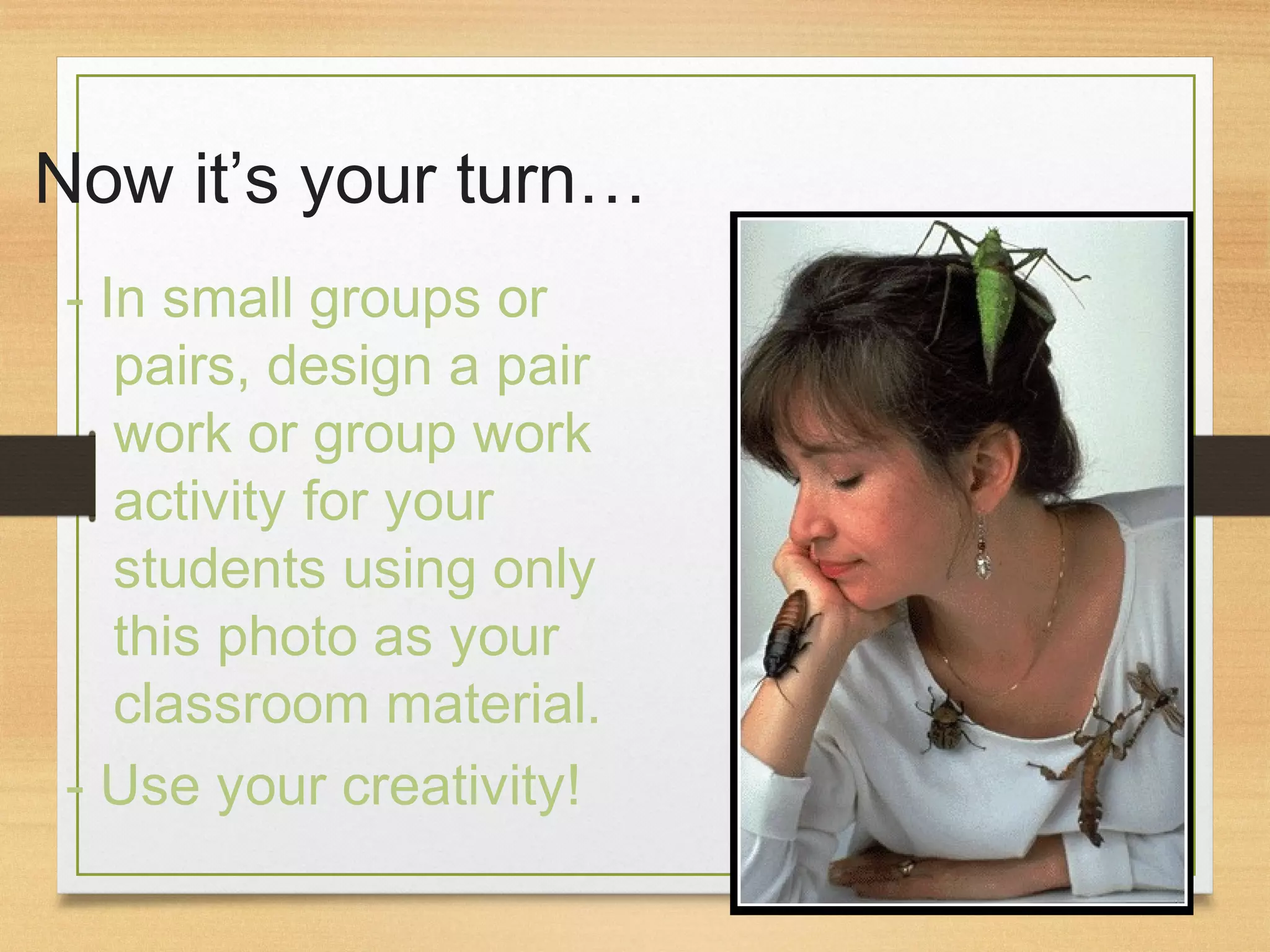
Now it’s your turn…
- In small groups or
pairs, design a pair
work or group work
activity for your
students using only
this photo as your
classroom material.
- Use your creativity!
 76 Ideas for Group Work in English, from Simon Midgely,
Raising Achievement in Schools.
http://www.simonmidgley.co.uk/talklearn/groupwork.htm
 Group Work Lesson Plans, from Lesson Planet.
http://www.lessonplanet.com/search?keywords=group+work&rating=3
 Jigsaw Group Work, from LeMill, Teemu Leiononen and Hans
Põldoja.
http://lemill.net/methods/jigsaw-group-work/view
Suggested Group Work Resources
Questions & Feedback
 What questions do you have about using
group work and pair work effectively? Other
feedback about what works and what
doesn’t?
Thank you!

Pairworkgroup

  • 1.
    Making Pair Workand Group Work Effective Strategies to overcome the challenges
  • 2.
    Why is GroupWork Important? Most descriptions of Communicative Language Teaching encourage teachers to use pair work and group work during their lessons. Why do you that that is?
  • 3.
    Communicative Approach • Interactionis the means and the goal • Learning is task-based • Meaning/understanding the message is more important than exact grammar • Authentic materials are used • Many answers are possible • Mistakes are a part of learning
  • 4.
    Types of CommunicativeActivities • Role plays • Interviews • Information gap • Games • Surveys • Debates • Pair work • Drama • Learn by teaching
  • 5.
    Teacher-Centered vs. Learner-Centered Classrooms Teacher-centered:the teacher is the focus and takes responsibility for everything - analyzing ideas, organizing information, explaining rules, correcting mistakes Learner-centered: students work independently; more responsible for activities; focus on communicating with each other and the teacher
  • 6.
    Learner-Centered classrooms arebetter -Just listening to the teacher doesn’t prepare students enough to use English -Students practicing English in pairs and groups will help them understand and remember new information better -Just listening to the teacher all the time is boring! Students lose motivation Boring
  • 7.
    Video Clip :SEE or DON’T SEE 1. Students always sitting in rows, facing teacher. 2. Students in groups. 3. Students in teams. 4. Students learning through games. 5. Students being tested through games. 6. All student groups writing the same thing. 7. The teacher giving feedback to the students. 8. Students giving feedback to each other.
  • 8.
    The Challenges #1: Studentsonly speak in Portuguese Strategies: -Teacher very strict about English-only in the classroom. -Close monitoring of pair work & group work. -Providing incentives for students/groups who only use English in class - candy, extra homework points.
  • 9.
    The Challenges #2: Studentsmake too much noise, are out of control Strategies: -Use a “quiet signal” to maintain control. It can be raised hand, a clap, light turn off/on -Set strong and clear guidelines about classroom behavior from the beginning -Assign a student monitor(s) to keep control
  • 10.
    The Challenges #3: Studentsdon’t complete activity; they are bored Strategies: -Know your learners! Always search for choose and design group work activities with their motivation in mind. -Each student given a “job” in the group - ex. Secretary, spokesperson, task control, etc -Follow-up reports, summaries to be given
  • 11.
    The Challenges #4: Somestudents don’t participate Strategies: -Give students who generally don’t participate the job of “spokesperson” in the group -Use “toothpicks” as a tool to control participation. Each student receives 6 and must use 1 toothpick every time they speak -Pair up two “quiet” students together
  • 12.
    The Challenges #5: Studentsdon’t understand directions Strategies: -Prepare and practice giving simple, clear instructions. Repeat many times. -If students really don’t understand, it’s okay to use Portuguese, but try to avoid it -Have one student who understands, explain directions to the class; very motivating
  • 13.
    The Challenges #6: Onegroup finishes before the others Strategies: -Prepare a back-up activity for groups who finish early -Use members of fast group as “teacher helpers” for the groups with difficulties -Carefully check over group’s completed work and correct or have them expand on ideas
  • 14.
    Different Combinations ofGroup Work Some suggestions about what usually works best….  Pairs - dialogue practice,vocabularly drills and grammar review  Groups of 5 - problem solving activities  Groups of 4 - introductions and social interactions  Groups of 3 - discussions
  • 15.
    Effective Technique: Jigsaw -Studentswork in “learning” groups to understand a particular topic well -New groups are formed called “teaching” groups where each member comes from a different learning group -Each member of the new teaching group is responsible for teaching their topic Benefits: prevents “slacking off,” everyone participates, a lot of material is addressed
  • 16.
    Now it’s yourturn… - In small groups or pairs, design a pair work or group work activity for your students using only this photo as your classroom material. - Use your creativity!
  • 17.
     76 Ideasfor Group Work in English, from Simon Midgely, Raising Achievement in Schools. http://www.simonmidgley.co.uk/talklearn/groupwork.htm  Group Work Lesson Plans, from Lesson Planet. http://www.lessonplanet.com/search?keywords=group+work&rating=3  Jigsaw Group Work, from LeMill, Teemu Leiononen and Hans Põldoja. http://lemill.net/methods/jigsaw-group-work/view Suggested Group Work Resources
  • 18.
    Questions & Feedback What questions do you have about using group work and pair work effectively? Other feedback about what works and what doesn’t?
  • 19.

Editor's Notes

  • #2 Outline of presentation - Brief overview of CLT, Video clip of best practices, challenges & strategies, combos/types of groupwork
  • #8 Shaping : Pair Work video clip