Total Physical Response
• Developed by James Asher.
• It is a language teaching method
built around the coordination of
speech and action; it attempts to
teach language through physical
(motor) activities.
Approach:
Theory of language
• Asher states that ‘’most of the
grammatical structure of the target
language and hundreds of vocabulary
items can be learnt from the skillful use
of imperatives by the instructor’’.
• Imperatives are used to initiate different
speech acts such as requests and
apologies.
• He views the verb in the imperative form
as the central linguistic motif around
which language use and learning are
organized.
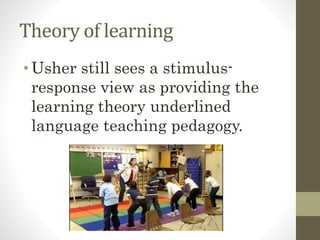
Theory of learning
•Usher still sees a stimulus-
response view as providing the
learning theory underlined
language teaching pedagogy.
Theory of learning
• Asher has elaborated an account of what
he feels facilitated or inhibits foreign
language leraning. For this dimension of
his learning theory he draws on three
rather influential learning hypotheses:
• The bio-program
• Brain lateralization
• Reduction of stress
Objectives
• The general objectives of Total
Physical Response are to teach oral
proficiency at beginning levels.
Comprehension is a means to an end
and the ultimate aim is to teach basic
speaking skills.
• A TPR course aims to produce
learners who are capable of an
uninhibited communication that is
intelligible to a native speaker.
The syllabus
• Total Physical Response requires initial
attention to meaning rather to the form of
items.
• Grammar is thus taught inductively.
• Grammatical features and vocabulary
items are selected according to the
situations in which they can be used in the
classroom and the ease with which can be
learned.
Types of learning and teaching
activities
• Imperative drills are the major classroom
activity in TPR. They are typically used to
elicit physical actions and activities on the
part of learners.
• Other class activities include role plays
and slide presentations.
• Reading and writing activities may also be
employed to further consolidate structures
and vocabulary, and as follow-up to oral
imperative drills.
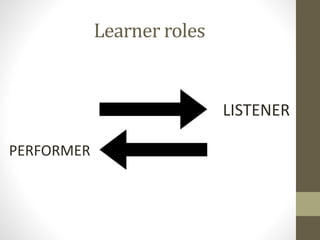
Learner roles
LISTENER
PERFORMER
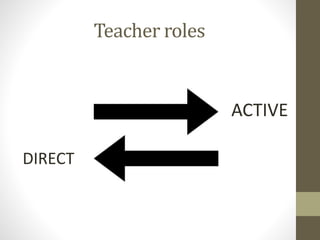
Teacher roles
ACTIVE
DIRECT
The role of instructional materials
• There is generally no basic text in a TPR course.
• For absolute beginners, lessons may not require
the use of materials, since the teacher’s voice,
actions and gestures may be a sufficient basis for
classroom activities.
• Later the teacher may use common classroom
objects, such as books, pens, cups and furniture.
• As the course develops, the teacher will need to
make or collect supporting materials to support
teaching points. (pictures, slides and word charts)
Conclusion
• TPR emphasizes the role of comprehension
in second language acquisition.
• It provides comprehensible input and
reduces stress.
• It deals with only the very beginning
states of learning.
• It should be used in association with other
methods and techniques.

Total physical response

  • 1.
    Total Physical Response •Developed by James Asher. • It is a language teaching method built around the coordination of speech and action; it attempts to teach language through physical (motor) activities.
  • 2.
    Approach: Theory of language •Asher states that ‘’most of the grammatical structure of the target language and hundreds of vocabulary items can be learnt from the skillful use of imperatives by the instructor’’. • Imperatives are used to initiate different speech acts such as requests and apologies. • He views the verb in the imperative form as the central linguistic motif around which language use and learning are organized.
  • 3.
    Theory of learning •Usherstill sees a stimulus- response view as providing the learning theory underlined language teaching pedagogy.
  • 4.
    Theory of learning •Asher has elaborated an account of what he feels facilitated or inhibits foreign language leraning. For this dimension of his learning theory he draws on three rather influential learning hypotheses: • The bio-program • Brain lateralization • Reduction of stress
  • 5.
    Objectives • The generalobjectives of Total Physical Response are to teach oral proficiency at beginning levels. Comprehension is a means to an end and the ultimate aim is to teach basic speaking skills. • A TPR course aims to produce learners who are capable of an uninhibited communication that is intelligible to a native speaker.
  • 6.
    The syllabus • TotalPhysical Response requires initial attention to meaning rather to the form of items. • Grammar is thus taught inductively. • Grammatical features and vocabulary items are selected according to the situations in which they can be used in the classroom and the ease with which can be learned.
  • 7.
    Types of learningand teaching activities • Imperative drills are the major classroom activity in TPR. They are typically used to elicit physical actions and activities on the part of learners. • Other class activities include role plays and slide presentations. • Reading and writing activities may also be employed to further consolidate structures and vocabulary, and as follow-up to oral imperative drills.
  • 8.
  • 9.
  • 10.
    The role ofinstructional materials • There is generally no basic text in a TPR course. • For absolute beginners, lessons may not require the use of materials, since the teacher’s voice, actions and gestures may be a sufficient basis for classroom activities. • Later the teacher may use common classroom objects, such as books, pens, cups and furniture. • As the course develops, the teacher will need to make or collect supporting materials to support teaching points. (pictures, slides and word charts)
  • 11.
    Conclusion • TPR emphasizesthe role of comprehension in second language acquisition. • It provides comprehensible input and reduces stress. • It deals with only the very beginning states of learning. • It should be used in association with other methods and techniques.