Negotiation of meaning is
a process that speakers
go through to reach a
clear understanding of
each other.
 NfM=Negotiation   for meaning

 NS=Native   Speaker

 NNS=Nonnative   speaker
According to Long
  Comprehensible input gained through
 interactional adjustments such as
 negotiating meaning and modifying
 output is central to second language
 acquisition, and much research has
 been undertaken to discover which
 classroom activities give learners the
 greatest benefit from this type of
 interaction (Pica 1994).
It is founded upon Krashen’s notion that
     knowledge of a second language is
        acquired through exposure to
            comprehensible input.
    They provide learners with negative
   evidence about their own output, and
   push them to modify it to make it more
             comprehensible and
        more target-like (Swain 1985).
In the mid-1980s there was a considerable
   amount of research to determine which
   kinds of classroom activities were most
   productive in terms of negotiated
   interaction. There are many versions of
   information gap tasks, but each has the
   same basic rationale: hide certain
   information from one or more participants
   so that, in order to get it, they need to
   understand and be understood with clarity.
  Is always, initiated by a native speaker
  or teacher who has not encountered a
  communication failure, impasse, or
  breakdown, but who has chosen where
  some language focus would be most
  useful.
 Team Work
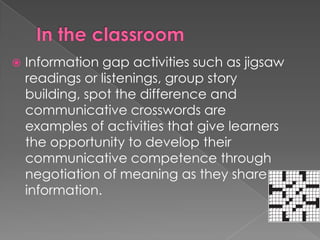
   Information gap activities such as jigsaw
    readings or listenings, group story
    building, spot the difference and
    communicative crosswords are
    examples of activities that give learners
    the opportunity to develop their
    communicative competence through
    negotiation of meaning as they share
    information.
 1 it can be tedious and face
  threatening;
 2 it is typically lexical in nature and not
  morph syntactic;
 3 it is hard to identify because its surface
  structures are often ambiguous
 4 May not provide an accurate
  depiction of the value of a task in
  providing participants with opportunities
  for language learning.
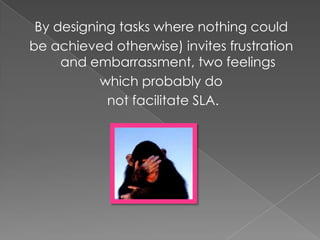
By designing tasks where nothing could
be achieved otherwise) invites frustration
     and embarrassment, two feelings
           which probably do
            not facilitate SLA.
As pointed
 out by Pica (1996) the processes beneficial
              to SLA which occur in NfM can
     surely also occur when learners are not
      stuck in some comprehension-related
  impasse and using a focus-on-form to get
                   themselves out of trouble.
In other words, we
explore the ways that success in
   communicating with and assisting a
   partner
may facilitate SLA.
Long (1980)

   Comprehension Checks

   Confirmation Check

   Clarification Requests
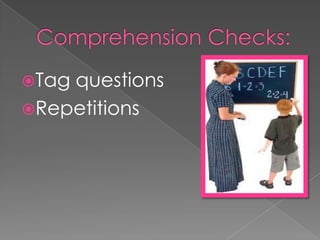
Tagquestions
Repetitions
   It involves repetition of all or a part the
    talker’s preceding statement.
   Answerable by simple confirmation.
   EX:
   N - What do you like in London?
   S - London? (1.0) Ah, there are a lot of things to do here
   N - A lot?
   S- There are a lot of things to do in your free time.
   A lot of shops, and you can go bowling, skating (1.0)
   there are cinemas. Where I live, no.
 Formed by questions.
 Recode information.
 I don’t understand
 Try again


Ex :
Yes, like, what was the most interesting thing in
   London?
Ah, there are a lot of things to do in London.
   Teachers and students try to convey
    information to one another and reach
    mutual comprehension
   through restating, clarifying, and confirming
    information. The teacher may help students
    get started
   or work through a stumbling block using
    linguistic and other approaches.
   Research examining how learners succeed
    in L2 classroom by interaction, has shown
    that learners
   help one another as they interact.
   Assistance, is a feature of learner talk that is
    claimed to promote L2 development. This
    comes
   about how the learners collaborate to create
    discourse in the target language.
   Collaboration is considered an important part
    of what happens when learners interact with
    one
   another.
   the level of potential development is
    determined by language produced
    collaboratively with a
   teacher or classmate.
   the actual developmental level is determined
    by individual linguistic production.
   We see evidence of learners supporting each
    other, frequently expressing interest in what
    their
   interlocutor is saying and giving
    encouragement to continue.
   To take a cognitive perspective, we might say
    that the frequency of these attempts to modify
   utterances are signs that the learners are
    indeed focusing on form and are not content
    to let their
   interlanguage fossilize comfortably.
 From a sociocultural perspective we
  might prefer to say that in such
  exchanges more ZPDs
 were created—more places in the data
  where learners needed to rely on one
  another in order to
 proceed.
 For both approaches the infrequency of
  negotiations for meaning can be
  explained either by the
 fact that learners mostly understood
  each other very well.
   Negotiation for Meaning and Peer
    Assistance in Second Language
    Classrooms by PAULINE FOSTER and AMY
    SNYDER OHTA

   British Council:
    http://www.teachingenglish.org.uk/know
    ledge-database/negotiation-meaninge
Negotiation of meaning is
a process that speakers
go through to reach a
clear understanding of
each other.

Negotiation for meaning theory

  • 2.
    Negotiation of meaningis a process that speakers go through to reach a clear understanding of each other.
  • 3.
     NfM=Negotiation for meaning  NS=Native Speaker  NNS=Nonnative speaker
  • 4.
    According to Long Comprehensible input gained through interactional adjustments such as negotiating meaning and modifying output is central to second language acquisition, and much research has been undertaken to discover which classroom activities give learners the greatest benefit from this type of interaction (Pica 1994).
  • 5.
    It is foundedupon Krashen’s notion that knowledge of a second language is acquired through exposure to comprehensible input. They provide learners with negative evidence about their own output, and push them to modify it to make it more comprehensible and more target-like (Swain 1985).
  • 6.
    In the mid-1980sthere was a considerable amount of research to determine which kinds of classroom activities were most productive in terms of negotiated interaction. There are many versions of information gap tasks, but each has the same basic rationale: hide certain information from one or more participants so that, in order to get it, they need to understand and be understood with clarity.
  • 7.
     Isalways, initiated by a native speaker or teacher who has not encountered a communication failure, impasse, or breakdown, but who has chosen where some language focus would be most useful.  Team Work
  • 8.
    Information gap activities such as jigsaw readings or listenings, group story building, spot the difference and communicative crosswords are examples of activities that give learners the opportunity to develop their communicative competence through negotiation of meaning as they share information.
  • 9.
     1 itcan be tedious and face threatening;  2 it is typically lexical in nature and not morph syntactic;  3 it is hard to identify because its surface structures are often ambiguous  4 May not provide an accurate depiction of the value of a task in providing participants with opportunities for language learning.
  • 10.
    By designing taskswhere nothing could be achieved otherwise) invites frustration and embarrassment, two feelings which probably do not facilitate SLA.
  • 11.
    As pointed outby Pica (1996) the processes beneficial to SLA which occur in NfM can surely also occur when learners are not stuck in some comprehension-related impasse and using a focus-on-form to get themselves out of trouble. In other words, we explore the ways that success in communicating with and assisting a partner may facilitate SLA.
  • 12.
    Long (1980)  Comprehension Checks  Confirmation Check  Clarification Requests
  • 13.
  • 14.
    It involves repetition of all or a part the talker’s preceding statement.  Answerable by simple confirmation.  EX:  N - What do you like in London?  S - London? (1.0) Ah, there are a lot of things to do here  N - A lot?  S- There are a lot of things to do in your free time.  A lot of shops, and you can go bowling, skating (1.0)  there are cinemas. Where I live, no.
  • 15.
     Formed byquestions.  Recode information.  I don’t understand  Try again Ex : Yes, like, what was the most interesting thing in London? Ah, there are a lot of things to do in London.
  • 16.
    Teachers and students try to convey information to one another and reach mutual comprehension  through restating, clarifying, and confirming information. The teacher may help students get started  or work through a stumbling block using linguistic and other approaches.  Research examining how learners succeed in L2 classroom by interaction, has shown that learners  help one another as they interact.
  • 17.
    Assistance, is a feature of learner talk that is claimed to promote L2 development. This comes  about how the learners collaborate to create discourse in the target language.  Collaboration is considered an important part of what happens when learners interact with one  another.  the level of potential development is determined by language produced collaboratively with a  teacher or classmate.  the actual developmental level is determined by individual linguistic production.
  • 18.
    We see evidence of learners supporting each other, frequently expressing interest in what their  interlocutor is saying and giving encouragement to continue.  To take a cognitive perspective, we might say that the frequency of these attempts to modify  utterances are signs that the learners are indeed focusing on form and are not content to let their  interlanguage fossilize comfortably.
  • 19.
     From asociocultural perspective we might prefer to say that in such exchanges more ZPDs  were created—more places in the data where learners needed to rely on one another in order to  proceed.  For both approaches the infrequency of negotiations for meaning can be explained either by the  fact that learners mostly understood each other very well.
  • 20.
    Negotiation for Meaning and Peer Assistance in Second Language Classrooms by PAULINE FOSTER and AMY SNYDER OHTA  British Council: http://www.teachingenglish.org.uk/know ledge-database/negotiation-meaninge
  • 21.
    Negotiation of meaningis a process that speakers go through to reach a clear understanding of each other.