Approaches to
Teaching
P r e s e n t a t i o n
Carlos Hernandez
Our view on Language and on
how Language Learning takes
place. I.e. That Language is a set
of grammar rules and can be
learned through learning said
rules and applying them to
translations.
Approaches also refer to the
methods that we use to teach
in the classroom based on
these views.
In this unit, “approaches” and
“methods” are used
interchangeably.
What is an approach to
Language Teaching?
Side Note:
Supporters of Communicative
approaches, for instance, believe
that Language is a tool to
communicate meaning and that
generally speaking we learn
Language better by using
Coomunicative Activities.
What is an approach to
Language Teaching?
Kinds Of Learning
Methods
Presentation Practice
and Production (PPP)
1. Grammar - Translation
5.
Lexical Approach
2. Totatl Physical
Response (TPR)
6.
Guided Discovery
7.
Communicative
Approaches
4.
Functional Approach
3.
8. Content Based Learning
9. Content Language
Integrated Learning
(CLIL)
PPP
Presentation, practice,
& production.
View of Language: Grammatical structures and
functions are the most important aspects of
Language.
View of Language Learning: Language is learnt
best by seeing new language in a context which
shows its meaning practicing in controlled and
guided conditions, then using it in freer conditions
and giving the learner less language support.
PPP
Presentation, practice,
& production.
Classroom Practices:
Syllabus focuses on Grammatical Structures
and Functions.
Lessons move from the Presentation stage, to
the Practice stage, to the Production stage.
Learners should not be allowed to make
mistakes during the Practice Stage.
The Teacher Inputs Language and guides
students.
The Learners are guided by the teacher and do
not make decisions about what or how to
learn.
Typical activities are Situational presentation
and Miming at the Presentation stage, Drills at
the Controlled Practice stage, Role plays and
Information gap activities at the Production
stage.
Lexical Approach
View of Language: Vocabulary is the most
important aspect of Language and it consists of
words and diferent types of chunks like:
Collocations, Idioms, and Fixed expressions.
View of Language Learning: Language is learnt by
learning chunks as a whole and complete unit.
Learners must become aware of chunks, they need
to be noticed.
Classroom practices:
The syllabus focuses on Lexis
Learners work with authentic written or spoken
texts in the classroom.
Learners are given activities focusing on on
chunks.
After noticing the chunks, learners are asked to
carry out tasks that involve them using the
chunks.
Functional Approach
View of Language: Functions are the most
important aspects of language.
View of Language learning: As for PPP.
Classroom practices:
The syllabus focuses on Functions and it is
usually graded according to their frequency IRL
and the Learner’s communicative needs.
Has no specific practices of its own. Uses PPP
stages or communicative activities.
Communicative Approach
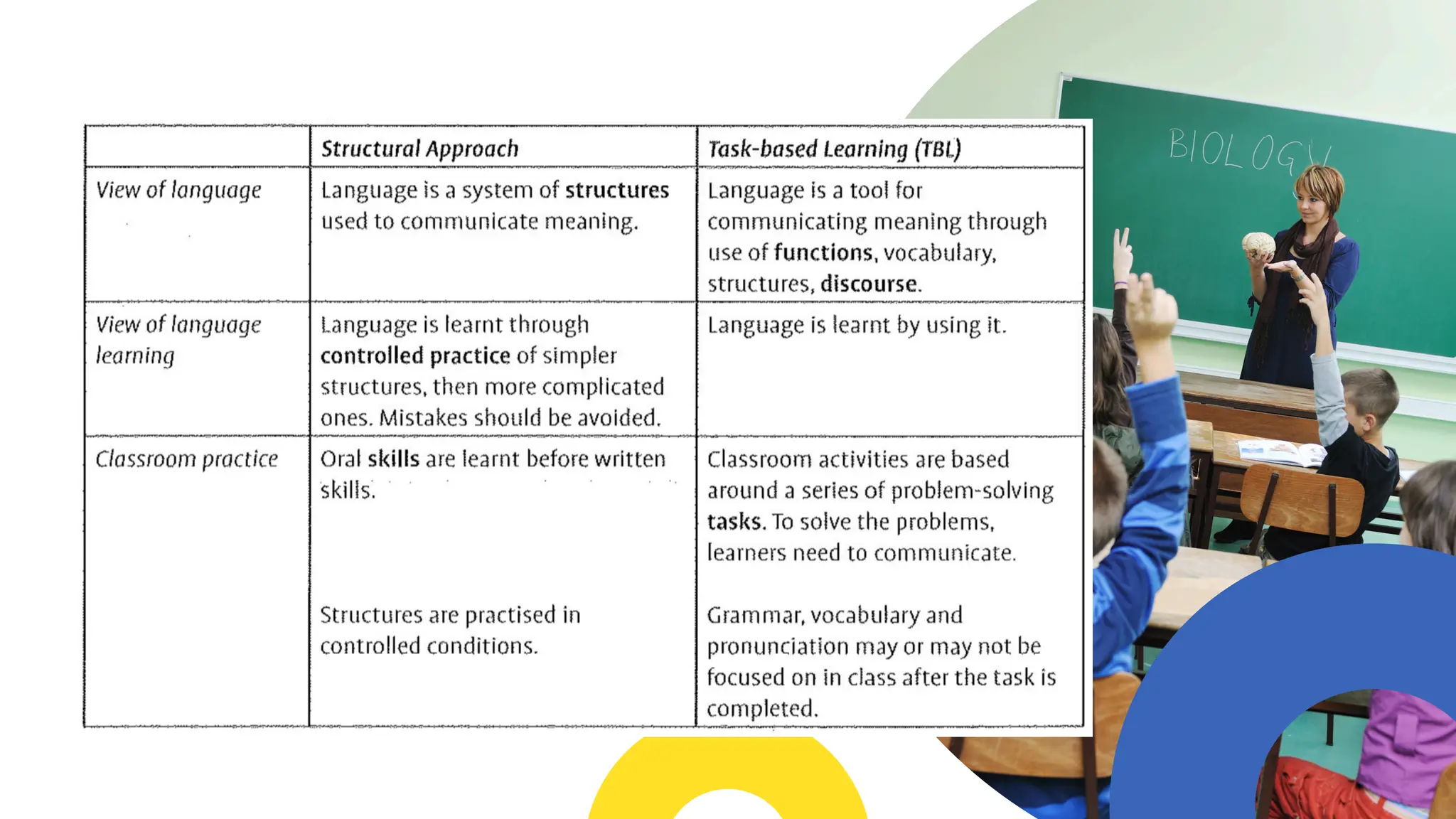
View of Language: Communication is
the most important aspects of
language. Meaning is communicated
through functions, grammar,
vocabulary, discourse and skills.
View of Language Learning: The best
way to learn a language is to use it in
interactions rather than learning
about it.
Communicative Approach
Classroom Practices:
The syllabus focuses on tasks,
functions, and topic areas based on
Learner’s communicative needs.
Lots of pair and group work.
Communicating meaning is very
important.
Fluency over Accuracy.
Use of Authentic materials.
Int he classroom learners become
active users of the Language, the
teacher’s role focuses mainly in
setting up communication
activities, providing error
correction during fluency activities
and inputting language when
needed.
Grammar - Translation
View of Language: Language is made up
of grammatical rules.
View of Language Learning: Language is
learnt by analysing and applying
grammatical rules.
Classroom practices:
Studying grammatical rules
presented through grammatical
terms, then applying them in
exercises.
Working out what language means
by applying rules.
Learning lists of words by heart.
Translating texts or isolated sentences
from L1 to L2 or viceversa.
Emphasis on grammatical accuracy.
Total Physical Response (TPR)
View of Language: Grammatical structures and vocabulary
are the most important aspects of language.
View of Language Learning:
Learners learn by being exposed to language.
Comprehension comes before production.
Learners often need a silent period to take in language
and should not be forced to speak before they are ready.
Language is learnt best when it is accompanied by
doing things physically.
Learning takes place when learners are relaxed.
Total Physical Response (TPR)
Classroom practices:
Used mainly with young learners and beginners.
The syllabus focuses on grammatical structures and
vocabulary involved in giving and following instructions.
Lessons involve the teachers role focuses giving
instructions and physically carrying out the instructions.
At more advanced stages and after the silent period,
learners give one another instructions.
Guided Discovery
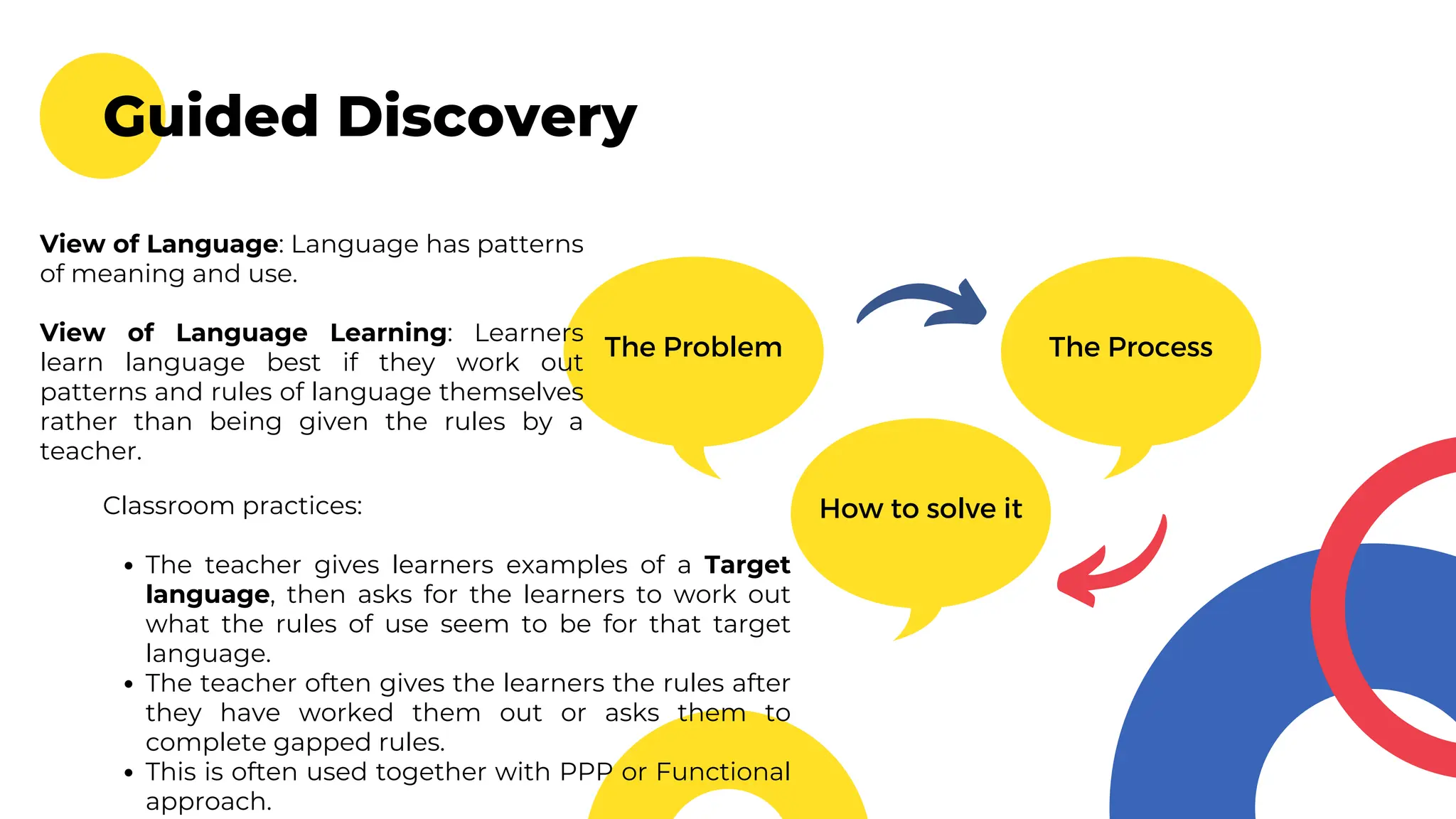
The Problem The Process
How to solve it
View of Language: Language has patterns
of meaning and use.
View of Language Learning: Learners
learn language best if they work out
patterns and rules of language themselves
rather than being given the rules by a
teacher.
Classroom practices:
The teacher gives learners examples of a Target
language, then asks for the learners to work out
what the rules of use seem to be for that target
language.
The teacher often gives the learners the rules after
they have worked them out or asks them to
complete gapped rules.
This is often used together with PPP or Functional
approach.
Content Based Learning
View of Language: Grammatical,
lexical, functional areas and skills are
important.
View of Language Learning:
Language is learnt best if presented to
learners through interesting topics
which can help them increase their
knowledge of the world.
Classroom practices:
The syllabus focuses on grammar,
lexis, functions or skills.
Used mainly in primary and
secondary schools.
Language is presented through
topics related to school subjects or
learning about the world.
Content and Language Integrated
Learning (CLIL)
View of Language:
Language serves to communicate
meaning.
All aspects of Language help to
communicate meaning.
View of Language Learning:
Language is mainly learned
through acquisition and through
use. It does not need to be focused
on.
Language is learnt best when it is
used to learn something else.
Content and Language Integrated
Learning (CLIL)
Classroom practices:
The syllabus is based round
learning about the subject matter
and cognitive skills related to the
subject.
The school subject is taught in L2.
The specific kinds of language
learnt are the types of language
needed to learn about the subject.
Lessons focus on the subject rather
than the Language.
Thank You

Unit 15_TKT Module 1 Presentation __.pdf

  • 1.
    Approaches to Teaching P re s e n t a t i o n Carlos Hernandez
  • 2.
    Our view onLanguage and on how Language Learning takes place. I.e. That Language is a set of grammar rules and can be learned through learning said rules and applying them to translations. Approaches also refer to the methods that we use to teach in the classroom based on these views. In this unit, “approaches” and “methods” are used interchangeably. What is an approach to Language Teaching?
  • 3.
    Side Note: Supporters ofCommunicative approaches, for instance, believe that Language is a tool to communicate meaning and that generally speaking we learn Language better by using Coomunicative Activities. What is an approach to Language Teaching?
  • 5.
    Kinds Of Learning Methods PresentationPractice and Production (PPP) 1. Grammar - Translation 5. Lexical Approach 2. Totatl Physical Response (TPR) 6. Guided Discovery 7. Communicative Approaches 4. Functional Approach 3. 8. Content Based Learning 9. Content Language Integrated Learning (CLIL)
  • 6.
    PPP Presentation, practice, & production. Viewof Language: Grammatical structures and functions are the most important aspects of Language. View of Language Learning: Language is learnt best by seeing new language in a context which shows its meaning practicing in controlled and guided conditions, then using it in freer conditions and giving the learner less language support.
  • 7.
    PPP Presentation, practice, & production. ClassroomPractices: Syllabus focuses on Grammatical Structures and Functions. Lessons move from the Presentation stage, to the Practice stage, to the Production stage. Learners should not be allowed to make mistakes during the Practice Stage. The Teacher Inputs Language and guides students. The Learners are guided by the teacher and do not make decisions about what or how to learn. Typical activities are Situational presentation and Miming at the Presentation stage, Drills at the Controlled Practice stage, Role plays and Information gap activities at the Production stage.
  • 8.
    Lexical Approach View ofLanguage: Vocabulary is the most important aspect of Language and it consists of words and diferent types of chunks like: Collocations, Idioms, and Fixed expressions. View of Language Learning: Language is learnt by learning chunks as a whole and complete unit. Learners must become aware of chunks, they need to be noticed. Classroom practices: The syllabus focuses on Lexis Learners work with authentic written or spoken texts in the classroom. Learners are given activities focusing on on chunks. After noticing the chunks, learners are asked to carry out tasks that involve them using the chunks.
  • 9.
    Functional Approach View ofLanguage: Functions are the most important aspects of language. View of Language learning: As for PPP. Classroom practices: The syllabus focuses on Functions and it is usually graded according to their frequency IRL and the Learner’s communicative needs. Has no specific practices of its own. Uses PPP stages or communicative activities.
  • 10.
    Communicative Approach View ofLanguage: Communication is the most important aspects of language. Meaning is communicated through functions, grammar, vocabulary, discourse and skills. View of Language Learning: The best way to learn a language is to use it in interactions rather than learning about it.
  • 11.
    Communicative Approach Classroom Practices: Thesyllabus focuses on tasks, functions, and topic areas based on Learner’s communicative needs. Lots of pair and group work. Communicating meaning is very important. Fluency over Accuracy. Use of Authentic materials. Int he classroom learners become active users of the Language, the teacher’s role focuses mainly in setting up communication activities, providing error correction during fluency activities and inputting language when needed.
  • 12.
    Grammar - Translation Viewof Language: Language is made up of grammatical rules. View of Language Learning: Language is learnt by analysing and applying grammatical rules. Classroom practices: Studying grammatical rules presented through grammatical terms, then applying them in exercises. Working out what language means by applying rules. Learning lists of words by heart. Translating texts or isolated sentences from L1 to L2 or viceversa. Emphasis on grammatical accuracy.
  • 13.
    Total Physical Response(TPR) View of Language: Grammatical structures and vocabulary are the most important aspects of language. View of Language Learning: Learners learn by being exposed to language. Comprehension comes before production. Learners often need a silent period to take in language and should not be forced to speak before they are ready. Language is learnt best when it is accompanied by doing things physically. Learning takes place when learners are relaxed.
  • 14.
    Total Physical Response(TPR) Classroom practices: Used mainly with young learners and beginners. The syllabus focuses on grammatical structures and vocabulary involved in giving and following instructions. Lessons involve the teachers role focuses giving instructions and physically carrying out the instructions. At more advanced stages and after the silent period, learners give one another instructions.
  • 15.
    Guided Discovery The ProblemThe Process How to solve it View of Language: Language has patterns of meaning and use. View of Language Learning: Learners learn language best if they work out patterns and rules of language themselves rather than being given the rules by a teacher. Classroom practices: The teacher gives learners examples of a Target language, then asks for the learners to work out what the rules of use seem to be for that target language. The teacher often gives the learners the rules after they have worked them out or asks them to complete gapped rules. This is often used together with PPP or Functional approach.
  • 16.
    Content Based Learning Viewof Language: Grammatical, lexical, functional areas and skills are important. View of Language Learning: Language is learnt best if presented to learners through interesting topics which can help them increase their knowledge of the world. Classroom practices: The syllabus focuses on grammar, lexis, functions or skills. Used mainly in primary and secondary schools. Language is presented through topics related to school subjects or learning about the world.
  • 17.
    Content and LanguageIntegrated Learning (CLIL) View of Language: Language serves to communicate meaning. All aspects of Language help to communicate meaning. View of Language Learning: Language is mainly learned through acquisition and through use. It does not need to be focused on. Language is learnt best when it is used to learn something else.
  • 18.
    Content and LanguageIntegrated Learning (CLIL) Classroom practices: The syllabus is based round learning about the subject matter and cognitive skills related to the subject. The school subject is taught in L2. The specific kinds of language learnt are the types of language needed to learn about the subject. Lessons focus on the subject rather than the Language.
  • 19.