BUAP
Licenciatura abierta facultad de lenguas
       Verónica E . Noriega Fernández
OUTPUT HYPOTHESIS
 “Output”, (1980) indicates the outcome of what the
  student has learned.
 The Output hypothesis states that it is the action of
  producing language, speaking and writing, which
  develops part of the process of second language
  learning (how proficient learners become). Swain
  (1985)
Three functions of output
1) the noticing/triggering function
2) the hypothesis-testing function
3) the metalinguistic (reflective) function.
    This means that the message needs to be conveyed
   precisely, coherently, and appropriately. This form of
   ‘pushing’ students in terms of output is precisely the
   same as that of Krashen’s comprehensible input notion
   of i +1.
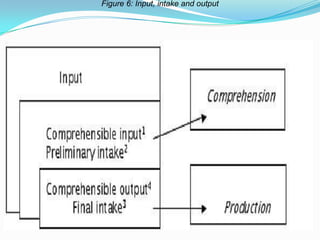
Figure 6: Input, intake and output
Krashen´s (1985) states that comprehensible input is the only
true way a learner has to acquire a second language.
INPUT
 Krashen´s input hypothesis which states that we
 acquire the target language only when we understand
 language (comprehensible input). In addition, in
 order for learners to understand a language point, the
 structure must be just "a little beyond" where students
 are at the moment and they will use cultural baggage.
CONCLUSION
Input hypothesis                  Output hypothesis
 Krashen stressed that            Consequently, the feedback
  comprehensible intput helps       provided to the learner may
  students acquire                  make input and output more
  language.One important            comprehensible. As Swain (1985)
  principle of Krashen´s theory     stated, production challenged
  states that input should not      learners to focus on the means
  be grammatically sequenced        of expression when they realize
  as such sequencing is not         it is necessary to enhance and
  needed; thus, students would      develop the target language
  be able to understand every       level, and it is just then, when
  class and will never stay         language output can contribute
  behind.                           to language acquisition.
CONCLUSION
Both theories complement each other as all the elements
  mentioned, strongly contribute to language acquisition.

One aspect to be taken into account is the positive
 environment a teacher must create during his/her lesson as
 it makes a difference in the students’ motivation and
 interest in acquiring the second language.

Feedback plays an important role as well as correct
 production, and interesting, appealing and meaningful
 materials which may challenge and motivate learners.

Input vs output hypothesis

  • 1.
    BUAP Licenciatura abierta facultadde lenguas Verónica E . Noriega Fernández
  • 3.
    OUTPUT HYPOTHESIS  “Output”,(1980) indicates the outcome of what the student has learned.  The Output hypothesis states that it is the action of producing language, speaking and writing, which develops part of the process of second language learning (how proficient learners become). Swain (1985)
  • 4.
    Three functions ofoutput 1) the noticing/triggering function 2) the hypothesis-testing function 3) the metalinguistic (reflective) function. This means that the message needs to be conveyed precisely, coherently, and appropriately. This form of ‘pushing’ students in terms of output is precisely the same as that of Krashen’s comprehensible input notion of i +1.
  • 5.
    Figure 6: Input,intake and output
  • 6.
    Krashen´s (1985) statesthat comprehensible input is the only true way a learner has to acquire a second language.
  • 7.
    INPUT  Krashen´s inputhypothesis which states that we acquire the target language only when we understand language (comprehensible input). In addition, in order for learners to understand a language point, the structure must be just "a little beyond" where students are at the moment and they will use cultural baggage.
  • 8.
    CONCLUSION Input hypothesis Output hypothesis  Krashen stressed that  Consequently, the feedback comprehensible intput helps provided to the learner may students acquire make input and output more language.One important comprehensible. As Swain (1985) principle of Krashen´s theory stated, production challenged states that input should not learners to focus on the means be grammatically sequenced of expression when they realize as such sequencing is not it is necessary to enhance and needed; thus, students would develop the target language be able to understand every level, and it is just then, when class and will never stay language output can contribute behind. to language acquisition.
  • 9.
    CONCLUSION Both theories complementeach other as all the elements mentioned, strongly contribute to language acquisition. One aspect to be taken into account is the positive environment a teacher must create during his/her lesson as it makes a difference in the students’ motivation and interest in acquiring the second language. Feedback plays an important role as well as correct production, and interesting, appealing and meaningful materials which may challenge and motivate learners.