Language
Function:
0
1
• Represents theactive use of language for a
specific purpose
• In academic setting, students use language
functions to express ideas, communicate with
others, and show understanding of content
4.
Language Form:
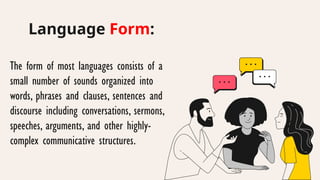
The formof most languages consists of a
small number of sounds organized into
words, phrases and clauses, sentences and
discourse including conversations, sermons,
speeches, arguments, and other highly-
complex communicative structures.
5.
Linguists have foundthat in spite of the many
superficial differences among languages, there are core
basic similarities among languages. Can you imagine a
language without words? Without sentences? Such ways
of communicating do exist. Examples are facial
expressions and the style of dressing.
..
6.
Language learners needto acquire
both the functions and the forms
that make up the English language
in order to reach high level of
proficiency.
7.
a speech soundor series of speech sounds that symbolizes and
communicates a meaning. In linguistics, a word of a spoken
language can be defined as the smallest sequence of phonemes
that can be uttered in isolation with objective or practical
meaning.
WORD
8.
a speech soundor series of speech sounds that symbolizes and
communicates a meaning. In linguistics, a word of a spoken
language can be defined as the smallest sequence of phonemes
that can be uttered in isolation with objective or practical
meaning.
WORD
9.
Formal vs. InformalLanguage
Formal language
• used in situations that circle around serious topics or events, or
involve people that we do not know
Informal language
• utilized in situations when we are more relaxed, and involve
people that we are familiar with
Speech Context andSpeech Styles
A change in the speech context will also change the language form
used in communication. For example, the vocabulary or the words
you use will vary greatly if you were talking about a certain topic
to a general public in a form of a formal speech than if you were
just having an informal discussion with your colleague or a friend.
12.
Speech Context andSpeech Styles
The duration of interaction will also change considerably if the
speech context shifts. In communication, the duration of interaction
refers to the length of time that at least two individuals are in
each other’s presence, especially when meaning is communicated
towards each other. Usually, formal interpersonal communication,
such as public or mass communication, have more rigid time limits
than if you are engaged in a casual and conversation with a friend.
13.
Speech Context andSpeech Styles
Likewise, a change in the speech context or speech style also
changes the manner of delivery and the message. The latter is more
thought-of and often prepared beforehand when delivered in a
public or mass communication.
14.
What do youremember about speech acts? When
do you perform them?
sPeech Acts
Locutionary Act
Illocutionary Act:
Perlocutionary Act:
This refers to the intended function or purpose
behind the statement. It's the act performed by
saying something—like making a promise, giving
a command, or making a request.
This is the basic act of producing sounds, words,
and sentences. It’s the literal, surface meaning of
what is being said.
This is the effect the utterance has on the
listener. It’s about how the listener responds or is
affected by the speech act.
15.
Communicative strategies, arethe approaches or
techniques you make use of when starting or
maintaining a conversation.While
the essence of communicative strategies is
generally to keep the communication channels
open, a shift in them can also affect the
elements mentioned previously.
Remember, you were taught how to hone your
methods of communication in beginning,
sustaining, regulating, and even ending
conversations in different
situations.
16.
CREDITS: This presentationtemplate was created by
Slidesgo, and includes icons by Flaticon, and
infographics & images by Freepik
Thank you!
...................